Athabasca Falls and Sunwapta Falls: the two short stops on the way to Jasper
What are Athabasca Falls and Sunwapta Falls, and are they worth stopping for?
Both are short, well-marked waterfall stops near the Jasper end of the Icefields Parkway, each with paved or gravel viewing platforms reachable in 10 to 20 minutes round trip. Athabasca Falls is the more dramatic of the two, dropping through a narrow limestone canyon it has carved over thousands of years; Sunwapta Falls is smaller but still worth the few minutes it takes.
Two short stops that don’t need a whole afternoon
Most of the big-name stops on the Icefields Parkway ask for time: a shuttle booking, a ticket window, a queue. Athabasca Falls and Sunwapta Falls don’t. Both sit a short walk from paved parking areas just off Highway 93 North, both are free to look at beyond the park pass you already need for the drive, and both can be seen properly in well under half an hour combined if you’re not lingering. That makes them an easy pair to slot into a day that’s mostly about getting from Lake Louise to Jasper, or back.
Neither waterfall is the tallest or most photographed thing on the parkway. Peyto Lake and the Columbia Icefield get more attention, and rightly draw more of your day. But Athabasca Falls in particular is worth more than a drive-by glance: it’s a genuinely dramatic piece of erosion, a narrow limestone canyon carved by a large volume of water moving fast, and it photographs and sounds more impressive in person than a 24-metre drop height suggests on paper. This guide covers only these two stops. For where they fit among the rest of the drive, in order, see our guide to the parkway’s stops.
Athabasca Falls: where a big river meets a narrow canyon
Athabasca Falls sits about 30 kilometres south of Jasper townsite, just off Highway 93 South at its junction with the Icefields Parkway. The turnoff is well signed, with a large paved parking area that fills up in July and August but rarely enough to cause a real delay.
What makes Athabasca Falls distinctive isn’t height. At roughly 24 metres, it’s shorter than Takakkaw Falls in Yoho or several other drops in the region. What it has instead is volume: the Athabasca River is one of the larger rivers draining the Rockies, and at this point it gets squeezed through a channel in the limestone bedrock that narrows to just a few metres across.
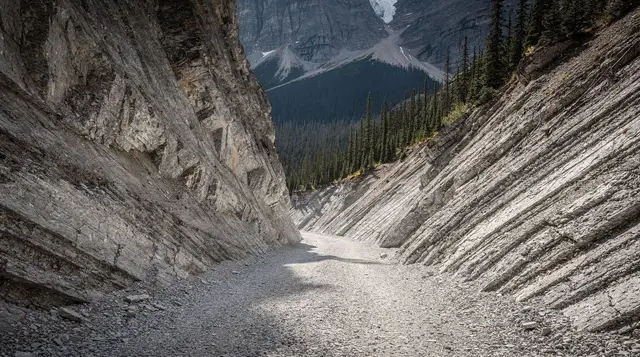
That combination, a lot of water forced through a tight gap, is what produces the noise, the spray, and the sense of force that surprises most first-time visitors. The rock itself shows the result: potholes, plunge pools, and a section of abandoned channel where the river has cut a new course through softer rock over thousands of years, leaving the older channel dry and visible from the path.
A network of paved and gravel paths loops around both sides of the canyon, with several fenced viewpoints looking straight down into the gorge. The full loop, walking both sides and crossing the footbridge below the falls, takes most visitors 15 to 20 minutes at an easy pace, longer if you stop often for photos. A shorter version, viewing the main falls from the closest platform and turning back, is closer to 10 minutes round trip. Stairs and some uneven gravel sections make the full loop more demanding than the main viewpoint, which sits close to the parking area on paved path.
Guardrails line every drop-off, and it’s worth staying behind them. The rock around the canyon is often wet from spray and can be slick even when it doesn’t look it, and the current in the river above the falls is stronger than it appears from a distance. Parks Canada signage at the site is direct about this for a reason: people have gone into the water here.
Sunwapta Falls: smaller, quicker, still worth the stop
Sunwapta Falls sits about 24 kilometres north of Athabasca Falls, roughly 20 minutes of driving, just off the Icefields Parkway on a short spur road closer to Jasper. It’s a smaller, quieter stop: the Sunwapta River drops over a horseshoe-shaped ledge into a narrow gorge, with the main viewpoint reached by a flat, paved path just a few minutes from the parking area.
The falls are less forceful than Athabasca Falls and the setting is less dramatic, but the short walk and easy access make it worth the few minutes it costs on the way past. A longer trail continues past the main viewpoint toward Lower Sunwapta Falls, a rougher and less-visited stretch that most people touring the parkway skip in favour of moving on toward the Columbia Icefield or Jasper townsite.
Athabasca Falls vs Sunwapta Falls at a glance
| Athabasca Falls | Sunwapta Falls | |
|---|---|---|
| Drop height | About 24 m | Smaller, less dramatic |
| Distance from Jasper | About 30 km | About 6 km |
| Walk to main viewpoint | 10 to 15 min (full loop 15-20 min) | A few minutes each way |
| Path surface | Paved and gravel, some stairs | Paved, flat |
| Crowds in summer | Busy midday, parking can fill | Quieter, smaller lot |
| Winter access | Platforms often icy, sections may close | Trail can be icy, less maintained |
Why winter changes both of these completely
It’s tempting to treat these as easy year-round stops since neither needs a ticket or a shuttle. That’s true in summer. In winter, it isn’t.
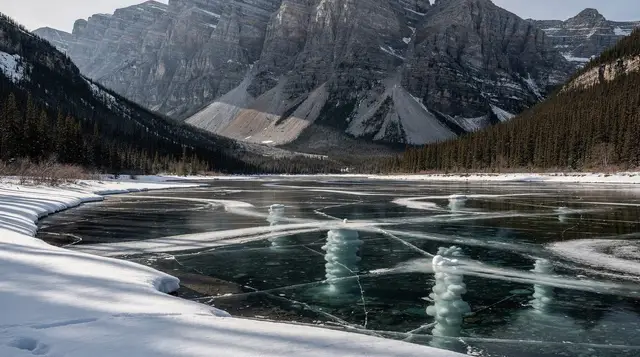
Spray from both waterfalls freezes onto everything nearby: the viewing platforms, the railings, the rock underfoot, and the paths leading to them. None of this gets de-iced on any regular schedule, so from roughly November through April the footing at both sites can be solid, uneven ice rather than the paved surface you’d find in July. At Athabasca Falls specifically, sections of the lower canyon loop are often closed or fenced off in winter conditions, cutting the walk down to just the closest viewpoint, if that’s accessible at all on a given day. Handrails ice over and become something to hold cautiously rather than lean on.
None of this means skip them in winter. The falls half-frozen, with ice building up around the edges of open water, are a striking sight, and Parks Canada keeps the parking areas plowed. But it does mean treating the stop differently than a summer visit: traction devices for your footwear are close to essential, not optional, and checking current conditions before detouring off the highway is worth the two minutes it takes. Our guide to driving the Icefields Parkway in winter covers road conditions for the drive itself, and our guide to what -25°C actually feels like is useful context if you haven’t spent a winter in the Rockies before.
Getting there and what you’ll need
Both falls sit directly on or just off Highway 93, the route most visitors are already driving between Lake Louise and Jasper, so neither requires a special detour. From Jasper townsite, Sunwapta Falls is about 6 kilometres closer than Athabasca Falls, meaning most drivers coming from Jasper reach Sunwapta first.
There’s no fuel, food, or reliable cell coverage at either site, which fits the pattern for most of this stretch of the parkway; see our guide to gas and cell coverage if you’re planning a longer day on this road. A valid Parks Canada day pass or Discovery Pass, the same one required anywhere in Banff National Park, Jasper, Yoho, or Kootenay, is required to stop at either falls, since both sit inside Jasper National Park. See our Parks Canada pass guide for current pricing.
Beyond the viewpoint: getting on the water
For visitors who want more than a look from the platform, the Athabasca River below the falls is a genuine whitewater rafting run, graded for a range of experience levels depending on the outfitter and section. A half-day whitewater trip below Athabasca Falls puts you on the same river you’ve just been looking down into, at a stretch further downstream where the grade suits open rafts, and a longer rafting day trip out of Jasper combines the falls stop with time on the water for anyone based there.
Combining the falls with the rest of the parkway
Because neither stop takes long, most itineraries fold Athabasca Falls and Sunwapta Falls into a longer day rather than visiting them on their own. A guided option that covers both, along with other stops toward the Jasper end of the parkway, is a day tour taking in Athabasca Falls, Sunwapta Falls, and Peyto Lake, useful if you’d rather not drive this stretch yourself or want the stops sequenced and narrated. There’s also a full day out of Jasper covering Sunwapta Falls and the glacier area for anyone based in Jasper rather than Banff or Lake Louise.
If you’re driving the parkway yourself and want to know where these two stops fit against Peyto Lake, Bow Lake, Mistaya Canyon, and the Columbia Icefield, our complete guide to the Icefields Parkway lays out a sensible sequence.
Athabasca and Sunwapta Falls: what to know before you stop
How far apart are Athabasca Falls and Sunwapta Falls?
About 24 kilometres, roughly 20 minutes of driving on Highway 93 North, with Sunwapta Falls to the north, closer to Jasper. Both sit just off the Icefields Parkway on short spur roads, so pairing them in one stop on the way to or from Jasper is straightforward.
How long does it take to see each waterfall?
Athabasca Falls has a short loop of paved and gravel paths, roughly 10 to 15 minutes at an easy pace if you follow the full canyon viewpoint circuit. Sunwapta Falls is quicker, a few minutes each way on a flat paved path from the parking area to the main viewpoint over the upper falls.
Can you visit Athabasca Falls and Sunwapta Falls in winter?
You can reach both in winter, but the experience is not the same as summer. Spray freezes onto the platforms, railings, and rock underfoot, the footing turns to solid ice with no de-icing, and the lower canyon trail at Athabasca Falls is often closed or fenced off entirely. Traction devices for your footwear are close to essential from November through April.
Is there an entrance fee for Athabasca Falls or Sunwapta Falls?
There’s no separate ticket for either waterfall, but both sit inside Jasper National Park, so a valid Parks Canada day pass or Discovery Pass is required to stop, the same pass that covers Banff, Yoho, and Kootenay.
Are Athabasca Falls and Sunwapta Falls suitable for kids or people with limited mobility?
The main viewpoints at both falls are close to the parking areas on paved or hard-packed paths, manageable for most kids and many visitors with limited mobility, though neither is fully wheelchair accessible once you’re near the railings and uneven canyon rock. Athabasca Falls’ extended canyon loop involves stairs and narrower gravel sections that are harder going.
How do these two waterfalls compare to Athabasca Glacier or Peyto Lake?
They’re a different kind of stop: quick, easy, no ticket required beyond the park pass, and no crowds management the way the Columbia Icefield or Moraine Lake need. If you’re choosing what to prioritize on a single day along the parkway, our guide to the stops in order covers where these two fit against the bigger-ticket attractions.
Why is Athabasca Falls considered more powerful than its size suggests?
The falls only drop about 24 metres, modest by Rockies standards, but the Athabasca River is one of the larger rivers in the region, so a large volume of water gets forced through a canyon just a few metres wide at its narrowest. That combination of high flow and a tight channel is what generates the noise and spray visitors notice before they see the water.
Canyon walks & waterfall tours on GetYourGuide
Verified deep-linked GetYourGuide tours. Book through these links and we earn a small commission at no cost to you.
GetYourGuide does not provide a product photo for this activity — the image shows the meeting point, photographed by us.