Canada’s first national park, explained
Every trip that starts in Banff starts inside a park boundary, whether that registers on arrival or not. Banff National Park was established in 1887, two years after a group of Canadian Pacific Railway workers stumbled onto hot springs on the side of Sulphur Mountain in 1885 and the federal government moved to protect the site. It was Canada’s first national park and, at the time, only the third in the world.
The original hot spring itself — the Cave and Basin, on the lower slopes of Sulphur Mountain — is often called the birthplace of Canada’s national park system, and it’s open to visit today, though the pool is no longer used for bathing; it’s now protected habitat for an endemic snail found nowhere else on Earth. That founding story is the reason the townsite of Banff looks the way it does: it sits inside the park it grew out of, and everything about how the town operates — capped commercial growth, a residency requirement tied to having a job in the park — traces back to that 1887 decision.
In 1984, UNESCO listed Banff alongside Jasper, Yoho, and Kootenay national parks as a single World Heritage Site under the name Canadian Rocky Mountain Parks. That’s a useful frame for planning: these four parks are managed as one interconnected system, connected by the Icefields Parkway and Highway 93/95, and a single pass covers entry to all four. Banff National Park itself now draws more than 4 million visitors a year, more than any other national park in Canada, which is the root cause of most of the crowding, parking, and shuttle problems covered on the individual destination pages in this guide.
This page is deliberately not about any one lake, canyon, or trail — Lake Louise, Moraine Lake, and Johnston Canyon each have their own detailed pages. What belongs here is the operating layer that applies to the whole park: who has to pay to be here, whose land this is, what the wildlife rules actually require, and how the seasons change what’s open.
Whose land this is
Banff National Park sits within Treaty 7 territory. The Stoney Nakoda (Îyârhe Nakoda) have the closest historical and present-day ties to the Bow Valley, and the park also lies within territory connected to the Blackfoot Confederacy — the Siksika, Kainai, and Piikani nations — and to the Tsuut’ina Nation. Further west, into British Columbia, the territory extends into Ktunaxa lands around Kootenay and Yoho.
The name “Banff” itself has nothing to do with any of this: it comes from Banffshire in Scotland, chosen by railway officials in the 1880s. For the Indigenous history and cultural experiences that connect to the park today — guided interpretive programs, cultural centres, seasonal events — see the dedicated Indigenous history and experiences in Banff guide rather than a summary here.
The Parks Canada pass: what it costs and why you can’t skip it
A Parks Canada pass is required for anyone entering Banff, Jasper, Yoho, or Kootenay national parks — including a simple pass-through drive with no stops planned. It’s not a toll booth you can avoid by staying on the highway; wardens do check parking lots and pull-offs, and an unpaid vehicle risks a fine well above the cost of the pass itself. Rates are reviewed annually, so treat the figures below as the current order of magnitude and confirm the exact number on the official Parks Canada site before you go.
| Pass type | Approximate price | Covers |
|---|---|---|
| Daily, per adult | ~11 CAD | One person, one day, any of the four parks |
| Daily, per vehicle | ~22 CAD | Everyone in the vehicle, one day |
| Discovery Pass (annual), per adult | ~75 CAD | One person, unlimited days, most of Canada’s national parks |
| Discovery Pass (annual), per vehicle | ~150 CAD | Everyone in the vehicle, unlimited days |
The break-even math is straightforward: if a trip covers more than about a week inside these parks, or if it also touches other Parks Canada sites elsewhere in the country later in the year, the annual Discovery Pass usually costs less than paying daily. Passes are sold online, at park gates, and at visitor centres in Banff and Lake Louise. For the full mechanics — where exactly it’s checked, what happens if you forget it, how to buy it before you land — see Parks Canada pass explained.
The pass covers entry only. Camping inside the park — at the frontcountry campgrounds around Tunnel Mountain and the Bow Valley, or in the backcountry — needs a separate reservation and, for backcountry sites, its own permit on top of the park pass. The same goes for fishing: a national park fishing permit is a distinct purchase from the provincial licence needed the moment you cross into Alberta’s non-park waters. None of this is enforced casually. Visitor centres in Banff townsite and at Lake Louise sell all of it in person, and staff there are usually the fastest way to sort out a pass problem discovered on the day, rather than trying to resolve it from a phone at a highway gate.
Kananaskis is not part of this — and it’s not free either
The single most common mix-up on this topic: Kananaskis is not a national park and is not covered by the Parks Canada pass. It’s provincial land managed by Alberta, roughly an hour from Banff, and it requires its own Kananaskis Conservation Pass — about 15 CAD per day or 90 CAD per year, per vehicle.
Having a Parks Canada Discovery Pass does nothing for you at a Kananaskis trailhead, and vice versa; they are sold by different governments, checked by different systems, and neither substitutes for the other. Canmore, by contrast, sits entirely outside the national park boundary and requires no pass of any kind — it’s a good base precisely because a night there doesn’t require paying park entry to sleep. The comparison is laid out fully in Kananaskis pass vs Parks Canada.
| Where | Pass required | Approximate cost | Sold by |
|---|---|---|---|
| Banff, Jasper, Yoho, Kootenay | Parks Canada pass | ~11 CAD/adult or ~22 CAD/vehicle per day | Parks Canada |
| Kananaskis Country | Kananaskis Conservation Pass | ~15 CAD/day or ~90 CAD/year per vehicle | Government of Alberta |
| Canmore | None | — | — |
Wildlife: the rules are not suggestions
Banff National Park is grizzly bear, black bear, elk, bighorn sheep, and moose habitat, and the safe-distance rules exist because animals here are genuinely wild, not habituated attractions. Parks Canada requires staying at least 100 metres from bears and wolves, and at least 30 metres from all other wildlife, including elk and bighorn sheep that look calm grazing beside a parking lot. Feeding any animal, deliberately or by leaving food accessible, is illegal and dangerous for the animal as much as for you.
Bear spray is the standard precaution for hiking here, but it cannot travel in checked or carry-on luggage on a flight — it’s classed as a hazardous good. Buy or rent it in Banff or Canmore on arrival instead of trying to bring your own from home. Elk rut season, roughly September and October, deserves specific caution: rutting bulls become genuinely aggressive and have charged people in residential streets in Banff townsite, not just on trails.
Trail closures for wildlife are common and non-negotiable — the eastern section of the Bow Valley Parkway closes to vehicles every spring for this reason, and hikers in Larch Valley during peak season are often required to move in groups of four or more because of grizzly activity. The full rule set is in bear safety and etiquette and elk rut season warning.
Seasons: what actually changes
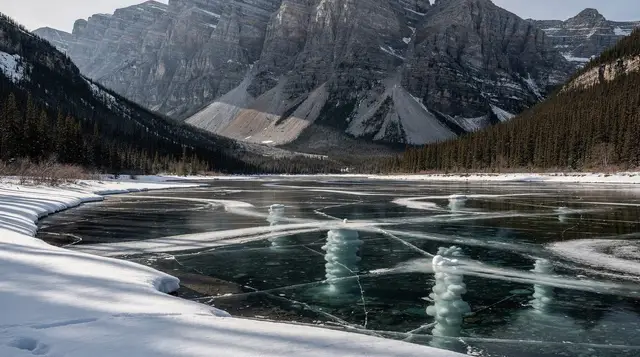
The park doesn’t run on a single calendar. Summer (July–August) is when every road, trailhead, and shuttle is running at full service and also when parking lots fill before 8 a.m. Shoulder seasons — June and September into early October — trade some closures (lake water is still partly frozen into June; some facilities close after Thanksgiving) for noticeably thinner crowds. Winter runs roughly November to May and shifts the entire park toward skiing, ice walks, and snowshoeing rather than lake photography, since Lake Louise and Moraine Lake stay frozen until mid-June in a typical year.
Temperatures swing hard: summer days sit around 20–25°C with cool nights, while winter can run -15 to -25°C with occasional drops below -30°C, moderated at times by warm chinook winds that can raise the temperature sharply within hours. Snow at higher elevations is possible in any month of the year, including July.
None of the four parks in the UNESCO listing run on quite the same clock, either. Banff and Lake Louise thaw and refreeze earlier than the higher, colder ground around the Columbia Icefield, and Yoho’s Takakkaw Falls road only opens once the snowpack above it has cleared, typically in June. Planning a single trip around one season assumption for the whole region is a common mistake — a late-May visitor can find Banff’s lower trails snow-free while a pass further along the Icefields Parkway is still closed.
For a month-by-month breakdown of what’s open, what’s closed, and what the weather actually does, see Banff month by month; for a first-trip framework that ties the park’s rules to an actual day count, see a guided day trip from Canmore or Banff to Moraine Lake, which sidesteps the pass and shuttle logistics entirely by having someone else drive.
How to use the park practically
Because the park boundary essentially surrounds the town, almost everything covered elsewhere on this site — Lake Minnewanka, the Icefields Parkway, Columbia Icefield, the ski resorts at Sunshine Village and Mount Norquay — is technically “inside the park” and therefore requires the pass. The exceptions worth knowing before you build an itinerary: Canmore is outside the boundary and pass-free, and Kananaskis requires its own separate provincial pass, not the park pass, even though it’s only an hour from Banff along a similar kind of mountain highway.
A few of the park’s more demanding experiences are worth booking rather than improvising, particularly in winter or on the glacier, where conditions and safety equipment matter more than usual. A guided tour onto the Columbia Icefield in a purpose-built Ice Explorer covers terrain that’s dangerous to walk onto independently, and an early-season snowshoeing outing in Sunshine Meadows comes with the avalanche-aware routing that solo winter hikers often lack.
For canyon ice in the cold months, a guided ice walk to the frozen falls of Johnston Canyon supplies the crampons and route knowledge that make the difference between a pleasant walk and a slip on glare ice.
If you’re still deciding how to structure the trip around all of this, start with how many days in Banff and first time in the Rockies, both of which assume the pass and the wildlife rules covered here as a given rather than an afterthought.
Banff National Park: frequently asked questions
Do I need a Parks Canada pass if I’m only driving through, not stopping?
Yes. The pass covers entry to the park, not specific stops, and it’s required even for a straight drive-through on the Trans-Canada Highway or the Icefields Parkway. Vehicles parked anywhere in the park without a valid pass displayed can be fined.
Is the Kananaskis Conservation Pass the same as the Parks Canada pass?
No, and this is the most common source of confusion for first-time visitors. Kananaskis Country is provincial Alberta land, not a national park, and it requires its own Kananaskis Conservation Pass, sold by the Government of Alberta. A Parks Canada Discovery Pass does not cover Kananaskis, and the Kananaskis pass does not cover Banff, Jasper, Yoho, or Kootenay.
How close can I get to wildlife in the park?
Parks Canada’s minimum distances are 100 metres from bears and wolves and 30 metres from all other wildlife, including elk, moose, and bighorn sheep. These are legal minimums, not guidelines, and rangers do enforce them, particularly during elk rut in September and October.
Can I bring bear spray on the plane to Banff?
No. Bear spray is classified as a hazardous good and cannot be carried in either checked or carry-on luggage on a flight. Buy or rent it after you arrive, in Banff or Canmore.
When was Banff National Park founded, and is it really Canada’s first?
Yes. A hot spring on Sulphur Mountain was reserved by the federal government in 1885 after being found by railway workers, and the surrounding area was formally established as Banff National Park in 1887, making it Canada’s first national park.
What does the UNESCO listing actually cover?
UNESCO’s 1984 World Heritage designation covers Banff together with Jasper, Yoho, and Kootenay national parks as one site, called the Canadian Rocky Mountain Parks. It recognizes the mountain landscape across all four parks jointly, not Banff alone.
Whose traditional territory is Banff National Park on?
The park lies within Treaty 7 territory, with the closest ties held by the Stoney Nakoda (Îyârhe Nakoda), and it also connects to territory of the Blackfoot Confederacy — the Siksika, Kainai, and Piikani nations — and the Tsuut’ina Nation, extending toward Ktunaxa territory further west in British Columbia.
Does the annual Discovery Pass ever make sense for a single trip?
It can. If a trip runs longer than about a week across these parks, or if the same travellers plan to visit other Canadian national parks later the same year, the annual per-adult or per-vehicle Discovery Pass typically costs less than paying the daily rate for every day of the trip.