Banff month by month: a full-year reference
What is Banff like in each month of the year?
Banff swings from -15 to -25°C in January with skiing in full swing, through a slow spring thaw where the famous lakes stay frozen into June, to a crowded 20-25°C peak in July and August, then a short golden larch window in late September before winter returns by November. Each month has a distinct mix of weather, openings, and crowd levels covered in the table below.
One page, twelve months, no guesswork
Banff doesn’t have a single “season” the way a beach destination does. Within a single calendar year it runs through a full ski season, a slow multi-week lake thaw, a short and crowded summer peak, a two-week window of gold larch trees, and a return to winter — and several of those transitions have hard dates attached, not vague seasonal averages. The Icefields Parkway’s commercial operations, the Bow Valley Parkway’s wildlife closure, and the freeze-thaw cycle of Lake Louise and Moraine Lake all move on their own separate calendars.
This page is a reference: a month-by-month table of approximate temperatures, what’s open, what’s closed, and how busy things are, followed by a short note on each month. It deliberately doesn’t go deep on any one season — visiting Banff in summer, visiting Banff in winter, and the shoulder-season pages linked throughout cover that detail. Treat this as the table you check before reading a season page, not a replacement for it.
The year at a glance
| Month | Typical daytime temp | Lakes | Icefields Parkway / Columbia Icefield | Bow Valley Parkway (east) | Ski season | Crowds |
|---|---|---|---|---|---|---|
| January | -15 to -25°C | Frozen, skating on Lake Louise | Parkway open, drivable; icefield facilities closed | Open | Peak ski season | Low outside SnowDays |
| February | -12 to -22°C | Frozen | Parkway open; icefield facilities closed | Open | Peak ski season | Low-moderate |
| March | -8 to -15°C | Frozen, starting to soften late in month | Parkway open; icefield facilities closed | Closes March 1 | Ski season continues | Low-moderate |
| April | -2 to 8°C | Frozen or breaking up | Parkway open; icefield facilities typically reopening late April | Closed | Winds down; Sunshine often extends | Low, quietest month with ski season |
| May | 5 to 15°C | Still frozen or just opening | Icefield operations typically running by mid-May | Closed | Mostly finished except Sunshine | Building steadily |
| June | 10 to 20°C | Lake Louise opens up mid-June; Moraine Lake later | Full icefield operations | Reopens June 25 | Closed | Rising sharply |
| July | 20 to 25°C | Fully open, turquoise | Full icefield operations | Open | Closed | Peak |
| August | 20 to 25°C | Fully open, turquoise | Full icefield operations | Open | Closed | Peak |
| September | 12 to 20°C, cooling fast | Open; larches gold in last two weeks | Full icefield operations, into October | Open | Closed | High early, easing late in month |
| October | 3 to 12°C | Open, cold | Icefield operations typically wind down mid-month | Open | Closed | Moderate, dropping |
| November | -5 to 2°C | Freezing over | Parkway open; icefield facilities closed | Open | Season opens | Low, quietest month overall |
| December | -10 to -18°C | Frozen | Parkway open; icefield facilities closed | Open | In full swing | Rising with holidays |
Treat every temperature range as an approximate guide, not a forecast — mountain weather shifts fast, and a chinook wind can push a January afternoon well above the table’s range for a day or two, just as easily as a cold snap can drop it well below.
January and February: the cold, quiet core of winter
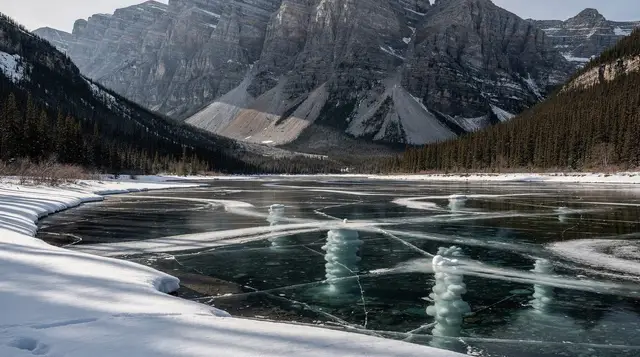
Daytime temperatures typically sit between -15 and -25°C, with occasional dips past -30°C, though a chinook wind can interrupt a cold stretch with a surprisingly mild afternoon. This is peak ski season at Banff Sunshine, Lake Louise Ski Resort, and Mt Norquay, and also the season for ice walks through Johnston Canyon and Maligne Canyon, the skating rink on Lake Louise, and the Abraham Lake ice bubbles, which are typically at their best from mid-January to mid-February.
SnowDays brings a burst of events and visitors in January, but outside that window this is genuinely the town’s quietest, coldest stretch — hotel rates reflect it. Full detail on this stretch lives on visiting Banff in winter.
March: winter holds on, one closure begins
March looks a lot like February on the ground — still cold, still skiable, still frozen lakes — but one date matters: the eastern section of the Bow Valley Parkway closes to vehicles on March 1 and stays closed until June 25 to protect wildlife through denning and early grazing season. Ski season continues at all three SkiBig3 resorts. This is a low-crowd month, useful if a cold-weather trip works for your dates and you don’t need parkway access.
April: the quietest month with skiing still open
April is a genuine gap month — winter activities are winding down, summer hasn’t started, and the lakes are still frozen or just beginning to break up. Daytime temperatures climb into single digits and occasionally the low teens Celsius, though nights stay cold. Most of SkiBig3 wraps up through April, though Banff Sunshine often runs the longest season of the three, sometimes into May. The Columbia Icefield’s Ice Explorer and Glacier Skywalk operations are typically still closed for the season at this point. Crowds and hotel prices are at their lowest of any month that still has some activities running.
May: the month people mistake for lake season
May is the single most common source of the “turquoise Banff lake” photo mismatch. Lake Louise and Moraine Lake are typically still frozen or only just starting to open up in May — the vivid turquoise colour doesn’t appear until the ice is gone and the glacial rock flour that gives the water its colour is fully suspended again, which doesn’t happen until at least mid-June.
Columbia Icefield operations typically resume around this point, and the Icefields Parkway becomes a fully functional day trip again. Crowds start building steadily as the month goes on, well ahead of the lakes themselves being ready. See when the lakes actually thaw and why the lakes are turquoise for the full explanation.
June: thaw month, and the Bow Valley Parkway reopens
June is a genuine transition month. Lake Louise typically opens up from its winter ice around mid-June; Moraine Lake follows a week or two later since it sits higher and colder. The eastern Bow Valley Parkway reopens to vehicles on June 25, right at the point where early-summer wildlife activity along it is still high. By late June the full summer picture — open lakes, open parkway, full icefield operations — is essentially in place, though crowds haven’t yet hit the July-August peak. This is a strong month for travellers who want summer conditions without summer’s worst congestion.
July and August: the peak, no ambiguity about it
This is Banff’s busiest, warmest, and most expensive stretch. Daytime temperatures typically run 20 to 25°C, every lake is open and at its most turquoise, the Icefields Parkway and Columbia Icefield operate on a full summer schedule, and the Bow Valley Parkway is open for wildlife-watching. It’s also when Moraine Lake’s shuttle-only access and Lake Louise’s paid, limited lakeside parking are under the most pressure — book shuttles and parking well ahead. If your dates are flexible, June and September offer most of the same access with noticeably fewer people, a trade-off covered in full on the dedicated summer guide below.
September: shoulder season, then two golden weeks
Early September still feels like summer, with warm days and open everything. By the last two weeks of the month the alpine larch trees turn gold, concentrated mainly around Larch Valley above Moraine Lake and Sunshine Meadows — a short, weather-dependent window that draws some of the heaviest hiking traffic of the year onto a small number of trails, often requiring hiking in groups of four or more because of grizzly activity. September is also when the wapiti rut begins, making elk unpredictable even inside town — see the elk rut warning before assuming a Banff Avenue elk is harmless. Overall this is one of the best-balanced months on the calendar.
October: cooling fast, attractions starting to close
October brings a sharp temperature drop — daytime highs typically fall from the low teens to single digits Celsius by month’s end — and most seasonal operations, including the Columbia Icefield’s Ice Explorer and Glacier Skywalk, typically wind down around the middle of the month. Crowds ease noticeably after the first week or two. This is a reasonable month for a quieter trip focused on shorter hikes and the town itself rather than high-elevation attractions, several of which are already closed for the season.
November: the other quiet month
November is Banff’s other genuine low-season month, alongside April, though colder. Temperatures typically sit from -5°C down to freezing, most warm-weather infrastructure is closed, and the ski season is only just getting underway rather than in full swing. Hotel rates are typically at their lowest point of the year outside of April. It’s a reasonable month for travellers whose priority is town-based sightseeing, museums, and hot springs rather than trails or lakes.
December: winter returns in earnest, and the holidays bring crowds back
By December, daytime temperatures typically run -10 to -18°C and all three SkiBig3 resorts are in full operation. Crowds and prices rise again around the Christmas and New Year holiday period specifically, even though the rest of the month stays relatively quiet. Ice walks at Johnston Canyon and Maligne Canyon, snowshoeing, and the winter town atmosphere around Banff Avenue are the main draws once the lakes and high passes are locked under snow and ice.
Planning a trip around this calendar
A few practical notes that cut across the whole year. The Parks Canada pass is required in the park regardless of month, including in the dead of winter when few facilities are open. Winter driving on Highway 93 and 95 in British Columbia requires winter tires by regulation from October 1 to April 30, and they’re strongly recommended on the Alberta side too even without the same legal requirement.
And if you’re building a trip around a specific attraction — the Columbia Icefield, the larches, a frozen lake for skating, a particular hike — checking that attraction’s own operating dates against the table above is worth doing before you lock in flights, since several of the park’s biggest draws run on a shorter season than Banff itself.
If you’re still deciding when to go rather than what to do once you’re there, how many days in Banff and summer versus winter in Banff are the two companion pages worth reading next, and a guided outing like a walking tour of the townsite works in almost any month as a low-commitment way to get oriented on day one.
For a winter visit specifically, an ice walk through Johnston Canyon’s frozen falls or a visit to the Columbia Icefield during its operating season are two of the more calendar-sensitive bookings on this page — both depend entirely on the seasonal windows described above, so check current operating dates before booking either one for the shoulder months. In summer, a boat cruise on Lake Minnewanka only runs once the lake is fully open, typically May through October.
Banff month by month: frequently asked questions
What is the best month to visit Banff overall?
There isn’t a single best month — it depends on what you want. June and September give the best balance of open attractions, workable weather, and manageable crowds. July and August guarantee warm weather and every trail and lake accessible, but at peak prices and peak congestion. Late September adds the larch colour window on top of shoulder-season calm, which is why many repeat visitors treat it as the sweet spot.
When do Lake Louise and Moraine Lake actually turn turquoise?
Not in May, whatever a filtered photo online suggests. Lake Louise typically opens up from its winter ice around mid-June, and Moraine Lake follows a week or two later since it sits higher and colder. Until the ice is fully gone the water is grey or milky rather than the turquoise colour that comes from suspended glacial rock flour once the lake is flowing freely again.
When are the larch trees gold near Banff?
Alpine larch turn gold for roughly the last two weeks of September, mainly at Larch Valley above Moraine Lake and at Sunshine Meadows. It’s a short, weather-dependent window, and it draws some of the heaviest hiking traffic of the year onto a small number of trails — the dedicated golden season guide covers timing and the group-of-four safety rule in detail.
When is the Icefields Parkway open, and when does the Columbia Icefield close for the season?
The Icefields Parkway itself stays open and plowed year-round, though winter driving demands proper tires and caution. The Columbia Icefield’s Ice Explorer and Glacier Skywalk operations are seasonal, typically running from April or May through October, closing once winter makes the ice-field access road and facilities unsafe to operate.
Why is the Bow Valley Parkway closed for part of the year?
The eastern section of the Bow Valley Parkway (Highway 1A) closes to vehicles from March 1 to June 25 each year to protect wildlife during a sensitive period, including denning and early grazing season. It reopens for the rest of the year and is one of the best wildlife-watching drives in the park once it does.
When does ski season run in Banff, and when is it quietest?
The three SkiBig3 resorts — Banff Sunshine, Lake Louise Ski Resort, and Mt Norquay — run roughly November through May, with Sunshine’s high elevation often stretching the season into late May. November and April are the quietest, cheapest months to ski, though early and late season conditions are more variable than the January-to-March core.
What are the quietest months to visit Banff?
November and April are consistently the lowest-traffic months, sitting between ski season and shoulder season on one side and between winter and summer on the other. Trade-offs exist: some attractions and tea houses are closed, days are short, and the Columbia Icefield facilities may not yet be running, but hotel rates and trail crowds are at their lowest.
How cold does it actually get in Banff in winter?
Daytime temperatures in January and February typically run -15 to -25°C, with cold snaps pushing below -30°C, though chinook winds can bring sudden, temporary warm-ups. Summer days sit in the 20 to 25°C range with cool nights, and snow at higher elevations is possible in any month of the year, even July.
Seasonal experiences on GetYourGuide
Verified deep-linked GetYourGuide tours. Book through these links and we earn a small commission at no cost to you.
GetYourGuide does not provide a product photo for this activity — the image shows the meeting point, photographed by us.