Visiting Banff in summer: what to expect from June to August
What is summer like in Banff, and is it the best time to visit?
Banff summer (June to August) means daytime highs of roughly 20 to 25 degrees Celsius, cool nights, and the only season when the Columbia Icefield, Glacier Skywalk, and Moraine Lake's turquoise water are all reliably accessible. It is also the busiest and most expensive season, with saturated parking, sold-out shuttles, and crowded trails — the shoulder seasons trade some of that access for far more breathing room.
Summer weather in Banff: what the numbers actually mean
Summer in the Canadian Rockies runs roughly June through August, and it’s the version of Banff most photos are taken in: blue sky, green valley floor, and lakes finally free of ice. Daytime highs in Banff itself typically sit between 20 and 25 degrees Celsius, warm enough for short sleeves on Banff Avenue in the afternoon, with Cascade Mountain framing the view north out of town. Nights are a different story — expect single digits after sunset, and pack accordingly if you’re camping, staying somewhere without much insulation, or catching a sunrise at Moraine Lake before the day warms up.
Elevation changes the equation fast. Sulphur Mountain’s summit and the higher stops on the Icefields Parkway can sit ten degrees cooler than the townsite, and snow flurries are possible at those elevations in any summer month, including July. It’s not common, but it’s not a freak event either — the Columbia Icefield area has its own microclimate, and a clear morning in Banff says nothing about conditions at Bow Summit, the parkway’s high point, two hours up the road. Rain is also part of the picture: mountain weather changes quickly, and an afternoon that starts sunny can turn showery by mid-hike, so a packable rain shell earns its space even on a forecast that looks clean.
What summer does not bring is Banff’s chinook winds, the warm gusts that punctuate winter cold snaps — those are strictly a cold-season phenomenon here. Summer weather is comparatively stable and predictable by Rockies standards, which is a large part of why it draws the crowds it does, and why hotel rates and tour prices climb to match.
Peak season means peak crowds
Banff National Park recorded more than four million visits last year, and a disproportionate share of them land in July and August. This isn’t a minor inconvenience — it changes how the whole trip works. Roam Transit buses run at or near capacity on the routes to Canmore and Lake Louise, downtown parking fills by mid-morning, and the lakeside lots at Lake Louise are routinely full before 8 a.m., which is exactly why they’re now paid, limited, and reservable rather than first-come, with an overflow lot at the ski resort as the fallback once the lakeside lot closes for the day.
Moraine Lake is the sharpest example of what peak-season demand looks like. The road has been closed to personal vehicles year-round since 2023, so every visitor gets there by Parks Canada shuttle, Roam Transit, a commercial tour, or bicycle — and in July and August, shuttle allocations sell out fast once bookings open, sometimes within the same day.
If a summer trip to Moraine Lake is on your list, treat the reservation as something to lock in well before you land, not something to sort out on arrival; the full booking mechanics, including how the release windows work, are covered separately in our Moraine Lake shuttle guide and our broader parking guide for the rest of the park.
None of this means summer isn’t worth it — it means arriving with a plan. Early starts, mid-week days where your schedule allows, and picking a mix of famous stops and quieter trails all help spread out the crush. If dodging your own rental car in gridlock isn’t appealing, an guided e-bike ride through Banff’s highlights sidesteps the parking problem entirely, and a guided walk through the village is a low-effort way to get oriented on your first afternoon before tackling anything more ambitious later in the trip.
What only opens in summer: the Columbia Icefield and Glacier Skywalk
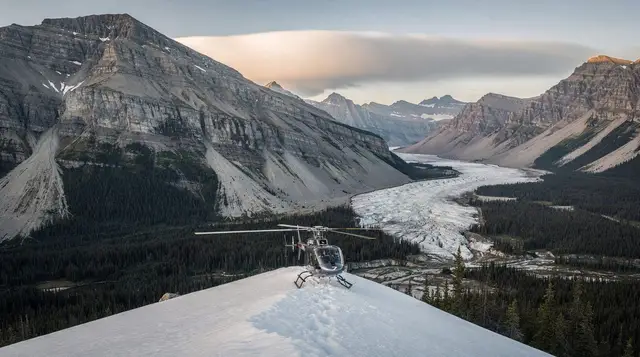
Summer is the only season the Columbia Icefield is genuinely accessible to most visitors. The Ice Explorer buses that drive out onto the Athabasca Glacier, and the Glacier Skywalk’s glass-floored platform 280 metres above the Sunwapta Valley, both run on a seasonal schedule from roughly April or May through October — outside that window, the facilities are closed and the glacier itself is off-limits to casual visitors. If summer is your only shot at this stretch of the Icefields Parkway, it’s worth building a full day around it rather than trying to squeeze it in on the way to Jasper.
The Athabasca Glacier itself is retreating by around 5 metres a year, which the on-site interpretation makes a point of showing you — painted markers along the walk up toward the toe of the glacier note where the ice sat decades ago, and the retreat is visible year over year even to a returning visitor. A guided outing puts that context alongside the logistics: the Columbia Icefield tour combining the Ice Explorer and Skywalk handles the timed-entry bookings for both stops and pairs them with commentary you won’t get parking yourself and walking up cold.
Summer also reopens the eastern section of the Bow Valley Parkway to vehicles once its spring wildlife closure ends on June 25 — through the rest of the season it’s the best road in the park for a slow wildlife-watching drive between Banff and Lake Louise, well worth the extra twenty minutes over the Trans-Canada.
What’s closed: no skiing until the snow returns
The flip side of warm weather is that Banff’s three ski areas are shut. Banff Sunshine, Lake Louise Ski Resort, and Mt Norquay — collectively marketed as SkiBig3 — run roughly November through May, with Sunshine occasionally stretching toward the end of that window on higher snowpack years, and none of them operate lift-served skiing in summer. Visitors chasing a specific ski season should be looking at the winter guide instead; a side-by-side of what each season actually offers, temperature by temperature and activity by activity, is in our summer versus winter comparison.
What those same slopes offer instead in summer is hiking and mountain biking on much of the same terrain, often using the same gondolas and chairlifts for access — a different experience, not a lesser one, but worth knowing going in if skiing specifically was the plan for this trip.
Hiking, lakes and wildlife in the summer window
By June the park’s signature lakes have generally thawed and turned their characteristic turquoise, a colour that comes from fine glacial silt suspended in the water rather than anything added or dyed. Lake Louise is usually clear by mid-June and Moraine Lake a little later, so late May or very early June photos of a turquoise Moraine Lake are not showing what’s actually there yet — by July both lakes are fully open, fully thawed, and at their most photogenic.
Trail conditions follow the same thaw. Popular hikes like Johnston Canyon, the Lake Agnes Tea House trail, and Tunnel Mountain are all in reasonable shape by early summer, though the tea houses along the Lake Louise trails are seasonal operations that don’t always take cards, so bring cash if you’re planning to stop for tea partway up. One thing summer does not deliver is the golden larch display — that’s strictly a late-September event in Larch Valley, covered on its own page, and hiking there in July gets you green larch trees and the same crowds without the payoff, so save that particular hike for autumn if the colour is the point.
Wildlife is active and visible through summer, which means keeping real distance matters: 100 metres from bears and wolves, 30 metres from everything else, and never feeding an animal regardless of how used to people it looks or how safe it seems from a car window. For a quieter, guided alternative to a crowded trailhead, a guided forest therapy session moves at a slower pace through the same forest and comes with someone who knows current wildlife activity on that day’s route, which a self-guided walk simply doesn’t offer.
Rainy days and other summer options
Summer isn’t only lakes and trailheads. A wet or smoky-sky afternoon — wildfire smoke can drift in from British Columbia or Alberta in a bad summer, and it’s worth checking air quality before committing to a strenuous hike — is a reasonable excuse to spend a few hours indoors. The Whyte Museum of the Canadian Rockies and the Banff Park Museum both cover the valley’s mountaineering and natural history, the Cave and Basin National Historic Site marks the literal birthplace of Canada’s national park system and is home to an endemic snail found nowhere else, and the Banff Centre for Arts and Creativity runs a summer program of concerts and exhibitions worth checking before you arrive.
The Banff Upper Hot Springs are open through summer as well, though at around 37 to 40 degrees Celsius the appeal is different in July than it is after a day in the winter cold — still a pleasant soak, just less of a novelty. A Lake Minnewanka boat cruise runs May through October and is one of the few ways to see that lake’s full 21-kilometre length rather than just the near shore.
Practical summer logistics: pass, budget, packing
A Parks Canada day pass is required inside Banff, Jasper, Yoho, and Kootenay in every season, summer included — budget roughly 11 CAD per adult per day or about 22 CAD per vehicle, with an annual Discovery Pass making more sense past about a week of driving between the parks. Prices are approximate; check the current official rate before you go, and the full mechanics are laid out in our Parks Canada pass guide.
Note that Kananaskis, just outside the national park boundary, runs its own separate Conservation Pass — a Parks Canada pass doesn’t cover it, and a Kananaskis pass doesn’t cover the national parks, so check which one a given day trip actually needs before you drive out.
Alberta charges 5% GST with no separate provincial sales tax, plus a 4% Alberta tourism levy on accommodation, and displayed prices are before tax. Tipping runs 15 to 20%. Summer is also the most expensive season for accommodation in Banff and Canmore alike, with rates that can run double what the same room costs in shoulder season, so a realistic day-to-day budget is worth setting before you arrive — see our Banff daily budget guide for actual ranges rather than guesswork.
Bring layers regardless of the forecast, a rain shell, and broken-in hiking shoes if trails are on the itinerary. Bear spray can’t travel in checked or carry-on luggage, so plan to buy or rent it locally rather than packing it from home. Mobile coverage is thin to nonexistent for long stretches of the Icefields Parkway, so download maps and any shuttle confirmations before you leave cell range.
Should you come in summer, or wait for the shoulder season?
Summer earns its reputation for a reason: it’s the only season with reliable access to the Columbia Icefield and the Glacier Skywalk, the lakes are at their most vivid, and every trail and facility in the park is open at once. It is also the most crowded, most expensive, and most logistically demanding season, with shuttle and parking capacity stretched thin across July and August in particular, and hotel and tour prices to match the demand.
That’s a genuine trade-off, not a reason to avoid summer — but it is a reason not to treat it as automatically the “best” time to visit. Late May through early June and September both trade some of summer’s guaranteed access for noticeably thinner crowds and lower prices, and late September adds the golden larches that summer simply doesn’t have. If your dates are flexible, our month-by-month breakdown lays out what each stretch of the year actually offers, month by month and activity by activity, so the choice comes down to what you actually want from the trip rather than which season gets called “best” the loudest online.
Common questions about visiting Banff in summer
Is July or August better for visiting Banff?
Both months run similarly warm and similarly busy. Late June and early September, still technically summer or just past it, are marginally quieter than the peak of July and August while keeping most of the same access.
Does it ever snow in Banff in summer?
Yes, at higher elevations. Passes and viewpoints above roughly 2,000 metres, including stops along the Icefields Parkway, can see snow flurries in any month, even July. Pack a warm layer regardless of the forecast in town.
Can I drive to Moraine Lake in summer?
No. The road to Moraine Lake has been closed to personal vehicles year-round since 2023. In summer you need Parks Canada’s shuttle, Roam Transit, a commercial tour, or a bicycle, and July and August departures sell out well in advance.
Is Banff too crowded in summer to be worth it?
It is genuinely the busiest season, with over four million annual park visitors concentrated heavily into these months, and parking and shuttle capacity struggle to keep up. Arriving early, booking ahead, and choosing less-photographed trails still makes for a good trip.
What’s open in summer that isn’t available the rest of the year?
The Columbia Icefield’s Ice Explorer buses and the Glacier Skywalk run only from around April or May through October. The Bow Valley Parkway’s eastern section also reopens to vehicles after its spring wildlife closure ends June 25.
Are the ski resorts open in summer?
No. Banff Sunshine, Lake Louise Ski Resort, and Mt Norquay all close for the season by late spring at the latest and reopen in November. Summer visitors hike and bike the same terrain instead of skiing it.
What should I pack for a Banff summer trip?
Layers. Daytime temperatures of 20 to 25 degrees Celsius can drop sharply after sunset and at elevation, so bring a fleece or light jacket, a rain shell, sturdy hiking shoes, and bear spray if you plan to hike, since it can’t be carried on a flight and needs to be bought or rented locally.
Seasonal experiences on GetYourGuide
Verified deep-linked GetYourGuide tours. Book through these links and we earn a small commission at no cost to you.
GetYourGuide does not provide a product photo for this activity — the image shows the meeting point, photographed by us.