The lake, the hotel and the road that gets you there
Lake Louise is the village and the lake most people picture when they picture the Canadian Rockies, and it earns that reputation honestly: a sheet of glacier-fed water at 1,750 metres, backed by the hanging ice of the Victoria Glacier, with the turreted Fairmont Chateau Lake Louise sitting at the near end like it was built to be photographed from the opposite shore. It mostly was — construction started in 1890, not long after the Canadian Pacific Railway realized what it had access to. The hotel dominates the view from the parking lot end of the lake, which is also the reason most people’s first Lake Louise photo has a slice of roofline in it whether they meant to include it or not.
The village itself, sometimes called Lake Louise Village or the Lake Louise hamlet, is a small highway-side cluster of hotels, a gas station, a grocery store and a handful of restaurants at the base of the access road, about 5 km below the lake. It exists mostly to service the lake and the ski resort above it, not as a destination in its own right, so don’t expect Banff’s density of shops and restaurants. Most people either day-trip from Banff or stay a night or two here specifically to get an early start on the lake before the parking lot fills.
Getting there from Banff
Lake Louise sits 58 km northwest of Banff on the Trans-Canada Highway, about 45 minutes by car in normal summer traffic. The lake itself is a further 5 km up Lake Louise Drive from the village and highway interchange, climbing about 200 metres to the lakeshore. A valid Parks Canada park pass is required for the whole trip, checked at intervals along the highway; there’s no separate lake entry fee on top of it.
Three ways to make that last 5 km in summer:
| Option | Cost | Reliability in July-August |
|---|---|---|
| Drive and park at the lake | Paid parking, filled most mornings by 8-9 a.m. | Low after mid-morning |
| Parks Canada shuttle (from the park-and-ride) | Reservation fee, booked in advance or a rolling 48-hour window | High, but seats sell out |
| Roam Transit Route 8X (express) or 8S | Transit fare | High, runs a regular schedule |
The lakeshore lot is small for how many people want to use it, and on a clear summer day it’s often full before 9 a.m. Once that happens, overflow traffic gets turned back down the hill rather than allowed to circle and wait. Parks Canada’s own shuttle system, which runs from a park-and-ride facility off the highway, and Roam Transit’s Lake Louise routes from Banff and Canmore are both more reliable than driving up hoping for a spot, especially from late June through early September. In shoulder season — May, early June, or October — the lot is far less contested and driving up directly is usually fine.
One mix-up is worth flagging plainly: this is not the parking lot for Moraine Lake. Moraine Lake sits in a separate valley about 14 km further along, and its access road has been closed to all personal vehicles, year-round, since 2023. The only ways in are the Parks Canada shuttle, Roam Transit, a commercial tour, or a bicycle. If your plan is to drive to “the lake with the ten peaks,” that’s Moraine, and you’ll need the shuttle system regardless of what you do at Lake Louise. Plenty of visitors do both lakes in a single day; the day trip guide for both lakes lays out a workable order for doing that without wasting the middle of the day on a road you can’t drive.
Outside a car or shuttle, Lake Louise also has a winter option worth knowing about: the Lake Louise Ski Resort runs its own access road and gondola a few kilometres from the lake, on a completely separate operation with its own parking. Don’t confuse the ski resort’s base area with the lake’s parking lot; they share a name and a general area, not a road.
When the lake is actually turquoise, and when it isn’t
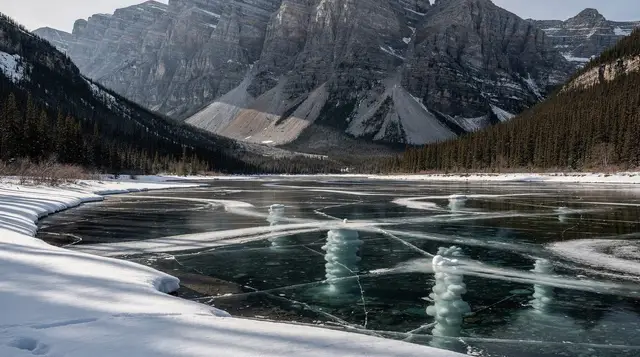
Photos of Lake Louise online are almost all taken between late June and September, and that’s not an accident of popularity — it’s close to the only window when the lake looks like those photos. Lake Louise typically stays frozen, or partly frozen with ice along the shallows, into mid-June. Ice-out timing shifts year to year with snowpack and spring temperatures, but a fully open, fully turquoise lake in April or May essentially doesn’t happen, whatever a filtered photo might suggest.
The colour itself comes from glacial rock flour — fine sediment ground by the Victoria Glacier and carried into the lake by meltwater, suspended finely enough in the water to scatter light and produce that milky blue-green rather than a clear alpine colour. That process needs open, flowing meltwater to work, so the colour builds through the summer as glacial melt increases, rather than appearing the moment the ice breaks up. Early summer visitors sometimes see a paler, cloudier lake than the postcard version; by August the effect is usually at its strongest.
Winter is a legitimately different, valid way to see this place, just not the one on the postcards. Once the lake freezes solid, Parks Canada grooms a walking path across the ice in front of the Fairmont, and the frozen lakeshore becomes a quiet, cold, genuinely striking scene in its own right, with the same mountain backdrop and none of the summer parking problem. It’s a different trip, not a lesser one, and worth planning for on purpose rather than stumbling into by accident in shoulder season.
What to actually do at the lakeshore
This page covers the lake and the village, not the hiking trails that start from the same lakeshore — Lake Agnes Tea House and the Plain of Six Glaciers both begin here but have their own pages, since both are multi-hour trails, not lakeshore activities. What follows is what there is to do without leaving the flat ground around the water.
Walk the lakeshore path. A wide, mostly flat gravel path runs along the north shore from the Fairmont toward the head of the lake, roughly 2 km one way if you go all the way to the end and back. It’s the easiest way to get past the crowd immediately in front of the hotel and get a cleaner view back down the lake, and it’s manageable in ordinary shoes for most visitors.
Rent a canoe. The boathouse at the lake’s edge rents canoes by the half-hour, and being on the water — rather than looking at it from the shore — is genuinely a different experience, if a fairly expensive one for the time you get. Lines form quickly on clear summer mornings and afternoons, and the boathouse can sell out its slots by late morning in peak season. A guided day tour that covers both Lake Louise and Moraine Lake is a practical way to see both lakeshores without driving yourself or gambling on shuttle availability, especially if you don’t want to manage the Moraine Lake shuttle booking on your own.
Eat or have coffee at the Fairmont. The hotel’s casual café and its more formal dining rooms both look directly onto the lake, and both get busy at midday in summer. It’s not cheap, and nobody should expect it to be, but it’s the one lakeside seat with a view that doesn’t involve standing on the path.
Photograph it properly. Early morning, before the wind picks up, gives the calmest water and the clearest reflection of the glacier; by mid-afternoon the lake is usually rippled and the light is flatter. The phone-versus-camera guide covers what actually helps versus what’s just extra gear to carry.
Skip the crowd, a little. The lakeshore directly in front of the hotel is the busiest few hundred metres in Banff National Park on a clear July day. Walking even 500 metres up the shoreline path thins the crowd noticeably, and the quiet-times guide has specifics on when the lot and the shoreline are least crowded if timing is flexible.
A day trip, or the base for something longer
Most visitors treat Lake Louise as a stop, not a stay: a morning or afternoon detour from Banff or Canmore, fit into a longer loop that might also include Moraine Lake, the start of the Icefields Parkway, or Yoho National Park just across the Continental Divide. That’s a reasonable way to do it, and the two-day Banff and Lake Louise itinerary is built around roughly that shape.
Staying a night in the village changes the calculation mainly for parking: arriving at the lot at 6 or 7 a.m., before the day-trip traffic from Banff and Calgary arrives, is close to the only reliable way to get a clear, quiet lakeshore photo without the ice skating tour, the shuttle line and the tour buses.
The where-to-stay comparison weighs that early-access advantage against the village’s higher prices and thinner dining options compared with Banff. For travellers building a longer trip around the lakes specifically, the iconic lakes itinerary sequences Lake Louise alongside Moraine, Peyto and Bow Lake rather than treating any one of them as a full day on its own.
Winter changes the arithmetic again: without the parking pressure of summer, and with the groomed lake-ice walking path in place, a clear cold morning here can be less crowded and arguably more distinctive than the same view in August. A guided skating outing on the frozen lake is a specific way to make use of that season rather than just passing through on the way to somewhere else.
Practical notes before you go
- Bring a park pass or buy one before arriving — it’s checked along the highway, not just at the lake, and there’s no on-site alternative if you don’t have one.
- Expect the lot to fill by mid-morning from late June through early September; plan around the shuttle or an early arrival rather than around driving up at noon.
- This is not the Moraine Lake road. If a route or a companion app is suggesting you can drive to Moraine Lake, that information is out of date; the road has been closed to personal vehicles since 2023.
- The lake isn’t turquoise before mid-June most years. A spring visit still has value — fewer people, a partly frozen lake, snow on the peaks — but it isn’t the postcard scene, and it’s worth knowing that going in.
- Cell coverage at the lake is inconsistent. Don’t count on booking a shuttle or a canoe slot from the parking lot itself; sort reservations before you leave Banff or Canmore.
- Combining Lake Louise with a wider loop? A day trip pairing Lake Louise with nearby canyons and glacier viewpoints covers more ground than the lakeshore alone in a single organized outing, useful for visitors without a rental car.
Questions about visiting Lake Louise, answered
Is the Lake Louise parking lot the same as the one for Moraine Lake?
No, and mixing them up is a common and costly mistake. Lake Louise has its own lakeshore parking area, reached by its own access road from the Trans-Canada Highway. Moraine Lake is a separate valley 14 km further on, and its road has been closed to all personal vehicles year-round since 2023, with access only by Parks Canada shuttle, Roam Transit, a commercial tour or bicycle.
Do I need a Parks Canada pass to visit Lake Louise?
Yes. Lake Louise is inside Banff National Park, so a valid Parks Canada day pass or annual Discovery Pass is required for everyone in the vehicle, checked at points along the highway and around the lake. There is no separate entry fee for the lake itself beyond the park pass.
When does Lake Louise actually turn turquoise?
Not in spring. The lake typically stays frozen or partly frozen into mid-June, and the milky, glacier-fed colour only fully develops once the ice clears and glacial silt starts circulating in the meltwater, usually from late June onward through summer.
Is the Lake Louise parking lot free?
No, lakeshore parking is paid, and the lot is small relative to the number of visitors, so it fills within the first hour or two of most summer mornings. Roam Transit and the Parks Canada shuttle from the park-and-ride are the more dependable options once the lot is full, which happens on most summer days.
Can you swim at Lake Louise?
Technically nothing stops you, but almost nobody does. The lake is fed directly by the Victoria Glacier and stays close to freezing even in August, so wading a few steps in for a photo is common; a real swim is not.
Do I need to book anything in advance for Lake Louise?
Not to see the lake itself, since it’s open to anyone with a park pass. Canoe rentals at the boathouse and tables at the Fairmont’s lakeside dining rooms are the two things worth reserving ahead in July and August, when both sell out by mid-morning.
Is Lake Louise worth visiting if I’m also going to Moraine Lake?
Most first-time visitors do both, and they’re different enough to justify it: Lake Louise has the hotel, the boathouse and easier access, while Moraine Lake has the Valley of the Ten Peaks backdrop and a harder-to-reach shuttle system. If you only have time for one, that trade-off is worth reading up on before you choose.
How long do people actually spend at the lake?
Most visitors spend two to four hours: enough time to park or arrive by shuttle, walk the lakeshore path, take photos from the end near the Fairmont, and maybe rent a canoe. Add an hour or more if you’re planning to eat at the hotel, since both the casual and formal dining rooms get busy at midday.