When do Banff's lakes thaw? A lake-by-lake guide
When do the lakes around Banff thaw out?
Lake Louise is usually free of ice by the middle of June, and Moraine Lake a week or two later since it sits higher and opens later in the season. Lower-elevation lakes such as Vermilion and Two Jack often clear earlier, in May, while high-elevation lakes on the Icefields Parkway, especially Peyto Lake, can carry ice patches into late June or even July in a cold year.
There isn’t one thaw date, there are several
Ask when “the lakes” thaw around Banff and the honest answer is that it depends on which lake you mean. Elevation is the main variable: Lake Louise sits at 1,750 metres and Moraine Lake at 1,884 metres, both noticeably higher than the Vermilion Lakes and Two Jack Lake closer to the townsite at roughly 1,400 metres.
Higher elevation means colder air pooling longer into spring, later snowmelt, and a later thaw. A second variable is basin size and depth, which affects how quickly a lake responds to a run of warm days. A third is simply how much snow fell the previous winter and how fast spring warms up, which shifts every date in this guide by one to three weeks in either direction depending on the year.
None of that means the timing is a mystery, though. Across enough seasons, the order in which Banff’s best-known lakes open up is consistent, even if the exact dates move around. This guide works through that order lake by lake, then lays out a rough month-by-month calendar you can use to plan a spring visit without arriving to a frozen surface you didn’t expect, or missing the colour by showing up too early.
Lake Louise: usually clear by mid-June
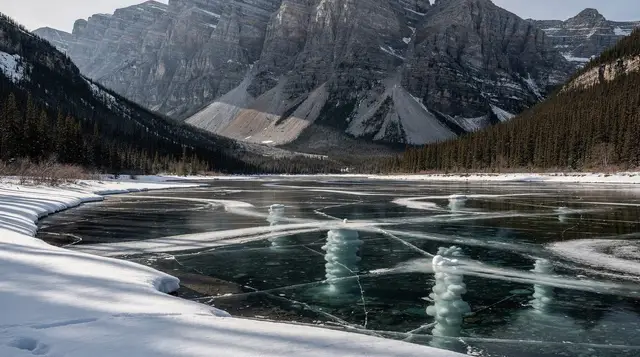
Lake Louise is frozen solid from roughly December through into spring, solid enough that Fairmont Chateau Lake Louise maintains a groomed skating rink directly on the ice in winter. The transition away from that isn’t gradual: rather than slushy patches appearing over weeks, the ice typically breaks up over a period of days to a couple of weeks once daytime temperatures hold consistently above freezing, generally putting the lake at open water by the middle of June in a typical year.
The Victoria Glacier at the head of the lake is part of why the thaw takes this long even after the surrounding valley has warmed up: cold air draining off the glacier keeps the lake basin colder than the town of Banff itself, which sits roughly 350 metres lower and several degrees warmer through the same weeks. If you’re checking conditions before a late-May or early-June trip, don’t extrapolate from what Banff’s weather looks like that day; Lake Louise runs its own, later schedule.
Once the ice is out, the water doesn’t turn postcard-turquoise immediately. It typically starts out clear or faintly green, and the more saturated colour builds over the following one to two weeks as glacial meltwater carries more rock flour into the basin. The optical mechanism behind that colour is covered in detail in why the lakes turn turquoise; what matters for timing purposes is that ice-out and full colour are two separate milestones, roughly two weeks apart.
Moraine Lake: a little later, and you can’t drive there anyway
Moraine Lake, in the Valley of the Ten Peaks, typically thaws one to two weeks after Lake Louise, commonly landing somewhere in the second half of June. The gap comes mostly from elevation: at 1,884 metres it sits meaningfully higher than Lake Louise, in a valley that holds shaded, cold air longer into the season.
There’s a practical wrinkle specific to Moraine Lake that doesn’t apply to Lake Louise: the access road is closed to private vehicles year-round, a change made permanent in 2023. The only ways in are Parks Canada’s shuttle, Roam Transit, a commercial tour bus, or arriving by bike. In practice, this means the lake usually becomes accessible to visitors at close to the same point it becomes visually ice-free, since the shuttle season itself typically starts in June once the road and facilities are ready. Checking the shuttle’s operating dates for the year you’re travelling tells you almost as much about the thaw as checking the ice report does.
If your trip depends on seeing Moraine Lake specifically, and it falls in the first half of June, build in the expectation that you might see a partially frozen lake rather than the full turquoise view, and have a lower-elevation lake as a backup for that day.
The lower lakes: Vermilion, Two Jack, and Minnewanka thaw earliest
Not every notable lake near Banff sits at Lake Louise’s elevation. The Vermilion Lakes, just outside the townsite along the Bow Valley Parkway, and Two Jack Lake and Lake Minnewanka, both a short drive northeast of Banff, sit several hundred metres lower than Lake Louise. That lower elevation, combined with more direct sun exposure through the day, typically puts these lakes at open water by early to mid-May, a full month or more ahead of Lake Louise in an average year.
This makes the lower lakes the better bet for anyone visiting in April or May and wanting open water rather than ice. It doesn’t mean turquoise colour, though: these lakes are fed by different water sources and mixes of glacial and non-glacial runoff, and the Vermilion Lakes in particular are known more for calm reflections of Mount Rundle at sunrise than for saturated glacial colour. Lake Minnewanka, the largest lake in the park at 21 kilometres long, runs its scenic boat cruise from May through October, and the cruise typically starts once the lake is reliably open, which is itself a useful signal for how thaw timing plays out that year.
The high lakes on the Icefields Parkway: Peyto often runs latest
The lakes along the Icefields Parkway sit at the opposite end of the elevation spread from Vermilion and Two Jack. Peyto Lake, viewed from a platform near Bow Summit at 2,088 metres, the highest point the parkway reaches, is typically the last of Banff’s well-known lakes to clear. In a cold or late spring, ice can linger along its shallower margins into late June, and patches have been reported into early July.
Bow Lake, a little lower and just off the parkway near Num-Ti-Jah Lodge, and the viewpoint over Crowfoot Glacier nearby, generally follow a similar late-spring pattern to Peyto rather than the earlier pattern of the townsite lakes. Part of the reason is straightforward: the parkway itself is a winter-maintained but genuinely alpine road, and the whole corridor between Lake Louise and the Columbia Icefield stays under a mix of snow, meltwater, and avalanche control operations well into what would be late spring at lower elevations elsewhere in the park.
If a road trip along the parkway is the main reason for your visit and it falls before late June, treat photos of a fully turquoise Peyto Lake the way you’d treat any other seasonal claim: check when they were actually taken. It’s entirely possible to drive the full 232 kilometres to Jasper in May or early June and find genuinely striking scenery, glaciers, waterfalls, canyons, all of it running at full force with spring meltwater, while Peyto itself is still half-frozen and grey-green rather than the saturated blue you’ve seen in photos.
Colour comes after the ice, and not immediately after
It’s worth separating two questions that get merged in trip planning: when does the ice leave, and when does the water turn the colour these lakes are known for. They’re not the same date. Once a lake is ice-free, it typically takes another one to three weeks for enough glacial rock flour to build up in suspension to produce the full turquoise or emerald colour associated with places like Lake Louise and Moraine Lake. Early on, freshly ice-free water more often reads as clear, dull green, or a muddy grey-green, especially right after a heavy runoff event.
This guide deliberately doesn’t go into why suspended rock flour scatters light the way it does; that mechanism, including why the same lake looks different shades depending on time of day and how far into the season you are, is covered separately in why Banff’s lakes are turquoise. What matters here is the practical implication: a lake being “open” and a lake looking like its postcard photos are two different milestones, and the gap between them is real, not a formality.
The single most important piece of trip-planning advice in this guide follows directly from that gap: a photo of a fully turquoise Lake Louise or Moraine Lake taken in May does not exist as a real, current photograph. Anything claiming to show that should be treated as either archived from a different month, digitally altered, or simply mislabelled. If you’re planning a spring trip specifically to see turquoise water, mid-June is the earliest realistic target for Lake Louise, and later still for Moraine Lake and the high parkway lakes.
A rough month-by-month thaw calendar
The table below gives typical windows, not guaranteed dates. Treat every entry as shifting by one to three weeks depending on that year’s snowpack and spring warmth.
| Lake | Elevation | Typical ice-out | Typical full colour |
|---|---|---|---|
| Vermilion Lakes | ~1,400 m | early to mid-May | variable, not primarily glacial |
| Two Jack Lake | ~1,430 m | early to mid-May | variable, partly glacial |
| Lake Minnewanka | ~1,475 m | early to mid-May | late May onward |
| Lake Louise | 1,750 m | mid-June | late June |
| Moraine Lake | 1,884 m | mid to late June | late June to early July |
| Bow Lake | ~1,920 m | mid to late June | late June onward |
| Peyto Lake | ~1,860 m (lake), viewpoint at 2,088 m | mid-June to early July | July |
A useful rule of thumb: if you can only visit once and turquoise water is the priority, the window from late June through July gives every lake in this table its best chance of having both cleared and coloured up, without yet running into the heaviest summer crowds that arrive through July and August.
Building a spring or early-summer visit around the thaw
If your trip lands in May or the first half of June, lean the itinerary toward the lower lakes and toward experiences that don’t depend on turquoise water. A half-day around the Vermilion Lakes and Two Jack Lake works well in this window, and a Lake Minnewanka boat cruise is often running by late May. It’s also a genuinely good window for a small-group outing that mixes lakes with a canyon walk while crowds are lighter: a scenic lakes tour through Canmore and Banff National Park covers several of the lower, earlier-thawing lakes in one outing.
If your trip is fixed for mid-June, Lake Louise is a reasonable bet for open water, though possibly not full colour yet, while Moraine Lake and the parkway lakes remain a gamble. A tour that bundles the townsite lakes together gives you a wider net than picking just one: a four-lake day tour spreads the risk of any single lake still being iced over across several stops instead of one.
For trips in late June through July, when every lake in the calendar above has a realistic shot at both open water and colour, it’s worth committing to the full Icefields Parkway corridor rather than just the townsite lakes. A full-day trip up the parkway to Bow Lake and Peyto Lake is a better use of a July date than an earlier one, precisely because the high lakes are the last to come into their own.
Travellers who want the glacier plus the classic lake views together in one outing, without self-driving the full corridor, often combine it with the icefield itself: a Columbia Icefield tour that also stops at Bow, Peyto, and Crowfoot Glacier covers that same late-June-onward window in a single booked day.
Checking conditions before you commit
Because the exact thaw date moves around by weeks from year to year, none of the ranges above should be treated as fixed. Parks Canada and the Lake Louise and Moraine Lake webcams, where available, are the most reliable free way to check current conditions in the days before a trip, and they’re worth five minutes before finalizing plans for a visit in May or early June specifically. If you’re building a longer visit and want to hedge across a range of possible thaw dates rather than betting on one lake, an itinerary built around the iconic lakes that includes both early and late-thawing stops absorbs a poorly timed date better than a single-lake day trip does.
For planning further out, how many days to allow in Banff and general notes on visiting in early summer are useful companions to this guide, and the topic of how affluence stacks on top of thaw timing, since the two don’t move on the same calendar, is covered separately in when the lakes are quietest.
Lake thaw and ice-off dates: frequently asked questions
When does Lake Louise thaw?
Lake Louise is typically ice-free by the middle of June, though the exact date shifts by one to three weeks depending on how much snow fell the previous winter and how warm the spring turns out to be. In a heavy snow year, ice can linger into late June. The lake is still frozen solid for ice skating as late as March, so the transition from ice rink to turquoise lake happens over a fairly narrow window.
When does Moraine Lake thaw?
Moraine Lake usually opens up a week to two weeks after Lake Louise, commonly in late June, because it sits at 1,884 metres, roughly 130 metres higher than Lake Louise, in a valley that holds cold air longer. The road and shuttle service to Moraine Lake also only run for the summer season, so in most years the lake becomes visible to visitors at roughly the same time it becomes visibly ice-free.
Which Banff-area lakes thaw earliest?
The lower-elevation lakes close to the townsite thaw earliest. The Vermilion Lakes, Two Jack Lake, and Lake Minnewanka sit at elevations several hundred metres below Lake Louise and typically show open water by early to mid-May, sometimes with lingering shore ice into the month. These are the lakes worth checking first if you’re visiting in spring and want open water rather than ice.
Is Peyto Lake frozen later than the other lakes?
Often, yes. Peyto Lake sits near Bow Summit at 2,088 metres, the highest point on the Icefields Parkway, and the parkway itself typically doesn’t fully clear of winter closures and hazards until late spring. It’s common for Peyto Lake to still carry ice along its shallower margins into late June, and in a cold year patches can persist into July, well after Lake Louise has cleared.
Can I see the turquoise colour if I visit in May?
Not the classic postcard colour, no. In May, most high-profile lakes are either still frozen, half-frozen, or newly open with clear or murky water rather than turquoise, because the glacial rock flour that produces the colour hasn’t yet been carried into the lake in volume. A photo of a fully turquoise Lake Louise or Moraine Lake taken in May doesn’t reflect what’s actually there; treat any such image online with suspicion.
How much does the thaw date vary from year to year?
Quite a lot. Because the timing depends on winter snowpack, spring temperatures, and how quickly that snow melts, the same lake can clear a full two to three weeks earlier or later from one year to the next. There’s no fixed calendar date to plan around; the ranges in this guide are typical windows, not guarantees, and checking recent reports or a live parks webcam before a spring trip is worth the five minutes it takes.
Does a frozen lake mean there’s nothing worth seeing?
Not at all, it’s a different kind of visit. A frozen Lake Louise in February or March is one of the most photographed winter scenes in the Rockies, with a maintained skating rink on the ice and dramatic contrast against the Victoria Glacier. What you won’t get before the thaw and the colour arriving is the turquoise water itself, so the two seasons suit different expectations rather than one being simply worse.
Lake Louise & Moraine Lake tours on GetYourGuide
Verified deep-linked GetYourGuide tours. Book through these links and we earn a small commission at no cost to you.
GetYourGuide does not provide a product photo for this activity — the image shows the meeting point, photographed by us.