232 kilometres, one highway, and more stops than a day trip can hold
The Icefields Parkway is Highway 93 North, and it runs 232 km between Lake Louise and Jasper, tracing the Continental Divide past glaciers, turquoise lakes, and waterfalls that don’t have an equivalent this concentrated anywhere else in the Canadian Rockies. It’s often called one of the world’s great drives, and the description is earned by the scenery rather than by any single dramatic landmark — it’s the accumulation of stops that makes it work. That’s also exactly why it trips people up: driven with no stops at all, it takes about 3 h 30 min, but almost nobody drives it that way, and treating the parkway like a quick errand between two towns is the single most common planning mistake covered on this page.
This page is the overview. It covers the distance, the timing, the pass, the fuel and signal gaps, and how the stops line up along the route, so you can plan the day (or two) around them properly. It does not repeat the details of each individual stop — Peyto Lake, Bow Lake, the Columbia Icefield, and the rest each have their own page with hours, parking, and what you’ll actually see. Think of this one as the chapter that ties them together.
Where it starts, where it ends, and what’s in between
The parkway begins at the Trans-Canada Highway junction near Lake Louise and ends at Jasper townsite, 232 km north. It’s a two-lane highway the whole way — no passing lanes for long stretches, no shoulders in places, and a posted speed limit that drops sharply at wildlife and viewpoint zones. Elevation climbs steadily from Lake Louise’s 1,750 m to Bow Summit at 2,088 m, the highest point on the route, before dropping into the Saskatchewan River valley and climbing again toward the Columbia Icefield.
Driving north to south (Jasper to Lake Louise) is exactly the same distance and takes the same time; neither direction is meaningfully better for scenery, though driving south in the afternoon puts the sun at your back for most of the glacier viewpoints. If your trip also includes Moraine Lake, remember that it sits on a different road entirely, reached only by the seasonal shuttle system, not by any point along the Icefields Parkway itself.
| Segment | Approximate distance | Approximate drive time (no stops) |
|---|---|---|
| Lake Louise to Bow Summit/Peyto Lake | 40 km | 30 min |
| Bow Summit to Saskatchewan River Crossing | 40 km | 35 min |
| Saskatchewan River Crossing to Columbia Icefield | 80 km | 1 h |
| Columbia Icefield to Jasper | 105 km | 1 h 20 min |
| Full route, Lake Louise to Jasper | 232 km | about 3 h 30 min |
Add real time for every stop: 20 to 40 minutes each at the photogenic pull-offs, an hour or more at the Columbia Icefield if you’re doing the Ice Explorer or the Glacier Skywalk, and 30 minutes or so at the waterfalls near Jasper. Most travellers doing the drive with a reasonable number of stops end up spending 8 to 10 hours between Lake Louise and Jasper, which is worth building into a schedule rather than discovering on the road.
The pass, the fuel, and the phone signal
Three practicalities apply to the entire route, not just to individual stops, and skipping any one of them causes real problems partway along the highway.
The Parks Canada pass is required in both directions, including a simple pass-through with no stops planned. The parkway runs entirely inside Banff and Jasper national parks, and the pass is checked at gates and parking areas the same way it is anywhere else in the parks — roughly 11 CAD per adult per day or 22 CAD per vehicle, with an annual Discovery Pass worth it for longer or repeat trips. The full mechanics, including where it’s sold and what happens if you arrive without one, are in Parks Canada pass explained.
There is one fuel stop on the entire route, at Saskatchewan River Crossing, roughly the midpoint. It operates seasonally and its hours can be shorter than you’d expect, especially early or late in the season. Outside of that one stop, there is no gas between Lake Louise and Jasper in either direction — fill the tank completely before leaving either townsite. Running low partway along is not a minor inconvenience; it’s a genuine problem on a highway with long stretches between any kind of service.
Cell coverage is unreliable to absent for most of the drive, including around the Columbia Icefield itself. Don’t count on calling ahead to confirm a shuttle booking, a restaurant reservation, or a road condition update once you’ve left town — download offline maps and any information you’ll need in advance. Both gaps are covered in more detail, stop by stop, in gas and cell coverage on the Icefields Parkway.
The stops, in the order you’ll reach them
Driving north from Lake Louise, the main stops come in a consistent sequence: Herbert Lake not far past the highway junction, then Crowfoot Glacier and Bow Lake, followed by Bow Summit and the short walk up to the Peyto Lake viewpoint — the highest point on the parkway and one of its most photographed views. From there the road drops toward Mistaya Canyon, a short walk to a narrow limestone gorge, and on to Saskatchewan River Crossing, the parkway’s only services stop and roughly its midpoint.
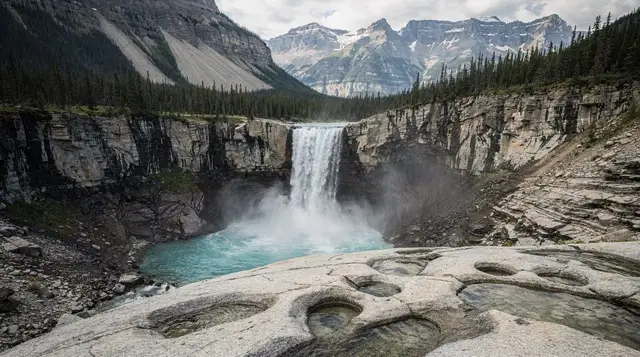
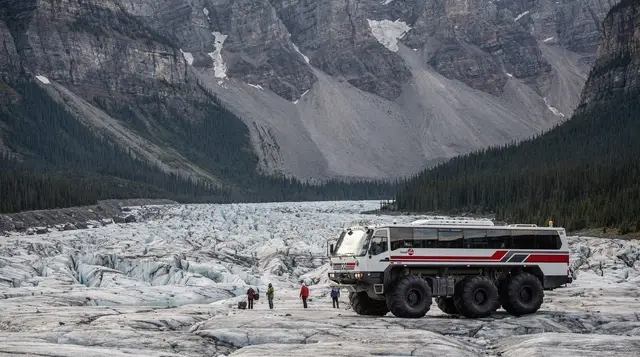
North of the crossing, the road climbs past the Weeping Wall and over Sunwapta Pass into Jasper National Park, arriving at the parkway’s biggest single draw: the Columbia Icefield, where the Athabasca Glacier is visible from the road and accessible on foot or by guided Ice Explorer, and the Glacier Skywalk, a glass-floored platform 280 m above the Sunwapta Valley a few minutes’ drive further north. Closer to Jasper, the last two major stops are Athabasca Falls and Sunwapta Falls, both short walks from their parking areas and both worth the few minutes it takes to see them properly rather than glancing from the road.
That’s the sequence at a glance — what each stop actually offers, how long to budget, and where the crowds bunch up is covered fully in the Icefields Parkway stops in order, and this page won’t repeat it. If you’d rather have someone else handle the driving and the stop-by-stop timing, a guided day tour covering the full route from Calgary or Banff takes care of the pacing for you, and a smaller private version of the same route gives more flexibility over how long you spend at each stop.
One day or two — and the mistake to avoid
The parkway can be driven as a one-way trip (Lake Louise to Jasper, or the reverse) in a single long day, or as a round trip from Banff or Lake Louise with a Jasper overnight in between. What it can’t comfortably be is a same-day round trip from Banff that also fits in a proper look at everything — that adds Banff’s own 26 km to Lake Louise on top of the 464 km round trip to Jasper and back, and something has to give. Most people who attempt it end up rushing the Columbia Icefield, skipping the waterfalls near Jasper entirely, or driving the last stretch back into Banff after dark, which is also when wildlife on the highway is hardest to see in time to react.
The straightforward fix is to stop treating Jasper as a lunch break and start treating it as a destination worth a night. A one-way drive with a Jasper hotel booked, followed by a return drive (or a flight home from Edmonton, for those ending their trip there) the next day, lets you see the Columbia Icefield and the Jasper-side waterfalls without racing daylight.
The trade-offs between the two approaches — one long day versus two calmer ones — are broken down fully in one day vs two days on the Icefields Parkway, and it’s also the structure behind the four-day Banff, Jasper, and Icefields itinerary and the longer six-day Banff-to-Jasper full loop on this site. A pre-set day tour sidesteps the whole calculation: the Banff sunset tour with dinner along the parkway is built around a single evening rather than a full day, which suits travellers who want the highlights without committing to an overnight in Jasper.
Jasper at the far end
Jasper is the town at the northern end of the parkway, smaller and quieter than Banff, and it sits inside the largest of the four Canadian Rocky Mountain parks. The July 2024 wildfire destroyed roughly a third of the town’s buildings, and while Jasper has rebuilt and is open to visitors again, some areas and trails still carry visible marks of it — worth knowing before you arrive rather than assuming everything looks the way it did before.
The current state of recovery, and what that means for a visit, is covered honestly in Jasper after the 2024 wildfire. Beyond the parkway itself, Jasper is also the base for the Jasper SkyTram and Maligne Canyon, but those belong to Jasper’s own destination page rather than this one.
Driving it in winter
The Icefields Parkway stays open through the winter in principle, but the drive changes in ways that matter. Snow, ice, and active avalanche control can close sections of the highway temporarily or slow the whole route to a crawl, particularly around Sunwapta Pass and the Columbia Icefield. Several summer stops lose part of their appeal or their access — the Ice Explorer and Glacier Skywalk both close for the season, typically from October to April — and shorter daylight hours compress an already long drive into a narrower window.
None of this means the parkway isn’t worth seeing in winter; the ice formations and near-empty pull-offs have their own appeal, and details on tire requirements, road closures, and what’s actually open are in the Icefields Parkway in winter and the broader winter driving in the Rockies guide. Check current road conditions before a winter or shoulder-season drive rather than assuming summer-season access — this is not a route to guess at.
For a lower-effort winter alternative to self-driving, a guided winter tour around Lake Louise covers some of the same scenery closer to Banff without the exposure of a full winter drive to Jasper and back.
Guided tour vs self-drive
Renting a car and driving the parkway yourself gives full control over how long you linger at each stop, at the cost of managing the fuel gap, the phone-signal gap, and the parking at busy viewpoints in July and August. A guided tour trades that flexibility for someone else handling the driving, the timing, and often entry to the Columbia Icefield attractions as part of the package — worth it in particular for anyone uneasy about mountain driving, travelling solo, or short on time.
If your trip is centred on Banff and Lake Louise rather than a Jasper overnight, a combined Lake Louise and Banff day trip covers the southern anchor of the parkway without committing to the full Jasper run. The fuller comparison of both approaches, cost included, weighs total cost, timing, and flexibility for each option.
Icefields Parkway: frequently asked questions
How far is it from Lake Louise to Jasper on the Icefields Parkway, and how long does it take?
It’s 232 km one-way, and a non-stop drive takes about 3 h 30 min. Almost every visitor stops at several viewpoints, which turns that into a full day, typically 8 to 10 hours if you want to see the main highlights without rushing.
Do I need a Parks Canada pass just to drive the Icefields Parkway?
Yes, even for a straight pass-through with no stops. The highway runs entirely inside Banff and Jasper national parks, so a valid Parks Canada day pass (around 11 CAD per adult or 22 CAD per vehicle) or an annual Discovery Pass is required in both directions, and it’s checked at gates and parking areas.
Is there a gas station along the Icefields Parkway?
One, at Saskatchewan River Crossing, roughly the midpoint, and it only operates seasonally with hours that can be shorter than expected. There is no other fuel between Lake Louise and Jasper, so fill up completely before leaving either town.
Will I have cell phone signal on the drive?
Only in patches. Coverage is unreliable to absent for most of the route between the two townsites, including around the Columbia Icefield. Download offline maps, tell someone your rough schedule, and don’t count on calling ahead for reservations or road updates once you’ve left Lake Louise.
Can I drive the Icefields Parkway as a day trip from Banff and come back the same day?
It’s possible but demanding: Banff to Jasper and back is roughly 580 km round trip on top of Banff’s own 26 km distance from Lake Louise, plus every stop you make. Most people who try it end up rushing the second half or driving the last stretch back to Banff in the dark. A one-way drive with a Jasper overnight, or a guided tour where someone else drives, avoids that trade-off.
Is the Icefields Parkway open in winter?
It stays open year-round in principle, but winter conditions change the drive completely: snow, ice, and avalanche control can close sections temporarily or slow traffic to a crawl, several stops lose their appeal or their access, and daylight hours shrink. Confirm current conditions before a winter or shoulder-season drive rather than assuming summer conditions apply.
What’s the single biggest mistake people make planning this drive?
Underestimating how long it takes and treating Jasper as a lunch stop rather than a destination. The parkway rewards slowing down at Peyto Lake, Bow Lake, the Columbia Icefield, and the waterfalls near Jasper — trying to do all of that and drive back to Banff in one day usually means seeing very little of any of it properly.
In what order do the main stops come, driving north from Lake Louise?
Roughly: Herbert Lake, Crowfoot Glacier, Bow Lake, Bow Summit and Peyto Lake, Mistaya Canyon, Saskatchewan River Crossing, the Columbia Icefield and Glacier Skywalk, and finally Athabasca Falls and Sunwapta Falls closer to Jasper. Exact order and side-trip time are covered stop by stop in the dedicated stops guide.