4 days from Banff to Jasper: the Icefields Parkway
The route in brief, and the mistake most people make
This itinerary follows the classic out-and-back version of the Icefields Parkway: two days based in Banff covering the town and the big lakes, a full driving day north to Jasper with stops along Highway 93, one night in Jasper, and a morning there before heading back. The number that trips people up is 232 — as in 232 kilometres from Lake Louise to Jasper, which Parks Canada and most maps will tell you takes 3 hours 30 minutes.
That figure is accurate for a car with no stops and an empty gas tank warning light already off. It is not a realistic plan for a day that also includes Peyto Lake, a few hours at the Columbia Icefield, and the Glacier Skywalk. Treat this as a full-day drive, arrive at your first icefield stop by mid-morning at the latest, and don’t schedule anything else for Day 3 evening beyond checking into Jasper.
Day 1: Banff, on foot and low-key
Arrive in Banff, whether by rental car from Calgary (128 kilometres, about 1 hour 30 minutes on the Trans-Canada Highway) or already in town, and spend the afternoon orienting yourself rather than rushing to the parkway. Walk Banff Avenue with Cascade Mountain framing the north end of the street, detour to Bow Falls, and take in the view of the Fairmont Banff Springs from Surprise Corner. If you have a few hours of energy left, ride the gondola up Sulphur Mountain for a wide look at the Bow Valley before dark.
This is also the evening to confirm your Parks Canada pass — required for the whole trip through Banff and continuing into Jasper National Park — and to double-check whether you need to reserve a Moraine Lake shuttle slot for tomorrow, since availability tightens fast in summer.
Day 2: Lake Louise and Moraine Lake
Head out early to Lake Louise, 58 kilometres and about 45 minutes from Banff. The lake’s turquoise colour, glacial flour suspended in meltwater below the Victoria Glacier, only appears once the ice breaks up, usually around mid-June — arrive earlier in the season and you’ll find a still-frozen surface instead of the postcard view. From the lakeshore, a short stretch of the trail toward Lake Agnes gives a higher vantage point if you have time before moving on.
Getting to Moraine Lake is the one piece of this day that doesn’t work like ordinary sightseeing: the access road has been closed to all personal vehicles year-round since 2023, so every visitor reaches the lake by Parks Canada shuttle, Roam Transit, or a booked tour. Reserve a shuttle slot well ahead, or skip the shuttle-booking guesswork with a Moraine Lake sunrise experience that gets you onto the rockpile above the Valley of the Ten Peaks before the day-trip crowds arrive.
If you’d rather see a wider spread of lakes than just these two, a tour combining Lake Louise, Emerald Lake, and Peyto Lake previews tomorrow’s Peyto Lake stop today, from the Bow Summit side, and swaps some of Moraine Lake’s crowding for quieter Yoho scenery. Spend the night back in Banff or Lake Louise village to keep tomorrow’s parkway drive as long as possible.
Day 3: The Icefields Parkway to Jasper
This is the driving day, and it deserves the whole day. Leave Lake Louise as early as you can manage — ideally by 8 a.m. — and fill your tank before you go. There is no fuel between Saskatchewan River Crossing, which only operates seasonally, and Jasper itself, so running low partway through is a real risk, not a theoretical one. Cell coverage drops out for long stretches too, particularly past Bow Summit, so download offline maps beforehand and don’t count on a signal to check opening hours or reservations along the way.
The route north on the Icefields Parkway (Highway 93 North) passes a set sequence of stops. Herbert Lake comes first, a quiet warm-up view with few other cars. Crowfoot Glacier follows, visible from a roadside pullout, then Bow Lake with the Crowfoot Glacier’s namesake peak reflected on calm mornings.
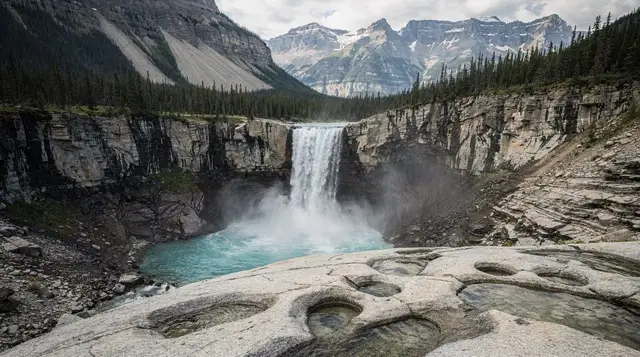
Climb to Bow Summit, at 2,088 metres the parkway’s high point, for the short walk to the Peyto Lake viewpoint — its wolf-head silhouette and improbable blue are best in full midday sun rather than early morning shadow, which is one reason a mid-morning arrival here works better than a pre-dawn one. Mistaya Canyon comes next, a compact limestone gorge worth a 15-minute detour from the parking area, followed by Saskatchewan River Crossing itself, then the Weeping Wall and the switchbacks up to Sunwapta Pass.
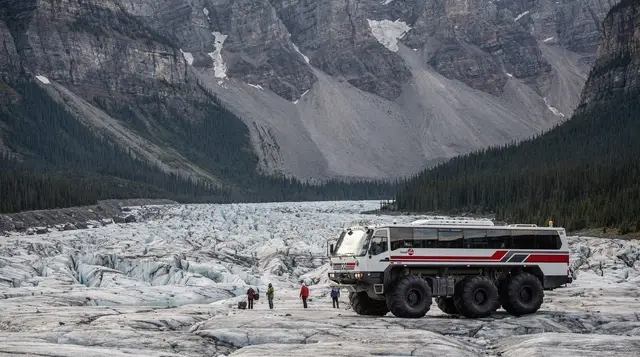
The Columbia Icefield is the day’s centrepiece and its biggest time commitment. The Athabasca Glacier, one of six glaciers flowing off the icefield, has been retreating by roughly 5 metres a year, and the Ice Explorer — a purpose-built bus with oversized wheels — is the only way onto the ice itself; it’s typically sold as a combined ticket with the Glacier Skywalk, a glass-floored walkway cantilevered 280 metres above the Sunwapta Valley a short drive up the road.
Both operate only from around April or May through October, so confirm current dates if you’re travelling at either edge of the season. A combined Columbia Icefield and Glacier Skywalk ticket is the standard way to book both in one pass, or take a guided tour of the Columbia Icefield with a local guide if you’d rather have the recession, the crevasse fields, and the safety briefing explained as you go rather than reading it off a signboard.
Budget at least 2 to 3 hours here between parking, the Ice Explorer ride, and the Skywalk, more if you’re visiting in peak summer when lineups build at both. From the icefield, continue north past Tangle Creek Falls to Athabasca Falls, a narrow, forceful drop through limestone that’s worth the short walk even at the end of a long driving day, then on to Sunwapta Falls before the final stretch into Jasper townsite. Check into your hotel and keep the evening simple — you’ve covered the parkway’s full stop list in a single day, which is the correct amount of ambition for Day 3.
Day 4: Jasper morning, then home
With only a half-day in Jasper before heading back, pick one or two things rather than trying to cover the town’s full list. The Jasper SkyTram is a strong option if you want a big view without a long hike — it climbs to 2,263 metres, the highest guided tramway in Canada, and runs a self-guided boardwalk at the top. Maligne Canyon, a 50-metre-deep limestone gorge close to town, is a shorter, easier alternative if you’d rather not add another gondola ride to a trip that’s already had two lake tours and an ice-walk equivalent.
It’s worth knowing before you arrive that the July 2024 wildfire destroyed roughly a third of Jasper’s townsite buildings. The community has rebuilt and is welcoming visitors again, though some neighbourhoods and nearby trails still show the fire’s effects — worth a look at what’s changed before you plan a specific walk, rather than assuming the whole town looks as it did in older photos or guidebooks.
By early afternoon, start the return drive: back down the Icefields Parkway to Lake Louise and on to Banff (roughly 4 to 4.5 hours total with minimal stops), or fly out of Edmonton if your trip continues elsewhere — Edmonton itself is not a day trip from Banff, so treat it strictly as a departure point on this leg, not a sightseeing stop. If you’re flying out of Calgary instead, budget the full return distance plus the YYC transfer time into your last day, and don’t schedule an evening flight so tight that a slow-moving RV or a wildlife jam on the parkway turns into a missed departure.
Fuel, food, and connectivity along the way
The gap in services on this route catches out more travellers than the driving time does. Between Lake Louise and Jasper, Saskatchewan River Crossing is the only fuel and food stop, and it’s seasonal — closed for parts of the year, with shortened hours even when open. There’s nothing else. Fill up fully before leaving Lake Louise or Banff, carry water and snacks, and don’t assume you’ll find a convenience store partway along. Cell service is patchy to non-existent for long sections, which matters for anything from checking Columbia Icefield ticket times to calling ahead for a Jasper dinner reservation, so handle both before you lose signal north of Bow Summit.
If 4 days feels tight
Four days is a workable but efficient pace for this route — it doesn’t leave room for Yoho’s Emerald Lake, a Lake O’Hara day (which runs on its own bus quota and lottery system regardless of your schedule), or a proper hike near Jasper beyond a short canyon walk.
If you can add two more days, our six-day Banff-to-Jasper full loop builds in that extra time properly, and our Icefields Parkway road trip guide breaks the drive itself down stop by stop if you want more detail before you go. For a side-by-side on whether to split the parkway across two calmer days instead of one long one, see one day versus two days on the Icefields Parkway.
Frequently asked questions about the Banff-to-Jasper drive
Can you drive the Icefields Parkway from Banff to Jasper in one day?
You can drive it in one day, but you shouldn’t treat it as a quick transfer. The 232-kilometre route takes 3 hours 30 minutes with no stops at all, but a realistic day includes photo stops at Peyto Lake and Bow Lake plus several hours at the Columbia Icefield, which turns the drive into a full day rather than a half-day errand.
Do you need to book the Columbia Icefield and Glacier Skywalk in advance?
Booking ahead is strongly recommended in July and August. The Ice Explorer glacier tour and the Glacier Skywalk are usually sold as a combined ticket, and both attractions operate on a seasonal schedule, typically opening in April or May and closing in October, so confirm current dates before building them into your day.
Is there fuel available between Lake Louise and Jasper?
Only at Saskatchewan River Crossing, and only seasonally. There is no other gas station on the 232-kilometre stretch of the Icefields Parkway, so fill your tank in Lake Louise or Banff before departing and top up again once you reach Jasper.
Does the Icefields Parkway have cell phone coverage?
Coverage is very limited for most of the drive. Expect long stretches with no signal at all, particularly between Bow Summit and the Columbia Icefield, so download offline maps and let someone know your rough schedule before you set out.
Can you visit Moraine Lake on this itinerary without booking a shuttle?
No. Moraine Lake Road has been closed to personal vehicles year-round since 2023, so reaching the lake on Day 2 of this itinerary requires the Parks Canada shuttle, Roam Transit, or a guided tour booked in advance, regardless of whether you have a rental car for the rest of the trip.
Is 4 days enough to properly see Banff, Lake Louise, and Jasper?
Four days is enough for a focused version of this route: two days around Banff and Lake Louise, one full day driving the parkway with icefield stops, and a half-day in Jasper before heading back. It is not enough time to also add Yoho, Kootenay, or multiple hikes without cutting something else short.
What should you skip if you only have 4 days for this route?
Skip Lake O’Hara, Yoho’s Emerald Lake side trip, and any full-day hike near Jasper — there simply isn’t a spare afternoon for them on a 4-day loop. If you want to add those, our 6-day Banff-to-Jasper itinerary builds in the extra time properly.
Do you need winter tires for this drive?
Alberta doesn’t legally require winter tires, though they’re strongly advised on this route outside summer. If your loop continues into British Columbia on Highways 93 or 95, winter tires are mandatory there from October 1 to April 30. In practice, the Columbia Icefield’s Ice Explorer and Glacier Skywalk are closed in winter anyway, which limits how much of this specific itinerary works outside the April-to-October season.
Columbia Icefield & glacier tours on GetYourGuide
Verified deep-linked GetYourGuide tours. Book through these links and we earn a small commission at no cost to you.
GetYourGuide does not provide a product photo for this activity — the image shows the meeting point, photographed by us.