No parking lot, no exceptions
Moraine Lake is one of the most photographed places in the Canadian Rockies, and it’s also one of the easiest to get badly wrong if you’re planning around driving there yourself. Since 2023, Parks Canada has closed the Moraine Lake Road to personal vehicles year-round. There is no day-use parking lot at the lake, no overflow lot down the road, and no early-morning workaround that gets a private car onto that stretch of pavement. If a blog post, a hotel concierge, or an old road atlas tells you otherwise, it’s out of date. Plan around the shuttle, not around your own car.
That single fact reshapes almost everything else about visiting: what time you arrive, how long you can stay, and how much flexibility you have once you’re there. This page covers the lake itself, the Rockpile viewpoint, and the access situation in enough detail to plan a visit properly. Reservation systems and shuttle schedules change from year to year and differ by operator, so treat the summary here as a starting point and confirm current details when you book; the Moraine Lake shuttle access guide goes deeper into the region-by-region logistics. For the trails that climb out of the lake basin toward Larch Valley and Sentinel Pass, that’s a separate hike with its own logistics, not covered here.
Why “moraine” is the wrong name
The lake was named in the 1890s by early surveyors who assumed the ridge damming its outlet was a glacial moraine, a pile of rock debris left behind by a retreating glacier. Later geological surveys concluded that the ridge is almost certainly the result of a massive ancient rockslide off the surrounding peaks, not a moraine at all. By then the name had stuck, and it’s stayed Moraine Lake ever since, misnomer included. It’s a small piece of trivia, but it explains a question a lot of visitors ask on the spot, standing on that exact pile of rock: where’s the glacier that made this?
The Ten Peaks themselves have their own naming quirk. Early explorers Samuel Allen and Walter Wilcox numbered the summits one through ten in the 1890s rather than inventing new English names for each one, and several of the peaks were subsequently given formal names drawn from Stoney Nakoda number words. A few peaks have since been renamed again for climbers and surveyors, so the numbering isn’t perfectly sequential today, but the “Ten Peaks” name and the numbered-ridge concept both trace back to that original survey.
Getting there without a car of your own
The road closure applies to everyone, whether you’re staying in Banff, Lake Louise, or Canmore. From the village of Lake Louise, the lake sits about 14 kilometres up a narrow, winding road that Parks Canada now reserves for shuttles, buses, cyclists, and pedestrians. Four options cover almost everyone:
| Option | Booking | Notes |
|---|---|---|
| Parks Canada shuttle | Reserve online in advance | Spring release of blocks, then a rolling 48-hour window; sells out on clear summer days |
| Roam Transit | Seasonal connecting routes | Links from Banff and Lake Louise; check current route numbers and schedule before you go |
| Commercial bus or tour | Booked with the operator | Bundles transport with a guided stop, often alongside Lake Louise or other lakes |
| Bicycle | No reservation, but check seasonal road status | Shares the roadway with shuttle buses; not for everyone, especially with young kids |
The Parks Canada shuttle is the cheapest of the four in isolation, but it’s also the one that requires the most planning. Reservations open in blocks months ahead for peak summer weeks, and what’s left afterward gets released on a rolling basis about 48 hours before each date. On a clear July or August morning, that rolling window can disappear within minutes of opening. If your travel dates are fixed and the shuttle is sold out, a commercial tour that includes Moraine Lake as a stop is usually the more reliable fallback, since it isn’t tied to the same booking system.
A guided option removes the reservation gamble from the equation entirely. The Moraine Lake Lake Louise Guided Tour handles the transport and pairs the two lakes in a single outing, which suits travellers who don’t want to track a shuttle release calendar on top of everything else.
The Rockpile viewpoint
Almost every photo of Moraine Lake you’ve seen comes from the same place: a short, rocky rise at the edge of the parking loop called the Rockpile. It’s a genuine geological feature, a jumble of rockfall debris rather than a built platform, and the climb to the top takes roughly 10 to 15 minutes each way over uneven stone stairs. In practical terms, that’s a five-minute walk that can take much longer once you’re stuck behind a line of people all trying to reach the same narrow viewing spot at the same time.
From the top, the view is the Valley of the Ten Peaks fanning out behind the lake, glacial-blue water in front, and the kind of scene that appeared on the Canadian twenty-dollar bill until the early 2000s. It’s a deserved reputation. It’s also a small space, and midsummer mid-morning crowding at the top of the Rockpile is one of the most predictable bottlenecks in the entire park. Arriving on an early shuttle, or visiting in shoulder season, makes a real difference here — the lake crowds and quiet times guide covers timing in more detail.
Below the Rockpile, a paved lakeshore path runs a short distance along the water, giving a lower-angle view without the climb. It’s a reasonable option for anyone who can’t manage the stairs, though the classic elevated shot only comes from the top.
The lake itself
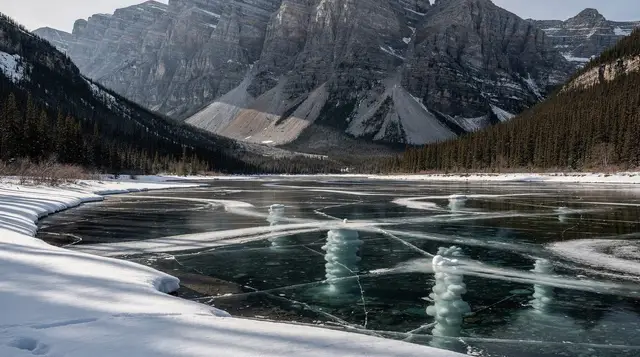
Moraine Lake sits at about 1,884 metres elevation, noticeably higher than Lake Louise’s 1,750 metres, and that difference shows up directly in how long the ice hangs on. Lake Louise typically opens up by mid-June; Moraine Lake usually takes longer, sometimes still carrying ice or snow patches into late June. A vivid turquoise photo from early or mid-May is not something anyone actually took at this lake — it simply isn’t open water yet at that point in the season.
Once it does open, the colour comes from the same source as every other glacially fed lake in the region: fine rock flour ground down by glaciers upstream, suspended in the water, scattering light in a way that produces that particular blue-green. The why lakes are turquoise guide explains the mechanism in more detail, and when lakes thaw has specific opening-date ranges by year if you’re trying to time a visit to open water.
Canoe rentals have operated seasonally at the dock in past years, letting visitors get out on the water rather than only viewing it from shore. Availability and pricing shift from season to season, so check current status directly before building a visit around it. Wading at the lake’s edge happens, but the water is glacial meltwater and stays cold even in the height of summer — actual swimming is rare for good reason.
Sunrise, and why people bother
Moraine Lake at sunrise has a specific appeal beyond the usual golden-hour photography logic: the earliest shuttles get visitors to the Rockpile before the crowds build, when the light hits the peaks across the valley without a lineup blocking the view. It’s a popular enough idea that “Moraine Lake sunrise” functions almost as its own category of tour and shuttle booking, distinct from a regular daytime visit.
The trade-off is an early alarm and a shuttle departure timed well before dawn, plus cold temperatures at elevation even in summer. For travellers who want that specific shot and don’t want to manage the shuttle reservation window themselves, the Moraine Lake Sunrise Experience is built around exactly that timing, with the tour operator handling the early departure and the reservation logistics. The Moraine Lake sunrise guide has more detail on what the early-morning visit actually involves, including how crowded even the “quiet” early slot has become.
Pairing Moraine Lake with the rest of the day
Because the shuttle system already gets you as far as the Lake Louise area, a lot of visitors combine Moraine Lake with Lake Louise itself in a single half-day outing, rather than treating either lake as a standalone trip. A longer version of the same idea folds in other lakes further along the same general corridor, which is where a multi-lake tour earns its keep: it removes the need to plan a separate shuttle reservation for each stop.
| Combination | What it adds | Typical length |
|---|---|---|
| Moraine Lake + Lake Louise | The two flagship lakes in one outing | Half a day |
| Moraine Lake + additional lakes further along the valley | Broader look at the region’s glacial lakes | Full day |
| Moraine Lake + a glacier stop | Adds a genuine ice-and-rock landscape to the lake views | Full day, early start |
The Louise Moraine Bow Emerald Peyto 4 Lake Tour covers the first two rows in a single booking, which is a reasonable way to see several of the region’s lakes without stitching together multiple shuttle reservations yourself. For a trip that stretches further, the Columbia Icefield: Moraine Lake Takakkaw Falls Adventure pairs Moraine Lake with a glacier stop and a waterfall for a considerably longer day out.
If a full multi-day loop through the Rockies is more what you’re after, the iconic lakes of Banff itinerary builds Moraine Lake in as one stop among several, with the shuttle-only access factored into the timing rather than treated as an afterthought.
What you actually need
A Parks Canada park pass is required regardless of how you arrive, since Moraine Lake sits inside Banff National Park, and shuttle or bus tickets don’t substitute for it. If you’re driving yourself as far as Lake Louise village or the ski resort area and then transferring to a shuttle for the final stretch, factor the pass into your day the same way you would for any other stop inside the park. Dress for elevation: even a warm day in the valley can be noticeably colder at the lake, and shoulder-season mornings regularly dip below freezing before the sun clears the peaks. A layer you can shed once the sun is fully up is more useful here than it sounds.
Cell coverage around the lake and along the access road is inconsistent at best, so it’s worth downloading or screenshotting your shuttle confirmation, return time, and pickup location before you leave Wi-Fi behind. Missing a scheduled return shuttle at a spot with no parking lot and no easy alternative is a genuinely bad way to end an otherwise good morning.
For travellers weighing whether to book a guided tour at all versus handling the shuttle reservations independently, the guided tour vs rental car guide walks through the trade-offs in more general terms. Moraine Lake is one of the clearest cases in the whole region where the road closure itself, not just convenience, pushes many visitors toward a booked option rather than a rental car.
Photographing the Rockpile without the crowd in the frame
The classic elevated shot works best in the first hour or two after the Rockpile opens for the day, before the platform fills in. Arriving on one of the earliest shuttles is the single biggest lever here, more than any camera setting. A polarizing filter helps cut glare off the water’s surface if you’re shooting with a dedicated camera; on a phone, tapping to expose for the water rather than the sky usually gets closer to the colour you’re actually seeing.
Because the Rockpile faces roughly toward the Ten Peaks, midday sun can flatten the scene, while early morning and the hour before sunset both put more definition into the ridgeline. None of that helps much if you’re standing three rows back from the rail, which is the more common problem in July and August — timing your shuttle earlier does more for the shot than any equipment choice.
Moraine Lake, questions answered
Can you drive to Moraine Lake?
No. Parks Canada closed the Moraine Lake Road to personal vehicles year-round starting in 2023, and there is no day-use parking lot at the lake anymore. The only ways in are the Parks Canada shuttle, Roam Transit, a commercial bus or tour, or bicycle.
How far is Moraine Lake from Lake Louise?
About 14 kilometres by road. Since the road is closed to private vehicles, that distance is covered by shuttle, bus or bike rather than by driving yourself, whichever route you’re coming from.
Do you need to book the Moraine Lake shuttle in advance?
Yes, and well in advance for summer visits. Parks Canada releases a block of shuttle reservations in spring, then opens a rolling window roughly 48 hours ahead for remaining seats, and both sell out quickly on clear summer days.
Is Moraine Lake worth it if the shuttle is sold out?
A commercial tour or Roam Transit’s connecting route is usually the fallback when Parks Canada shuttle seats are gone, since neither depends on the same reservation system. Showing up hoping to park is not an option at all.
How long does the Rockpile walk take at Moraine Lake?
The climb to the main viewpoint is short, generally 10 to 15 minutes each way over uneven rock stairs, though the platform gets crowded enough in midsummer that the wait to reach the top can take longer than the walk itself.
When does Moraine Lake thaw?
Moraine Lake sits higher and typically stays frozen longer than Lake Louise, often not opening up fully until late June. A turquoise photo from May doesn’t exist; expect ice, snow patches, or a partly frozen surface into early summer.
Can you swim or canoe at Moraine Lake?
Wading at the shoreline happens, but the water is glacially cold year-round. Canoe rentals have operated seasonally at the lake in past years; check current availability before planning around it, since operations can change from season to season.
Is Moraine Lake the same as the old Canadian twenty-dollar bill photo?
Yes. The Rockpile view of Moraine Lake and the Valley of the Ten Peaks appeared on the Canadian twenty-dollar bill series that circulated until the early 2000s, which is part of why the viewpoint draws so many visitors specifically to recreate it.