Moraine Lake sunrise: the Rockpile at dawn
How do you actually see the sunrise at Moraine Lake?
You take the first Parks Canada or Roam Transit shuttle of the morning, or you stay overnight at the campground, then walk up to the Rockpile viewpoint before first light. Personal vehicles cannot access Moraine Lake Road at any time of year, so arriving early by car is not an option.
Moraine Lake at sunrise is one of the most photographed views in the Canadian Rockies, and also one of the most misunderstood. The postcard shot from the Rockpile looks like something you stumble into after a quiet drive up a mountain road. In practice, getting there for first light is a logistics exercise before it is a photography exercise, because Moraine Lake has had no personal vehicle access, at any hour, since 2023.
This page is about what happens once you are standing on the Rockpile in the dark waiting for the light to change, not about how to book the ride up — that detail lives on the shuttle access guide. Here, the focus is the moment itself: how the light actually moves across the Valley of the Ten Peaks, how crowded the viewpoint gets, and where photographers waste their one shot at the shot.
Why the Rockpile, specifically
The classic Moraine Lake image is taken from a glacial moraine, a jumble of rock debris left behind by an ancient landslide, that rises maybe 20 metres above the lake’s outlet. Parks Canada built a short, steep trail and a viewing platform on top of it, which is why every version of this photo looks so similar: there is really only one vantage point that lines up the lake, the ten peaks of the Wenkchemna group, and the reflection all at once.
Side trails along the lakeshore give a lower, flatter angle that loses the depth of the Ten Peaks, so almost everyone with a camera ends up funnelled onto the same 30 metres of rock. That single-vantage-point reality is the whole reason crowding matters here in a way it does not at, say, Lake Louise, where the shoreline path spreads people out along a much longer frontage.
Getting up there before light
Because Moraine Lake Road is closed to private cars year-round, everyone arrives the same way: on the Parks Canada shuttle, on Roam Transit, on a commercial tour bus, or by bicycle up the road from the Trans-Canada Highway. None of that changes at 4:30 in the morning. The first shuttles of the day typically start running in the pre-dawn window during peak summer months specifically so photographers and hikers can be on site for sunrise, but that also means the first shuttle is not a secret — it is usually the single most competitive departure of the day.
If you are relying on it, plan to be at the pickup point well before the scheduled time, because a shuttle that is full does not wait for a second wave of arrivals. Every detail of how to actually book a seat, including the reservation windows and the rolling booking calendar, is covered on the dedicated shuttle access page rather than here.
Once you are dropped at the parking area, it is a five to ten minute walk uphill to the Rockpile viewpoint, over uneven rock in low light. A headlamp is worth carrying even in midsummer, since the trail is dark well before the sky starts to lighten, and loose rock underfoot is not somewhere you want to be testing a phone flashlight one-handed while also holding a camera bag.
What the light actually does
The lake sits at the bottom of a deep valley, walled in on three sides by the Wenkchemna Peaks, so sunrise here does not behave like sunrise on open ground. The peaks themselves catch the first direct light 20 to 40 minutes before anything reaches the valley floor, turning a soft pink-orange while the lake below is still in cool blue shadow.
That contrast — warm rock above, cold water below — is the actual photograph most people are chasing, more than a simple sunburst. The water itself typically does not pick up direct sunrise colour until the sun has cleared the ridgeline to the east, which on the ground works out to somewhere between 30 and 60 minutes after the official sunrise time for the Banff area, depending on the season and exactly which peak the sun has to clear.
That gap matters for planning your shot list. Arriving right at official sunrise and leaving once the sky brightens means missing the part of the show that actually reads as “sunrise” in a photo — the alpenglow on the peaks reflected in still water. Photographers who get this wrong tend to shoot for ten minutes, decide the light looks flat, and pack up just as the reflection starts working. Budget at least 45 to 60 minutes on the Rockpile if the goal is the full sequence from first alpenglow to full daylight, not just a single frame.
Wind is the other variable that decides whether any of this works. Moraine Lake is glacially fed and often dead calm in the very early morning before thermal winds pick up later in the day, which is exactly why sunrise produces the mirror-flat reflections the lake is known for. By mid-morning, breezes off the peaks frequently ripple the surface enough to break up the reflection entirely, which is one more reason the early shuttle is worth the effort beyond simply avoiding people.
Crowding at the Rockpile
Because there is essentially one vantage point, and because everyone arriving for sunrise gets funnelled onto it within the same 20-minute window, the Rockpile at dawn in July and August can feel closer to a queue than a quiet nature moment. Tripods get set up shoulder to shoulder along the railing, and courtesy around exposure times — nobody wants to be the person blocking a long exposure for thirty seconds — becomes a real, if unspoken, code of conduct. Getting there on one of the first shuttles, rather than a mid-morning one, is the single biggest lever for space at the rail; the crowd noticeably thins for anyone who arrives 20 to 30 minutes ahead of the main wave of buses.
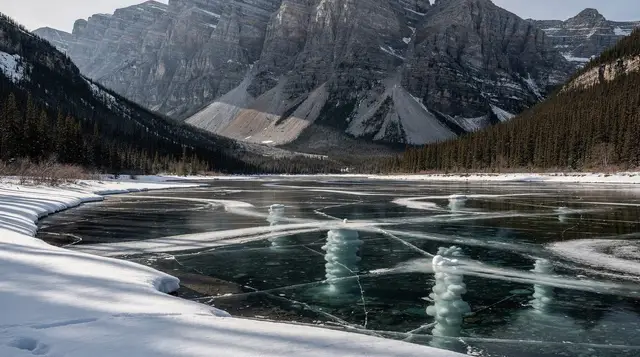
Shoulder season mornings — early June before full thaw, or September once school-holiday traffic drops off — thin the Rockpile considerably, though June carries the real risk that the lake is still partly frozen and not yet the turquoise colour everyone is picturing. For a broader read on which weeks trade colour for quiet, the lake crowding guide breaks down the pattern week by week across the main lakes, not just Moraine.
A mistake worth naming directly
It is worth saying plainly: there is no version of “drive up early to beat the crowds” that works at Moraine Lake anymore. The road closure is not seasonal, and it is not a matter of gates opening before a certain hour — personal vehicles are excluded from Moraine Lake Road for the entire year, every day, regardless of season or time. Older travel writing that describes parking at the lake before dawn is describing a version of Banff that no longer exists. If a source, a forum post, or an itinerary suggests driving yourself up for sunrise, it predates 2023 and should be ignored. The shuttle, the bus tour, or an overnight stay at the campground are the only three ways in, at any hour.
Camping as the alternative
Staying overnight at the Moraine Lake campground removes the shuttle-timing risk entirely, since you are already on site when the alarm goes off. It suits photographers who also want the blue hour before sunrise — the deep, even light in the 20 to 30 minutes before the sky starts to warm — since that window is difficult to catch reliably on a shuttle schedule built around a fixed departure time. The trade-off is availability: sites are limited, oversubscribed relative to demand, and reserved well ahead through the regular campground booking system rather than picked up on arrival. It is not a fallback plan for someone who decides the week before; it needs the same lead time as booking any other reservation for the lake.
What to bring, briefly
A headlamp for the dark walk up, a layer warmer than the daytime forecast suggests since valley floors hold overnight cold well past dawn, and a lens cloth, since condensation on a cold camera body meeting warm breath and morning humidity is a common and avoidable way to lose the first few minutes of light to a foggy front element.
A compact travel tripod works better than a full-size one given how tight the Rockpile gets; a wide-to-normal zoom, roughly 16 to 35mm equivalent, covers the classic composition, while a short telephoto is useful for isolating individual peaks once the sun clears the ridge. For anyone deciding between a phone and a dedicated camera for this specific shot, the trade-offs in low light and dynamic range are covered on the phone versus camera guide.
Sunrise timing by season
| Season | Approximate sunrise (local) | Lake condition | Notes |
|---|---|---|---|
| Late June | 5:30–5:45 a.m. | Often still partly icy | Colour can be patchy; check recent conditions first |
| July–August | 5:45–6:15 a.m. | Fully thawed, turquoise | Busiest shuttles and busiest Rockpile |
| September | 6:45–7:15 a.m. | Turquoise, may be running lower | Thinner crowds, cooler mornings |
| Early October | 7:15–7:45 a.m. | Colour fading toward season-end | Shuttle service winding down; verify it is still running |
Treat these as planning ranges rather than fixed clock times; actual sunrise shifts by several minutes week to week, and the moment the water itself lights up runs later still, for the reasons covered above.
Booking the ride, briefly
For travellers who would rather have the sunrise slot arranged for them than manage a shuttle reservation alone, a guided option removes that specific risk. A small-group sunrise tour that includes Moraine Lake, Lake Louise and Johnston Canyon builds the transport and timing into one itinerary.
Travellers based in Canmore rather than Banff have a similar option with a sunrise departure from Canmore covering Moraine Lake and Lake Louise, which saves the drive into Banff before the shuttle connection. For a trip built specifically around the Rockpile itself rather than a wider loop, the dedicated Moraine Lake sunrise experience keeps the morning focused on one viewpoint rather than a multi-stop route.
Beyond the Rockpile
Sunrise is not the only reason to be at Moraine Lake early. Photographers with a full morning free sometimes pair the viewpoint with the start of the Larch Valley and Sentinel Pass trail, which begins near the same shuttle drop-off and climbs above the lake for a wider valley view once the light has flattened out at lakeshore level. Paddling the lake itself, rather than photographing it from above, is a separate and slower way to experience the same water; details on canoe access and timing are on the canoeing guide.
For background on why the water reads as such a strong turquoise in the first place — it comes down to suspended rock flour ground fine by glacial movement, not a trick of filters or editing — see the colour explainer, and for the related question of exactly when the ice clears each year, the thaw timing guide tracks it lake by lake.
Anyone building a longer stop at the lake beyond sunrise itself will also find broader viewpoint and drive planning on the scenic viewpoints guide, and photographers assembling a wider Rockies shot list may want the Banff photography itinerary, which sequences several dawn and dusk locations across a multi-day visit rather than a single morning. The Moraine Lake destination page also covers the broader picture — elevation, the lake’s history on the old twenty-dollar bill, and how it compares to Lake Louise for a first-time visit — for context beyond the sunrise window specifically.
For travellers who want the sunrise paired with a slightly longer outing rather than a there-and-back shuttle trip, hikers who prefer to keep moving once the light show settles can look at the Larch Valley hike departing from Moraine Lake, timed for the shoulder-season golden larches rather than the pre-dawn light.
Realistic expectations
None of this guarantees the postcard shot. Cloud cover can flatten the alpenglow entirely, wind can arrive earlier than usual and break the reflection before the light peaks, and a full shuttle can mean standing three or four rows back from the rail rather than at it. Treat a Moraine Lake sunrise less like a scheduled event and more like a weather-dependent one you have bought yourself a ticket to attend — the logistics get you to the Rockpile at the right time, but the actual outcome still depends on a clear eastern sky and a calm morning, neither of which any shuttle booking can promise.
Moraine Lake sunrise: your questions answered
What time does the sun actually hit Moraine Lake?
The lake sits in a deep valley, so the Ten Peaks catch light 20 to 40 minutes before the water does, depending on season. Full sunrise colour on the lake surface typically arrives 30 to 60 minutes after the official sunrise time for Banff.
Is the Rockpile crowded at sunrise?
Yes, especially from mid-June through August. The viewpoint is small and every shuttle unloads a fresh group. Arriving on one of the first two shuttles and walking up immediately gives the best chance at open sightlines.
Can I drive to Moraine Lake early to beat the crowds?
No. Moraine Lake Road has been closed to personal vehicles year-round since 2023. There is no early-arrival driving strategy left; every visitor, regardless of timing, arrives by shuttle, bus, tour or bicycle.
Is camping at Moraine Lake a better way to catch sunrise?
It removes the shuttle-timing risk, since you are already there, but sites are limited and sell out fast in the reservation window. It suits photographers who also want blue hour and are not counting on a single shuttle departure to work out.
What months allow a turquoise-water sunrise photo?
Moraine Lake is usually ice-covered into mid or late June. A recognizably turquoise sunrise is realistic from late June through September, tapering as ice returns in autumn.
Do I need a tripod for sunrise photos at the Rockpile?
A tripod helps in the low light before the sun clears the peaks, but the Rockpile is crowded and narrow, so a compact travel tripod or a handheld approach with image stabilization is more practical than a full-size setup.
Is sunset an easier alternative to sunrise at Moraine Lake?
Sunset lights the peaks rather than the water, since the sun sets behind the Wenkchemna Peaks from the lake’s perspective, so the two are different photographs, not interchangeable substitutes.
Lake Louise & Moraine Lake tours on GetYourGuide
Verified deep-linked GetYourGuide tours. Book through these links and we earn a small commission at no cost to you.
GetYourGuide does not provide a product photo for this activity — the image shows the meeting point, photographed by us.