Lake viewpoints from the road: scenic drives without the long stop
Can you see Banff's famous lakes without stopping for long?
Yes. Bow Summit for Peyto Lake, several pull-offs on the Icefields Parkway, the Vermilion Lakes stretch of Highway 1A, and the approach road to Lake Minnewanka all give a lake view in 10 minutes or less from the car. A Parks Canada pass is required for every one of these stops, even a quick photo.
Stops built for a short window, not a long visit
Not every lake in the Rockies needs an hour. Some of the best-known views in Banff National Park are designed, deliberately or by geography, to be seen from a car window or a five-minute pull-off rather than a lakeshore picnic. This page is about that category of stop: the roadside viewpoints along the Icefields Parkway, the drive-by look at Vermilion Lakes from Highway 1A, and the glimpses of Lake Minnewanka from its access road.
None of this duplicates the dedicated lake guides — for what Peyto Lake actually looks like, how long the walk is, or when Vermilion Lakes turns pink at sunset, those pages cover it in detail. Here the focus is the logic of the stop itself: where you pull off, how much parking there really is, what the light does at different hours, and what it costs to be there at all.
The common thread across every stop on this page is the Parks Canada pass. It’s easy to assume a five-minute photo stop on a public highway doesn’t need one. It does. Banff, Jasper, Yoho, and Kootenay are all national parks, and the pass requirement applies to the road itself, not to how long you’re parked beside it. Wardens do patrol popular pull-offs, particularly on the Icefields Parkway in summer, and an unpaid stop is a real risk, not a technicality. Buying the pass online or at a park gate before you set out saves the awkward moment of a warden checking windshields at a scenic pull-off — it happens, and it’s not limited to the marquee stops.
The other thing every stop here shares is limited, non-reservable parking. Unlike a ticketed attraction, a roadside pull-off has no waitlist and no way to check ahead — you either find a spot when you arrive or you don’t, and the difference usually comes down to what hour you show up.
Bow Summit: the highest, and one of the shortest, stops
Bow Summit sits at 2,088 metres, the high point of the Icefields Parkway and the boundary between two watersheds. The parking lot here serves the viewpoint for Peyto Lake, and it’s a genuine case of maximum view for minimum effort: a paved path of 400 to 500 metres climbs gently to the main platform, roughly 10 to 15 minutes round trip for most people. A second, higher platform adds another 15 to 20 minutes on gravel if you want a wider panorama, and it’s the better spot for a camera rather than a phone, since it clears the treeline that partly blocks the lower platform’s view.
The catch is the lot itself. It’s modest for the volume of traffic this stretch of highway carries between late June and early September, and it fills between about 10 a.m. and 4 p.m. Arriving before 9 a.m. or after 5 p.m. is the practical way to get a space without circling; there’s no reserved or overflow system here, just a lot that’s either open or full. Overflow vehicles parked on the highway shoulder are common in peak season but not something to plan around — it’s a narrow, high-speed road, and Parks Canada does ticket and occasionally tow shoulder parking near the summit. For everything else about the lake — the colour, the shape, when it thaws — see the dedicated Peyto Lake guide.
The pull-offs along the Icefields Parkway
Bow Summit is the best-known stop, but it’s one of several along the 232-kilometre Icefields Parkway between Lake Louise and Jasper where the road itself is the viewpoint. Crowfoot Glacier has a small pull-off with a clear sightline to the hanging glacier across the valley, no walking required — it’s one of the few stops on this list where you genuinely don’t need to leave the car for a usable photo.
Bow Lake has a slightly larger lot with lake-level access a short walk from the car, more substantial than a pure drive-by but still fast if that’s all you want; the lake itself sits right at road level, which makes it one of the easier reflection shots on the whole parkway when the wind is calm.
Further north, Mistaya Canyon and Saskatchewan River Crossing offer their own short stops, though the drama there is a river gorge rather than a lake, and neither has the parking pressure of Bow Summit. If your goal is genuinely a string of quick lake and glacier views rather than a single long stop, our guide to the parkway’s stops in order lays out the full sequence with distances between each one, useful for deciding how many pull-offs you can realistically fit before dark.
Worth planning around: fuel and connectivity are both limited on this road. There’s no service station between Saskatchewan River Crossing (itself seasonal) and Jasper, a gap of well over 100 kilometres, and mobile coverage drops out for long stretches. A quick photo stop shouldn’t turn into an emergency, so fill the tank in Lake Louise or Banff before setting out, and download offline maps rather than relying on a live signal to find the next pull-off.
| Stop | Distance from car | Parking pressure |
|---|---|---|
| Crowfoot Glacier | None — roadside | Low |
| Bow Lake | Short walk to shore | Moderate, summer afternoons |
| Bow Summit (Peyto Lake) | 400–500 m paved path | High, 10 a.m.–4 p.m. in July–August |
| Mistaya Canyon | Short walk from lot | Moderate |
Vermilion Lakes from Highway 1A: the fastest stop of all
Of every viewpoint on this page, the Vermilion Lakes pull-offs on Highway 1A are the closest thing to a drive-through. The road runs directly alongside the three lakes at the western edge of Banff, with several small pull-offs that require no walking at all — some visitors don’t even leave the car. Mount Rundle’s reflection on still mornings or at sunset is the reason people stop, and the dedicated Vermilion Lakes guide covers timing that in more depth. Because it’s this close to town, it also works as a stop on foot or by bike for anyone based in Banff without a car, not just a drive-by for people already on the road.
Because it sits right at town’s edge, this stretch of the 1A stays open year-round, unlike the section further west between Johnston Canyon and Castle Junction, which closes to vehicles from March 1 to June 25 for wildlife movement. That’s a closure worth knowing if you’re planning a longer drive along the Bow Valley Parkway rather than just the Vermilion Lakes stretch, since the two are the same road but different seasonal rules apply depending on which section you’re on — the Vermilion Lakes end is open, the far end toward Castle Junction is not, for roughly four months each spring.
Parking pressure here is real but manageable compared with Bow Summit, mostly because there are several separate pull-offs spread over a couple of kilometres rather than one central lot. If the first is full, the next one usually isn’t, which makes this one of the more forgiving stops on this list for a spontaneous sunset drive.
Lake Minnewanka Scenic Drive: glimpses on the way in
The access road to Lake Minnewanka, Banff’s largest lake at 21 kilometres long, offers a different kind of roadside view: partial glimpses of the water and the cliffs above it on the drive in, before you reach the main day-use area at the western end where most visitors park properly for a longer stop — a boat cruise, a picnic, or a walk along the shore. A couple of short pull-offs along the drive give a wider look at the lake in its mountain setting without committing to the full parking area, useful if you’re passing through toward Two Jack Lake rather than stopping at Minnewanka itself.
These upper pull-offs rarely fill the way the main Minnewanka day-use lot does on summer weekends, since most traffic is headed straight for the boat launch and the developed shoreline rather than stopping partway up the drive. That makes this one of the more reliable quick stops on this page outside of peak holiday weekends. For the boat cruise and the full lakeside experience, the Lake Minnewanka guide has the detail.
Parking realities: what these viewpoints actually promise
The single biggest gap between expectation and reality at these stops is parking availability. None of the lots described here — Bow Summit, Crowfoot Glacier, the Vermilion Lakes pull-offs — scale with peak-season demand. In July and August, especially between mid-morning and late afternoon, a full lot is the normal condition, not an exception.
There’s no reservation system for any of these roadside stops, unlike Moraine Lake, where the road is closed to private vehicles entirely and a shuttle booking replaces the parking question altogether. See our Moraine Lake shuttle guide if that’s the stop you’re actually planning, since it works on a completely different system from everything else on this page.
The practical response is timing, not persistence. Early morning, generally before 9 a.m., and early evening after about 5 p.m. both carry lighter traffic and better light for photography, since midday sun tends to flatten the colour contrast that makes these lakes distinctive in photos. Shoulder season — May, June, and September into October — also helps, simply because there’s less overall traffic competing for the same handful of spaces, even though a few of these stops (Bow Summit especially) can still see a queue on a clear September weekend with good larch colour further up the valley.
If a lot looks full, circling for a few minutes sometimes opens a spot as other visitors move on, but plan for the possibility of continuing to the next stop instead. Nobody running this drive should assume a space will be waiting, and building slack into the schedule — 15 extra minutes per stop — costs little if the lot turns out to be open, and saves the day if it isn’t.
Doing this as a dedicated route
If the appeal is stringing several of these stops together into one outing rather than fitting them around a longer itinerary, our scenic drives itinerary section covers a full day built around exactly this kind of stop-and-go pacing. It pairs well with a guided option too: a small-group day tour along the Icefields Parkway from Canmore or Banff handles the driving and stopping logic for you, including knowing which lots tend to be viable at which hour.
For visitors basing themselves in Calgary rather than Banff, a full-day Icefields Parkway tour departing Calgary covers the same string of viewpoints as one outing, useful if a rental car and the parking uncertainty above aren’t appealing.
Evening light changes the calculation, too. An Icefields Parkway sunset tour that includes dinner times the drive for the golden-hour light these viewpoints are made for, without the parking-lot roulette of trying to hit Bow Summit at 6 p.m. on your own schedule. For a slower, small-group pace with more stops built in, a small-group Columbia Icefields Parkway day tour from Banff covers the viewpoint stretch alongside the glacier stop further north, which is a longer day than most of the drive-by stops on this page but folds them into the same route.
What these stops don’t replace
None of the pull-offs described here are a substitute for actually visiting a lake up close. Peyto Lake from Bow Summit is a lookout roughly 240 metres above the water with no maintained shoreline trail; the Vermilion Lakes drive-by is not the same as paddling on them, and the Lake Minnewanka access-road glimpses are not the same as the boat cruise or the shoreline walk at the main day-use area. If a five-minute stop leaves you wanting more, most of these lakes have a proper visitor guide with trail lengths, opening times, and seasonal notes, and it’s worth reading the specific one before you build a whole afternoon around what turns out to be a two-minute look from a pull-off.
That distinction matters most for anyone weighing a roadside stop against a longer visit on a tight schedule: a pull-off answers “can I see it,” not “can I properly experience it,” and conflating the two is the most common disappointment travellers report about these viewpoints.
Lake viewpoints from the road, answered
Do you need a park pass just to stop and take a photo?
Yes. A Parks Canada day pass or Discovery Pass is required anywhere inside Banff, Jasper, Yoho, or Kootenay national parks, including a five-minute roadside stop on the Icefields Parkway or the 1A. There’s no exemption for a quick look, and wardens do check pull-offs.
Is parking guaranteed at these viewpoints in summer?
No. Lots at Bow Summit, Crowfoot Glacier, and the Vermilion Lakes pull-offs are small relative to July and August traffic, and they fill between roughly 10 a.m. and 4 p.m. Some visitors circle or wait a few minutes; a few keep driving and try the next stop. Never plan around a guaranteed spot.
Which lake viewpoint takes the least time?
The Vermilion Lakes pull-offs on Highway 1A, right at the edge of Banff, take as little as five minutes from the car and require no walking. Bow Summit for Peyto Lake is the next shortest, at 10 to 15 minutes round trip on a paved path.
Can you see Lake Minnewanka from the road without parking at the lake itself?
Partially. The Lake Minnewanka Scenic Drive gives glimpses of the lake and the surrounding cliffs from the car, with a few short pull-offs before the main day-use area at the lake’s western end, where most people park properly for a longer stop.
Are these roadside stops the same as visiting the lakes themselves?
No, and this page isn’t a substitute for the dedicated lake guides. A pull-off gives a wide view of the landscape and the lake in context; walking to the actual shoreline, as at Lake Louise or Moraine Lake, is a different kind of stop with its own crowds, timing, and parking rules.
What time of day is best for photographing these views?
Morning, generally before 10 a.m., for both light and parking. Midday sun flattens the colour contrast in glacial lakes, and by late morning in July and August most small pull-offs are already at capacity.
Is the Bow Valley Parkway open year-round for the Vermilion Lakes view?
The Vermilion Lakes are reached from Highway 1A right at Banff’s western edge and stay open year-round. The seasonal closure on the 1A applies farther west, on the section between Johnston Canyon and Castle Junction, closed to vehicles from March 1 to June 25 for wildlife.
Gondolas & mountain viewpoints on GetYourGuide
Verified deep-linked GetYourGuide tours. Book through these links and we earn a small commission at no cost to you.
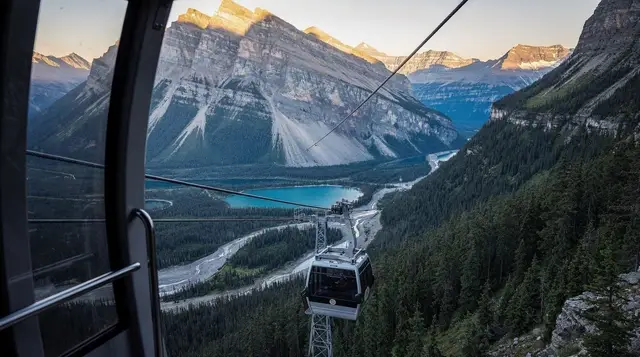
GetYourGuide does not provide a product photo for this activity — the image shows the meeting point, photographed by us.