Vermilion Lakes: Banff's closest sunset lake
Are the Vermilion Lakes worth visiting, and when is the best time?
Yes. The Vermilion Lakes are a five-minute drive or a 20-minute walk from Banff Avenue, with no fee beyond the standard Parks Canada pass. The best light on Mount Rundle falls in the hour before sunset, year-round, while waterfowl and elk are easiest to spot at dawn and dusk in spring and fall.
Three lakes, five minutes from Banff Avenue
The Vermilion Lakes are the easiest named lake in Banff National Park to reach from the townsite, and that is the entire case for visiting them. There is no glacier at the far end, no château on the shore, and nothing that would put them on the cover of a brochure next to Moraine Lake or Lake Louise. What they offer instead is a chain of three shallow lakes — First, Second and Third Vermilion Lake — strung along the Bow Valley floor just west of Banff, reachable by a short drive, a bike ride or a walk that does not require a car at all.
The draw is the view back toward town: Mount Rundle and Sulphur Mountain rising across the water, with reflections that show up clearly on a calm evening. Add reliable birdlife, occasional elk in the surrounding meadows, and a road that stays open and plowed all winter, and the Vermilion Lakes end up doing double duty: a genuine sunset spot and a fallback stop for travellers who do not have a full day free for the bigger lakes.
Do not confuse this with the lakes on the Icefields Parkway — Peyto Lake and Bow Lake sit more than an hour north and take the better part of a day. The Vermilion Lakes are a local stop, not an excursion, and treating them as one is the main way visitors misjudge how much time to set aside.
Getting there: no shuttle, no pass, no booking
Vermilion Lakes Drive branches off Mount Norquay Road at the western edge of the Banff townsite, just past the railway underpass. From the corner of Banff Avenue and Mount Norquay Road, the first lake appears within two to three kilometres — about a five-minute drive, a ten-minute cycle, or a 20 to 25-minute walk along the road shoulder and adjoining path.
There is no shuttle system here and none needed, because Vermilion Lakes Drive has always allowed private vehicles, with no seasonal closure and no booking window — the opposite of the situation at Moraine Lake, where the access road has been closed to private cars year-round since 2023. Parking is at a series of unpaved pull-offs along the road, free of charge, with space for perhaps half a dozen vehicles at each one. On a busy July evening the first pull-off can fill, so plan to continue to the next one rather than treating a single stop as the only option.
Cyclists have an alternative worth knowing about: the paved Legacy Trail connects into the Vermilion Lakes area from town, and the paved and gravel paths along the lakeshore make for an easy, mostly flat ride. Walkers coming from downtown can follow the Fenland Trail, a short forested path that links the Banff townsite to the near end of First Vermilion Lake without ever touching the road.
The only requirement to be here at all is the same one that applies across the park: a valid Parks Canada park pass, checked at the highway gates rather than at the lake itself. There is no separate fee, no kiosk and no ticket booth at Vermilion Lakes Drive.
The three lakes, in order
| Lake | Distance from Banff Ave | Character |
|---|---|---|
| First Vermilion Lake | ~2 km | Closest, marshy edges, best birdlife |
| Second Vermilion Lake | ~3.5 km | Widest reflection of Mount Rundle |
| Third Vermilion Lake | ~4.5 km | Quietest, furthest pull-offs, fewer visitors |
The three lakes are really one shallow, marshy system that the Bow River carved and then partly abandoned, which is why the shoreline looks more like wetland than the deep glacial basins at Lake Louise or Moraine Lake. That shallow, reedy shoreline is exactly what makes the birdlife reliable — deep, cold, glacially fed lakes rarely support this much waterfowl.
Most visitors stop at First or Second Vermilion Lake and turn back; the road continues past Third Vermilion Lake before rejoining the highway system, and traffic thins noticeably past the second pull-off. If you are short on time, First and Second Vermilion Lake give you the classic Mount Rundle reflection shot; if you want quiet, keep driving to Third.
Sunset: what you are actually looking at
The photograph everyone comes for is Mount Rundle’s long ridge, and often Sulphur Mountain beside it, mirrored in still water with the sky colouring behind them. That reflection depends on wind more than season — a flat calm evening in January can outperform a breezy one in July. Sunset itself shifts through the year, from roughly 9:30 p.m. in late June to around 5 p.m. in December, so check the actual time for your date rather than assuming a fixed “golden hour.”
Arrive 20 to 30 minutes before sunset to find a pull-off, walk down to the water’s edge, and let the ripples settle. The clearest reflections tend to form in the 10 to 15 minutes after direct sun has left the water but before the sky has fully darkened — the same narrow window that makes phone-versus-camera technique worth thinking about in advance, since a phone’s automatic exposure will often blow out the sky trying to brighten the darker foreground.
Compare that against the region’s other sunset draws: Two Jack Lake offers a similar reflection with a shorter drive from the Lake Minnewanka Scenic Drive turnoff, while a dedicated Moraine Lake sunrise trip is a different undertaking entirely — a pre-dawn shuttle booking rather than an after-dinner walk. If your evening is already committed elsewhere, the Vermilion Lakes are the rare Banff view you can still fit in on short notice.
For travellers who would rather not manage the timing themselves, a guided evening outing bundles the driving, the wildlife spotting and the sunset stop into one booking: Banff’s twilight wildlife and alpine lakes private sunset safari covers this stretch of the valley with a guide watching for animals along the way, which matters more here than it sounds — elk and waterfowl are easiest to spot from a slow-moving vehicle with someone who already knows where to look.
Wildlife and birding
The marshy shallows are the reason the Vermilion Lakes show up on Banff birding lists more often than the glacial lakes do. Expect mallards, common mergansers and Canada geese through the warmer months, with trumpeter swans occasionally overwintering on the open-water sections. Muskrats work the reed beds along the shore, visible if you stand still for a few minutes rather than walking the full length of the pull-offs.
Elk graze the open meadows beside the road in spring and fall, and the elk rut in September and October makes bulls noticeably more aggressive — stay in or near your vehicle if a bull is close to the road, and never approach for a photo. Ospreys and, less often, bald eagles fish the shallows in summer. As with any wildlife in the park, the standard distances apply: at least 30 metres from elk, deer and other large mammals, and 100 metres from any bear or wolf, though bears are an occasional rather than routine sighting at these particular lakes.
This same stretch of valley connects to the Bow Valley Parkway, where the eastern section closes to vehicles from March 1 to June 25 to protect calving and denning animals — a useful comparison for why quiet, low-traffic roads like Vermilion Lakes Drive matter for wildlife in this valley generally. For a broader sense of what to expect and when, the wildlife viewing map and timing guide and the park’s bear safety and etiquette guidance are worth reading before any evening drive in the Bow Valley.
Winter and the shoulder seasons
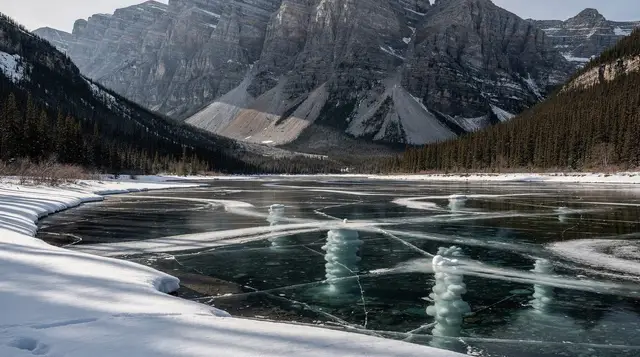
Vermilion Lakes Drive is plowed and open all year, which sets it apart from other winter-sensitive routes in the park such as the Icefields Parkway or the seasonal road closure at Yoho’s Takakkaw Falls. The lakes freeze over by mid-winter, usually by December, and the ice generally holds through March. A frozen, snow-dusted lake with Mount Rundle behind it photographs differently from the open-water reflection, but it is no less a reason to come — and on a still, cold evening, with the light dropping fast and temperatures well below freezing, this can be one of the more striking short outings in Banff, without the driving distance of Lake Minnewanka or the crowds of Lake Louise’s winter ice rink.
May and June, before the lakes fully thaw at the higher elevations elsewhere in the park, and September and October, after the summer crowds thin, are the shoulder-season sweet spots here — good light, active wildlife, and pull-offs that are rarely full. For travellers planning a winter-heavy trip more broadly, a winter canyons and lakes style of outing pairs well with an evening stop here; a version built around it, Banff’s winter canyons and lakes tour adventure, groups several cold-season stops into one day so the light-limited winter afternoon is used efficiently.
How this fits into a Banff itinerary
Because the Vermilion Lakes need no reservation and no half-day commitment, they work as an add-on rather than a headline stop. A common pattern: spend the day on foot around town — Banff Avenue, the Cave and Basin, the Bow Falls — then drive or cycle out to the Vermilion Lakes as the light drops, before dinner back in town. It also slots naturally into a first-timer’s one-day Banff itinerary as the closing stop, since nothing about it requires an early start or a long return drive.
If you are choosing where to base yourself, proximity to spots like this is one real argument for staying in the Banff townsite over Canmore: a Canmore base adds roughly 20 minutes each way to an outing that, from Banff Avenue, takes five. For visitors trying to see several of the region’s photogenic lakes in a single organized day rather than piecing together their own stops, a wider day tour such as Banff’s four iconic lakes tour covers a broader loop, though the Vermilion Lakes themselves are close enough that most visitors are better off seeing them independently, on their own schedule, rather than as one stop among several on a bus route.
What to bring
Layers matter more than gear here. Evenings by the water run several degrees cooler than downtown Banff, especially once the sun drops behind Sulphur Mountain, so a windproof layer is worth carrying even on a warm July day. Binoculars help for the birdlife and for spotting elk in the meadows before you are close enough to disturb them. A tripod steadies a long-exposure shot of the reflection, though a stable rock or the hood of your car works in a pinch. Bear spray is standard practice anywhere in the park’s backcountry-adjacent areas, and this valley is no exception, even though sightings here tend to be birds and elk rather than bears.
Getting the timing right
The single most common mistake is arriving at or after the sunset moment itself, rather than 20 to 30 minutes before it, and finding the light already flat by the time a parking spot and a spot at the water’s edge are sorted out. The second most common mistake, as noted above, is confusing this stop with the lakes on the Icefields Parkway and setting aside a day for what is really a 45-minute outing. Treat the Vermilion Lakes as what they are: the shortest, least complicated lake view in Banff, and one of the few in the park you can decide to visit on the same evening you think of it.
Vermilion Lakes: frequently asked questions
Do I need a separate ticket or pass for the Vermilion Lakes?
No. Vermilion Lakes Drive is a public road inside Banff National Park, so the only requirement is the Parks Canada park pass you already need to be in the park at all. There is no shuttle, no timed entry and no extra fee, unlike the road to Moraine Lake.
How far are the Vermilion Lakes from downtown Banff?
About 2 to 3 kilometres from Banff Avenue to the first lake, roughly a 5-minute drive, a 10-minute cycle or a 20 to 25-minute walk. It is the most accessible named lake in the park from the townsite itself.
What is the best time of day to visit for photos?
The hour before sunset, when low light hits Mount Rundle and Sulphur Mountain across the water. On calm evenings the reflection is clearest; wind ripples the surface and flattens the mirror effect, so a still evening matters more than a specific season.
Are the Vermilion Lakes the same as the lakes on the Icefields Parkway?
No. Peyto Lake and Bow Lake sit along the Icefields Parkway, a half-day or full-day drive north of Banff. The Vermilion Lakes are a short local stop at the edge of the townsite, not part of that route and not a day trip in themselves.
Can you swim or paddle at the Vermilion Lakes?
Canoeing and kayaking are possible with your own or a rented boat, though there is no on-site rental outfitter at the lakes themselves. Swimming is not set up or supervised here; most visitors come for the view, the walk and the wildlife rather than time in the water.
What wildlife can you see at the Vermilion Lakes?
Waterfowl year-round, including mallards, mergansers, Canada geese and, at times, trumpeter swans, plus muskrats along the shoreline. Elk graze the surrounding meadows in spring and fall, and ospreys and bald eagles fish the shallows in summer. As with all wildlife in the park, stay at least 30 metres back.
Do the Vermilion Lakes freeze in winter?
Yes. The lakes ice over by mid-winter, and the road stays open and plowed, making this a reliable cold-weather stop for sunset views even when Lake Louise and Moraine Lake are harder to reach or photograph.
Is there parking at the Vermilion Lakes?
Yes, at several unpaved pull-offs along Vermilion Lakes Drive, free and without reservation. Space is limited at each pull-off, so on a busy summer evening you may drive past one or two before finding a spot.
Lake Louise & Moraine Lake tours on GetYourGuide
Verified deep-linked GetYourGuide tours. Book through these links and we earn a small commission at no cost to you.
GetYourGuide does not provide a product photo for this activity — the image shows the meeting point, photographed by us.