Where and when to see wildlife around Banff
Where and when is the best time to see wildlife near Banff?
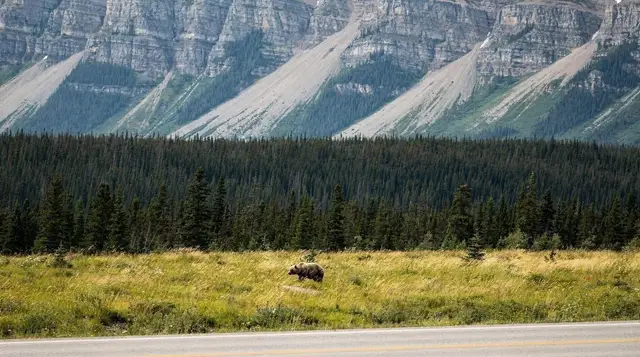
Elk, and occasionally wolves, are most visible along the Bow Valley Parkway at dawn and dusk from late June to October. Deer and waterfowl gather at Vermilion Lakes year-round, bighorn sheep and mountain goats graze the open slopes near Mount Norquay and Sunshine Village most mornings, and black bears feed on the greening avalanche slopes of the Icefields Parkway in May and June. None of it is guaranteed on any given day.
Four places, four different animals, and no guarantees
Banff National Park is not a zoo, and nobody, guide or otherwise, can promise a specific animal on a specific day. What is true is that certain places and certain hours produce sightings far more often than others, and knowing the pattern is most of the battle.
This page maps four of the most consistent wildlife-viewing settings around Banff: the Bow Valley Parkway for elk and, sometimes, wolves; Vermilion Lakes for deer and birds; the open slopes near Mount Norquay and Sunshine Village for bighorn sheep and mountain goats; and the Icefields Parkway for black bears on spring avalanche slopes.
Two things this page does not cover, because each has its own page: what to actually do if you encounter a bear or a large animal up close (see our bear safety and roadside etiquette guide), and the elk rut of September and October, when bull elk become genuinely dangerous even inside the Banff townsite (covered separately in our elk rut warning). The seasonal vehicle closure on the eastern Bow Valley Parkway, which runs from March 1 to June 25 to protect calving and denning wildlife, also has its own page; what matters here is simply that the parkway behaves differently before and after that date, and the notes below account for it.
Bow Valley Parkway: elk, and sometimes wolves, at dawn and dusk
The Bow Valley Parkway (Highway 1A) runs roughly parallel to the Trans-Canada Highway between Banff and Lake Louise, and it is slower, quieter, and far more productive for wildlife than the main highway. Its grassy verges and open meadows are prime elk grazing ground, and elk are visible along the parkway most evenings from late June through October, typically in the last two hours of daylight.
Wolves are a different proposition. The Bow Valley wolf pack ranges widely, and while sightings do happen on the parkway, they are infrequent and usually brief: a shape crossing the road at dawn, gone into the trees within seconds. Treat any wolf sighting as a bonus, not a plan. The parkway’s eastern section is closed to vehicles annually from March 1 to June 25 for wildlife protection; outside that window, driving it slowly at first light or in the final hour before sunset is the single best wildlife-viewing habit in the park. Our dedicated Bow Valley Parkway wildlife route guide breaks down which pullouts tend to produce sightings.
Whatever you see, stay in the vehicle unless you are at a proper pullout, and never approach on foot. Parks Canada asks drivers to stay at least 100 metres from bears and wolves and at least 30 metres from other large mammals, including elk, which can and do charge.
Vermilion Lakes: deer and birds, no hiking required
Vermilion Lakes sits just west of the Banff townsite, reachable by a short drive or an easy bike ride, and it rewards a slow pace rather than a long one. Mule deer browse the willow thickets along the shoreline through most of the year, and the lakes themselves draw a steady rotation of birdlife: ospreys and bald eagles hunting from snags, great blue herons stalking the shallows, and rafts of ducks and other waterfowl on the open water.
It is the easiest wildlife stop on this list, since it asks nothing of you beyond parking and looking, and the classic reflection of Mount Rundle at sunset (detailed in our Vermilion Lakes sunset guide) means most visitors are stopping for the view anyway and the animals are a bonus.
Early morning and the hour around sunset are again the most productive windows here, largely because the light is better for photography and the animals are more active in cooler air, not because anything is scheduled.
Mount Norquay and Sunshine Village: bighorn sheep and mountain goats on open slopes
Bighorn sheep and mountain goats live above the treeline year-round; neither is a true hibernator, so both remain visible in every season, though snow can push them to lower, more sheltered slopes in the depths of winter. The open, rocky terrain near Mount Norquay, just above the Banff townsite, and around Sunshine Village further along the Trans-Canada, gives both species room to graze in plain sight rather than hiding in forest cover.
Bighorn sheep in particular are often visible directly from the Mount Norquay access road, sometimes standing on the pavement itself, which is exactly the situation where stopping in a traffic lane causes a collision. Pull fully onto a shoulder before you slow down to look. Mountain goats tend to keep to steeper, more distant terrain and are more often spotted with binoculars than with the naked eye. Early morning and late afternoon, when both species move onto exposed rock and grass to feed, are the most consistent windows at either location.
Icefields Parkway in spring: black bears on the greening slopes
The Icefields Parkway earns a separate mention because its wildlife pattern is tied to a very specific window: April through June, before the parkway’s spectacular glacier scenery pulls most visitor attention northward. Black bears emerging from winter dens in April seek out the first available food, and that food is the new grass, dandelions, and other early greenery that grows on south-facing avalanche slopes well before the forest floor has properly thawed. Those slopes line long stretches of the parkway, which is why the road becomes one of the most consistent black bear corridors in the Canadian Rockies for roughly ten weeks each spring.
By mid-to-late summer, as berries ripen at higher elevations, bears typically move away from the roadside and sightings along the parkway drop off. Grizzly bears also use these slopes, though less predictably than black bears, and the safety guidance is identical for both: 100 metres of distance, no exceptions, and no exiting the vehicle to get closer. Our Icefields Parkway guide covers the drive itself, including the long stretch with no fuel between Saskatchewan River Crossing and Jasper.
A season-by-season likelihood table
Nothing here is a guarantee; treat this as a rough, honestly hedged sense of which months favour which sighting, based on typical animal behaviour rather than any tracked count.
| Location | Spring (Apr–Jun) | Summer (Jul–Aug) | Autumn (Sep–Oct) | Winter (Nov–Mar) |
|---|---|---|---|---|
| Bow Valley Parkway — elk | Moderate | High | High (rut, extra caution) | Low to moderate |
| Bow Valley Parkway — wolves | Low | Low | Low | Low |
| Vermilion Lakes — deer, birds | Moderate | Moderate | Moderate | Low to moderate |
| Norquay / Sunshine — sheep, goats | Moderate | Moderate | Moderate | Low to moderate |
| Icefields Parkway — black bears | High | Low to moderate | Low | Very low (denning) |
Best time of day, at a glance
| Window | Roughly | What it favours |
|---|---|---|
| First light | 5:30–8 a.m. in summer, later in winter | Elk, bears, and sheep at their most active |
| Midday | 11 a.m.–4 p.m. | Least productive; animals resting in shade or cover |
| Pre-dusk | Last 2 hours of daylight | Elk on the Bow Valley Parkway, deer at Vermilion Lakes |
Doing it yourself versus a guided evening tour
A self-driven pass along the Bow Valley Parkway at dawn or dusk costs nothing beyond your park pass and fuel, and it works well if you already have a rental car and are comfortable driving unfamiliar roads in low light. What it does not give you is a spotting scope, a second set of eyes that is not also watching the road, or a driver who already knows which pullouts have produced sightings in the past few days.
That trade-off is exactly what a guided evening wildlife tour is built around. Operators typically run a three-hour evening wildlife viewing and sunset drive timed to the dusk window described above, with a driver-guide who is scanning the roadsides while you are free to simply look.
Several tours run out of Canmore rather than Banff; if that is your base, an evening wildlife viewing tour departing from Canmore covers similar ground along the Bow Valley without requiring you to drive back into Banff first. In winter, when daylight hours are short and roads can be icy, a winter wildlife and sightseeing minibus tour hands the driving to someone used to the conditions.
None of these tours can promise a specific animal, and a guide will generally say so upfront rather than oversell the odds; what they reliably add is more attentive looking during the hours that already favour sightings, not a shortcut around the underlying unpredictability.
Groups, calving season, and the fine print
A few practical notes that apply across all four locations. Parks Canada sometimes requires hikers on certain trails, including popular ones near Larch Valley, to travel in groups of four or more during periods of high grizzly activity; that rule is explained in full in our group-of-four hiking guide and does not apply to roadside viewing from a vehicle. Spring, from roughly April through June, is calving and denning season for elk and bears alike, and animals with young are markedly more defensive; this is the same period when the Bow Valley Parkway’s eastern section is closed to vehicles, precisely to reduce disturbance during it.
If you are combining wildlife viewing with a hike rather than a drive, our broader hiking in Banff itinerary and our bear spray and hiking safety guide cover what changes once you are on foot rather than behind a windshield; carrying bear spray and knowing how to use it matters far more on a trail than on a roadside pullout. Wildlife along Lake Minnewanka, including on the scenic boat cruise, follows a similar pattern to Vermilion Lakes: mostly birds and the occasional deer or bear seen from a safe distance on the water rather than up close on shore.
Feeding, baiting, or approaching any animal from a vehicle is prohibited under the Canada National Parks Act, and stopping in a live traffic lane to photograph wildlife (often called wildlife jamming) is both dangerous and finable. If you want to see what a slow morning on the parkway can turn up without the pressure of self-driving it, browsing the wider wildlife and nature listings for the area is a reasonable next stop before you commit to a route.
Wildlife viewing near Banff: frequently asked questions
What is the best time of day to see wildlife near Banff?
Dawn, roughly 5:30 to 8 a.m. in summer, and the two hours before dusk are consistently the most productive windows. Large mammals feed in the cool, low-light hours and rest through the heat of the afternoon, so a midday drive along any of these routes usually turns up far less.
Where can I see elk near Banff?
The Bow Valley Parkway between Banff and Lake Louise is the most reliable stretch, along with the open meadows around the Banff townsite itself, including the golf course and the roadsides near the Fairmont Banff Springs. Elk graze the parkway’s grassy verges most evenings from late spring through autumn.
Can I see wolves on the Bow Valley Parkway?
Occasionally, but wolves are far less predictable than elk and move through large territories. Sightings tend to cluster around dawn in the eastern section of the parkway when it is open to vehicles, and most visitors who see one describe it as a brief, distant crossing rather than a lingering encounter.
When do black bears come out in spring near Banff?
Black bears typically emerge from dens in April and are most visible through May and June, when they graze on new grass and dandelions along roadside avalanche slopes on routes like the Icefields Parkway. As berries ripen in mid to late summer, they tend to move higher and further from roads.
Do I need a permit or guide to go wildlife viewing near Banff?
No permit is required beyond the standard Parks Canada pass for entering the park. A guided evening wildlife tour is not necessary but does add a spotting scope, a driver who is not also watching the road, and local knowledge of where animals were seen the previous few days.
Is it safe to stop on the road to photograph animals near Banff?
Only if you pull fully onto a shoulder or into a designated pullout. Stopping in a traffic lane to photograph an animal, sometimes called wildlife jamming, causes collisions and pressures animals to move; Parks Canada enforces fines for it. Never feed or approach wildlife from a vehicle.
What animals can I see at Vermilion Lakes?
Vermilion Lakes is best for mule deer along the shoreline willows, and for birds: ospreys, bald eagles, great blue herons, and a range of waterfowl on the water itself. It is a low-effort stop reachable by a short drive or bike ride from downtown Banff, with no hiking required.
When are bighorn sheep and mountain goats visible near Banff?
They are visible on the open slopes near Mount Norquay and Sunshine Village in most months, since both animals stay above treeline year-round and are not true hibernators. Sightings are most consistent in the early morning and again in late afternoon, when they move onto exposed rock and grass to feed.
Wildlife & nature tours on GetYourGuide
Verified deep-linked GetYourGuide tours. Book through these links and we earn a small commission at no cost to you.
GetYourGuide does not provide a product photo for this activity — the image shows the meeting point, photographed by us.