Bear safety and etiquette around Banff
How far away should I stay from a bear near Banff?
Parks Canada requires a minimum of 100 metres from bears and wolves, compared with 30 metres for elk, sheep, and other large mammals. Carry bear spray you can reach in under two seconds, make noise on the trail, and travel in a group rather than alone, especially in dense brush or near running water.
Living with grizzlies and black bears
Banff National Park is bear country, not in some abstract brochure sense but literally: grizzly bears and black bears use the same valley bottoms, forest edges, and alpine meadows that hikers walk through every summer and fall. Encounters are uncommon relative to the roughly four million people who visit the park each year, but they are not rare enough to ignore, and the consequences of getting one wrong are serious.
This page covers the practical rules Parks Canada asks visitors to follow: how much distance to keep, how bear spray works and how you actually get a canister here, what to do if a bear is close, and the group-size rule that applies on specific trails during the alpine larch season in late September. It does not cover the elk rut, which is a separate hazard with its own distance rule, and it does not attempt to list every wildlife-viewing spot in the park; for that, see the wildlife viewing map and times.
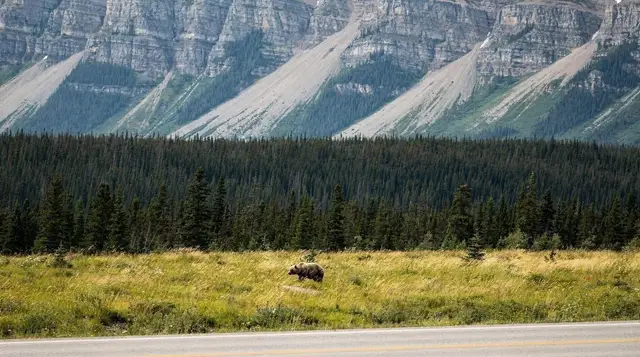
Both species live throughout Banff National Park and the connected parks along the Icefields Parkway, and both show up close to town more often than first-time visitors expect. A bear on the Bow Valley Parkway shoulder or feeding on buffaloberries within sight of a trailhead near Banff or Canmore is a normal summer sighting, not an anomaly.
The 100 metre rule
Parks Canada’s minimum safe distance from bears and wolves is 100 metres. That is more than double the 30 metre minimum that applies to elk, sheep, and other large mammals, and it reflects how quickly a bear can close ground, an adult grizzly can outrun a person over short distances, and how unpredictable a surprised or food-focused bear can be. A hundred metres is roughly the length of a football field: hard to eyeball accurately, which is exactly why the rule matters. If you are close enough to see a bear clearly with the naked eye and it appears to be reacting to your presence, ears up, head raised, stopped feeding, you are almost certainly closer than 100 metres and need to increase distance immediately, calmly, without running.
This distance rule is not a suggestion with a fine for non-compliance attached to casual sightseeing; it exists because most negative bear encounters in the park involve a person who got closer than they realized, often for a photograph. No photo is worth closing that gap. A longer lens, not closer feet, is the only acceptable way to get a tighter shot.
Bear spray: rules, limits, and how to actually get some
Bear spray is a pressurized capsaicin deterrent, and the rule that surprises visitors most is that it cannot travel with you by air, not in a carry-on and not in checked luggage, because it is classified as a hazardous pressurized irritant. That means if you are flying into Calgary and driving the roughly 128 kilometres to Banff, you arrive with none, and you need to buy or rent a canister locally: outdoor and sporting goods shops in Banff and Canmore carry it, some hotel front desks rent it for the length of a stay, and a few gas stations along the highway stock it as well. Plan to pick one up before your first hike, not after.
Owning spray is only half the safety measure; the other half is carrying it somewhere you can reach in under two seconds, on a hip belt holster or chest rig, not zipped inside a backpack where it does nothing during an actual encounter. Practise removing the safety clip and aiming before you need it for real; fumbling with an unfamiliar canister at close range costs the seconds that matter.
It is worth being honest about what bear spray does and does not do. Used correctly, at close range, with the wind roughly at your back rather than blowing the spray away from the bear, it measurably reduces the chance of injury in a close encounter. It is not a guaranteed deterrent, and it is not a substitute for the distance and noise practices below. Treat it as a last-resort tool for an encounter that has already gone wrong, not as licence to approach more closely because you are carrying it.
a guided nature walk that covers bear-country safety hands-on is a reasonable way to build real comfort with distances, noise discipline, and spray handling before a solo or self-guided hike, particularly for visitors with no previous bear-country experience.
Noise, groups, and avoiding a surprise encounter
Most negative bear encounters start with surprise, a bear that did not hear or smell a person coming and reacted defensively at close range. The single most effective thing a hiker can do is make deliberate, ongoing noise: talk normally with hiking companions, call out periodically on blind corners, and increase volume near dense brush, thick berry patches, and running water, all places where a bear’s ability to hear or smell you approaching is reduced. Parks Canada no longer particularly recommends bear bells as a primary strategy; their thin, continuous jingle is easy for a bear to tune out, and it does not carry the same information as a human voice.
Group size matters on its own. A group of four or more adults hiking and talking together is measurably safer than a solo hiker or a pair, both because of the additional noise and visual presence and because bears are documented to be far less likely to approach or act defensively toward larger groups. This is not just general advice; it is codified into an actual access rule on specific trails during specific weeks, covered in the next section.
a private bear-country hiking tour with a guide handling route choice, group spacing, and spray readiness removes most of the judgment calls for visitors uneasy about applying these rules unsupervised on a longer trail.
The group-of-four rule at Larch Valley and Sunshine Meadows
For roughly the last two weeks of September, when the alpine larches turn gold, Larch Valley above Moraine Lake and the Sunshine Meadows area above Sunshine Village see two things converge: the heaviest foot traffic of the entire hiking calendar, and an unusually high concentration of grizzly bears feeding on ripening buffaloberries at exactly the elevations those trails cross.
Parks Canada’s response, in place for several recent seasons, is a group-access restriction rather than a closure: hikers must travel in tight groups of four or more people, checked at the trailhead, to proceed past a certain point. Solo hikers and pairs are turned back or asked to wait and join another group.
This restriction is trail- and date-specific, not a blanket rule for the whole park, and it is enforced by wardens on the ground rather than by an honour system, so arriving without three companions at the trailhead during peak larch season means waiting to team up with strangers or picking a different hike that day. Trip reports and exact dates change year to year with bear activity, so check current Parks Canada notices before planning a solo trip to either trail in late September specifically. For a fuller look at planning around this window, see the dedicated explanation of the group-of-four rule.
Outside that narrow window and those two specific areas, the rule does not apply, and normal bear-safety practice, distance, noise, spray, applies instead.
What to do at close range
Encountering a bear at genuinely close range, inside that 100 metre buffer, without warning, calls for a different response than simply increasing distance from far away. Stop moving. Do not run: running can trigger a chase response in an animal that can outrun a person over short distances, and climbing a tree is not reliable protection against either species. Speak in a low, calm, steady voice so the bear can identify you as human rather than prey or a threat. Group together if you are with others, making yourselves appear larger. Back away slowly on a diagonal rather than directly retreating or advancing, watching the bear without staring it down as a direct challenge.
If the bear is aware of you but not approaching, continue backing away until you have restored real distance, then leave the area rather than continuing on the same trail. If a bear does approach or charge, the correct response differs by species and by whether the behaviour reads as defensive or predatory, grizzlies and black bears are not treated identically in that specific scenario, and it is worth reviewing current Parks Canada guidance or asking a local outfitter directly rather than relying on general internet advice for that narrow situation. Deploy bear spray only once the bear is within its effective range, generally described as a matter of a few metres rather than a distant precaution, aiming slightly downward into the face.
Grizzly bears versus black bears
Telling the two apart matters less for how you behave, distance and noise apply to both, than for reading a situation correctly. Grizzlies are larger, carry a distinct shoulder hump, and have a dished, concave facial profile; they favour open alpine terrain, avalanche paths, and berry slopes like those above Larch Valley. Black bears are smaller, lack the hump, have a straighter facial profile, and are more commonly seen in forest and along valley-bottom trails closer to Banff and Canmore townsite. Colour is not a reliable way to tell them apart, black bears are sometimes brown or cinnamon-coloured, and grizzlies range from blond to nearly black.
| Feature | Grizzly bear | Black bear |
|---|---|---|
| Shoulder | Prominent hump | No hump |
| Facial profile | Dished, concave | Straighter |
| Typical terrain | Open alpine, avalanche paths | Forest, valley bottom |
| Colour | Blond to dark brown | Black to cinnamon (variable) |
| Minimum distance | 100 metres | 100 metres |
Where bear safety intersects with a typical Banff trip
Bear safety is not confined to full-day backcountry routes. Short, popular trails close to town, sections of the Bow Valley Parkway corridor, and even the edges of Canmore see bear activity, particularly around dawn, dusk, and late summer berry season. The same rules apply regardless of how short or well-travelled a trail looks on a map: carry spray you can reach, hike with company, and make noise through blind sections and brush.
For visitors who would rather see bears at a safe, managed distance than manage the risk of an unplanned trail encounter, a Canadian Rockies wildlife and bear country tour out of Calgary or a grizzly bear refuge tour with lunch both offer close, controlled viewing without the exposure of an unguided hike through active habitat.
Bear safety and etiquette: frequently asked questions
How close is too close to a bear in Banff National Park?
Parks Canada’s minimum is 100 metres for bears and wolves. That is roughly the length of a Canadian football field, not a distance you can judge by eye in seconds, so if a bear is visibly reacting to you, you are already too close and need to back away.
Can I bring bear spray on the plane to Banff?
No. Bear spray is a pressurized irritant and is banned from both carry-on and checked baggage on flights to Calgary or anywhere else. Buy or rent a canister once you arrive in Banff or Canmore, from an outdoor shop, a gas station, or some hotel front desks, and hand it over or dispose of it properly before you fly home.
Does bear spray actually work?
Used correctly and at close range, bear spray reduces the odds of injury during a close encounter, but it is not a guarantee. Wind, distance, and hesitation all cut its effectiveness, and it does nothing sitting zipped inside a backpack. Practise the safety catch before you need it, and carry it on a hip belt or chest holster, not buried in a pack.
Why do some trails require groups of four or more people?
Parks Canada sometimes restricts specific trails to tight groups of four or more hikers travelling together, most commonly at Larch Valley and Sunshine Meadows during the alpine larch season in the last two weeks of September, when grizzly density on those slopes is unusually high. The restriction is enforced at the trailhead and checked by wardens; solo hikers and pairs are turned back.
What should I do if I see a bear on the trail?
Stop, stay calm, and assess the distance. If the bear has not noticed you, back away quietly the way you came. If it has noticed you, speak in a low, calm voice, group together, and back away slowly without running or turning your back. Never approach for a photo, and never get between a sow and her cubs.
What is the difference between grizzly bears and black bears around Banff?
Grizzlies are larger, have a shoulder hump and a dished facial profile, and tend to favour open alpine slopes and avalanche paths. Black bears are smaller, lack the hump, and are more often seen in forest and along the valley bottom. The safety response, distance, noise, and spray, is the same for both, though the advice on playing dead versus fighting back differs and is worth reviewing with a local outfitter before a backcountry trip.
Is it safe to hike alone near Banff?
Parks Canada actively discourages solo hiking in bear country, and on the group-restricted sections of Larch Valley and Sunshine Meadows in late September it is not permitted at all. Outside those restricted zones, solo hiking is legal but carries meaningfully more risk; a group of four or more travelling together and making noise is the safest practical unit.
Do bear bells actually keep bears away?
Bear bells produce a thin, continuous jingle that many bears seem to tune out, and Parks Canada no longer recommends them as a primary noise strategy. Talking, clapping, and calling out periodically, especially near blind corners, running water, and dense brush where a bear might not hear you coming, works better than a bell alone.
Wildlife & nature tours on GetYourGuide
Verified deep-linked GetYourGuide tours. Book through these links and we earn a small commission at no cost to you.
GetYourGuide does not provide a product photo for this activity — the image shows the meeting point, photographed by us.