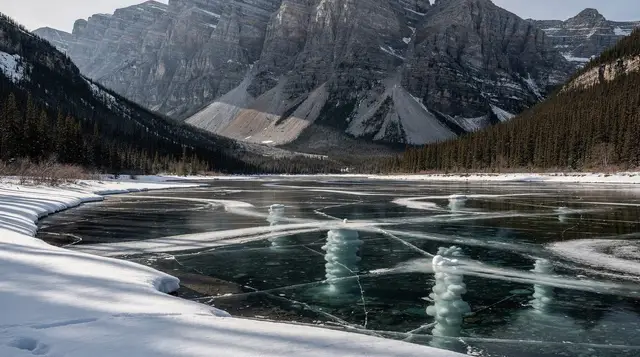
A short, steep climb into a gold-needled meadow
Larch Valley and Sentinel Pass climb out of the Moraine Lake basin into a subalpine bowl framed by the Valley of the Ten Peaks, and for about two weeks every September it fills with alpine larches turning the same deep gold you see on postcards. Outside that window, it’s still a solid mountain hike with wide views; inside it, it becomes one of the most crowded and most tightly managed trails in the park, largely because grizzlies feed on the same slopes at the same time of year.
This page covers the trail itself, the larch season, and the safety rules that come with it. Getting to the trailhead is a separate question, already answered on the Moraine Lake page and in the Moraine Lake shuttle access guide: there’s no public parking at Moraine Lake, and the shuttle, bus, tour, or bike-in options that apply to the lake apply equally to this hike, since they share the same trailhead.
The trail, section by section
| Segment | One-way distance | Elevation gain | What’s there |
|---|---|---|---|
| Moraine Lake (1,884 m) to Larch Valley | About 2.4 km | About 535 m | Switchbacks through spruce and fir forest, then the tree line opens onto meadow |
| Larch Valley to the Minnestimma Lakes | About 0.5 km | Minimal | A cluster of small tarns in the open larch meadow, the most photographed stretch |
| Minnestimma Lakes to Sentinel Pass | About 2.9 km | About 190 m | Steep, exposed scree switchbacks with no shade |
| Total to Sentinel Pass | About 5.8 km | About 725 m | Return trip is roughly 11.6 km |
The first stretch is the steady work: a set of switchbacks through dense forest that gains most of Larch Valley’s elevation before you see any real view. That effort buys the payoff. The trail breaks out of the trees into open subalpine meadow, and the Valley of the Ten Peaks unfolds behind you, with Moraine Lake itself turning into a small turquoise wedge far below. If you’re only doing the shorter version of this hike, this is where to stop: Larch Valley and the Minnestimma Lakes give you the meadow, the larches, and the peak panorama without the harder climb above.
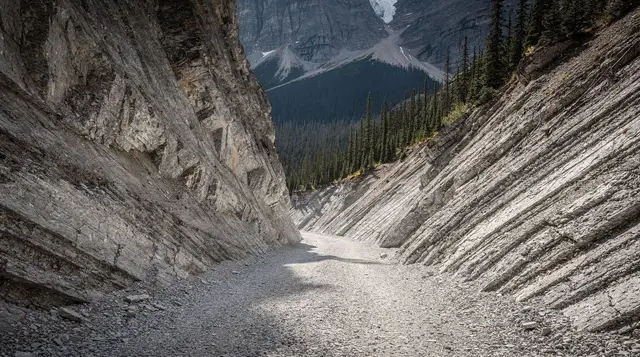
Continuing to Sentinel Pass means leaving the meadow for loose, sun-exposed scree with no tree cover and no water source, gaining the last 190 metres in tighter switchbacks. At 2,611 metres, the pass sits among the higher maintained trail points in Banff National Park, with a view that opens north into Paradise Valley on the far side, toward Lake Louise. It’s a legitimately harder push than the valley section below it, and worth reserving for a day when you have the time, the legs, and the weather for it; storms build fast at this elevation and there’s no shelter on the pass.
Plan on 3 to 5 hours return if you’re stopping at Larch Valley, and 5 to 7 hours return for the full trip to Sentinel Pass, including time to actually stand in the meadow rather than just walk through it. There’s no tea house on this route, unlike the Lake Agnes Tea House hike or the Plain of Six Glaciers hike out of Lake Louise, so carry all the food and water you need for the round trip.
The golden larch window: roughly the last two weeks of September
Alpine larches are unusual among conifers in that they’re deciduous: their needles turn from green to a deep gold before dropping for winter, and Larch Valley is one of the most reliable places in the Rockies to see it happen at scale. That colour change is concentrated into a short window, generally the last two weeks of September, though the exact dates shift a few days year to year depending on frost timing and wind.
Arrive a week too early and the meadow is still green; a week too late and the needles are already down, leaving bare branches and a carpet of gold on the ground rather than gold in the trees. There is no larch season in July, August, or October in any meaningful sense on this trail; a photo of gold needles taken outside late September on this hike doesn’t exist, whatever a caption claims.
That narrow window is exactly why this stretch of trail turns into the busiest hiking corridor in the park for those two weeks. Trailhead lots (which, again, don’t exist here for private cars) and shuttle seats fill up specifically for larch season, and the trail itself can feel more like a queue than a wilderness hike on a clear Saturday.
If crowding matters more to you than catching peak gold, hiking in mid-July through early September gets you the same meadow, the same peaks, and a fraction of the people, just without the larches in colour. For a broader look at when this valley is quieter versus overwhelmed, the larch season crowds guide and the general lake and trail crowds guide both go into more detail on timing a visit around the worst of it.
Why hiking in groups of four or more is often mandatory here
Buffaloberries ripen on the same subalpine slopes that Larch Valley crosses, at almost exactly the same time as larch season, and they’re a major late-summer food source for grizzlies fattening up before winter. That overlap means this specific stretch of trail, particularly the approach toward Sentinel Pass, sees some of the most concentrated bear activity of any maintained trail in Banff National Park during September.
Parks Canada responds with restricted group access: during active bear activity, hikers are required to travel in tight groups of four or more people, sometimes with staff checking group sizes at the Moraine Lake trailhead, and the trail can be closed outright if a bear is feeding close to it. This isn’t a general park-wide rule; it’s specific to this valley and this season, and it’s enforced, not a suggestion. Solo hikers and pairs should expect to link up with other parties at the trailhead rather than set out alone. The group-of-four rule guide covers how the restriction is actually communicated and enforced trailhead to trailhead.
Carry bear spray and know how to use it before you’re on the trail, not while a bear is in front of you. It travels in neither carry-on nor checked airline luggage, so plan to buy or rent it in Banff or Canmore. Beyond the spray itself, the basics still apply: make noise on blind corners and near running water, keep any food sealed, and never approach or feed wildlife, whatever the shot looks like. The bear safety guide covers the flying restriction and the practical side of carrying spray in more depth.
Larch Valley versus other Banff hikes
Larch Valley sits toward the harder end of the day hikes accessible from Banff and Lake Louise. For comparison:
| Hike | Return distance | Elevation gain | Difficulty |
|---|---|---|---|
| Tunnel Mountain | 4.3 km | 300 m | Easy |
| Lake Agnes Tea House | 3.4 km | 400 m | Moderate |
| Plain of Six Glaciers | 5.5 km | Moderate | Moderate |
| Larch Valley | About 4.8 km | About 535 m | Moderate to challenging |
| Larch Valley to Sentinel Pass | About 11.6 km | About 725 m | Challenging |
If you’re building out a hiking day and want other options at different fitness levels, the best day hikes by difficulty guide sorts the full list, and the general hiking in Banff itinerary strings several trails together across a multi-day trip. For a trip built specifically around the larch window, the larch season itinerary plans around the timing and crowding issues covered above.
Guided hikes and small-group tours
Because of the shuttle-only access, the crowding during larch season, and the group-size requirement near Sentinel Pass, a fair number of visitors book a guided hike rather than coordinate the shuttle, the timing, and a hiking group on their own. A guided small-group hike with lunch and transfers included, such as the Larch Valley guided hike with lunch and transfers, folds the trailhead access, a naturalist guide, and the group-size requirement into one booking, which matters more here than on most trails given how often solo hikers are turned back at the trailhead during active bear periods.
Other options cover the same ground with different logistics: a smaller-format outing built around the Moraine Lake Larch Valley hike, or a combined day that pairs this trail with other Canmore and Banff highlights through the Banff and Canmore Larch Valley and Moraine Lake tour. None of these substitute for your own fitness or footwear, but they do remove the access and group-size problem, which for many visitors is the harder part of this particular hike.
Getting there and what to check first
This hike shares its trailhead with Moraine Lake, so the access rules are identical: no personal vehicle can reach the lake, and the only ways in are the Parks Canada shuttle, Roam Transit, a commercial bus or tour, or bicycle. Reserve shuttle seats well in advance for a September morning, since larch season combines with the general Moraine Lake demand to sell out the earliest, most useful departure times first.
A Parks Canada pass is required for the park regardless of how you arrive at the trailhead. Before setting out, check current trail status for bear closures or the group-size requirement, current weather (afternoon storms build quickly at this elevation), and whether the section toward Sentinel Pass is open at all that day, since it’s the section most often restricted.
Pack layers regardless of season: the trailhead sits at nearly 1,900 metres and Sentinel Pass at over 2,600, and temperatures swing well below whatever Banff itself is reporting that morning. Sturdy footwear matters more here than on the shorter, well-maintained trails closer to town, given the scree above the Minnestimma Lakes. For a fuller packing list across seasons, see the what to pack guide, and check the best time to visit tool if you’re still deciding when to build a Rockies trip around this hike.
Larch Valley and Sentinel Pass: frequently asked questions
When is the best time to hike Larch Valley for the golden larches?
Roughly the last two weeks of September, though the exact window shifts a few days each year depending on frost and wind. Once the needles turn, they drop within a week or two, so there’s no way to bank on a specific date months in advance.
Do you really need a group of four to hike to Sentinel Pass?
During periods of active grizzly activity, yes, and Parks Canada enforces it with trail signage and, at times, staff checking group sizes at the Moraine Lake trailhead. It’s tied to bears feeding on buffaloberries in the same subalpine terrain the trail passes through, not a general rule for every hike in the park.
How do you get to the Larch Valley trailhead?
The trail starts at Moraine Lake, which has had no public parking since 2023. You reach it by Parks Canada shuttle, Roam Transit, a commercial bus or tour, or bicycle; see the Moraine Lake access guide for the current reservation details, since that logistics layer changes from season to season.
How long is the hike to Larch Valley and Sentinel Pass?
Larch Valley itself is about 4.8 kilometres return from Moraine Lake with roughly 535 metres of elevation gain. Continuing to Sentinel Pass extends the round trip to about 11.6 kilometres with about 725 metres of total gain.
Can you see Larch Valley without hiking all the way to Sentinel Pass?
Yes. The larch meadows and the Minnestimma Lakes are reached well before the pass, and most of the classic gold-larch photographs are taken in that lower section, not at the pass itself. Sentinel Pass adds a steeper, more exposed final push mainly for the wider view over Paradise Valley.
Is the Larch Valley trail difficult?
It’s a genuine mountain hike, not a stroll. Expect sustained switchbacks, roughly 535 to 725 metres of elevation gain depending on how far you go, loose scree near Sentinel Pass, and no shade for the upper half. Fitness, proper footwear, and an early start matter more here than on most trails around Banff.
What should I bring for bear safety on this hike?
Bear spray, carried where you can reach it in seconds, is close to non-negotiable in this valley during buffaloberry season. It can’t travel in carry-on or checked luggage, so buy or rent it locally. Hiking in a group, making noise on blind corners, and checking trail status before you go all matter as much as the spray itself.
Is there anywhere to buy food or water on the trail?
No. There’s no tea house on this route, unlike the Lake Agnes or Plain of Six Glaciers trails from Lake Louise. Carry all the water and food you’ll need for the full round trip, since the only services are back at the Moraine Lake day-use area.