Bear safety on Banff trails: distances, spray, and hiking smart
What do I actually need to know about bears before hiking near Banff?
Keep at least 100 metres from bears and wolves and 30 metres from other wildlife, hike in a group and make noise on blind corners, and carry bear spray you know how to use. Bear spray cannot travel by air in carry-on or checked baggage, so plan to buy or rent it once you arrive rather than bring it from home.
Hiking in bear country is not optional caution
Every trail out of Banff, from the easy loop at Johnston Canyon to the alpine approach to Larch Valley, runs through habitat that grizzly bears, black bears, and wolves actually use. This isn’t a remote-possibility warning tacked on for liability reasons.
Bears are seen along popular trails most summers, trail closures for bear activity happen through the season, and the animals aren’t confined to some far corner of the backcountry. Banff National Park and neighbouring Kananaskis manage this reality with clear rules: minimum distances, group-size requirements on some trails, and a hard line on what you’re allowed to fly with. None of it is complicated, but skipping it is how avoidable encounters happen.
This guide covers the core practices that apply to most day hikes near Banff: how far to stay from wildlife, how group size and trail noise reduce risk, and the specific, often-missed problem of getting bear spray to Banff when you can’t put it in a plane. It doesn’t go deep on the seasonal group-of-four requirement around Larch Valley, which has its own timing and enforcement details covered in a dedicated guide, and it only touches briefly on elk aggression in town during the rut, which is a separate situation covered in our general wildlife safety guide.
The distances that actually matter
Parks Canada sets two clear minimums, and they’re worth committing to memory rather than looking up mid-trail:
| Wildlife | Minimum distance | Examples |
|---|---|---|
| Bears and wolves | 100 metres | Grizzly bear, black bear, wolf |
| Other wildlife | 30 metres | Elk, bighorn sheep, mule deer, moose |
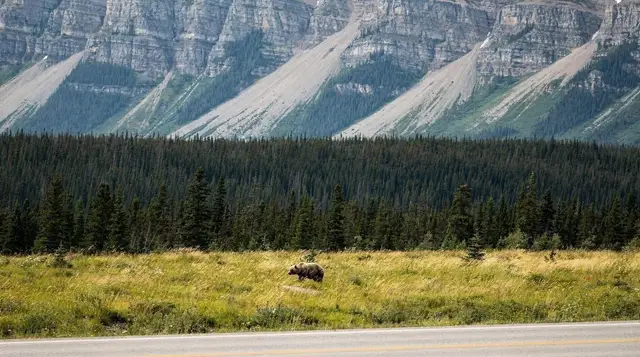
These are minimums for animals behaving normally, not targets to approach toward. If a bear lifts its head to look at you, if an elk stops grazing and turns to face you, or if any animal changes what it was doing because it noticed you, you’re already closer than you should be, whatever the tape measure says. The right response is to back away calmly, not to hold your ground for a better photo. A 100-metre gap is roughly the length of a Canadian football field, which is a useful way to judge it in the field, since most people badly underestimate distance to a large animal standing still.
The gap exists for two reasons that go beyond your own safety: bears and wolves that become comfortable around people are far more likely to be relocated or destroyed once they start approaching hikers or associating people with food, and a habituated animal is a bigger risk to the next hiker who has less warning. Every time someone gets close for a photo, they’re spending down the margin for everyone who comes after them on that trail.
Hiking in a group, and making noise on purpose
Group size and trail noise do more for your safety than almost anything else you can carry. Solo hikers are statistically more likely to be involved in a serious bear encounter than people hiking in groups of three or more, and the effect isn’t subtle. A group is louder without trying, moves with more combined awareness, and looks and sounds like something a bear is far more likely to avoid than approach.
Noise matters because most bear encounters happen when a bear is surprised at close range, not because it was stalking a hiker. Bears generally want distance from people and will move off well before you’re close if they hear you coming. The problem is trail sections where sound doesn’t carry: blind corners, dense brush, and the sound of rushing water near creeks and waterfalls, all common on trails like Johnston Canyon or the approach to Grassi Lakes near Canmore. On those stretches, talking normally isn’t always enough. Call out periodically, clap, or say “hey bear” in a firm, carrying voice, especially where you can’t see what’s around the next bend.
A bear bell is a poor substitute for this. Its jingle is quiet, monotonous, and easy for an animal to filter out as background noise the same way you’d stop noticing a ceiling fan, and it barely carries over water or wind at all. Treat a bell as a minor extra if you like the sound, never as your actual noise strategy, and never as a reason to skip calling out on blind corners.
Bear spray: the thing you cannot fly with
This is the detail that catches the most visitors off guard, and it’s worth being direct about it: bear spray cannot travel by air, in a carry-on or in checked luggage, on any airline flying into Calgary or anywhere else. It’s a pressurized canister of capsaicin, the same category of restriction that blocks other aerosols and pressurized items, and airlines and airport security treat it as a prohibited item with no exceptions for hikers. If you pack a can from home and it turns up at security, it gets confiscated, not held for pickup, and you won’t get it back.
The same restriction runs in both directions. You can’t take a can you bought in Banff back home on the plane either, and it can’t cross the Canada-US border by vehicle without permits that aren’t realistic for a short trip. Plan for this from the start rather than discovering it at the airport: buy or rent bear spray once you’re in the Banff or Canmore area, and plan to use it up, hand it off, or return it before you leave rather than trying to bring it anywhere by air.
Where to get it once you’re here
Outdoor gear shops on Banff Avenue and in downtown Canmore stock bear spray as a matter of course, typically in the range of CAD 40 to 70 for a full canister with a holster. If you’d rather not buy a full can for a short trip, several outfitters and gear-rental counters in both towns rent spray by the day for well under that, and some hotels and hostels can point you toward the nearest option. A few of the guided hikes below supply and carry spray for the whole group as part of the tour, which is the simplest option if you’d rather not manage a canister at all.
However you get it, buy it before your hike, not on the way to one, and check that the canister isn’t past its expiry date printed on the label; older stock loses pressure and range over time.
Spray is a tool, not a substitute for distance
Bear spray is meant for a bear that’s already close and showing aggression, not as a reason to approach wildlife for a better look, and not as a replacement for keeping your distance in the first place. It works by dispersing an irritant cloud that a bear has to pass through to reach you, which is why range and wind direction matter more than most people expect.
Practice removing the safety clip before you need to, since fumbling with it at close range costs seconds you don’t have, and carry it clipped to a belt or chest strap where you can reach it in under two seconds, not buried in a pack. If you do need to use it, aim slightly downward into the bear’s approaching path rather than straight at its face, and keep spraying as it closes the distance.
Hiking with kids, and what actually changes
None of the core advice changes for families: same 100-metre and 30-metre minimums, same emphasis on noise and group size, same rule about spray and flying. What does change is practical: kids are naturally quieter and more easily distracted on a trail, so an adult calling out on blind corners becomes more important, not less, and a family group of three or four already meets the size threshold that matters most on trails without special restrictions. If you’re weighing which trails suit a family day out, our guide to easy, accessible trails around Banff is a better starting point than trying to bear-proof a route that’s a stretch for young legs regardless of wildlife.
What to do if you actually see a bear
Most sightings on popular trails near Banff are bears at a distance, moving away or feeding, uninterested in you. The right response there is simple: stop, watch briefly if it’s safe to do so, and back away the way you came without approaching for a photo. Do not run; running can trigger a chase response in animals that would otherwise ignore you.
If a bear has noticed you and doesn’t move off, speak in a low, calm, firm voice, make yourself look as large as possible by raising your arms or a jacket, and continue backing away at an angle rather than turning and running. Have your spray out and the clip removed well before this point, not still in your pack. A charging bear is not always an attack; bears sometimes bluff-charge and veer off, and running or sudden movement is more likely to escalate that than standing your ground and using spray if the bear keeps closing.
Report any close encounter to Parks Canada staff at the nearest visitor centre or via the park’s wildlife reporting line, even if nothing happened beyond a sighting at distance. That reporting is part of how trail closures and warnings get updated for the next hiker.
Two situations that deserve their own pages
Two related rules come up constantly in bear-safety questions and deserve more space than a paragraph here:
The group-of-four requirement. During peak grizzly activity, usually a window in late summer and early autumn, Parks Canada restricts travel on parts of the Lake Louise area, most notably the corridor toward Larch Valley, to parties of four or more hikers travelling together within sight of each other. It’s actively enforced with trailhead checks, and the specifics of when it applies and how it’s checked are covered in our dedicated guide to the group-of-four rule.
Elk in town during the rut. This guide is about trail safety with bears in mind, but wildlife risk in the Banff area isn’t limited to trails. During the elk rut, roughly September through October, bull elk become aggressive and territorial enough to be a genuine hazard on Banff’s streets and pathways, not just in the backcountry. That situation has its own timing and behaviour cues, covered in our general wildlife safety guide.
Guided hikes if you’d rather not carry the spray yourself
Hiking with a guide who’s trained in wildlife protocol, carries spray, and knows current trail and sighting conditions removes a lot of the guesswork above, which is worth considering for a first Rockies trip or a family group. A private four-hour bear-country hiking tour covers the core safety practices hands-on rather than from a page, with a guide reading the trail as you go.
For something shorter and less committing, a guided nature walk built around bear-country safety tips works well as an introduction before you head out on your own trails. And for a broader wildlife-focused day that ranges beyond a single trailhead, a wildlife-focused guided hike across Banff and Kananaskis pairs the safety briefing with a better shot at an actual, safe sighting than solo hiking usually offers.
None of these tours replace knowing the basics yourself, and none of them are required to hike safely near Banff. But for anyone unsure about reading trail signs, judging distance, or just wanting an experienced set of eyes on a first outing, they take a genuine variable out of the day.
Planning the rest of your hike
Bear safety is one layer of planning a day on the trails, not the whole plan. Our guide to Banff’s day hikes by difficulty is a good starting point for choosing a route that matches your group’s fitness and time, and the hiking in Banff itinerary strings several trails together if you’ve got more than a day to spend on foot.
If wildlife viewing itself is more the point than the hike, our wildlife viewing map and timing guide covers where and when sightings are most likely along routes like the Bow Valley Parkway. And if you’re weighing a guided hike against going it alone more generally, our comparison of guided hikes versus a rental car and our note on what a guide actually adds cover the trade-offs beyond wildlife safety alone.
Whatever trail you pick, from the short loop at Grotto Canyon to a longer day toward Sentinel Pass, the same short list holds: know your distances, hike with others, make noise where you can’t see ahead, and have spray you bought or rented after you landed, not one you tried to bring from home.
Bear safety in Banff: the questions people actually ask
Can I bring bear spray on the plane to Banff?
No. Bear spray is classed as a restricted or prohibited item by every major airline and by CATSA and the TSA, whether it’s packed in a carry-on or checked bag. There is no workaround for flying with it, and a canister found in luggage will be confiscated at security, not just flagged. Buy or rent it once you land near Banff or Calgary instead.
Can I bring a can of bear spray home with me after my trip, or take it across the border?
No. The same rules that stop it going into the aircraft on the way in stop it going out, and bear spray also can’t cross the Canada-US border in a vehicle without the right permits, which isn’t practical for a visitor. Most people either use up what they bought, hand off an unused canister to someone still in the area, or leave it with an outfitter or rental counter that accepts returns.
How far should I stay from bears, and does the distance change for other animals?
Parks Canada’s standard is at least 100 metres from bears and wolves, and at least 30 metres from other wildlife such as elk, bighorn sheep, and deer. Those are minimums for animals that aren’t showing signs of stress; if an animal changes its behaviour because of you, at any distance, you’re already too close and should back away.
Does a bear bell actually work?
A bear bell’s jingle is quiet and constant, easy for a bear to tune out the way we tune out background noise, and it doesn’t carry well over rushing water or wind. Talking, calling out, or clapping periodically, especially near blind corners and dense brush, projects sound in a way a bell doesn’t, and hiking in a group beats both. Treat a bell as a minor supplement, never as your main precaution.
Do I need to hike in a group of four because of bears?
In some areas and seasons, yes, Parks Canada restricts travel to groups of four or more hikers travelling tightly together, most often around Lake Louise’s Larch Valley corridor during peak grizzly activity. That restriction has its own rules for timing and enforcement, which we cover in a dedicated guide, since it’s more specific than general trail safety.
What should I actually do if I encounter a bear on the trail?
Stop, stay calm, and identify whether the bear has noticed you. If it hasn’t, back away slowly and leave the area. If it has and doesn’t move off, speak in a low, firm voice, make yourself look larger, and continue backing away without running or turning your back. Have your bear spray in hand with the safety clip removed, not still in your pack, well before you’re close enough to need it.
Where can I buy or rent bear spray near Banff?
Outdoor gear shops on Banff Avenue and in Canmore sell bear spray, typically for roughly CAD 40 to 70 a canister, and several rental counters and outfitters offer it by the day for a fraction of that if you’d rather not carry a full can home with you or dispose of it. Some guided hiking tours also supply and carry spray for the group, which removes the decision entirely.
Wildlife & nature tours on GetYourGuide
Verified deep-linked GetYourGuide tours. Book through these links and we earn a small commission at no cost to you.
GetYourGuide does not provide a product photo for this activity — the image shows the meeting point, photographed by us.