The most commercial stop on the parkway, and why that’s not an insult
Every guide to the Icefields Parkway eventually gets to the same fact: the Columbia Icefield is the one stop on the whole 232-kilometre drive that feels like a tourist attraction rather than a pullout. There’s a large visitor centre, a fleet of specialized vehicles, timed tickets, and a gift shop.
For a road that otherwise runs past glaciers, waterfalls, and turquoise lakes with nothing but a parking lot and an interpretive sign, the Icefield Centre is a different kind of place. That’s not a criticism. Getting a bus with tires taller than a person onto an active glacier is a genuinely unusual piece of engineering, and for a lot of visitors it’s the single most memorable stop of the entire Banff-to-Jasper drive.
The thing worth getting straight before you book anything is that “the Columbia Icefield” and “the Glacier Skywalk” are two different products sold from the same building, and it’s easy to conflate them when you’re skimming a website at speed. This page covers the icefield tour: the Ice Explorer buses that drive out onto the Athabasca Glacier itself. The Skywalk, a glass-floored viewing platform over the Sunwapta Valley a short shuttle ride down the road, is covered on its own page and isn’t detailed here. They’re often sold as a combined ticket, and mixing them up when you book is one of the most common planning mistakes people make on this stretch of highway.
Where it sits, and how you get there from Banff
The Columbia Icefield sits almost exactly at the halfway point of the Icefields Parkway, about 180 kilometres from Banff and roughly the same distance again from Jasper on the other side. Driving from Banff, plan on about 2 hours 15 minutes of highway time before you even factor in stops, and there will be stops — this is one of the most scenic drives in the country, and almost nobody does it without pulling over repeatedly.
| From | Distance | Drive time (no stops) |
|---|---|---|
| Banff | 180 km | About 2 h 15 min |
| Lake Louise | 122 km | About 1 h 30 min |
| Jasper | 108 km | About 1 h 15 min |
That table undersells the reality of the drive. Most visitors treat the Columbia Icefield as the anchor stop of a full day on the Icefields Parkway, built around a route that also takes in Peyto Lake, Bow Lake, and the Crowfoot Glacier viewpoint on the way north, with Athabasca Falls and Sunwapta Falls closer to the Jasper end. The Icefields Parkway stops in order guide lays out the whole sequence, and the one day versus two days guide is worth reading before you commit to doing the whole thing as a single long day from Banff.
One practical note that catches people off guard: there is no fuel between Saskatchewan River Crossing and the Jasper townsite outside of a seasonal stop, and mobile coverage along most of the parkway is patchy at best. The gas and cell coverage guide is worth a look before you set out, because “I’ll just check the map when I get closer” doesn’t work for long stretches of this drive.
The Ice Explorer: onto the ice itself
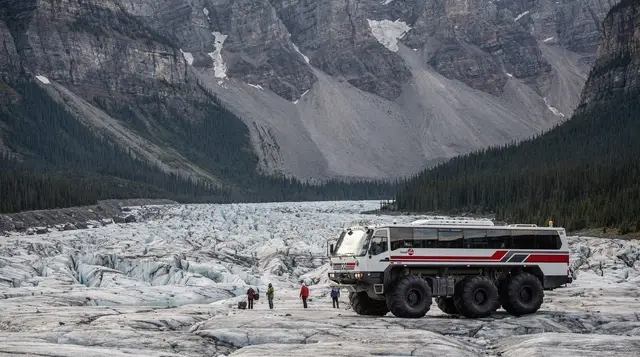
The core experience is straightforward in concept and unusual in execution. From the Icefield Centre, a standard motorcoach shuttles visitors a short distance to a separate loading area, where the actual Ice Explorers take over — specialized buses built on massive, low-pressure tires designed for glacial ice and the loose moraine around it. The vehicles descend a steep access road onto the toe of the Athabasca Glacier, one of six major glaciers that spill off the Columbia Icefield itself, and stop directly on the ice.
Once parked, passengers step out onto a marked, patrolled section of the glacier for roughly 15 to 20 minutes. It’s a strange sensation even for people who’ve hiked plenty of snowfields: the ice underfoot is old, dense, and often has a faint grey cast from windblown rock dust rather than looking like the postcard-blue you might expect. Meltwater runs in small channels across the surface, and on a sunny day the reflected light off the ice and the surrounding peaks is intense enough that sunglasses are worth having even if you didn’t think you’d need them.
The combined ticket covering both the Ice Explorer ride and the Skywalk platform down the road is the most popular way to book this stop, since it bundles the two Icefield Centre attractions into a single reservation rather than requiring two separate stops in the parking area.
For travellers who’d rather have a guide narrating the geology and glacial history as part of the visit, the Columbia Icefield tour that pairs the Ice Explorer with a local guide adds context that the standard shuttle-and-bus routine doesn’t provide on its own. And because pricing on this attraction runs high relative to most other Banff-area stops, it’s worth checking the discounted Columbia Icefield ticket option before paying full rate at the counter.
A retreating glacier, marked in the landscape
The Athabasca Glacier isn’t a static backdrop; it’s actively retreating, and has been for well over a century. Current measurements put the pace at roughly 5 metres a year, which sounds modest until you see it expressed as distance on the ground. Parks Canada has installed a series of dated markers along the trail and old parking area below the Icefield Centre, each one showing where the toe of the glacier stood in a given year — 1992, 1982, and further back toward the glacier’s furthest historical extent in the 1800s. Walking from the current trailhead to the current ice front means passing marker after marker, each one a reminder that the ice used to be right there.
That retreat has a direct, practical consequence for anyone thinking about walking to the glacier independently rather than riding the Ice Explorer: the unguided walk to the toe of the glacier is now considerably longer than it once was, over loose moraine and exposed bedrock with no shade and often a stiff, cold wind funnelling down off the ice. It’s a legitimate hike in its own right, not a five-minute stroll from the parking area, and the terrain gets rougher the closer you get. The glaciers retreat explained guide goes into the broader pattern across the Rockies, of which the Athabasca Glacier is one of the most visibly documented examples anywhere in Canada.
Safety: this is a glacier, not a snowfield
However you experience it, the Athabasca Glacier is not a place to improvise. Crevasses — some genuinely enormous — form throughout the ice and can be concealed by snow bridges that look perfectly solid from above and aren’t. Fatal falls into hidden crevasses have happened on this exact glacier, including to visitors who stepped past the roped and marked boundary the Ice Explorer tour keeps everyone within. The safe area for the guided bus tour is patrolled and repeatedly re-surveyed for exactly this reason, and it exists precisely because the terrain a few dozen metres beyond it is genuinely dangerous.
If you want to go further onto the ice than the Ice Explorer stop allows — deeper onto the icefield, roped up, with proper crevasse-rescue equipment — that requires a certified mountain guide, not a self-guided walk with hiking poles. A guided glacier walk with a licensed operator is the only reasonable way to do that; wandering past the markers on your own, however solid the ice looks, is the single most avoidable way to turn a memorable day into an emergency.
When it’s open, and when it isn’t
The Ice Explorer and the Glacier Skywalk both run on a seasonal schedule, generally opening in late April or May and closing in early October, with the exact dates shifting slightly year to year based on conditions. Outside that window, the Icefield Centre itself typically closes or scales back to a bare minimum, the glacier access road isn’t operating, and the Icefields Parkway becomes a winter-driving route rather than a sightseeing corridor — worth knowing if you’re building a shoulder-season trip around this stop specifically. The Icefields Parkway in winter guide covers what the road and the corridor actually look like once the summer attractions shut down.
| Season | Ice Explorer / Skywalk | Icefields Parkway itself |
|---|---|---|
| Late April/May-early October | Operating, standard visitor season | Open, busiest June-August |
| Early October-late April | Closed | Open for driving, winter conditions, no icefield access |
Within the open season, midsummer mornings and midday hours are the busiest by a wide margin, with tour buses and self-drive visitors converging at once. Arriving early or booking a fixed-time ticket in advance avoids the worst of the queue at the loading area.
Money and logistics
Ticket pricing for the Ice Explorer and the Skywalk combo shifts from season to season and by ticket type, so treat any number you see quoted, including here, as a rough order of magnitude rather than a fixed price — check the current official rate before you commit to a plan. As a stop within a broader Icefields Parkway day, budgeting somewhere in the CAD 150-300 per person range for the tour itself, plus your Parks Canada pass, is a reasonable planning figure, but confirm before you book.
A Parks Canada day pass or annual Discovery Pass is required regardless, since the Icefield Centre sits inside Jasper National Park and this stretch of highway falls under the same park pass system that covers Banff, Yoho, and Kootenay. The pass is separate from, and in addition to, whatever you pay for the Ice Explorer ticket itself.
Building it into a bigger day
Almost nobody visits the Columbia Icefield in isolation — it’s a stop, not a destination, embedded in a longer drive along the parkway. The most common pattern is a single long day from Banff or Lake Louise, out to the icefield and back, or a one-way drive through to Jasper with an overnight there before returning. The four days Banff Jasper icefields itinerary and the dedicated Icefields Parkway road trip itinerary both build in realistic timing around this stop, accounting for how much of the day the Ice Explorer loading process alone can take.
For travellers basing themselves further south and treating the icefield as a long day trip rather than part of a Banff-to-Jasper transfer, it’s worth being honest about the driving involved: over 4 hours round trip from Banff before any time at the centre itself, which is a genuinely long day. Reading the one day versus two days breakdown before committing to a single-day version from Banff saves a fair number of people from an exhausting drive back after dark.
The Columbia Icefield, questions answered
What’s the difference between the Columbia Icefield and the Glacier Skywalk?
They’re two separate paid experiences sold from the same Icefield Centre. The Columbia Icefield tour is the Ice Explorer bus ride onto the Athabasca Glacier itself. The Glacier Skywalk is a glass-floored walkway over the Sunwapta Valley a short shuttle ride away, and it doesn’t put you on the ice at all.
How much does the Columbia Icefield Ice Explorer cost?
Pricing changes from year to year and by ticket type (icefield only versus a combo with the Skywalk), so treat any figure here as a rough range rather than a quote. Check the current official rate before you book, and expect it to sit well above a typical park attraction given the specialized vehicles involved.
Is the Columbia Icefield open in winter?
No. The Ice Explorer tours and the Glacier Skywalk both run seasonally, roughly from late April or May through early October. Outside that window the Icefield Centre and the glacier access road close, and the Icefields Parkway itself becomes a winter-driving route rather than a sightseeing stop.
How far is the walk to the toe of the Athabasca Glacier?
Longer than it used to be. The glacier has been retreating roughly 5 metres a year, and Parks Canada has placed dated markers along the old parking area and trail showing where the ice front stood in past decades. Walking from today’s trailhead to today’s ice front is now a real hike, not a quick stroll.
Can you walk onto the Athabasca Glacier on your own?
Not safely, and not legally past the marked boundary. Crevasses hide under snow bridges that can look solid and aren’t, and rescues on this glacier have killed people who wandered past the roped-off area. The safe way onto the ice is the Ice Explorer bus or a guided glacier walk with a certified guide roped and equipped for the terrain.
Do I need a Parks Canada pass for the Columbia Icefield?
Yes. The Icefield Centre sits inside Jasper National Park, and a valid Parks Canada day pass or Discovery Pass is required to be on this stretch of the Icefields Parkway at all, separate from whatever you pay for the Ice Explorer or Skywalk ticket itself.
How long does a Columbia Icefield visit take?
Budget 2 to 3 hours for the Ice Explorer tour itself, including the loading process and time on the ice, plus however long you spend at the Icefield Centre before or after. Add more if you’re combining it with the Glacier Skywalk on the same stop.
Is the Columbia Icefield worth it if I’ve already seen glaciers elsewhere?
The Ice Explorer is one of very few ways anywhere in the world to drive a purpose-built vehicle directly onto a glacier’s surface and step out on it, which is different from viewing a glacier from a trail or a viewpoint. Whether that’s worth the price is a personal call, but it isn’t a generic glacier viewpoint you can replicate for free nearby.