Riding the Ice Explorer onto Athabasca Glacier
What is the Ice Explorer tour on Athabasca Glacier?
It's a guided ride in a giant-wheeled Ice Explorer bus from the Columbia Icefield Centre down onto Athabasca Glacier, with about 15 to 25 minutes of supervised time to walk on the ice in a marked zone. The whole experience runs roughly 1.5 to 2 hours and operates only from April or May to October, weather and ice conditions permitting.
What actually happens when you ride the Ice Explorer onto the ice
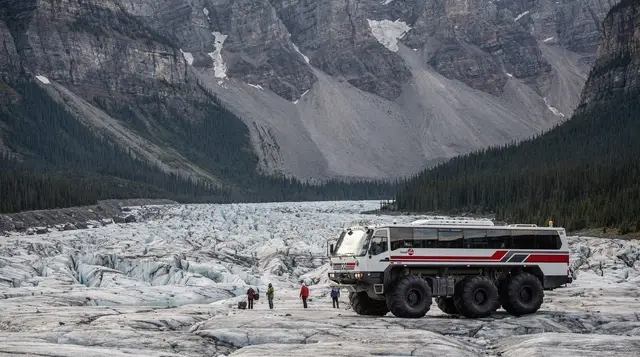
The Ice Explorer is the only way most visitors ever set foot on a real glacier without hiring a mountain guide. It’s a purpose-built bus on six massive tires, designed to drive down a gravel moraine road and out onto the surface of Athabasca Glacier itself, part of the Columbia Icefield. The appeal is straightforward: you get glacier ice under your boots, a short supervised walk, and none of the training or gear a roped glacier crossing would otherwise require. It’s also, by a wide margin, the most popular single stop along the Icefields Parkway.
What it is not is a hike, a technical excursion, or a year-round attraction. This page covers only the Ice Explorer bus tour — boarding, the drive, and the time on the ice. If you’re after the glass-floored platform over the valley, that’s the separate Glacier Skywalk. If you want to actually walk across the glacier roped up with crampons, further out than the bus goes, that’s covered on the guided glacier walk page. The three are frequently sold together but are genuinely different products with different vehicles, different guides, and different time commitments.
Where the tour starts: the Columbia Icefield Centre
Every Ice Explorer departure begins at the Columbia Icefield Centre, a visitor building right on the Icefields Parkway roughly midway between Lake Louise and Jasper. This is where you check in, and where most tour operators expect you to be 30 to 45 minutes ahead of your scheduled slot, since check-in, a short safety briefing, and boarding all happen before the bus leaves the yard.
The Centre itself has washrooms, a cafeteria, a gift shop, and a small interpretive display on the icefield and its history — useful if your slot has a wait built in, less useful if you’re trying to make good time on a one-day Parkway drive. There’s no fuel here and cell coverage is unreliable, so treat the Centre as your last reliable stop for services in either direction; see the notes on fuel and cell coverage along the Parkway before you commit to a same-day round trip from Banff or Jasper.
Boarding the Ice Explorer
From the Centre, a standard shuttle bus first carries passengers a short distance to the Ice Explorer loading area at the edge of the moraine — you don’t board the giant-wheeled vehicle directly from the parking lot. This transfer step catches some first-timers off guard; budget an extra 10 to 15 minutes for it beyond the advertised tour length.
The Ice Explorers themselves are unmistakable: six tires roughly the height of a person, a boxy passenger cabin, and a low gear ratio built for crawling rather than speed. Guides run through a short safety talk before departure covering where you can and can’t walk once you’re on the ice, and what the vehicle will and won’t do on the descent. It’s brief, but it’s not skippable — listen to it, since the rules around meltwater channels and marked zones are the same ones that keep this tour incident-free year after year.
The drive down onto the ice
The route down follows a purpose-built gravel road cut into the lateral moraine, dropping from the loading area to the toe of Athabasca Glacier. It’s a slow, deliberately unhurried descent — the vehicles are built for stability on the grade, not speed, and the ride down is part of the experience rather than a means to an end. Guides narrate as you go, pointing out the moraine ridges that mark how far the glacier has retreated over past decades; the retreat itself, and what’s driving it, is explained in more depth on the glaciers retreat explained page.
Once the bus reaches the ice, it parks in a fixed, marked area that’s re-assessed regularly through the season as the surface shifts. This isn’t a random pull-off — the parking zone is chosen specifically because it sits on stable, relatively flat ice away from visible crevasses and major meltwater channels.
Time on the glacier: what you can and cannot do
This is the part people come for, and it’s shorter than most expect: roughly 15 to 25 minutes actually standing on Athabasca Glacier, bookended by the shuttle transfer and the Ice Explorer ride on either side. Within that window, guides keep everyone inside a roped or flagged perimeter. Staying inside it isn’t a suggestion — meltwater runs across the ice in channels that can be ankle-deep or considerably deeper, the surface itself is harder and more slippery than packed snow, and crevasses exist not far outside the marked area even if they’re not obvious from where you’re standing.
The meltwater itself is genuinely drinkable, and guides usually point out where you can fill a bottle or cup it in your hands — it’s one of the small, memorable parts of the stop. Just don’t wander toward a channel on your own to get to it; use the spot the guide indicates. Photos are the other main activity here, and the light and colour of the ice up close is a fair bit different from what you see looking up at the icefield from the road.
Expect cold. Even on a warm Parkway day, the glacier surface runs noticeably colder than the Icefield Centre parking lot, and wind funnels down off the ice field itself. A packable jacket is worth having in July as much as in September.
How long the whole thing takes
Add it up and a standalone Ice Explorer tour, door to door from the Columbia Icefield Centre, runs about 1.5 to 2 hours: check-in and briefing, the shuttle transfer, the descent, the time on the ice, and the return climb back up the moraine road. Tours bundled with the Glacier Skywalk — which is common, since both are run by the same operator and sit a short drive apart — extend the outing to roughly 3 to 3.5 hours once you include travel between the two sites and time at the Skywalk platform itself.
If you’re driving the Parkway in a single day from Banff or Lake Louise, that block of time needs to be planned for rather than squeezed in; see the one day versus two days on the Icefields Parkway breakdown, or the complete stop-by-stop guide for how this fits against Peyto Lake, Bow Lake, and the falls further south.
When you can actually book this
The single most common misconception about this tour is that it runs year-round because the icefield itself is always there. It isn’t available in winter. The loading area, the moraine road, and the ice parking zone are only operated and maintained through the warmer months, and the vehicles themselves are stored off-season.
| Period | Ice Explorer operation |
|---|---|
| November to March | Closed. No departures at any price. |
| Late April to mid-June | Opens gradually as the access road and ice conditions allow; early-season dates can shift or cancel with short notice. |
| Late June to early September | Full daily operation, multiple departures, highest demand. |
| Mid-September to October | Operating, tapering toward month-end as weather turns; last dates vary year to year. |
Exact opening and closing dates move from year to year depending on snowpack and ice conditions, so treat “April or May to October” as the working window and check the specific season’s dates before booking a shoulder-month trip, especially in October.
Cost and which tour to pick
Several operators sell essentially the same Ice Explorer experience, bundled with different add-ons — the Skywalk, extra stops along the Parkway, or a private vehicle instead of a shared coach. None of these differ in what happens once you’re on the glacier; the differences are in what surrounds that stop.
| Option | What it adds | Best for |
|---|---|---|
| Ice Explorer paired with the Glacier Skywalk | Both the glacier ride and the Skywalk platform in one ticket | First-timers who want the two signature Icefield stops without booking separately |
| the Ice Odyssey glacier experience | A self-contained Ice Explorer and glacier walk package | Travellers focused on the ice itself over the Skywalk |
| a private vehicle out to the Icefield | Door-to-door transport from Banff or Canmore in a private car, folded into the Icefield visit | Groups or families who’d rather skip a shared coach |
| a Jasper-based day tour to the Icefield and Skywalk | Departure from Jasper instead of Banff, useful if you’re based north | Travellers staying in Jasper rather than Banff or Canmore |
None of the above require you to drive yourself to the Icefield Centre; all include transport, the Ice Explorer stop, and return. If you’re driving your own vehicle up the Parkway and just want the Ice Explorer ticket on arrival, walk-up and same-day tickets are sold directly at the Centre, though midsummer days can sell out departures by early afternoon.
What to wear and bring
Dress for the glacier, not for the parking lot. A warm layer, wind protection, and closed-toe shoes with reasonable tread cover the walking area well; nothing technical is required. Sunglasses and sunscreen matter more than people expect — glare off the ice is intense even on an overcast day. Bring a water bottle if you want to try the meltwater, and keep a camera or phone charged, since this is the stop most people photograph the most on the whole Parkway drive.
What you don’t need: crampons, poles, or mountaineering boots. Those belong to the separate guided glacier walk, which goes further out onto the ice on foot with a roped group and different safety equipment entirely.
Ice Explorer versus the guided walk versus the Skywalk
It’s easy to conflate the three Columbia Icefield attractions, so here’s the plain distinction. The Ice Explorer gets you onto the glacier in a vehicle, with a short, easy walk in a fixed zone — no fitness requirement, no gear, about 20 minutes of actual ice time. The guided glacier walk covers considerably more distance on foot, in crampons, with a certified guide, and demands a reasonable level of fitness and a few hours of your day. The Glacier Skywalk doesn’t put you on the glacier at all — it’s a cantilevered glass platform overlooking the Sunwapta Valley, a separate stop reached by shuttle from the same visitor centre.
Most travellers doing the Parkway once choose the Ice Explorer, often combined with the Skywalk, simply because it needs the least planning and suits the widest range of ages and abilities. The guided walk is worth it if getting further out onto real glacier ice, on foot, is specifically what you’re after — otherwise the Ice Explorer delivers the core experience in a fraction of the time.
Getting there from Banff, Lake Louise, or Jasper
The Columbia Icefield Centre sits on the Icefields Parkway (Highway 93 North), about 180 kilometres from Banff, roughly a 2 hour 15 minute drive one-way without stops. From Lake Louise it’s closer, and from Jasper it’s the shorter approach at under 105 kilometres, under an hour and a half. There’s no fuel between Saskatchewan River Crossing and the Icefield Centre area other than what’s seasonally available, so top up before you commit to the drive; the gas and cell coverage guide has the specifics.
If you’d rather not drive the Parkway yourself, every tour option listed above includes transport, which also removes the stress of timing a same-day return with the Ice Explorer’s departure schedule. For a broader multi-day plan that folds this stop into a longer Rockies trip, see the four days Banff to Jasper Icefields itinerary or the standalone Icefields Parkway road trip plan.
FAQ about riding the Ice Explorer on Athabasca Glacier
Is the Ice Explorer tour open all year?
No. It’s a seasonal operation, typically running from late April or May through October, depending on snowmelt and ice conditions. There’s no winter departure — the loading area and ice road aren’t maintained for it, and the glacier surface isn’t safe for the vehicles once conditions change.
How long do you actually spend on the ice itself?
Plan on roughly 15 to 25 minutes standing on Athabasca Glacier once the Ice Explorer parks in the designated area. The full outing, including the shuttle from the Icefield Centre, the ride down, and the return, runs about 1.5 to 2 hours.
Can I drink the meltwater or walk wherever I want on the glacier?
You can drink the meltwater — it’s clean glacial runoff — but only from the areas guides point out, and you should stay inside the roped or flagged zone the whole time. Meltwater channels and crevasses exist outside that zone, and the ice is far colder and more slippery than it looks.
Do I need my own boots or crampons?
No special gear is needed for the Ice Explorer stop. Sturdy, closed-toe shoes with some grip are enough for the marked walking area. Crampons and technical footwear are for the separate guided glacier walk, not this tour.
Is the Ice Explorer the same as the Glacier Skywalk?
No, they’re two different attractions at two different stops, though many tour packages combine both in one day. The Ice Explorer takes you onto the ice of Athabasca Glacier; the Glacier Skywalk is a glass-floored viewing platform above the Sunwapta Valley, a short drive away.
How cold is it on the glacier compared to the parking lot?
Noticeably colder, and often windier. Even on a 20 degree Celsius day at the Icefield Centre, expect single digits and a stiff breeze once you step onto the ice — bring a layer even in July.
Can young kids and older travellers do this tour?
Yes. The Ice Explorer is wheelchair accessible up to the vehicle, and the walking area on the ice is flat and short. It suits most fitness levels, which is the main reason people choose it over the guided walking tour on the glacier.
Columbia Icefield & glacier tours on GetYourGuide
Verified deep-linked GetYourGuide tours. Book through these links and we earn a small commission at no cost to you.
GetYourGuide does not provide a product photo for this activity — the image shows the meeting point, photographed by us.