Guided glacier walks: how to actually set foot on the ice
What is a guided glacier walk, and how is it different from the Ice Explorer?
A guided glacier walk puts you in crampons and a harness, roped to a certified mountain guide, actually walking on the surface of the Athabasca Glacier or nearby ice. The Ice Explorer stays on a plowed, marked corridor in a wheeled vehicle and never lets passengers off onto open glacier.
Most visitors to the Columbia Icefield never set foot on the ice at all. They ride the Ice Explorer down a plowed, roped-off corridor, take photos from the safety of a wheeled vehicle, and drive on. That’s a legitimate way to see a glacier up close, but it isn’t glacier travel — it’s a bus tour on ice. A guided glacier walk is the other option: crampons on your boots, a harness around your waist, roped to a certified mountain guide, actually walking across the surface of the Athabasca Glacier or a comparable tongue of ice nearby.
What actually happens on a guided glacier walk
The trip starts off the ice, not on it. Guides fit crampons to your boots, check your harness, and run through a safety briefing covering how the rope team moves, what to do if someone starts to slip, and why you never step off the guide’s chosen line without being told to. Only after that does the group walk out onto the glacier itself, moving in a line, roped together at set intervals.
Once on the ice, the pace is deliberately slow. The guide reads the surface as you go — snow bridges, discoloured ice, subtle dips that hint at what’s underneath — and adjusts the route in real time. You’ll typically get close enough to a crevasse to look into it, sometimes stand near a moulin (a vertical shaft where meltwater disappears into the glacier), and see blue ice where the surface has been scoured clean of debris. None of that is available from the Ice Explorer’s fixed corridor, which stays on ground the operator has stabilized and marked for repeated vehicle traffic.
A typical outing runs 3 to 4 hours on the ice itself, bracketed by the briefing, the drive out, and the drive back — plan on a half day at minimum, more often most of a day once you count travel from Banff along the Icefields Parkway.
Where these walks happen: the Columbia Icefield area
The most accessible on-ice guided walks near Banff operate around the Athabasca Glacier, the tongue of the Columbia Icefield that reaches closest to the highway. It’s the same glacier the Ice Explorer visits, but guided walking parties go elsewhere on its surface, away from the vehicle corridor, onto terrain the guide has scouted for that day’s conditions.
a guided hike onto the Athabasca Glacier itself is the most direct version of this experience out of the icefield area. Some operators fold it into a longer day that also stops at the Glacier Skywalk and other Icefields Parkway viewpoints — worth checking if you’d rather not string together separate bookings; a full-day guided tour covering the parkway’s glaciers and the Skywalk packages that combination with transport from Banff included.
How it differs from the Ice Explorer, precisely
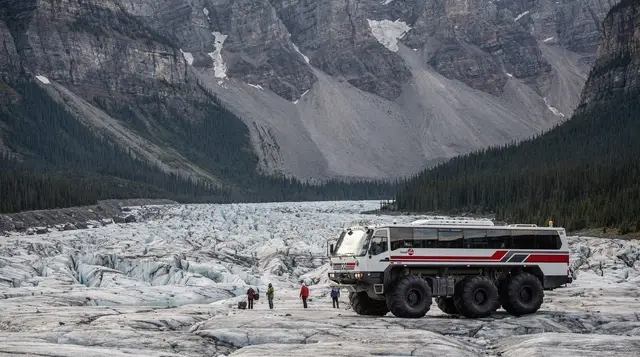
The distinction matters enough to spell out. The Ice Explorer is a modified bus with oversized tires, driving a plowed, monitored route across the lower Athabasca Glacier. Passengers can step outside the vehicle for a few minutes on a roped-off patch of ice, but they never leave that immediate, pre-cleared area, and there’s no crampon fitting or rope team involved. It’s a good way to stand on a glacier for the first time with zero physical demands and no technical gear.
A guided glacier walk is a walking trip. You cover real distance on foot, on ice that hasn’t been groomed for vehicles, moving under your own power the entire time. The guide’s job is route-finding and crevasse assessment rather than driving a fixed loop. If what you want is the sensation of stepping onto a glacier for a photo, the Ice Explorer does that with less effort and lower cost. If you want to understand what glacier travel actually involves — the gear, the pace, the constant low-level attention to where you’re putting your feet — the guided walk is the one that delivers it. Our separate guide to riding the Ice Explorer covers that experience on its own terms.
The real danger: crevasses hidden under snow
Crevasses are the reason none of this happens without a guide. A glacier moves, and as it does the ice cracks open into fissures that can run tens of metres deep. Fresh snowfall can bridge a crevasse with a thin, deceptively solid-looking lid that gives no warning before it collapses under weight. From the surface, a snow-bridged crevasse and solid ice can look identical.
This is exactly why walking out onto the Athabasca Glacier unguided is dangerous, and why people who’ve tried it have died doing so. A certified guide isn’t a formality here — they’re trained to probe likely crevasse locations, read subtle surface cues, and keep the rope team on ground they’ve assessed. The rope itself matters as much as the guide’s judgment: if one person breaks through a snow bridge, the rest of the team can arrest the fall rather than watching it happen. None of that protection exists if you walk out alone, however sturdy the ice looks.
Our dedicated guide on why glaciers retreat explains the mechanics behind why the crevasse field keeps shifting: the Athabasca Glacier has been losing roughly 5 metres of length a year on average, and a retreating glacier doesn’t get simpler to read — it exposes new ice and new crevasse patterns that weren’t there the season before.
Gear, crampons, and what the outfitter provides
Outfitters supply the technical kit: crampons, harness, rope, ice axe if the route calls for one, and often helmets. What you’re expected to bring is more basic — sturdy, ankle-supporting boots that a crampon can actually clamp onto (check with the operator in advance whether your own boots qualify, or whether rental boots are available), layered clothing since glacier air runs noticeably colder than the parking lot at the Discovery Centre, gloves, and eye protection.
Glacier glare is easy to underestimate. Sun reflects off ice and snow far more intensely than off ordinary ground, and sunburn — including on the underside of your chin and inside your nostrils — happens fast even under overcast skies. Sunglasses or glacier goggles and sunscreen aren’t optional extras on this trip.
Guide certification: who you’re trusting on the ice
The guides running these trips are typically certified through the Association of Canadian Mountain Guides (ACMG) or hold an equivalent recognized glacier or mountain guide qualification. That certification covers exactly the skills this trip depends on: crevasse rescue, route-finding on glaciated terrain, and rope team management. When booking, it’s reasonable to ask what certification the guiding company holds — a legitimate operator will answer without hesitation, and it’s the single detail that matters most for a trip built entirely around managed exposure to a real hazard.
Physical difficulty, age limits, and group size
Most operators pitch these trips as accessible to reasonably fit beginners rather than experienced mountaineers. You don’t need prior glacier or climbing experience, but you do need to be comfortable walking for hours on uneven, sometimes slick terrain at altitude, occasionally uphill. Minimum ages vary by operator, commonly somewhere around 8 to 12 years old, and groups are usually kept small — often under a dozen people per guide — so the guide can actually manage the rope team rather than herd a crowd.
If you’re travelling with younger kids or anyone with limited mobility, this isn’t the right glacier experience; the Ice Explorer or the Glacier Skywalk suit that better.
Season, weather, and cancellations
These walks run on a shorter window than the Ice Explorer’s roughly April-or-May-to-October season. Guides need stable enough snowpack and crevasse conditions to set a safe route, which in practice usually means the trip operates from June or July through September. Even within that window, a trip can be shortened, rerouted, or cancelled on short notice after fresh snowfall, high wind, or a shift the guide doesn’t like the look of. Book with a flexible day either side if you can, and don’t schedule a guided glacier walk as the only thing you’re doing on a tight one-day pass through the Icefields Parkway.
Mobile coverage along this stretch of highway is minimal to nonexistent — worth knowing before you rely on checking a forecast or a booking confirmation from the parking lot; see our notes on gas and cell coverage along the parkway for the practical details.
What a guided glacier hike costs
Prices vary by operator, group size, and whether transport from Banff or Jasper is included, but as a rough range, expect roughly 150 to 300 CAD per person for a half-day to full-day guided glacier walk, taxes not included. That’s meaningfully more than an Ice Explorer ticket, which reflects the smaller group sizes, the certified guide, and the technical equipment involved rather than any extra length of time spent travelling.
| Experience | What you actually do | Typical time | Rough cost (CAD, per person) |
|---|---|---|---|
| Guided glacier walk | Walk roped, in crampons, on open glacier ice | 3–4 hrs on ice, half to full day total | 150–300 |
| Ice Explorer | Ride a wheeled vehicle on a plowed corridor | About 1.5 hrs at the icefield | Sold separately, lower cost |
| Glacier Skywalk | Walk a glass-floored platform above the valley | 30–60 min | Sold separately, lower cost |
Alternatives if you want glacier scenery without stepping on ice
Not everyone wants — or should attempt — roped travel on crevassed terrain, and there’s no reason to force it. A few alternatives get you close to glacier landscapes with less technical exposure. The Stanley Glacier hike in Kootenay National Park is a guided nature walk up a valley to a viewpoint of a hanging glacier and cirque, on foot but without crampons or rope; a guided hike into the Stanley Glacier valley covers that terrain with a naturalist guide rather than a mountain guide, and it suits hikers who want the scenery and the interpretation without the ice travel.
Two other guided ice experiences worth knowing about are a different thing entirely: winter ice walks through Johnston Canyon or Grotto Canyon near Lake Louise, done in cleated boots along a frozen creek bed rather than on glacier ice. Those trips run in the coldest months, involve no crevasse risk, and are a completely separate category from what’s covered here — our guide to what guided hikes actually add over hiking solo covers the broader case for booking a guide on any of these outings, glacier or canyon.
Booking a guided glacier walk from Banff
Meeting points vary: some operators run pickup directly from Banff or Lake Louise hotels, others meet at the Columbia Icefield Discovery Centre if you’re already driving the parkway that day as part of an Icefields Parkway road trip. Confirm the meeting point, what’s supplied versus what you need to bring, and the operator’s weather cancellation policy before you book — a glacier walk is one of the trips on this route most likely to shift at short notice, and knowing the refund or rebooking terms in advance saves a frustrating morning at the Discovery Centre parking lot.
FAQ: guided glacier walks on the Columbia Icefield
Is a guided glacier walk safe?
It’s as safe as roped travel on a moving glacier can be, which is to say it carries real but managed risk. Guides are trained to read the surface, probe for hidden crevasses, and keep the rope team within a route they’ve assessed that day; the risk that remains is why solo travel on the same ice has killed people.
Do I need hiking or mountaineering experience?
No. Most outfitters running these trips out of Banff and Jasper accept complete beginners, provided you’re reasonably fit and comfortable walking a few hours on uneven, sometimes slippery terrain. The guide handles the technical decisions; you handle showing up in decent boots.
How long does a guided glacier walk take, including transport?
Budget a half day to a full day once you count the drive out to the Columbia Icefield area and back. Actual time on the ice is typically 3 to 4 hours, bracketed by a safety briefing and gear fitting beforehand and a drive each way.
What’s the difference between this and the Ice Explorer bus tour?
The Ice Explorer drives a fixed, plowed route on the lower, monitored part of the Athabasca Glacier and you never leave the vehicle’s immediate area. A guided glacier walk gets you roped up on foot, moving across open ice near crevasses the guide has assessed, which is a genuinely different kind of access — see our separate guide to the Ice Explorer for that comparison.
Can I book a guided glacier walk without a car?
Most operators run pickup from Banff, Lake Louise, or Jasper, or meet at the Columbia Icefield Discovery Centre if you’re already driving the Icefields Parkway that day. Check the specific tour’s meeting point before assuming a shuttle is included.
When can you actually do a guided glacier walk?
Roughly June or July through September, shorter than the Ice Explorer’s April-or-May-to-October season, because guides need stable enough snow and crevasse conditions to set a safe route. Trips can still be cancelled or rerouted on short notice after a fresh snowfall or a shift in the ice.
What should I wear or bring?
Sturdy, ankle-supporting boots that fit crampons, layered clothing, gloves, sunglasses or glacier goggles, and sunscreen — glacier glare burns faster than most people expect, even on a cool day. Crampons, harness, and rope are supplied by the outfitter; check in advance whether your own boots are compatible.
Columbia Icefield & glacier tours on GetYourGuide
Verified deep-linked GetYourGuide tours. Book through these links and we earn a small commission at no cost to you.
GetYourGuide does not provide a product photo for this activity — the image shows the meeting point, photographed by us.