Banff’s biggest lake, five minutes off the highway
Most visitors to Banff National Park end up at Lake Louise or Moraine Lake within a day of arriving. Lake Minnewanka gets a fraction of that traffic despite sitting closer to town than either one, and despite being, by a wide margin, the largest body of water in the park at roughly 21 kilometres long. Part of the reason is that it doesn’t photograph the same way — it’s a working lake, with a dam at one end, a boat cruise, anglers on the shoreline, and a paved scenic drive rather than a single famous viewpoint. That’s also what makes it worth a stop: it’s one of the few places near Banff where you can actually get on the water, not just look at it.
The lake sits inside a widened section of the Bow Valley northeast of Banff townsite, reached by the Lake Minnewanka Scenic Drive, a short paved loop off the Trans-Canada Highway that also passes Two Jack Lake and the historic Lower Bankhead coal-mining site. Traditional territory here belongs to the Îyârhe Nakoda (Stoney Nakoda) and Treaty 7 nations; “Minnewanka” is commonly cited as a Stoney word, sometimes translated as “Lake of the Spirits,” though translations of the name vary by source.
The lake’s current size and shape are partly artificial. A natural lake already existed here, but a hydroelectric dam built at the outlet in the early twentieth century, and raised again in 1941, backed up the Bow Valley far enough to flood the small townsite of Minnewanka Landing, along with an earlier, smaller dam structure. That flooded foundation is one of the features pointed out on the boat cruise, and it’s part of why the lake reads as more of an engineered reservoir than a naturally occurring alpine lake, even though the setting around it, ringed by the Fairholme Range and Mount Inglismaldie, is every bit as much a product of the Rockies as Lake Louise or Moraine Lake.
Getting to Lake Minnewanka
Lake Minnewanka is about 6 kilometres from Banff townsite, a drive of 10 to 15 minutes depending on traffic and how many bighorn sheep decide to stand in the road. There’s no need to backtrack through Banff itself first — the turnoff onto the scenic drive comes directly off the Trans-Canada Highway at the Banff East exit.
If you’d rather not drive, Roam Transit’s Route 6 runs from the Banff townsite directly to the Lake Minnewanka day-use area on a seasonal schedule (see getting around without a car for the full transit picture). This matters more than it sounds: the parking lot at the lake’s main day-use area fills up by mid-morning on summer weekends, and unlike Moraine Lake there’s no shuttle-only rule here, just a finite number of parking spaces and a lot of people trying to use them at once.
A valid Parks Canada pass is required to be in Banff National Park at all, Lake Minnewanka included, even if you’re only stopping for twenty minutes. It isn’t sold at the lake itself, so buy or display it before you arrive, either at the park gates on the Trans-Canada or online in advance.
The boat cruise, season by season
The main organized activity at Lake Minnewanka is the sightseeing boat cruise, a covered tour boat that runs a narrated route past Devil’s Gap, along Stewart Canyon, and over the submerged townsite of Minnewanka Landing, which was flooded when a hydroelectric dam raised the lake’s water level in 1941. The cruise runs about an hour on the water, with boarding time on either side.
This is a seasonal operation, generally running from May or June through September, tracking the same rough window as most other summer-only attractions in the park. It does not run in winter, and shoulder-season dates can shift from year to year with ice conditions and staffing, so confirm current sailing times before building a day around it rather than assuming the schedule is fixed.
a guided winter tour around Lake Louise covers a different season and a different lake, but it’s a useful comparison if you’re trying to decide when to visit the area at all: Lake Minnewanka’s cruise is a warm-weather activity, full stop.
| Season | Cruise available | What you’ll find at the lake |
|---|---|---|
| June-September | Yes, regular sailings | Boat cruise, fishing, picnic areas, busiest parking |
| May, October | Sometimes, check current schedule | Quieter, cooler, some services reduced |
| November-April | No | Frozen lake, closed cruise dock, limited services |
If the cruise itself doesn’t fit your schedule or budget, the drive and shoreline alone are free once you’re past the park gate, and the things to do at Lake Minnewanka page rounds up the free options alongside the paid ones.
Fishing at Lake Minnewanka
Lake Minnewanka is one of the more accessible fishing spots near Banff townsite, stocked historically with lake trout and home to whitefish as well. Anglers fish from the shoreline near the day-use area and from small boats launched at the public ramp.
Fishing anywhere inside Banff National Park requires a Parks Canada national park fishing permit, which is entirely separate from an Alberta provincial licence and from the park entry pass itself — three different pieces of paper for three different requirements. Permits are sold at the Banff townsite visitor centre and some outdoor retailers. See fishing permits and spots for where else in the region you can legally cast a line, and check current catch limits before keeping anything, since rules can change season to season.
Shore fishing is easiest right around the day-use area, where the bank is level and parking is close by, though it’s also the busiest stretch on summer days. Anglers willing to walk a little further along the north shore, past the boat launch, generally find more room and fewer people. A small boat or canoe extends the options considerably, since much of the lake’s productive water sits well off the accessible shoreline, but motorized boats need to meet Parks Canada’s own permitting rules for the lake, on top of the fishing permit itself, so check current requirements before launching anything with an engine.
Picnic areas and short walks
The Lake Minnewanka day-use area has the largest and most developed picnic facilities along the scenic drive: covered tables, washrooms, and direct lake access next to the parking lot and cruise dock. It’s a straightforward stop for lunch without any hiking required.
For something more active without committing to a full hike, the walk to Stewart Canyon follows the lake’s inlet a short distance from the day-use area and makes a reasonable add-on to a picnic stop. Longer options branch off from the same trailhead network, including the C-Level Cirque trail and the considerably longer route out to Aylmer Lookout, both of which climb well above the lake and are better suited to visitors who came specifically to hike rather than to picnic.
None of these are covered as separate Lake Minnewanka activities here in the depth they deserve; if a longer hike is the plan, check best day hikes by difficulty before committing to distance and elevation gain you weren’t expecting.
Lower Bankhead, a short detour off the same scenic drive, is the site of a former coal mining operation that supplied Banff’s early hotels and rail yards; interpretive signage and building foundations remain, and it’s an easy add-on for anyone doing the full loop rather than just the out-and-back to the lake itself.
Wildlife on the access road
The Lake Minnewanka Scenic Drive is one of the more reliable places near Banff townsite to see bighorn sheep, which graze along the road cuts and sometimes block traffic outright, and elk, which move through the valley bottom especially at dawn and dusk. Slow down well before you’d think you need to, since animals here are used to vehicles and don’t always move with much urgency.
The elk rut in September and October makes males considerably more aggressive in this same stretch of valley, including close to parked cars, so keep a real distance rather than approaching for a photo. General guidance on distances, timing and what you’re likely to see is in wildlife viewing map and times and bear safety and etiquette, both worth a read before the drive rather than after an encounter.
Is Lake Minnewanka the same as Two Jack Lake?
No, and it’s a common mix-up because they sit a few minutes apart on the same road. Two Jack Lake is smaller, quieter, and has its own separate day-use area and a different feel entirely — closer to a swimming-hole atmosphere in summer, without a boat cruise or the same fishing infrastructure. If you’re short on time, Lake Minnewanka is the one with the organized activities; Two Jack Lake is the one to add if you want a quieter stop with less going on. Vermilion Lakes, on the opposite side of Banff townsite entirely, is a different destination again and not part of the same scenic drive.
Swimming, and why almost nobody does it
Lake Minnewanka is glacially fed and stays cold well into summer, cold enough that swimming laps or spending an afternoon in the water isn’t something most visitors attempt. Wading at the shoreline near the day-use area is common enough on hot afternoons, but there’s no supervised beach, no lifeguard, and no meaningful warm season for the lake itself. Treat any photo of someone swimming here as the exception, not something to plan a visit around.
Winter at Lake Minnewanka
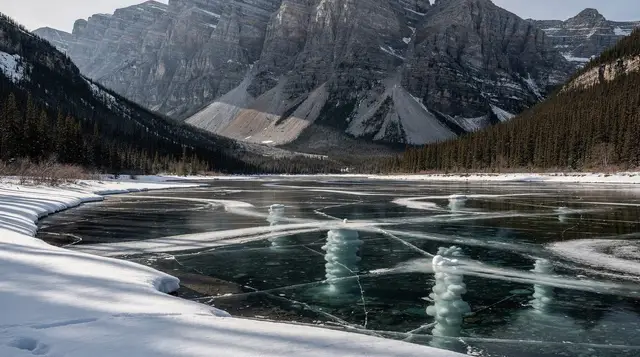
Once the boat cruise season ends, the lake freezes over and the scenic drive sees far fewer visitors. Some sections of the road may see seasonal restrictions or closures toward the far end, separate from the day-use area near the lake’s outlet, so check current conditions rather than assuming full access. There’s no organized winter activity comparable to the ice walks at Johnston Canyon or Maligne Canyon here — Lake Minnewanka in winter is a quiet, frozen landscape rather than a program of scheduled activities, which is either a reason to skip it or a reason to like it, depending on what you’re after.
Fitting Lake Minnewanka into a Banff itinerary
Because it’s close to town and doesn’t require a full day, Lake Minnewanka slots easily into a first full day in the park. It pairs well with a morning or afternoon in Banff townsite itself, and doesn’t compete for the same block of time as a trip out to Lake Louise or the Icefields Parkway, both of which need the better part of a day on their own. See one day in Banff for how it can slot alongside a townsite morning, and Banff’s daily budget for how the cruise price compares to other paid activities in the park.
an early sunrise outing at Moraine Lake is a useful comparison for planning purposes: it demands a pre-dawn start and shuttle logistics, while Lake Minnewanka works on ordinary daytime hours and doesn’t require booking weeks ahead, which makes it a good fallback for a day when the big-name lakes aren’t practical or when the Moraine Lake shuttle is fully booked.
For travellers building a longer loop through the region rather than a single Banff-based day, a broader day trip covering Banff’s gondolas and winter hikes or a guided outing from Canmore or Banff to Moraine Lake both bundle transport and access in one booking, which removes the parking and shuttle-timing questions entirely for anyone who’d rather not self-drive the scenic drive network on their own.
Practical summary
| Question | Answer |
|---|---|
| Distance from Banff | About 6 km, 10-15 minutes |
| Getting there without a car | Roam Transit Route 6, seasonal |
| Boat cruise season | Roughly May/June to September |
| Boat cruise duration | About 1 hour on the water |
| Fishing | Requires a Parks Canada fishing permit |
| Swimming | Possible but rare; the water is cold |
| Winter | Lake freezes, cruise does not operate |
| Pass required | Yes, Parks Canada park entry pass |
Frequently asked questions about visiting Lake Minnewanka
How long is the Lake Minnewanka boat cruise?
The narrated sightseeing cruise runs about an hour on the water, with boarding and parking adding extra time on top. It operates seasonally, roughly from May or June through September, and isn’t available in the off-season or winter.
Can you swim in Lake Minnewanka?
Technically yes, but almost nobody does. The lake is fed by glacial meltwater and stays cold even in August, so wading at the shoreline is far more common than actual swimming, and there are no lifeguards or supervised beach areas.
Is Lake Minnewanka the same lake as Two Jack Lake?
No. They sit along the same scenic drive and are often visited together, but Two Jack Lake is a separate, much smaller lake next to Lake Minnewanka, with its own day-use area and its own character.
Do you need a fishing licence at Lake Minnewanka?
Yes. Fishing anywhere in Banff National Park, including Lake Minnewanka, requires a valid Parks Canada national park fishing permit, purchased separately from any provincial Alberta licence, plus a Parks Canada entry pass to be in the park at all.
How do you get to Lake Minnewanka without a car?
Roam Transit’s Route 6 runs from Banff townsite directly to the Lake Minnewanka day-use area on a seasonal schedule, which avoids the need to park along the scenic drive during busy summer weekends.
Is Lake Minnewanka worth visiting if you’ve already seen Lake Louise or Moraine Lake?
Yes, for a different reason. Lake Louise and Moraine Lake are about the view; Lake Minnewanka is about doing something on the water, whether that’s the boat cruise, fishing, or a picnic, and it’s close enough to Banff to fit into a half-day without much driving.
Does Lake Minnewanka freeze in winter?
Yes, the lake ices over for winter, and the boat cruise does not operate in the off-season. The scenic drive itself may also see seasonal closures on its far end, so check current conditions before planning a winter visit specifically around the lake.