Canoeing and kayaking near Banff: where the calm water actually is
Where can you canoe or kayak near Banff?
The Bow River and Vermilion Lakes right in Banff are the easiest, cheapest paddling. Lake Louise and Moraine Lake offer the iconic turquoise water but cost more and draw long rental lines, and Moraine Lake's shuttle-only access makes bringing your own canoe there impractical. Emerald Lake in Yoho is a calmer, less crowded alternative about an hour away.
If you want to get on the water near Banff without a rapid in sight, there are really five options worth knowing about, and they differ a lot in cost, crowding and how much planning they need. This guide covers the flatwater spots only: the Bow River through downtown Banff, Vermilion Lakes, Lake Louise and Moraine Lake for the classic turquoise water, and Emerald Lake in Yoho National Park as the quieter alternative.
It doesn’t cover the motorized Lake Minnewanka cruise, which is a different kind of outing on a different lake, or whitewater rafting on the Kicking Horse, which is a faster-water activity with its own gear and guides. Both have their own pages if that’s what you’re after.
The Bow River in downtown Banff
The easiest paddling near Banff is also the one most visitors overlook, mostly because it doesn’t photograph like a glacial lake. The Bow River runs right through town, and a rental put-in near the Bow Falls area lets you paddle a calm, slow-moving channel with Mount Rundle and Tunnel Mountain in view, without a shuttle, a reservation, or a long drive.
This is genuinely low-effort paddling. Outfitters in town rent canoes and kayaks by the hour, typically in the 40 to 70 CAD per hour range depending on the boat and the season, and you can usually walk up and be on the water within a few minutes rather than waiting in a line. The current on this stretch is gentle enough for a family outing, and it’s one of the few paddling options in the area open to same-day, no-plan visitors.
The trade-off is scenery. The Bow River here is pleasant but brownish-green, not the turquoise colour the lakes are known for, and wildlife sightings are possible but not guaranteed — an elk or a bald eagle along the bank is a bonus, not something to count on. If your priority is an easy, cheap hour on the water with minimal logistics, this is it. If you came for the postcard colour, keep reading.
If you’d rather have a guide point out what to look for along the bank instead of renting and setting out on your own, a guided kayaking trip through Banff National Park covers the same calm stretch of river with someone else handling the routing.
Vermilion Lakes: calm water, quiet crowds
A short drive or bike ride from downtown Banff, Vermilion Lakes is a chain of shallow, marshy lakes best known as a sunset photography spot, with Mount Rundle reflected in the still water. It’s less commonly promoted as a paddling destination, which is exactly its appeal: you can have long stretches of it to yourself even in July.
There isn’t a large-scale rental operation directly on Vermilion Lakes the way there is at Lake Louise, so paddling here usually means bringing your own canoe or kayak, or renting in town and carrying or roof-racking it out. That extra step filters out a lot of the crowd. The water is shallow and reed-lined in places, which makes it a good spot for slow, contemplative paddling and birdwatching rather than a long-distance outing, and it’s calmer than the open water of the bigger lakes when afternoon wind picks up.
Access is by the Vermilion Lakes Drive, a short paved road off the Trans-Canada Highway on the edge of town, and there’s no fee beyond your park pass. If Lake Louise’s turquoise water is the draw but the crowds aren’t appealing, Vermilion Lakes won’t replace that colour, but it will give you calm water and elbow room within minutes of downtown.
Lake Louise: the iconic water, at iconic prices
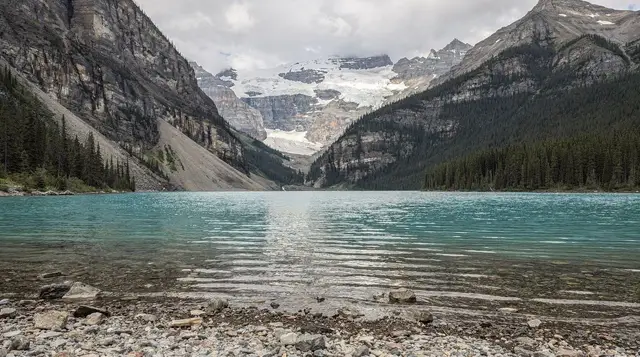
Lake Louise is the paddling most people picture when they think of canoeing in the Canadian Rockies — the glacier-fed turquoise water, the Victoria Glacier at the far end, the Château Lake Louise on the shore. It’s also the most expensive and most crowded option on this list.
A permanent boathouse rents canoes by the hour, and rates commonly run from around 150 CAD for the first hour, priced per canoe rather than per person, with the rate rising through peak summer. There’s no advance booking for the canoe rental itself — it’s a first-come, first-served dock, and on a clear July or August morning a wait of 30 minutes or more is routine, longer by midday. Arriving at opening is the only reliable way to shorten that wait. For the full breakdown of current pricing, wait times and how the line actually works, see the dedicated canoeing at Lake Louise and Moraine Lake guide.
The lake is reachable by car with paid, limited parking at the lakeshore, or by Roam Transit’s 8X and 8S routes from Banff and Lake Louise village, which is worth considering in peak season when the lakeshore lots fill early. The lake itself doesn’t clear of ice until around mid-June most years — see when the lakes thaw for the seasonal detail — so a canoe trip planned for May or even early June is likely to find ice, not open water.
Moraine Lake: the view is real, the logistics aren’t simple
Moraine Lake, set against the Valley of the Ten Peaks, is arguably even more photogenic than Lake Louise, and it sometimes has its own small canoe rental concession on the dock. The colour and the setting are the draw. The access is the complication.
The road to Moraine Lake has been closed to private vehicles year-round since 2023. The only ways in are the Parks Canada shuttle, Roam Transit, a commercial tour bus, or cycling the access road yourself — full details in the Moraine Lake shuttle guide. That single fact reshapes how paddling here actually works. If you’re hoping to bring a canoe or kayak you rented in Banff or Canmore, there’s no practical way to get it to the lake: you can’t drive it in, and hauling a boat onto a shuttle, a bus, or a bike isn’t something any of those services are set up for.
In practice, that leaves two routes to paddling at Moraine Lake. First, if a rental concession happens to be operating on the dock that season — which isn’t guaranteed and has varied from year to year — you can rent on-site, subject to the same shuttle-only access as everyone else. Second, a guided tour that packages the shuttle, timing and a canoe outing together removes the guesswork, since the operator handles getting you and the boat to the water within the shuttle’s access windows. A guided big-canoe outing through Banff National Park is one way to get a paddling experience without wrestling with the shuttle logistics yourself.
Either way, don’t plan a Moraine Lake canoe trip as a spontaneous stop on a driving day. Reserve your shuttle slot in advance — blocks open in spring, with a rolling 48-hour booking window later in the season — and treat the canoe rental as a bonus if the timing and availability line up, not as the anchor of your day.
Emerald Lake: the quieter alternative in Yoho
If the idea of Lake Louise’s turquoise water appeals but the wait and the price don’t, Emerald Lake in Yoho National Park is worth the drive. It’s about 85 kilometres and roughly an hour from Banff, just over the Continental Divide into British Columbia, near the small village of Field.
Emerald Lake has its own boathouse and canoe rental, generally at a lower price point and with noticeably shorter lines than Lake Louise, even in peak summer. The lake sits in a bowl of peaks with the President Range behind it, and while it draws its own crowd, it’s a visible step down in intensity from Lake Louise’s dock scrum. A loop trail circles the lake if you’d rather walk the shoreline than paddle it, or do both.
Because Yoho is in British Columbia, not Alberta, your Parks Canada pass still covers entry, but be aware the drive there and back adds meaningfully to a day already built around Banff-area sightseeing — the Natural Bridge and Takakkaw Falls are both close by if you want to make a fuller day of the Yoho side, though the road to Takakkaw Falls itself closes for winter.
Renting locally versus bringing your own boat
None of the paddling spots covered here require you to own a canoe or kayak — every one of them has a rental option nearby, whether that’s a boathouse on the lake itself or an outfitter in Banff or Canmore town. For most visitors, especially anyone flying in, renting locally is the only realistic choice: airlines won’t fly a canoe, and hauling one on a road trip through the Rockies is impractical for a single afternoon’s paddling.
Where this gets complicated is Moraine Lake, as covered above — the shuttle-only access means a boat rented in town can’t easily be brought to the water there. Lake Louise, Emerald Lake and the Bow River, by contrast, all have rental docks or put-ins reachable by car or transit, so a locally rented canoe or kayak works fine. If you’d rather have the paddling built into a guided day that also covers wildlife-watching stretches of the Bow Valley, a guided big-canoe tour on the Bow River watching for wildlife combines the easy town-site paddling with some naturalist commentary, which suits travellers who’d rather not manage a rental themselves.
What canoeing and kayaking cost near Banff
| Location | Typical rental cost (per hour, per boat) | Access | Best for |
|---|---|---|---|
| Bow River, Banff | ~40–70 CAD | Walk-up, no reservation | Easy, cheap, same-day |
| Vermilion Lakes | Bring your own or carry a rental | Short drive from Banff | Quiet water, birdwatching |
| Lake Louise | ~150+ CAD, rising in peak season | Car or Roam Transit 8X/8S | Iconic scenery, willing to queue |
| Moraine Lake | Varies, concession not guaranteed | Shuttle, bus or bike only | Bonus paddle, not the plan |
| Emerald Lake (Yoho) | Lower than Lake Louise | ~85 km / 1 hour drive | Similar scenery, shorter lines |
These figures are planning ranges, not quotes — rental prices move year to year and by season, so confirm the current rate at the boathouse or outfitter before you go.
Safety and cold water
Every one of these bodies of water is fed by snowmelt or glacial melt, and even in the height of summer the water stays cold — often in the single digits Celsius for the high-elevation lakes, a little warmer at the Bow River and Vermilion Lakes. Life jackets are required and provided by every legitimate rental operator; wear it rather than stow it. Wind can pick up on open water through the afternoon, particularly at Lake Louise and Moraine Lake, so a morning paddle tends to be calmer than a midday one.
None of these spots involve rapids or moving water beyond the Bow River’s gentle current, so no whitewater experience is needed. If you’re drawn to faster-moving water instead, that’s a different kind of outing with its own gear, guides and safety briefing, covered separately.
Choosing between a guided tour and paddling on your own
Renting a canoe or kayak yourself and paddling at your own pace is cheaper and simpler for the Bow River, Vermilion Lakes and Emerald Lake, where access is straightforward and there’s no line to manage beyond the rental desk itself. A guided tour earns its cost mainly at Moraine Lake, where the shuttle logistics are the real obstacle, or if you want a single outing that strings together several of Banff’s best-known viewpoints without planning the driving and timing yourself — a full-day tour covering nine iconic Banff spots is one way to see a broad slice of the park, paddling included, in a single organized day.
If you’re weighing how a canoe outing fits into a longer visit, timing your visit well to avoid the worst of the midday rush matters, and parking at Banff and Lake Louise is worth reading before you drive anywhere near the Lake Louise lakeshore in July or August.
Canoeing and kayaking near Banff: frequently asked questions
Where’s the best place to canoe near Banff without a crowd?
Vermilion Lakes and the calm stretch of the Bow River near downtown Banff see far fewer paddlers than Lake Louise or Moraine Lake, mostly because they lack the postcard turquoise colour that draws the crowds. Emerald Lake in Yoho, about 85 kilometres from Banff, is the quieter option if you’re willing to drive for scenery closer to Lake Louise’s without the same lineup.
Can you bring your own canoe or kayak to Moraine Lake?
In practice, no. The road to Moraine Lake has been closed to private vehicles year-round since 2023, and access is limited to Parks Canada shuttles, Roam Transit, a commercial tour, or a bicycle. Strapping a canoe to a shuttle or carrying one up the access road by bike isn’t realistic for most visitors, which is why a rental on-site or a guided tour that includes paddling is the practical route.
Do you need a permit to canoe on the Bow River in Banff?
No separate permit is required to paddle the calm town-site stretch of the Bow River, but everyone inside Banff National Park needs a valid Parks Canada park pass, and boaters should carry a life jacket for each person. Rental outfitters supply both the gear and the safety basics as part of the rental.
Is Lake Louise or Moraine Lake better for canoeing?
Lake Louise has a permanent boathouse with a larger rental fleet and is reachable by road or by Roam Transit’s 8X and 8S routes, which makes it the more dependable option. Moraine Lake’s canoe rental, when it operates, is smaller in scale and tied to a shuttle-only access window, so treat Lake Louise as the reliable choice and Moraine Lake as a bonus if the timing and availability line up.
What’s the water temperature like for canoeing near Banff?
Cold, even in summer. These are glacier- and snowmelt-fed lakes and rivers, and water temperatures commonly sit in the single digits Celsius through most of the season, with the Bow River and lower-elevation spots warming a little more than the high-elevation lakes. A life jacket is non-negotiable, and a capsize is a genuine cold-water hazard, not just an inconvenience.
When do the lakes near Banff become paddleable?
Lake Louise typically clears of ice by mid-June, with Moraine Lake following a little later, so canoeing before then simply isn’t offered. The Bow River and Vermilion Lakes, at lower elevation, are usually paddleable earlier in the spring and later into the fall than the high-elevation lakes.
Do I need previous kayaking or canoeing experience?
No. All of the spots covered here are flatwater — calm lakes and a gentle river channel, not whitewater — and rental outfitters run brief safety orientations before you launch. Wind picking up across open water in the afternoon is the main thing beginners should watch for, which is why a morning session is usually calmer.
Lake cruises, canoeing & rafting on GetYourGuide
Verified deep-linked GetYourGuide tours. Book through these links and we earn a small commission at no cost to you.
GetYourGuide does not provide a product photo for this activity — the image shows the meeting point, photographed by us.