Emerald Lake: Yoho's largest lake, a short drive from Banff
Is Emerald Lake part of Banff National Park?
No. Emerald Lake is in Yoho National Park, a separate national park in British Columbia that borders Banff National Park at the Continental Divide. It's about 85 kilometres from Banff via Field, roughly a 1 hour 15 minute drive, and it's covered by the same Parks Canada pass system as Banff, but it isn't the same park.
A different park, one province over
Emerald Lake gets lumped in with the Banff lake circuit often enough that it’s worth saying plainly: it isn’t in Banff National Park. It’s in Yoho National Park, a separate national park that begins in British Columbia, on the far side of the Continental Divide from Banff. The two parks share a boundary near Kicking Horse Pass, and they’re both part of the same UNESCO Canadian Rocky Mountain Parks designation, but they’re administered as distinct parks with their own gates, their own trail networks, and — this trips people up specifically — their own approach to Parks Canada passes, which we’ll get to below.
Emerald Lake is the largest lake within Yoho, a park that’s a fraction of Banff’s size at roughly 1,313 square kilometres against Banff’s 6,641. Where Banff’s big lakes (Lake Louise, Moraine Lake) sit close to the Trans-Canada Highway on the Alberta side, Emerald Lake sits a further, paved side-road drive past the small railway town of Field, which makes it feel more removed from the main tourist corridor than it actually is on a map.
Getting there from Banff, via Field
From Banff, the route runs west on the Trans-Canada Highway (Highway 1), past Lake Louise, over Kicking Horse Pass at the Continental Divide, and down into British Columbia toward Field. That stretch to Field is about 85 kilometres, roughly an hour of driving. From the highway junction just past Field, Emerald Lake Road climbs about 8 kilometres up a paved spur to the lake itself, adding another 10 to 15 minutes. All told, budget around 1 hour 10 to 15 minutes from Banff to the Emerald Lake parking lot, more if you’re stopping for photos at any of the pullouts along the way.
There’s no train, bus route, or scheduled shuttle running visitors from Banff to Emerald Lake specifically; getting there means a rental car, a private transfer, or a guided tour that includes the stop. If you’re coming from Lake Louise rather than Banff itself, the drive is shorter, since you’re cutting off the first stretch of highway.
| From | Distance | Drive time |
|---|---|---|
| Banff | ~93 km | ~1h10–1h15 |
| Lake Louise | ~50 km | ~40–45 min |
| Field, BC | ~8 km | ~10–15 min |
The largest lake in Yoho, and where its colour comes from
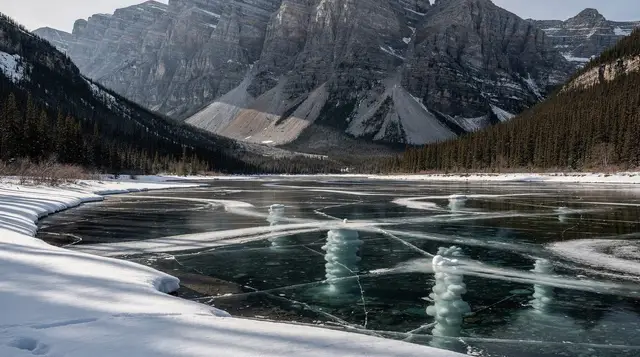
Emerald Lake sits at roughly 1,300 metres, ringed by the peaks of the President Range — Mount Burgess and the President and Vice President peaks are the ones you’ll see reflected in photos — with meltwater feeding in from the surrounding glaciers and snowfields. Like the better-known lakes near Banff and Lake Louise, the colour comes from glacial rock flour: fine sediment ground by moving ice, suspended in the meltwater, scattering light toward the blue-green end of the spectrum.
The mechanism is the same one behind Lake Louise, Moraine Lake, and Peyto Lake — see our full explanation of why these lakes turn turquoise if you want the detail once rather than repeated on every lake page.
The timing follows the same seasonal pattern too. Ice typically holds into late spring, meltwater volume builds through June, and the colour is strongest through July and August, when glacial melt peaks. By late September, as melt slows, the water often shifts toward a duller, flatter green. Our lake thaw timing guide has the month-by-month breakdown that applies across the region’s glacial lakes, Emerald included. A May visit here, like a May visit to Moraine Lake, is more likely to show a partly frozen, murky lake than the bright green of the postcards — plan expectations accordingly if your trip lands in shoulder season.
Walking the loop trail
The main draw at Emerald Lake, beyond the view from the parking area, is the loop trail that circles the entire shoreline: about 5.2 kilometres, with almost no elevation gain, typically taking 1 to 1.5 hours at a relaxed walking pace with stops for photos. It’s one of the easier lakeshore walks in the Banff-Yoho area precisely because it stays flat and follows the water the whole way, rather than climbing to a viewpoint the way the tea house trails above Lake Louise do.
The trail surface varies: packed gravel and dirt for most of its length, with a boardwalk section crossing the marshy inflow at the lake’s north end, and a footbridge near the lodge on the south side. It isn’t paved, and after rain the north-end boardwalk area can get soft underfoot, but it doesn’t require technical footwear — trail runners or hiking shoes are enough for most of the year. Because the loop stays close to water level the whole way, it also tends to stay a few degrees cooler than the parking lot on a hot July afternoon, which is a small but real reason people prefer it over shorter, sunnier stops.
If you only have time for part of the loop, the south shore near Emerald Lake Lodge gives the classic view back across the water toward the President Range and is the busiest section; the north and west sides thin out noticeably, even at midday in summer.
The lodge, canoes, and what’s actually on site
Emerald Lake Lodge sits on a small peninsula partway around the lake, a historic property with a restaurant and rooms, reachable by a short footbridge from the main parking and day-use area. It’s a working lodge, not a museum piece, so day visitors are welcome to walk through the grounds and use the restaurant, but it isn’t set up as a tourist attraction in its own right.
Canoe rentals run from the lakeshore near the lodge through the warmer months, roughly late spring into early fall depending on ice and water levels, priced by the hour. On a clear summer afternoon, demand outstrips the rental fleet fast, so if paddling the lake is the point of your visit, plan to arrive early or expect a wait. There’s no boat launch for private watercraft and no swimming beach to speak of — like most of the region’s glacial lakes, the water stays cold enough year-round that swimming isn’t really the draw.
Facilities at the day-use area are basic: washrooms, a parking lot, and the lodge itself for food, rather than a visitor centre or interpretive building.
What’s nearby that this guide doesn’t cover
Two well-known Yoho stops sit close to Emerald Lake Road but get their own dedicated coverage rather than a full treatment here. The Natural Bridge — a rock arch the Kicking Horse River has carved through over centuries — is a short detour on the way in, worth the five-minute stop if you’re already driving past.
Takakkaw Falls, one of Canada’s tallest waterfalls, is up a separate spur road further into the Yoho Valley and is closed to vehicles outside the summer season; see our dedicated Takakkaw Falls guide for access details and timing, since it’s a different stop with its own seasonal closure to plan around, not an add-on to an Emerald Lake visit.
The Parks Canada pass, and why Yoho still needs one
This is where the “separate park” point actually matters for your wallet and your glovebox, not just for geography trivia. Yoho is checked under the same Parks Canada pass system as Banff, Jasper, and Kootenay — a valid day pass or annual Discovery Pass gets you into all four, and a pass bought at the Banff park gate is valid here too. You do not need to buy a second, Yoho-specific pass. See our Parks Canada pass guide for current per-adult and per-vehicle rates, since prices are set annually and worth checking against the official schedule before you go.
What Yoho does not share is any relationship with the Kananaskis Conservation Pass, the separate Alberta provincial system required in Kananaskis Country. The two systems are unrelated — a Parks Canada pass doesn’t cover Kananaskis, and a Kananaskis pass doesn’t cover Yoho — and mixing them up is a common, avoidable mistake on multi-stop Rockies trips. Our Kananaskis pass vs. Parks Canada guide breaks down which one you actually need for which stop.
Crowds, parking, and self-drive access
As of this review, Emerald Lake Road remains open to private vehicles year-round (conditions permitting in winter), with no shuttle-only restriction of the kind imposed on Moraine Lake since 2023. That’s the practical reason some travellers choose Emerald Lake over Moraine Lake on a tight schedule: you can still drive yourself there and park, rather than booking a shuttle seat in advance.
That doesn’t mean the lot is empty. Through July and August, expect it close to full by mid-morning, with a genuine chance of a short wait for a space around midday. Arriving before 9 a.m. or after 4 p.m. is the reliable way to get a spot without circling. Our lake crowds and quiet times guide covers this pattern across the region’s popular lakes, and the same logic applies here: fewer cars, shorter trail traffic, and better light in the early morning window.
Emerald Lake versus Lake Louise and Moraine Lake
If you’re deciding which lake stop to prioritize on a limited schedule, the honest comparison is this: Lake Louise and Moraine Lake are more dramatic in a single glance, framed tightly by taller peaks and reachable on much shorter walks, but they’re also more crowded and, in Moraine’s case, shuttle-dependent. Emerald Lake is a gentler, larger scene, its loop trail gives a longer walk without a climb, and — for now — you can still just drive there.
It also sits an extra half hour or so further out, in a different park, which is worth weighing if your day is already tight. Our Lake Louise vs. Moraine Lake guide covers that specific trade-off in more depth if Emerald Lake is a third option on your list rather than a replacement for either.
Booking a tour that includes Emerald Lake
Because Emerald Lake is a further, separate-park drive from Banff, a fair number of visitors without a rental car — or without the appetite for a full day behind the wheel — book it as part of a guided outing instead. The guided hiking tour around the Emerald Lake basin is built specifically around this lake and its surrounding trail network, rather than treating it as one stop among many.
For a broader day that strings several of the region’s lakes together, the day tour from Banff covering Lake Louise, Yoho, Moraine Lake, and Emerald Lake handles the driving across two parks in one outing. And for travellers based further out, the day trip from Calgary through Canmore and Banff into Yoho National Park covers the full distance without you needing your own vehicle.
Practical notes before you go
- It’s a different park pass check, same pass. Have your Parks Canada pass ready; you don’t need a second one for Yoho, but you still need one.
- Fuel up in Banff or Lake Louise. Field has very limited services; don’t count on finding gas at the Emerald Lake turnoff.
- Bring layers regardless of season. The lake sits in a valley that holds shade longer than open Banff-side viewpoints, and mornings run cold even in July.
- Time zone note. You’re crossing from Alberta into British Columbia on this drive; check your phone’s clock rather than assuming, especially if you’ve booked a timed shuttle or tour elsewhere the same day.
- Don’t stack this with Takakkaw Falls in shoulder season. The Yoho Valley Road to Takakkaw Falls closes outside summer; check current status before building it into the same day as Emerald Lake.
- Pack out food scraps. Black bears are active in the Emerald Lake basin through the warmer months, same as elsewhere in the Rockies parks.
Frequently asked questions about Emerald Lake and Yoho National Park
Is Emerald Lake in Banff National Park?
No. Emerald Lake sits inside Yoho National Park, in British Columbia, which is a distinct national park from Banff even though the two share a boundary at the Continental Divide near Kicking Horse Pass. Banff National Park is entirely in Alberta; Yoho is entirely in BC.
How far is Emerald Lake from Banff?
About 85 kilometres to Field, BC, roughly an hour on the Trans-Canada Highway, then another 8 kilometres up the paved Emerald Lake Road spur. Total drive time from Banff runs around 1 hour 10 to 15 minutes without stops.
How long does it take to walk around Emerald Lake?
The full loop trail is about 5.2 kilometres and mostly flat, taking roughly 1 to 1.5 hours at an easy pace with photo stops. It’s one of the easier lakeshore walks in the Yoho and Banff area.
Do you need a different park pass for Yoho than for Banff?
You need a valid Parks Canada pass to stop in Yoho, the same as in Banff, since both parks are checked under the same national park fee system alongside Jasper and Kootenay. A Banff day pass or Discovery Pass already covers Yoho; you don’t need to buy a second, Yoho-specific pass. This is different from the Kananaskis Conservation Pass, which is a separate provincial system with no relationship to any Parks Canada pass.
Can you canoe on Emerald Lake?
Yes, canoe rentals are available on the lakeshore near Emerald Lake Lodge through the warmer months, typically late spring through early fall, weather and ice conditions permitting. Rentals are priced by the hour and demand outpaces supply on busy summer afternoons.
When does Emerald Lake turn its bright green colour?
The colour builds through June as glacial meltwater carrying rock flour flows in, peaks through July and August, and fades toward a duller green by late September. Like other glacially fed lakes in the region, it can still be partly frozen or a murky grey-green in May.
Is Emerald Lake worth visiting if you’ve already seen Lake Louise and Moraine Lake?
Most visitors find it worthwhile, and for a specific reason: unlike Moraine Lake, Emerald Lake still allows self-drive access, and the loop trail is longer and quieter than the short paths at Lake Louise or Moraine. It’s a different experience more than a better one — larger, flatter, and generally less crowded outside midday in peak summer.
Is there a shuttle to Emerald Lake, or can you drive there yourself?
As of this review, Emerald Lake Road remains open to private vehicles, with no shuttle-only restriction like the one at Moraine Lake. The parking lot is modest for the traffic it gets in July and August, though, so arriving before mid-morning or after late afternoon avoids the worst of it.
Lake Louise & Moraine Lake tours on GetYourGuide
Verified deep-linked GetYourGuide tours. Book through these links and we earn a small commission at no cost to you.
GetYourGuide does not provide a product photo for this activity — the image shows the meeting point, photographed by us.