Most of the lakes people photograph in this part of the Rockies spend half the year frozen and unreachable by any road that isn’t plowed for a ski hill. Emerald Lake is the exception in Yoho National Park: its access road off the Trans-Canada Highway stays open through winter, one of the few big glacial lakes in the region you can actually drive to in January.
That alone sets it apart from its more famous neighbours in the same stretch of highway — Takakkaw Falls and the Natural Bridge near Field, both of which have their own seasonal quirks and their own pages. This one is about Emerald Lake on its own terms: the loop trail, the fishing bridge, the lodge, and the canoe rentals that make it one of the more approachable paddling spots in Yoho National Park.
Getting there: the one Yoho stop that doesn’t wait for summer
Emerald Lake sits about 85 km from Banff, close to an hour by car, reached by following the Trans-Canada Highway west past Lake Louise and through the Kicking Horse Pass into British Columbia. A short, well-marked turnoff a few kilometres past the village of Field leads up a narrow access road to the lake itself. Unlike the road into Takakkaw Falls, which shuts down for winter because it can’t be plowed reliably, the Emerald Lake road is maintained year-round, so it’s a viable stop whether you’re passing through in July or driving the Icefields Parkway corridor in the middle of February.
That said, “open” doesn’t mean “the same experience in every season.” What you’ll find at the lake changes enormously depending on when you show up, and the biggest mistake first-time visitors make is assuming the water will look the way it does in the photos regardless of the month. It won’t. More on that below.
There’s no public transit option that reaches Emerald Lake directly — Roam Transit’s routes stop at Lake Louise and don’t extend into British Columbia, so a private vehicle, a rental car, or a guided tour is the only practical way in. Several multi-lake tours out of Banff and Lake Louise bundle Emerald Lake with Peyto Lake, Bow Lake and sometimes Marble Canyon into a single day, which is a reasonable option if you’d rather not drive the Trans-Canada yourself or want a guide narrating the geology along the way — the Lake Louise, Emerald and Peyto Lake tour covers exactly that combination in a single day trip from Banff.
The loop trail: 5.2 km, flat, and the fishing bridge at the start
The main reason to get out of the car at Emerald Lake is the trail that circles it. It’s about 5.2 km end to end, and it’s close to flat for its entire length, following the shoreline through spruce and fir forest with the lake almost always visible through the trees. There’s no meaningful elevation gain, which puts it well below the effort of trails like Larch Valley or Plain of Six Glaciers, and it’s a realistic option for families, casual walkers, or anyone short on time who still wants more than a five-minute stop at the parking lot.
Most people cover the full loop in about 1.5 to 2 hours, walking at an unhurried pace with stops for photos. The far side of the lake, away from the lodge and parking area, tends to be quieter and gives the best unobstructed views back across the water toward the President Range, the cluster of peaks that forms the backdrop on the lake’s north side. In shoulder season, expect sections of the trail to be muddy, snow-patched, or icy depending on exposure — it isn’t groomed the way a resort trail would be, so trail runners and light hikers are a better call than open sandals outside the height of summer.
Right at the start of the loop, within a few minutes’ walk of the parking lot, you’ll cross the fishing bridge — a wooden footbridge spanning the point where Emerald Lake begins to drain into the broader Kicking Horse River drainage. It’s a natural first stop: the water is often calm enough here to give a clean reflection of the shoreline, and it’s the easiest place on the whole route to get close to the lake’s colour without committing to the full walk. If you’re only stopping for ten minutes between other Yoho or Icefields Parkway plans, the fishing bridge and the view from just beyond it are the highlight to prioritize.
If you’d rather have a naturalist point out what you’re looking at than walk the loop alone, the Emerald Lake and Basin guided hiking tour covers the same lakeshore ground with a guide who can talk through the geology, the wildlife signs and the basin above the lake as you go.
| Trail feature | What to expect |
|---|---|
| Full loop distance | About 5.2 km round trip |
| Elevation gain | Minimal — the trail is essentially flat |
| Typical walking time | 1.5 to 2 hours at a relaxed pace |
| Fishing bridge | A few minutes from the parking lot, at the trailhead end |
| Surface | Packed dirt and boardwalk sections; can be muddy or icy outside summer |
Emerald Lake Lodge: worth a stop even without a reservation
Emerald Lake Lodge sits right at the water’s edge, close to the fishing bridge and the start of the loop trail, and it’s easy to fold into a lakeshore visit whether or not you’re staying overnight. The lodge’s dining room and bar are open to day visitors, and a coffee or a meal here is a reasonable way to extend a stop at the lake into something closer to half a day, particularly if you’ve just finished the full loop and want to sit somewhere with a view rather than eat standing in the parking lot.
It’s worth knowing going in that this is a remote, lake-access lodge with a limited kitchen and no drive-up competition nearby, so prices run higher than a comparable meal in Field or Golden, and service can slow down during a busy midday rush in July and August. It’s not a budget stop; if you’re travelling on a tighter daily budget, packing a lunch and eating at one of the picnic tables near the parking area is the more economical option, and it’s what a fair number of day visitors actually do.
Canoeing Emerald Lake: what it costs and when it runs
A boathouse near the parking area rents canoes through the warmer months, and paddling here is one of the calmer options in the region — Emerald Lake is more sheltered than the open water at Lake Minnewanka and less busy than the boathouse queues you’ll often find at Lake Louise or Moraine Lake in peak season. Rental rates typically run somewhere in the CAD 40 to 75 per hour range, varying with the season and canoe size, and the season itself is tied directly to ice-out: rentals generally don’t start until the lake is reliably clear, usually sometime in June, and wind down again by early fall.
On clear summer weekends, canoe rentals can sell out by mid-morning, so there’s no guarantee of a walk-up spot if you arrive at noon expecting to paddle. If getting on the water is the main reason for the visit, arriving earlier in the day improves the odds considerably. There’s no dedicated canoe-focused tour built specifically around Emerald Lake among the region’s guided options, so a self-arranged rental at the boathouse remains the straightforward way to get out on the water here.
When the colour actually shows up — and when it doesn’t
This is the detail that trips up more visitors than any other at Emerald Lake, and it applies just as much here as it does at Lake Louise and Moraine Lake: the lake spends a large part of the year frozen, and the vivid emerald-green colour that gives it its name is a summer phenomenon, not a year-round one.
The colour comes from suspended glacial rock flour — fine sediment ground down by glaciers upstream and carried into the lake by meltwater, where it stays suspended in the water column and scatters light in a way that produces that distinctive green-blue tone. Until the ice clears and meltwater starts flowing in earnest, none of that is happening — the guide to when the lakes thaw covers the same pattern across the region’s other glacial lakes, if you’re timing a trip around several of them.
Emerald Lake typically remains frozen or partly frozen well into late spring, with the colour developing from June onward and holding through the summer before fading again as flows drop off in fall. A photo showing brilliant emerald water in April or early May simply isn’t representative of what’s actually there at that time of year — if you’re visiting in spring, expect ice, not colour, and plan the trip accordingly rather than being caught off guard at the trailhead.
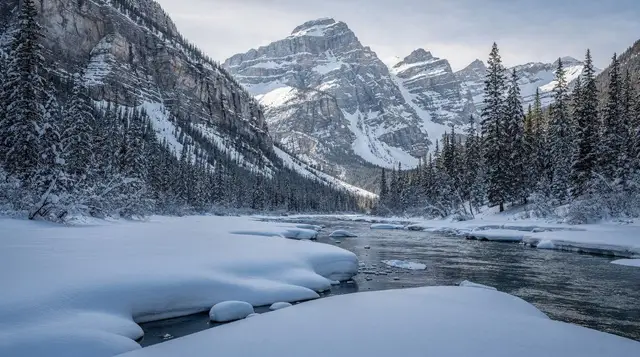
Outside the colour season, the lake isn’t without appeal. A frozen Emerald Lake under snow, framed by the same peaks, has its own quiet character, and the access road being open year-round means it’s one of the more reliable winter stops in the area for anyone snowshoeing or simply wanting a short walk with a mountain backdrop that doesn’t require a summer-only detour.
Parking and crowds: the part that catches people out in summer
The parking area at Emerald Lake is small relative to how many people want to be there on a clear July or August day, and it can fill by mid-morning, particularly on weekends and holiday long weekends. This isn’t unique to Emerald Lake — it’s the same pattern you’ll find at Lake Louise and, historically, at Moraine Lake before its road closed to private vehicles entirely — but it’s less widely known here simply because Emerald Lake gets less attention in general travel writing than its more famous neighbours.
Some seasons have included a shuttle option, typically from a satellite lot or from Field itself during the busiest weeks of summer, as a release valve when the main lot is full — but this has varied year to year, so checking for a current-season notice before you go is worth doing rather than assuming one will be running. The most dependable strategy remains the one that works across this whole region: arrive early, ideally before mid-morning.
A valid Parks Canada day pass or annual Discovery Pass is required for the vehicle regardless of when you visit, since Emerald Lake sits inside Yoho National Park; there’s no separate fee for the lake itself.
What else is nearby, and what this page deliberately leaves out
Emerald Lake shares a stretch of highway with several other Yoho stops, and it’s worth being clear about what’s covered here and what isn’t. Takakkaw Falls, one of the tallest waterfalls in Canada, sits on its own access road nearby, but that road closes for winter and the falls have their own detailed page.
The Natural Bridge, a short rock formation over the Kicking Horse River near Field, is similarly close by but treated separately, as is the village of Field itself, Yoho’s small operational base. If you’re planning a full day in this part of the park, it’s worth reading up on all four separately rather than assuming one covers the others — they’re minutes apart by car but different enough in character and season to deserve their own planning.
Further afield, Golden is about 45 minutes further west and is the base for activities like the Kicking Horse River whitewater rafting season, which runs from roughly May through September, and is a common add-on for anyone continuing west past Yoho rather than looping back to Banff the same day. Golden is also home to the Golden Skybridge, a pair of suspended pedestrian bridges that make for a different kind of stop if you’re not looking for another lake or trail.
Fitting Emerald Lake into a longer day
Because the drive out from Banff runs close to an hour each way, most visitors combine Emerald Lake with at least one other stop rather than making the round trip for the lake alone. The most common pairing is with Lake Louise, and a number of guided day tours are built around exactly that combination — the Lake Louise, Moraine Lake and Emerald Lake tour covers all three of the region’s best-known lakes in one guided day if you’d rather not manage the driving and parking logistics yourself.
For a longer day that adds glacier and canyon stops, the Lake Louise, Emerald and Peyto Lake tour with Marble Canyon and the Columbia Icefield covers a bigger slice of the region in one trip, suited to travellers with limited days.
If you’re building your own route rather than booking a guided day, a reasonable structure treats Emerald Lake as roughly a two-hour stop — enough time for the loop trail and a coffee at the lodge — folded into a broader loop through Yoho National Park or paired with a night in Golden or Field.
Anyone mapping out several days rather than a single outing may find it easier to start from the five-day Banff, Yoho and Kootenay itinerary, which sequences Emerald Lake alongside the region’s other stops rather than leaving you to work out the order on the fly. Before setting out, it’s also worth confirming your park pass situation using the Parks Canada pass guide, since a Banff-only day pass doesn’t automatically cover a stop inside Yoho.
Emerald Lake in a nutshell
For a lake that gets a fraction of the attention Lake Louise and Moraine Lake attract, Emerald Lake earns its place mainly through accessibility: it’s the one big lake in this stretch of the Rockies you can reach by car in any month, its trail is short and flat enough for almost anyone, and its canoe rentals and lodge give it more to actually do than a pure viewpoint stop.
The trade-offs are real, too — a small parking lot that fills fast in summer, a lodge that charges accordingly for its captive location, and a colour that only shows up for roughly four months of the year. Time the visit for June through September if the emerald water is the point, arrive early if you’re driving yourself, and treat a winter or shoulder-season stop as a different, quieter kind of visit rather than a lesser version of the summer one.
Emerald Lake questions, answered
Is Emerald Lake open all year, unlike Takakkaw Falls?
Yes. The short access road off the Trans-Canada Highway is plowed and open year-round, so you can drive to Emerald Lake in January just as easily as in July. The road to Takakkaw Falls, by contrast, closes for winter, which is one reason the two are worth treating as separate trips rather than one combined stop.
How long does the loop trail around Emerald Lake take?
The full lakeshore loop is about 5.2 km and almost entirely flat, so most people cover it in 1.5 to 2 hours at a relaxed walking pace with photo stops. It’s an easy trail by Yoho standards, with no significant elevation gain, though the far side can be muddy or snow-covered outside summer.
What is the fishing bridge at Emerald Lake?
It’s the wooden bridge you cross right at the start of the loop, near the parking area and lodge, spanning the outlet where Emerald Lake drains into the Kicking Horse River system. It’s a natural photo stop and also the easiest point to see the lake’s colour up close before setting out on the longer walk.
Can you rent a canoe on Emerald Lake, and how much does it cost?
Yes, a boathouse near the parking area rents canoes through the summer season, typically running from late spring to early fall depending on ice-out and weather. Expect roughly CAD 40 to 75 per hour depending on the season and canoe size; rentals often sell out by mid-morning on clear summer days, so there’s no guarantee of a walk-up spot in July or August.
When does Emerald Lake actually turn emerald-green?
Not in spring. Like the other glacier-fed lakes in this part of the Rockies, Emerald Lake is frozen or partly frozen well into late spring, and the milky green-blue colour only fully develops once the ice clears and glacial rock flour starts circulating in the meltwater, typically from June onward. A photo of vivid emerald water in April or early May doesn’t reflect what you’ll actually see.
Is Emerald Lake parking difficult in summer?
Often, yes. The lot is small relative to demand, and on clear days in July and August it can fill by mid-morning, especially on weekends. Some seasons have included a shuttle option from a satellite lot or from Field during peak periods, though this isn’t guaranteed to run every year, so checking Parks Canada’s current-season notices before you go is worth the two minutes it takes.
Do I need a Parks Canada pass to visit Emerald Lake?
Yes. Emerald Lake is inside Yoho National Park, so a valid Parks Canada day pass or annual Discovery Pass is required for every vehicle, the same as in Banff, Jasper and Kootenay. There’s no separate lake admission fee beyond the park pass itself.
Is Emerald Lake Lodge open to non-guests?
Yes. The lodge’s public areas, including its dining room and bar, are open to day visitors, not just overnight guests, and it’s a reasonable stop for a coffee or a meal partway around the loop. It sits right at the lake’s edge near the fishing bridge, so you don’t need to detour far to reach it.