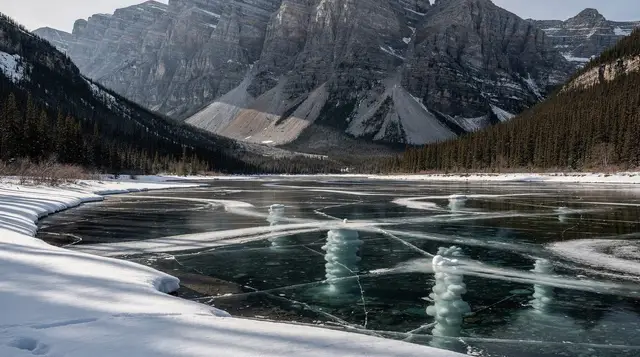
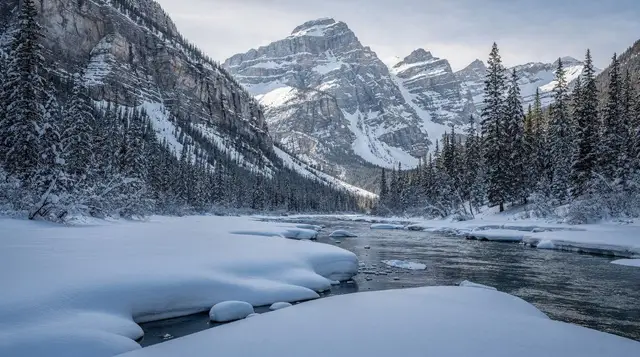
Summer vs winter in Banff: which season fits your trip
Is Banff better in summer or winter?
Neither is objectively better; they're different trips. Summer (July-August) brings 20-25°C days, thawed turquoise lakes, and the heaviest crowds of the year, while winter (November-May) brings -15 to -25°C, three SkiBig3 ski resorts, and ice walks, with far fewer people on the trails that stay open at all.
Ask anyone who has visited Banff more than once and they’ll usually tell you it felt like two different towns depending on when they went. That isn’t an exaggeration built for a brochure — it’s a function of a national park that sits at 1,383 metres in the Canadian Rockies, where the difference between a July afternoon and a January one is closer to 40 degrees Celsius than 10. Picking a season isn’t a minor scheduling detail here; it decides which lakes you’ll actually see in colour, whether you’re renting hiking boots or ski boots, and how many other people will be standing next to you at the viewpoint.
This page sets summer and winter side by side on the facts that actually change a trip: temperatures, what’s open and what’s closed, crowd levels, cost, and the narrow shoulder-season windows that don’t fit neatly into either category. It doesn’t rank one season above the other, because the honest answer depends on what you came to do.
Summer in Banff: July and August at their busiest
Summer in the Canadian Rockies means daytime highs of roughly 20 to 25°C, long daylight hours, and the only period when every lake, trail, and road in Banff National Park is realistically open at once. It’s also, without question, the most crowded stretch of the year — the park draws more than four million visitors annually, and a large share of them arrive in these eight or nine weeks.
The payoff for the crowds is real. Lake Louise and Moraine Lake are at their most reliably turquoise, the Icefields Parkway is fully drivable end to end, and activities that simply don’t run in winter — canoeing, boat cruises, guided hikes into the high alpine — are all on the table. A two-day loop covering the classic viewpoints is a reasonable ask in July in a way it isn’t in January; our two-day Banff bucket list tour is built around exactly that kind of dense, warm-weather itinerary.
Two things catch first-time summer visitors off guard. First, snow at higher elevation is possible in any month of the year — a July hike above the treeline can still turn up a surprise snow squall, so packing a layer isn’t optional just because it’s summer in the valley. Second, “summer” doesn’t mean every lake is thawed the moment the calendar turns to June. Lake Louise typically clears to its blue colour around mid-June, and Moraine Lake usually later still, so an early-June trip planned around lake photos can be disappointed by ice rather than turquoise water.
Wildlife is also active in a different way in summer than it will be later in the year. Elk, bighorn sheep, and the occasional bear are commonly seen from roadside pullouts through July and August, and the standard distances still apply everywhere in the park: at least 100 metres from bears and wolves, and at least 30 metres from everything else, including elk that look tame grazing beside a parking lot. That changes noticeably as summer ends — the elk rut in September and October turns otherwise placid males aggressive, occasionally right in town, which is a shoulder-season hazard summer visitors don’t have to think about.
Winter in Banff: cold, quiet, and built around three ski hills
Winter runs roughly November through May, with daytime temperatures typically sitting between -15 and -25°C, and occasional cold snaps pushing well below -30°C. The cold is real, but it’s also softened at times by chinook winds that can push temperatures up sharply within a day or two — a chinook is one of the few things that makes a Banff winter afternoon genuinely mild without warning.
The organizing fact of winter here is SkiBig3, the joint arrangement covering three resorts: Banff Sunshine Village, which typically runs the longest season of the three, often into late May; Lake Louise Ski Resort; and Mt Norquay, the closest to town and the one that runs night skiing.
Skiing is far from the only winter activity, though — ice walks through frozen canyons, snowshoeing, dog sledding, horse-drawn sleigh rides, and skating on a groomed rink at Lake Louise all fill days that don’t involve a lift ticket. Our winter ice walk with cleats provided covers the canyon side of that list, while a broader winter hikes and gondola day trip strings several cold-weather stops into one outing.
Winter also means real closures, not just snowier versions of summer routes. The road to Takakkaw Falls in Yoho National Park closes outright for the season, and higher alpine trails become genuinely hazardous without avalanche training and gear — this isn’t the season to freelance a route you read about for summer. Snowmobiling, for what it’s worth, is banned inside the national park entirely, in winter or any other season, so it’s never part of the calculation here regardless of month.
On the road, winter tires aren’t legally required in Alberta but are strongly advised, and they are legally mandatory from October 1 to April 30 once you’re on British Columbia mountain highways — relevant if a winter trip pushes west toward Yoho or Kootenay territory. A glacier day out on the Icefields Parkway looks and runs very differently in January than it does in August, worth checking before you plan one.
The shoulder seasons: quieter, cheaper, and a narrow golden window
May-June and September-October sit between the two extremes, and they’re often the best-value weeks of the year for people willing to trade some certainty for smaller crowds. Trails and lakes aren’t fully summer-ready in late May — expect lingering snow and a later thaw at higher elevations — and by October, daytime temperatures are dropping and some seasonal operations (tea houses, boat cruises, the Columbia Icefield experiences) are winding down or already closed for the year.
The one unmissable event tucked into the shoulder season is the alpine larch turning gold, concentrated in the last two weeks of September and almost entirely at Larch Valley and Sunshine Meadows. It’s a short window, and word has gotten out: this is genuinely one of the most congested hiking periods of the year despite falling outside peak summer. It also comes with a safety wrinkle worth knowing before you go — grizzly activity in the area during larch season means trail wardens frequently require hikers to travel in groups of four or more, a rule that catches solo hikers and couples off guard every year.
Shoulder season also affects the Bow Valley Parkway in a way that surprises people who assume all closures happen in winter. The eastern section of the parkway actually closes to vehicles from March 1 to June 25 to protect wildlife during a sensitive period — which means the road is fully open through winter and only shuts down as the calendar moves toward summer.
Summer vs winter, side by side
| Summer (Jul-Aug) | Winter (Nov-May) | |
|---|---|---|
| Daytime temperature | 20-25°C | -15 to -25°C, colder in cold snaps |
| Crowd level | Highest of the year | Lowest, except around holidays and SkiBig3 peak weeks |
| Lakes | Thawed, turquoise from mid-June (Lake Louise) | Frozen; some used for skating instead |
| Icefields Parkway | Fully open, all stops accessible | Open but seasonal stops (Columbia Icefield tours) closed |
| Signature activity | Hiking, canoeing, boat cruises | Skiing across three SkiBig3 resorts, ice walks |
| Main cost driver | Peak-season accommodation rates | Lift tickets and gear rental |
| Best suited to | First-time visitors wanting the classic lake views | Skiers, snow-sport travellers, budget-on-lodging trips |
What actually stays open, closes, or changes by season
The honest planning question isn’t “is Banff open in winter” — it always is — but which specific pieces shut down and when. A few worth flagging directly:
| Route or site | Status by season |
|---|---|
| Bow Valley Parkway (east section) | Closed to vehicles March 1-June 25; open the rest of the year, including winter |
| Takakkaw Falls road (Yoho) | Closed for winter entirely |
| Columbia Icefield / Ice Explorer | Runs roughly April/May-October only |
| Lake Louise, Moraine Lake | Frozen until mid-June or later; not turquoise before then |
| SkiBig3 resorts | Operate roughly November-May, closing dates vary by resort and snow year |
| Johnston Canyon walkway | Open year-round; requires ice cleats once frozen |
A route or a viewpoint being open in one season says nothing about the others, and pages or guides that treat “open” as a year-round default are the ones that leave people standing at a locked gate. If a specific stop matters to your itinerary, check its own season note before building a day around it.
Cost: winter isn’t automatically the cheaper option
It’s tempting to assume winter, with fewer visitors, must also be cheaper, but that’s only partly true. Accommodation in Banff and Canmore does generally undercut the peak July-August rates once you’re past the December holidays and into the January-March core of winter, and flights can follow the same pattern. But winter introduces its own costs that summer skips entirely: SkiBig3 lift tickets, ski or snowboard rental, and layers of cold-weather gear that a summer hiking trip simply doesn’t need. A budget built around hiking and sightseeing in July looks different from one built around two days of lift tickets and rental gear in February, even before either factors in the Parks Canada pass both seasons require.
Packing costs shift with the season too, and they’re easy to underestimate. A summer trip needs little beyond layers, sun protection, and sturdy footwear, most of which travellers already own. A winter trip is a different equation: insulated boots, a proper winter jacket, gloves, and traction devices for icy walkways add up quickly if you’re arriving from a climate that doesn’t require them, on top of whatever ski or snowshoe gear you rent locally rather than pack from home.
Shoulder season remains the strongest value case on paper — lower accommodation rates, no lift tickets to buy, and a real (if narrow) shot at good hiking weather — offset by the risk of unpredictable conditions and some attractions not yet open or already closed for the year.
Choosing between them
If the goal is the postcard version of Banff — turquoise lakes, green valleys, the full Icefields Parkway — that’s a summer trip, full stop, and the crowds are the price of admission. If skiing three resorts on one pass, walking a frozen canyon in cleats, or seeing the Rockies genuinely quiet is the draw, winter delivers something summer can’t replicate at any price. Travellers chasing the narrow larch window or simply trying to dodge both the July crowds and the -25°C mornings should look hardest at the shoulder weeks, understanding that some doors — tea houses, boat cruises, glacier tours — will already be closed.
For a broader, month-by-month version of this same comparison, our month-by-month guide breaks the whole year down rather than collapsing it into two seasons. Those leaning toward a cold-weather multi-stop day should look at the winter canyons and lakes tour alongside the ski-resort options above.
Summer vs winter in Banff: your questions answered
Are Lake Louise and Moraine Lake open and turquoise all year?
No. Both lakes stay frozen well into spring. Lake Louise typically thaws to its turquoise colour around mid-June, and Moraine Lake usually a little later than that, so a visit in April or May sees ice and snow, not the blue water in the postcards. Outside that thaw window the lakes still make for a legitimate winter or shoulder-season stop, just a different-looking one.
Is the Bow Valley Parkway open to drive in winter?
Yes, in winter the full length of the Bow Valley Parkway (Highway 1A) is open to vehicles. The seasonal closure runs the other way: the eastern section closes to cars from March 1 to June 25 to protect wildlife during a sensitive period, which actually falls in the shoulder season rather than winter itself.
Do I need a car for Banff in winter, and is driving difficult?
A car is useful but not required, since shuttle buses connect Banff and Canmore hotels to all three SkiBig3 resorts. If you do drive, winter tires are strongly recommended on Alberta’s mountain roads and legally required from October 1 to April 30 on the British Columbia side of the Rockies, including the Icefields Parkway once it crosses into Yoho and Kootenay.
When exactly do the larches turn gold near Banff, and is it crowded?
Alpine larches usually turn gold in a narrow window in the last two weeks of September, concentrated around Larch Valley and Sunshine Meadows. It’s one of the most crowded weeks of the shoulder season, and Parks Canada or trail wardens frequently require hikers to move in groups of four or more on some trails because of grizzly activity during this period.
Which hiking trails or roads are actually closed once winter sets in?
Several close outright rather than just getting snowy. The road to Takakkaw Falls in Yoho National Park closes for winter, and many higher-elevation trails become impassable or avalanche-prone without proper gear and skills. Lower routes like Johnston Canyon and Tunnel Mountain stay accessible, though Johnston Canyon requires ice cleats once its walkway freezes.
Is a Banff winter trip actually cheaper than a summer one?
Not automatically. Lift tickets, ski rentals, and winter-specific gear add real cost that a summer hiking trip skips, though winter can undercut peak summer on accommodation and avoids the premium pricing of July and August. The bigger cost driver is usually what you choose to do each day, not the season on the calendar.
Snowshoeing, ice walks & winter tours on GetYourGuide
Verified deep-linked GetYourGuide tours. Book through these links and we earn a small commission at no cost to you.
GetYourGuide does not provide a product photo for this activity — the image shows the meeting point, photographed by us.