Visiting Banff in winter
What is winter like in Banff and is it worth visiting?
Banff winter runs roughly November to May, with daytime highs of -15 to -25 degrees Celsius and occasional dips below -30, softened by chinook winds. It's worth visiting for skiing across three SkiBig3 resorts, frozen canyon walks, and quiet lakes, but several roads, trails, and viewpoints that are easy in summer become closed or genuinely risky.
How Banff winter differs from the postcard version
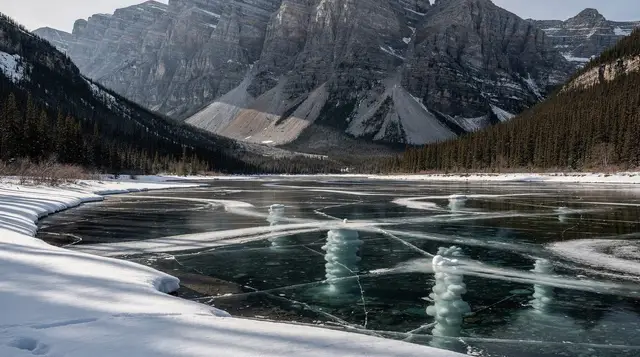
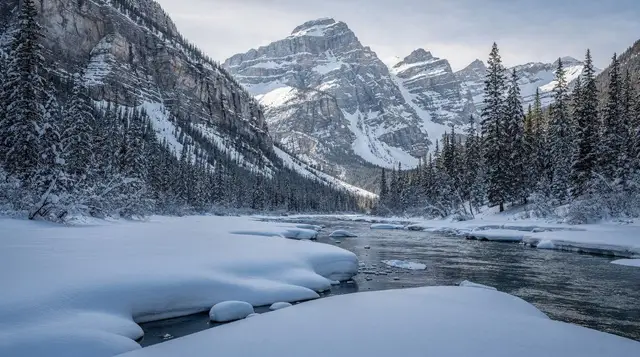
Search “Banff winter” and you get two competing images: a turquoise lake ringed by snowy peaks under bluebird sky, and a ski town buried in powder. Both are real, at different moments, and neither is the whole picture. The lakes are frozen solid and mostly white by December, not turquoise. The skiing is genuinely good across three separate resorts.
And a handful of roads, trails, and viewpoints that look effortless in July become closed, seasonal, or meaningfully riskier once the snow sets in. This guide covers what to actually expect from a winter visit to Banff, roughly November through May, without the month-by-month detail covered separately in the Banff winter month by month guide.
Temperatures and the chinook factor
Winter daytime highs in Banff typically run from -15 to -25 degrees Celsius, with occasional cold snaps that push below -30, usually in a short stretch during December or January. Nights are colder again. What throws people off is how much a single day can swing: chinook winds, warm downslope gusts that roll off the eastern side of the Rockies, can raise the temperature 15 to 20 degrees within a matter of hours. A morning at -22°C can be -5°C by early afternoon, then drop back overnight. Check the forecast the evening before rather than days out, and dress in layers you can actually remove.
| Month | Typical daytime high | What to expect |
|---|---|---|
| November | -5 to -10°C | Early snow, ski season starting |
| December | -10 to -20°C | Cold building, holiday crowds |
| January | -15 to -25°C | Coldest month, full ski conditions |
| February | -12 to -22°C | Still cold, Abraham Lake ice bubble window |
| March | -5 to -12°C | Warming, variable snowpack |
| April | 0 to 8°C | Melt underway, resorts starting to close |
| May | 5 to 15°C | Spring in town, Banff Sunshine often still open |
For a deeper dive into what -25°C actually feels like to move around in, and how to dress for it, see what minus 25 degrees really means.
Skiing across the three SkiBig3 resorts
Banff’s winter season is built around three ski areas marketed together as SkiBig3: Banff Sunshine Village, Lake Louise Ski Resort, and Mt Norquay. They’re separate businesses with separate lift tickets, not one combined pass by default, though multi-day and multi-resort products exist. The season runs roughly November to May, but not evenly across the three.
Banff Sunshine usually has the longest season of the group, often running into late May, because its base sits higher than the other two and holds snow longer into spring. Lake Louise Ski Resort is the largest by terrain and typically closes in April. Mt Norquay is the smallest and closest to town, a few minutes’ drive, and is the one resort that runs night skiing. All three tend to close earlier in a light-snow year and later in a heavy one, so treat the “May” end date as optimistic rather than guaranteed. A side-by-side comparison of terrain, price, and who each resort suits is in SkiBig3 resorts compared.
a guided day out that mixes a winter hike with a gondola ride above Banff works well for a first winter day if skiing isn’t the goal, since it covers the scenery without needing your own gear or a lift ticket.
Getting to the resorts without a car
Free or hotel-included shuttles run from most accommodation in Banff and Canmore to all three SkiBig3 resorts during the season, and Roam Transit covers stops within town, along Tunnel Mountain, and out to Canmore. Renting a car for the sole purpose of reaching the ski hill is rarely necessary. The full shuttle schedule and which hotels include it is broken down in the Banff ski shuttle guide; the same logic applies to getting around town generally, since a car adds cost and parking hassle without adding much convenience for a Banff-based winter stay.
What actually closes or gets harder in winter
This is the part visitors researching from summer photos tend to miss. A few examples, separated by what’s closed and what’s simply riskier:
Genuinely closed or unavailable:
-
The Moraine Lake road has been closed to personal vehicles year-round since 2023, and the limited shuttle and tour access that exists in summer is mostly suspended in winter, since the lake is frozen and buried in snow with nothing scenic to shuttle toward.
-
The seasonal services at Saskatchewan River Crossing on the Icefields Parkway close for winter, along with the Columbia Icefield’s Ice Explorer and Glacier Skywalk operations, which run roughly April or May through October.
-
The Lake Agnes and Plain of Six Glaciers tea houses close for the season; both are summer-only stops above Lake Louise.
-
Takakkaw Falls Road in Yoho closes for winter, cutting off vehicle access to that viewpoint until late spring.
Open, but a different experience than summer:
-
The Icefields Parkway itself stays open year-round, plowed but often snow-packed or icy, with long stretches with no cell coverage and, once Saskatchewan River Crossing’s seasonal station closes, no fuel between Lake Louise and Jasper. Photos of the parkway in golden summer light are not what a January drive looks like. Many visitors book a private winter tour along the Icefields Parkway instead of self-driving the full 232 kilometres, which trades flexibility for a driver who knows current road conditions.
-
The eastern section of the Bow Valley Parkway (Highway 1A) closes to vehicles from March 1 to June 25 every year — but that’s a wildlife-protection closure timed to spring, not a winter one. Through the coldest months the parkway is normally open and in reasonable driving shape, and it remains one of the better routes for spotting elk and wolves against snow.
-
Johnston Canyon stays open and becomes a different kind of attraction: the trail turns into a managed ice walk, with crampons often supplied or rented on site. See the ice walk section below.
The general pattern: anything that depends on a seasonal building, a specific unplowed road, or a hike above the treeline should be assumed closed or hazardous between November and May unless you’ve confirmed otherwise for the current year.
Frozen canyon walks
Two canyons turn into guided ice-walk destinations once temperatures drop: Johnston Canyon near Banff and Maligne Canyon near Jasper. Both freeze into columns of ice along their canyon walls, and both are usually visited with crampons, either rented on site or supplied as part of a guided walk, since the trail surface underfoot is packed ice rather than the boardwalk you’d find in summer.
a guided ice walk to Johnston Canyon’s frozen falls is the more accessible of the two from a Banff base, given the shorter drive. If you’d rather try it independently, rental crampons are available in town, but going with a guide on your first attempt is the safer call given how variable ice conditions can be week to week.
Wildlife in winter: quieter, not absent
Black bears and grizzlies go into winter dormancy roughly from late October or November through March or April, which means the bear-spray-everywhere rule that applies from spring through fall doesn’t hold on a genuine midwinter hike. That said, other wildlife stays active year-round: elk, mule deer, and bighorn sheep are commonly seen at lower elevations in winter, sometimes right at the edge of town, and wolves are more visible against snow. The minimum-distance rules don’t relax just because bears are asleep — 100 metres from wolves, 30 metres from elk, deer, and sheep.
A guided option covering both scenery and wildlife spotting without self-driving is a winter wildlife and sightseeing minibus tour, useful on a day when road conditions make solo driving less appealing. For the general rules year-round, see bear safety and etiquette; for a route built specifically for winter sightings, see the Bow Valley Parkway, one of the better winter routes for spotting elk and wolves.
The Abraham Lake window, briefly
One of the most photographed winter subjects near Banff isn’t in Banff at all: the frozen methane bubbles trapped under the ice at Abraham Lake, about 3 hours away on the David Thompson Highway, outside the national parks. The viewing window is narrow, usually mid-January to mid-February, and shifts year to year with ice thickness and snow cover. It’s a full outing on its own rather than something to fold into a Banff day, and the practical details — access, timing, and what to bring — are covered fully in the Abraham Lake ice bubbles guide rather than here.
Other winter activities around Banff
Beyond skiing and ice walks, winter opens up a handful of activities that don’t run in warmer months: dog sledding, horse-drawn sleigh rides, and outdoor ice skating on Lake Louise on a rink maintained right on the frozen lake surface, with the Fairmont Chateau Lake Louise as a backdrop. Snowmobiling, by contrast, is banned inside the national park entirely; if that’s part of the appeal, it needs to happen outside park boundaries. For a lower-key half-day out, a guided winter ice walk with cleats included covers frozen waterfalls and canyon ice without needing a ski day or your own gear, and a private option that also reaches Lake Louise and into Yoho territory rounds out a longer winter stay.
Driving conditions and what to pack
Winter driving on Alberta highways, including the Trans-Canada from Calgary, doesn’t legally require winter tires, though they’re strongly advised given how quickly conditions turn. British Columbia does mandate winter tires from October 1 to April 30 on mountain highways, which matters if a winter trip extends toward Yoho or Kootenay on highways 93 or 95. Bear spray isn’t useful in winter and can’t fly in checked or carry-on luggage anyway, so don’t pack it for a winter-only trip.
What does matter: insulated waterproof boots with real traction, a proper winter jacket rather than a city coat, and a plan for daylight hours that run noticeably shorter than summer. A full packing rundown for both seasons is in what to pack for summer and winter, and general winter driving technique — black ice, whiteout stretches, what to keep in the vehicle — is covered in winter driving in the Rockies.
Budget and logistics that shift in winter
Accommodation in Banff and Canmore is generally cheaper in winter outside the December holidays and February long weekends than during the July-August peak, though ski-season weekends near the resorts can still book up. The Parks Canada pass is still required year-round for entry to Banff National Park, at the same per-day or annual rates regardless of season — a winter visit doesn’t reduce the fee. For a broader look at where to base a winter trip, where to stay across Banff, Canmore, or Lake Louise weighs the trade-offs, and an itinerary built specifically around a ski-focused week is laid out in a ski-focused winter itinerary.
Is a winter trip to Banff worth it?
For the right traveller, yes: three ski resorts within a short shuttle ride, genuinely striking frozen canyons and lakes, quieter trails than the July crush, and activities that simply don’t exist in summer, from ice walks to sled dogs. The trade-offs are real too — cold that demands proper gear, shorter daylight, closed roads and viewpoints that summer visitors take for granted, and an Icefields Parkway that looks nothing like its June postcard version. Anyone weighing whether cold-weather logistics are worth the payoff should read is winter cold in Banff worth it for a blunt take before booking.
Visiting Banff in winter: common questions
How cold does it actually get in Banff in winter?
Daytime highs typically sit between -15 and -25 degrees Celsius from December through February, with occasional cold snaps below -30. Chinook winds, warm downslope gusts off the Rockies, can push temperatures up by 15 to 20 degrees within a single day, so a forecast checked the night before is more useful than one checked a week out.
Can I still drive the Icefields Parkway in winter?
The road stays open, but winter driving on the Icefields Parkway is far harder than the summer version most photos show: compact snow and ice on the pavement, no cell coverage for long stretches, and no gas between Saskatchewan River Crossing and Jasper because the seasonal services there are closed. Many visitors take a guided winter tour instead of self-driving the full 232 kilometres.
Is Moraine Lake accessible in winter?
The Moraine Lake road has been closed to personal vehicles year-round since 2023, and in winter the shuttle and tour operations that run in summer are largely suspended as well, since the lake itself is frozen and snowed over. Winter visitors generally focus on Lake Louise and the Icefields Parkway instead.
Do I need bear spray in Banff in winter?
No. Black bears and grizzlies are in winter dormancy from roughly late October or November through March or April, so the carry-a-bear-spray rule that applies from spring through fall doesn’t apply on a genuine winter hike. Other wildlife, including elk and wolves, stays active year-round, so distance rules still hold.
Which SkiBig3 resort has the longest winter season?
Banff Sunshine typically has the longest season of the three SkiBig3 resorts, often running into late May thanks to its high elevation and reliable snowpack. Lake Louise Ski Resort and Mt Norquay usually close in April, a few weeks earlier.
Do I need a car to visit Banff in winter?
Not for the core experience. Free or included shuttles run from most Banff and Canmore hotels to all three SkiBig3 resorts, and Roam Transit covers in-town stops. A car becomes more useful for the Icefields Parkway or Abraham Lake, and winter driving conditions on mountain highways call for real preparation either way.
When can I see the Abraham Lake ice bubbles?
The frozen methane bubbles at Abraham Lake are usually visible from around mid-January to mid-February, though the exact window shifts with ice thickness and snowfall each year. Abraham Lake sits outside the national parks on the David Thompson Highway, about 3 hours from Banff, and deserves its own trip rather than a same-day add-on.
Does Bow Valley Parkway close for winter driving?
The eastern section of the Bow Valley Parkway (Highway 1A) closes to vehicles from March 1 to June 25 each year, but that closure is for wildlife, not snow or ice. Through the winter months themselves, the parkway stays open and is usually in decent driving condition.
Snowshoeing, ice walks & winter tours on GetYourGuide
Verified deep-linked GetYourGuide tours. Book through these links and we earn a small commission at no cost to you.
GetYourGuide does not provide a product photo for this activity — the image shows the meeting point, photographed by us.