Johnston Canyon and Maligne Canyon ice walks
Can you walk Johnston Canyon or Maligne Canyon in winter without a guide?
Not safely, and most winter access to both canyons is structured around commercial guided ice walks rather than free hiking. The catwalks and canyon floor ice over completely, ice cleats and route knowledge are required, and Maligne Canyon in particular has thin-ice sections over moving water that a guide is trained to read. This is a different activity from the summer hike on the same trail.
Two canyons, one rule: winter access means a guide
Johnston Canyon, close to Banff, and Maligne Canyon, near Jasper, are two of the most visited canyons in the Canadian Rockies, and both turn into a genuinely different place once temperatures drop and the water that carved them freezes solid. In summer, both are self-guided walks on catwalks and boardwalks that you can do at your own pace, no booking required. In winter, that changes.
The same catwalks ice over, sections of trail can be closed or rerouted around unstable ice, and the canyon floor itself becomes a sheet of frozen spray and, in Maligne’s case, layered blue ice over moving water below. Commercial operators run guided ice walks at both locations specifically because winter access requires ice cleats, route knowledge, and a guide trained to read where the ice is solid and where it is not. This page covers what those guided walks actually involve, how the two canyons differ, and why neither is a safe do-it-yourself outing once the freeze sets in.
This is not the same activity as the summer hike on the same trail, and treating it as such is the most common mistake in trip planning for this region. If you are picturing the free, independent walk to the lower and upper falls that most summer visitors do, see Johnston Canyon and the Ink Pots for that version. What follows here is the winter, guided, ice-cleat version of both canyons.
Johnston Canyon in winter: what the guided walk covers
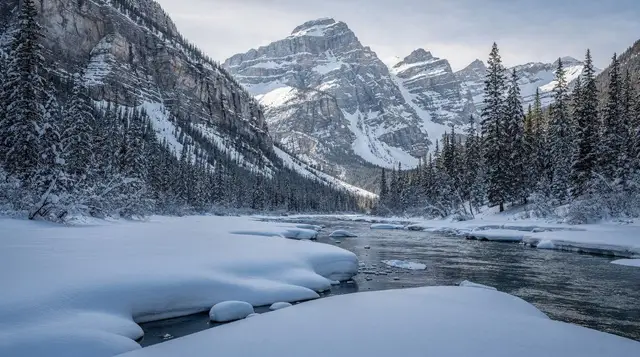
Johnston Canyon sits along the Bow Valley Parkway a short drive from Banff, and its winter ice walk is the more frequently run and more accessible of the two, with far more departures per week than Maligne Canyon manages. The walk follows the same catwalk system used in summer, bolted to the canyon wall above the creek, but in winter those catwalks and the canyon floor below are coated in ice, and frozen spray builds into curtains and columns along the rock face, most dramatically around the lower and upper falls.
Guides fit every participant with ice cleats at the trailhead, walk the group at a controlled pace, and stop at points along the route to point out ice formations and explain what is actually happening geologically, which is a level of context a solo winter walk would not give you even if it were safe to attempt.
Operators run this in a few different formats. Daytime tours are the most common and generally the shortest, running an hour to two hours depending on how far the group goes toward the upper falls. Evening tours add lanterns or headlamps and a noticeably different atmosphere once the canyon walls are lit against the dark, which is worth choosing deliberately rather than defaulting to a daytime slot if atmosphere matters to you.
an evening, lantern-lit ice walk through Johnston Canyon is the option to book if you want the after-dark version rather than a standard daytime walk, and it tends to run a smaller group size than the busier daytime departures.
For a route that pushes further into the canyon rather than stopping at the lower falls, a guided ice walk continuing to the frozen falls covers more of the ice formations along the upper section, at the cost of a longer walk on uneven footing.
Some operators also fold the ice walk into a wider day out from Banff rather than selling it as a single stand-alone stop, pairing it with other nearby winter sights along the parkway.
Maligne Canyon in winter: deeper, and the draw is blue ice
Maligne Canyon sits near Jasper, roughly 288 kilometres and about three and a half hours from Banff along the Icefields Parkway, which makes it a Jasper-based activity for most Banff visitors rather than a same-day add-on. It is one of the deepest canyons in the Canadian Rockies, cut through limestone in places to depths that make the summer boardwalk viewpoints feel genuinely dramatic even before winter adds ice to the picture.
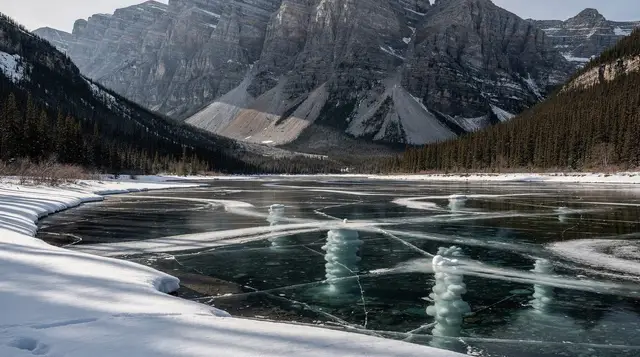
The specific draw of the winter ice walk here is blue ice: as the creek freezes in stages through the season, ice forms in visible layers low in the gorge, and daylight passing through those layers reads as a deep, saturated blue that is not something you get from the frozen spray at Johnston Canyon.
Reaching that blue ice means descending into the gorge itself on a guided route, which is a materially different undertaking from standing at the rim viewpoints most summer visitors use. Guides fit ice cleats, choose a route around the day’s specific ice conditions (which shift through the season as new sections freeze and older ones thaw and refreeze), and walk the group through sections of the canyon floor that are closed to unguided access specifically because the ice quality over moving water underneath is not something a visitor can reliably judge on their own.
This is the core safety reason winter access to Maligne Canyon runs through a guide rather than a gate you can walk past: the ice looks solid in a lot of places where it is not, and the consequence of getting that judgment wrong is falling through onto or into moving water in a narrow, cold gorge.
Because Maligne Canyon ice walks are based out of Jasper rather than Banff, they are not part of the tour list built around this page’s Banff-based inventory, and travellers planning this specific canyon should book directly with a Jasper-area operator once they are in that part of the trip.
Why neither canyon is a safe winter walk on your own
The two canyons’ summer reputation as an easy, family-friendly self-guided walk carries over in people’s expectations more than it should: the winter version is not the same undertaking, and neither is safe to attempt without cleats, a guide, and current knowledge of that week’s ice conditions. Three hazards drive this. The catwalks themselves ice over and can be genuinely slick even where the surface looks walkable, especially in shaded sections that never get direct sun.
Ice over moving water is inherently variable in thickness and strength even a few metres apart, which is exactly the judgment a trained guide makes and a visitor generally cannot. And both canyons see closures and rerouted sections through the winter as park managers respond to specific ice and weather conditions, so a route that was open last week is not guaranteed to be open on your visit.
This is the same broader caution that applies to winter road and trail conditions across the Rockies generally, covered in winter driving in the Rockies for the drive itself, and in what minus 25 really means for how cold conditions get on a body standing still to take photos.
How the two canyons compare
| Johnston Canyon | Maligne Canyon | |
|---|---|---|
| Nearest town | Banff (short drive) | Jasper |
| Distance from Banff | About 25 km | About 288 km, roughly 3.5 hours |
| Main winter draw | Frozen falls, ice curtains | Blue ice deep in the gorge |
| Typical walk length | 1 to 2 hours | Varies by operator and route |
| Departure frequency | Frequent, daily options including evening | Less frequent, seasonal |
| Depth character | Moderate, catwalk along canyon wall | Notably deeper canyon |
| Booked through | Banff/Bow Valley-based operators | Jasper-based operators |
What to wear and what’s provided
Every legitimate operator at both canyons supplies ice cleats fitted to your boots at the start of the walk, so you do not need to buy or bring your own traction gear. What you are responsible for is dressing for one to two hours of slow-moving, mostly standing-still activity in a shaded canyon, which is colder than the same air temperature would feel on an open, sunny trail. Insulated waterproof winter boots matter more here than almost anything else, since the walk is entirely on foot over ice and hard-packed snow.
Layer under a windproof outer shell, bring mittens over thin gloves for actual hand warmth, and add a hat or hood, since guided groups move at a deliberately unhurried pace with regular stops for photos and explanation rather than the steady movement that keeps a hiker warm on a faster trail. A headlamp is worth carrying on an evening Johnston Canyon walk even when lanterns are provided, as a backup light source for uneven footing.
Pricing: expect a range, not a fixed number
As with most guided activities in this region, pricing for ice walks varies by operator, by whether the tour includes hotel transportation, by group size, and by season, and it changes from year to year. There is no single reliable figure to quote here that will still be accurate by the time you book. What holds steady across operators is the general shape of the pricing.
| What varies | Typical effect on price |
|---|---|
| Transportation included vs. self-drive | Tours with pickup cost more than meet-there options |
| Time of day | Evening/lantern tours are sometimes priced differently from daytime |
| Route length | Longer routes toward the frozen falls or deeper into the gorge cost more |
| Group size | Private or small-group tours cost more per person than larger shared groups |
| Season and demand | Peak weeks (school holidays, weekends) book out and can price up first |
Check current pricing directly with the specific tour before building it into a fixed daily budget, and see Banff’s daily budget for how a booked activity like this fits into a wider trip cost.
Getting there without your own vehicle
If you are staying in Banff without a rental car, most Johnston Canyon ice walk operators include hotel pickup as part of the booking, which removes the need to arrange your own transportation along the Bow Valley Parkway in winter driving conditions.
a full-day scenic tour from Calgary that includes the Johnston Canyon ice walk is worth considering if you are not staying in Banff or Canmore and don’t want to drive the Trans-Canada and parkway yourself in winter conditions.
For the general shuttle and transit picture around the valley, see getting around without a car; for the arrival leg from the airport, see Calgary to Banff.
Maligne Canyon logistics are different in kind: because it’s a Jasper-area activity, getting there from Banff means the Icefields Parkway drive or a multi-day Banff-to-Jasper itinerary rather than a same-day Banff booking, and Jasper after the 2024 wildfire is worth a read before you finalize plans around the townsite, since some services and areas are still affected.
Not the same as Abraham Lake’s ice bubbles
Winter “ice” activities in this region get lumped together in generic listicles more than they should, and one mix-up worth heading off directly: the frozen methane bubbles at Abraham Lake are a completely different phenomenon in a completely different place, well outside both Banff and Jasper National Parks on the David Thompson Highway, and viewing them involves walking on a frozen lake surface rather than a canyon catwalk or gorge floor.
It is its own trip with its own gear and timing considerations, covered separately in the Abraham Lake ice bubbles guide. Don’t assume a Johnston Canyon or Maligne Canyon booking gets you anywhere near that lake, and don’t assume the same gear list applies to both.
Pairing an ice walk with the rest of a Banff winter day
A Johnston Canyon ice walk, especially a daytime one, generally doesn’t fill an entire day on its own, which makes it easy to pair with something else along the same stretch of road or back in town.
a standard guided ice walk through Johnston Canyon is the straightforward daytime version to build a half-day around, leaving the rest open for skiing, a hot springs soak, or exploring Banff itself. Travellers without a vehicle who want more than one parkway stop in a single outing can look for a bundled sightseeing tour that pairs the ice walk with other roadside sights.
Beyond the ice walk itself, Banff’s winter, month by month is worth reading to see how an ice walk day fits into the broader coldest-months picture, and snowshoeing near Banff is a reasonable second activity if you want more time on snow without the technical ice-cleat element.
Booking tips that actually matter
Book ahead for evening and weekend Johnston Canyon slots, especially over the Christmas–New Year’s stretch and February school-break weeks, since group sizes are capped and popular departure times sell out first. Confirm what’s included before you pay: ice cleats are close to universal, but hotel pickup, hot drinks, and photo add-ons are often priced separately. Ask specifically how far the group goes toward the upper falls at Johnston Canyon, or how deep into the gorge the route goes at Maligne Canyon, since this affects how much time you’ll spend on uneven, icy footing. Confirm the operator’s weather and ice-condition cancellation policy too, since both canyons can see last-minute route changes when conditions shift.
Johnston Canyon and Maligne Canyon ice walks: common questions
Is a guided ice walk the same trail as the summer Johnston Canyon hike?
It is the same physical canyon and largely the same catwalk system, but not the same experience. In summer you can walk the lower and upper falls sections independently at your own pace on bare metal catwalks; in winter those same catwalks ice over, sections can be closed or rerouted, and access runs through a guided group wearing ice cleats rather than a self-directed walk.
Do I need my own crampons or ice cleats?
No. Every commercial Johnston Canyon and Maligne Canyon ice walk operator supplies ice cleats as part of the booking, sized to your boots at the meeting point. Bringing your own is unnecessary and can complicate the fitting process if they are not compatible with the operator’s system.
What is the difference between Johnston Canyon and Maligne Canyon ice walks?
Johnston Canyon is close to Banff, shorter, and runs frequent departures including an evening lantern-lit option, which makes it an easy add to a Banff-based itinerary. Maligne Canyon is near Jasper, roughly three and a half hours from Banff by road, is notably deeper, and its winter draw is the blue ice visible low in the gorge, which most visitors see as part of a Jasper-based trip rather than a Banff day trip.
Can I see the blue ice in Maligne Canyon on my own?
Reaching the canyon floor safely in winter effectively requires a guided tour, since that is where the blue ice is visible and where the ice conditions are least forgiving. Standing at the canyon rim viewpoints in winter is possible without a guide, but you will not see the blue ice from up there the way a guided walk down into the gorge shows it.
Are these ice walks suitable for kids or people with limited mobility?
Most operators set a minimum age, commonly somewhere around five to seven years old, and the walk involves uneven, icy footing over roughly one to two hours depending on the route, so it is not a good fit for anyone unsteady on their feet even with cleats fitted. Check the specific operator’s age and fitness guidance before booking, since it varies.
Are ice walks at Johnston Canyon and Maligne Canyon the same as the Abraham Lake ice bubbles?
No. Abraham Lake’s frozen methane bubbles are a different phenomenon on a different lake, well outside both national parks on the David Thompson Highway, and involve walking on a frozen lake surface rather than a canyon catwalk. The two are sometimes lumped together in generic “winter ice” lists, but they require separate trips and different gear expectations.
When does the ice walk season run?
Roughly December through March, tracking the same cold-weather window that freezes the canyon catwalks and gorge floor solidly enough for guided access. Exact opening and closing dates shift year to year with temperature and snowfall, so confirm current availability with the operator close to your travel dates rather than assuming a fixed calendar.
Snowshoeing, ice walks & winter tours on GetYourGuide
Verified deep-linked GetYourGuide tours. Book through these links and we earn a small commission at no cost to you.
GetYourGuide does not provide a product photo for this activity — the image shows the meeting point, photographed by us.