Maligne Canyon: walking the bridges above Jasper's deepest gorge
What is Maligne Canyon and how do you walk it?
Maligne Canyon is a narrow limestone gorge up to 50 metres deep near Jasper, crossed by a series of numbered bridges on a well-marked trail that starts as paved path and turns to forest track the further you go. In summer you walk it yourself in an hour or two; in winter the same gorge freezes into ice formations only reachable on a guided walk with crampons.
A gorge, not a lake: what this guide actually covers
Maligne Canyon is a limestone gorge a short drive from Jasper townsite, cut up to 50 metres deep by a river that, further upstream, disappears into the ground entirely and reappears through the canyon walls. It’s crossed by a series of numbered footbridges, walkable on your own in summer and reachable only on a guided ice walk in winter. That’s the whole subject of this page.
It is not Maligne Lake, even though the two share a name and a road. Maligne Lake is a separate destination about 45 minutes further along Maligne Lake Road, best known for the view of Spirit Island that appears in half the postcards from this part of the Rockies — a view you can only get from a boat cruise or a canoe, not from any trail. If a boat trip and a famous island view are what you’re after, that’s a different day and a different guide; this one stays with the canyon and its bridges.
The drive from Banff: further than it looks on the map
Maligne Canyon sits roughly 300 kilometres from Banff, about 3 hours 45 minutes to 4 hours of driving along the Icefields Parkway and through Jasper townsite. That’s meaningfully further than the 288-kilometre, roughly 3.5-hour drive to Jasper itself, since the canyon is a short distance beyond town, off the same road that continues to Maligne Lake.
This is the mistake worth flagging clearly: Maligne Canyon is not a Banff attraction with a long drive attached, it’s a Jasper attraction, full stop. Treating it as a single long day out of Banff means roughly 6 to 7 hours of driving round trip before you’ve spent any real time at the canyon itself, on top of whatever else you stop for along the parkway. If a Jasper day trip from Banff is on your list at all, read why one day in Jasper is usually too short before you commit to it — the honest answer is that Maligne Canyon works far better as part of a multi-day Jasper stay than as a stretch goal tacked onto an Icefields Parkway day.
If you’re already staying in or near Jasper, the canyon is a much shorter trip: a well-signed turn off the highway, a paved parking area, and a trailhead that needs no shuttle, no reservation, and no timed entry, unlike Moraine Lake back near Banff.
The walk: six bridges, an increasingly wild gorge
The canyon trail is organized around six numbered bridges, and you decide how far to go rather than committing to a fixed loop from the start.
| Section | Approximate distance (return) | Surface | Who it suits |
|---|---|---|---|
| Bridge 1 to Bridge 2 | About 1 km | Paved, railed | Most visitors, strollers, limited mobility with assistance |
| Bridge 1 to Bridge 4 | About 2.5 km | Paved then packed gravel | Comfortable walkers, families with older kids |
| Full loop to Bridge 6 | About 3.7 to 4 km | Gravel and forest track, some elevation change | Hikers wanting fewer crowds and a longer gorge view |
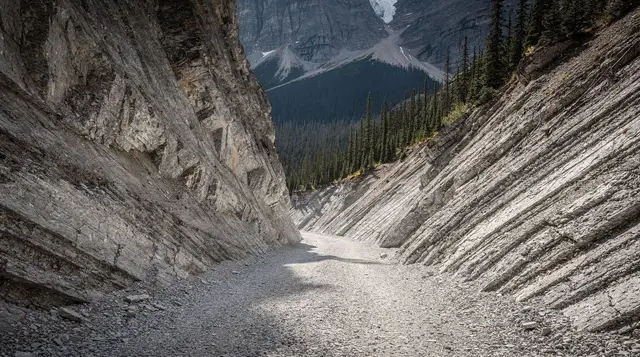
Bridge 1 crosses the canyon at its narrowest and deepest point, where the walls close in and the drop below is close to the full 50 metres the canyon reaches. This is also where most visitors stop, and where midday crowds bunch up in July and August, since it’s the shortest walk from the parking area and the most dramatic single viewpoint on the trail.
Past Bridge 2, the crowd thins out fast. The path narrows, the canyon walls become less sheer and more forested, and by Bridge 4 you’re walking a quieter trail with occasional glimpses down into the gorge rather than constant railing-side views. The full loop continuing to Bridge 6 swings away from the canyon rim through forest before looping back to the parking area, adding distance and a modest amount of elevation change without technical difficulty.
Interpretive signage along the route explains the canyon’s karst geology: upstream, the river that carved this gorge partly disappears underground into a network of sinkholes and resurfaces through the canyon walls further down, a process that’s still actively deepening and reshaping the gorge. Potholes, undercut walls, and abandoned side channels are all visible from the bridges if you look for them, evidence of a canyon that’s still being cut rather than a finished, static landscape.
Maligne Canyon in winter: the ice walk
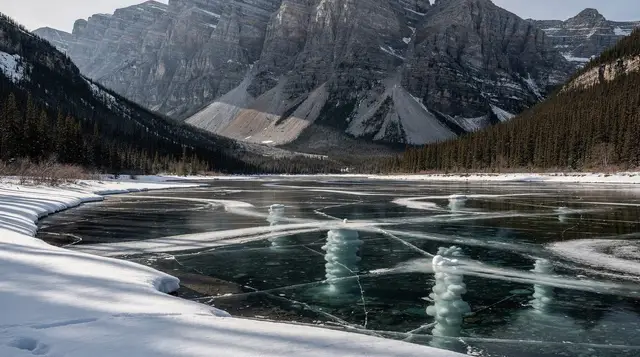
Winter turns Maligne Canyon into a genuinely different destination, and one you can’t visit on your own. As temperatures drop, the waterfalls along the gorge freeze into columns and curtains of ice, and guided operators lead small groups down onto the canyon floor itself, walking beneath ice formations that simply aren’t visible from the summer bridge trail above.
This isn’t a stroll with spikes on your boots. Guides supply crampons, assess ice conditions before each departure since thickness and stability shift through the season, and route groups around sections where moving water beneath the ice makes footing genuinely unpredictable. Parks Canada and local operators are consistent that unguided winter access to the canyon floor is not a safe option — this is one of the clearer cases in the Rockies where paying for a guide isn’t about convenience, it’s about not falling through ice over moving water in a narrow gorge with no cell signal.
The season runs roughly December through March, weather and ice conditions permitting, and it pairs naturally with a similar guided walk at Johnston Canyon closer to Banff — our guide to both canyons’ ice walks covers how the two compare and what each trip actually includes. If a canyon ice walk is the centrepiece of your winter Jasper stop:
a guided Maligne Valley and canyon tour out of Jasper covers the gorge with a local guide who can adjust the route to conditions and answer the geology questions the signage only partly answers.
Getting oriented: what’s nearby
Maligne Canyon sits along the same road that continues to Maligne Lake, and it’s close enough to several other Jasper-area stops that most visitors combine it with at least one more thing on the same outing.
- Maligne Lake, about 45 minutes further along the road, for the boat cruise to Spirit Island — a separate trip, not a canyon add-on.
- Jasper townsite, a short drive back toward the highway, with the SkyTram as an easy pairing on the same day.
- The Icefields Parkway heading south, if you’re continuing toward the Columbia Icefield or back to Banff and Lake Louise.
- Athabasca Falls, a shorter stop en route between Jasper and the icefield, easily combined with a Maligne Canyon morning.
A tour that bundles the canyon with Maligne Lake’s better-known scenery suits travellers who want both without organizing two separate outings: a combined canyon and Medicine Lake tour from Jasper adds a stop at Medicine Lake, whose seasonal disappearing water level is tied to the same underground drainage system that shapes the canyon itself.
Practical details before you go
A valid Parks Canada day pass or Discovery Pass is required to stop at Maligne Canyon, the same pass that covers Jasper National Park generally and, further south, Banff, Yoho, and Kootenay — see our breakdown of the Parks Canada pass if you haven’t already sorted this out for the rest of the trip. There’s no separate entry ticket for the summer trail itself.
Parking at the main trailhead is paved and free once you’re carrying a valid park pass, but it fills up by mid-morning in July and August; arriving before 9 a.m. or after mid-afternoon avoids most of the crush at Bridge 1 and Bridge 2. There’s no shuttle requirement here, unlike the reservation system now governing Moraine Lake back near Banff — you drive yourself, park, and walk.
Cell coverage at the trailhead and along the canyon is patchy at best, consistent with much of this stretch of Jasper National Park, so download any maps or tickets you need before you leave town. Bear activity is a real consideration between May and October; carry bear spray bought or rented locally rather than attempting to fly with it, and review the basics in our bear safety guide if this is your first Rockies trip.
Jasper townsite itself is still recovering from the July 2024 wildfire, which destroyed roughly a third of its buildings. The canyon is natural terrain well outside the area the fire reached, and the trail and bridges operate as usual, but services, accommodation availability, and hours in town have shifted since — our guide to Jasper after the fire covers what’s changed if you’re planning where to stay or eat before or after your canyon walk.
Where this fits in a longer trip
Maligne Canyon rarely justifies its own dedicated day from Banff, but it fits comfortably into a multi-day itinerary that already has Jasper on the list. A four-day Banff, Jasper, and Icefields Parkway loop leaves room for a morning or afternoon at the canyon without forcing a rushed single-day round trip from Banff.
For visitors weighing whether any canyon and waterfall stop is worth the detour on this trip at all, our canyons and waterfalls overview compares Maligne Canyon against the shorter, closer options nearer Banff, including Johnston Canyon and Marble Canyon in Kootenay — useful context if your time in the Rockies is limited and you’re deciding which gorge, if any, makes the cut.
Maligne Canyon: your questions answered
How far is Maligne Canyon from Banff?
Roughly 300 kilometres, about 3 hours 45 minutes to 4 hours of driving via the Icefields Parkway and through Jasper townsite. That’s noticeably further than the 288-kilometre, 3.5-hour drive to Jasper itself, since the canyon sits a short distance beyond town along Maligne Lake Road. It’s not a Banff day trip; treat it as a stop during a multi-day Jasper visit.
Is Maligne Canyon the same place as Maligne Lake?
No, and mixing them up is the single easiest planning mistake here. Maligne Canyon is the gorge and bridge trail covered in this guide, reached by a short drive and a footpath. Maligne Lake is a separate destination about 45 minutes further along the same road, and its well-known Spirit Island view is only seen from a boat cruise or canoe, not from any trail or roadside pullout.
How many bridges are there, and do you need to cross all of them?
The trail is built around six numbered bridges, but you choose how far to go. Bridge 1 and Bridge 2 form a short paved loop suitable for most fitness levels. Continuing to Bridge 4 adds a longer, narrower stretch along the canyon rim. The full loop out to Bridge 6 and back through the forest is the longest option and sees far fewer visitors than the first two bridges.
Can you do the winter ice walk on your own?
No, not safely, and Parks Canada and local operators are consistent on this point. The canyon floor in winter is a mix of frozen waterfalls, thin ice over moving water, and sections where the ice thickness varies within a few metres. Guided walks supply crampons, assess conditions daily, and know which sections to avoid; going in alone without that knowledge has led to real rescues.
Do you need a Parks Canada pass to visit Maligne Canyon?
Yes. The canyon sits inside Jasper National Park, so the same Parks Canada day pass or annual Discovery Pass that covers Banff, Yoho, and Kootenay applies here too. There’s no separate ticket for the trail itself in summer; the guided ice walk in winter is priced and booked on top of the pass requirement.
Is Maligne Canyon suitable for kids or strollers?
The Bridge 1 to Bridge 2 section is paved and manageable for most strollers and younger kids, with railings along the steepest drops. Past Bridge 2 the path narrows, gains and loses elevation, and comes closer to unguarded canyon edges in places, so it’s a better fit for kids old enough to stay close and listen to instructions.
What should you bring, especially for the ice walk?
For the summer trail, sturdy shoes and a layer for wind are enough; the forested sections stay cool even on warm days. For the winter ice walk, wear warm layers and bring your own boots that fit over crampons, since guided operators typically supply the crampons but not full winter footwear. Bear spray is worth carrying between May and October, but remember it can’t travel in checked or carry-on luggage, so buy or rent it locally rather than packing it.
When is the best time to visit, and when is it busiest?
Late June through September is the main window for the full summer trail, with mornings and early evenings noticeably quieter than midday tour-bus traffic at Bridge 1 and Bridge 2. The winter ice walk runs roughly December through March, weather and ice conditions permitting, and books up on weekends and around the holidays.
Canyon walks & waterfall tours on GetYourGuide
Verified deep-linked GetYourGuide tours. Book through these links and we earn a small commission at no cost to you.
GetYourGuide does not provide a product photo for this activity — the image shows the meeting point, photographed by us.