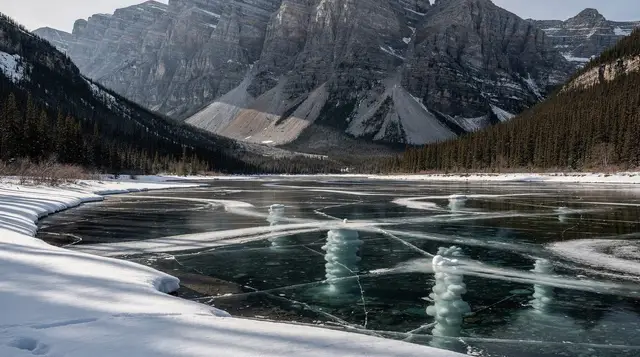
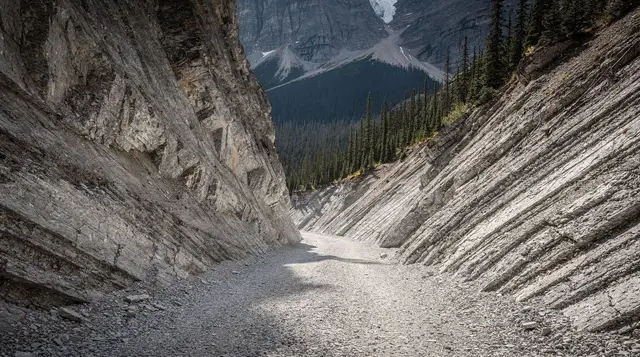
Most visitors see Johnston Canyon as a stop between Banff and Lake Louise, and that undersells it. The Bow Valley Parkway hairpins along the canyon rim, and a series of steel catwalks bolted to the limestone walls takes you down into the gorge itself, close enough to the Lower Falls to feel the spray. It’s one of the few places in the park where the trail is the attraction as much as the destination.
The catch is that everyone else has the same idea. Johnston Canyon is one of the most visited short hikes in Banff National Park, and the Lower Falls catwalk in July and August can back up into a slow shuffle rather than a hike. None of that makes it not worth doing — it makes timing the visit the actual skill.
Getting there from Banff
Johnston Canyon sits on the Bow Valley Parkway (Highway 1A), about 25 to 30 minutes and 23 km from Banff townsite. The parkway’s seasonal wildlife closure on its eastern section runs March 1 to June 25 most years, but the Johnston Canyon parking lot stays reachable from both ends throughout that closure — check current signage rather than assuming, since Parks Canada adjusts the exact dates annually.
The main parking lot sits right off the highway and fills by mid-morning from June through September; a smaller overflow lot a short walk down the road picks up the overflow. In peak summer, Roam Transit runs a seasonal route out to the canyon from Banff, which is worth checking if you’d rather not hunt for parking. A Parks Canada day pass is required to stop here, the same as anywhere else in Banff National Park — see our Parks Canada pass guide for current rates.
Lower Falls: the 1.1 km everyone does
From the parking lot, the trail to the Lower Falls is 1.1 km one way, following the Bow Valley Parkway version of the canyon downstream along a wide gravel path before it narrows onto the metal catwalk. The catwalk is bolted directly to the canyon wall a few metres above the creek, and the noise and spray build steadily as you approach the falls.
At the end, a short tunnel leads to a viewing platform that puts you almost inside the waterfall — the Lower Falls drop about 10 metres into a churning pool, and the platform gets genuinely wet from the spray on a summer afternoon. It’s a satisfying payoff for very little elevation gain, which is exactly why it draws the crowds it does.
Budget 45 minutes to an hour round trip if you’re not stopping much, longer if you’re taking photos or waiting your turn on the platform. Surfaces are a mix of paved sections and metal grating with occasional gaps — fine for most kids past toddler age, not stroller-friendly.
Upper Falls: the better view for the same crowd
Past the Lower Falls junction, the trail continues 2.7 km one way to the Upper Falls, gaining more elevation and switching from catwalk to packed gravel and dirt. The crowd thins out considerably past this point — a lot of Lower Falls visitors turn back rather than continue.
The Upper Falls drop from a higher point and are visible from two vantage spots: a lower viewpoint close to the base, and an upper viewpoint reached by a steeper spur that gives a wider view of the falls dropping through a notch in the rock. The upper spur has some exposed sections and isn’t the place to let kids wander unsupervised.
Round trip to the Upper Falls and back to the parking lot runs 1.5 to 2 hours at a moderate pace, including time at both viewpoints. Wear shoes with actual tread — the gravel section past the Lower Falls turns to slick mud after rain.
| Segment | One-way distance | Elevation gain | Typical surface |
|---|---|---|---|
| Parking lot to Lower Falls | 1.1 km | Minimal | Paved and metal catwalk |
| Lower Falls to Upper Falls | 1.6 km | ~120 m | Gravel and dirt |
| Upper Falls to Ink Pots | 3.1 km | ~135 m | Dirt, roots, some exposed sections |
The Ink Pots: where the crowd disappears
Past the Upper Falls, the trail keeps climbing out of the canyon and opens into a subalpine meadow scattered with small, spring-fed pools — the Ink Pots. They’re cold, mineral-tinted, and named for the way sediment stirred up from below clouds the water in shifting patterns. The Sawback Range forms a backdrop that’s a completely different landscape from the canyon you just climbed out of.
It’s 5.8 km one way from the parking lot to the Ink Pots, which puts the round trip at nearly 12 km — a real hike, not an extension of an afternoon stroll. The reward is proportional: where the Lower Falls can feel like a lineup, the meadow at the Ink Pots is usually close to empty even in August, since most visitors never get past the Upper Falls junction.
Plan on 4 to 5 hours round trip from the parking lot if you’re doing the full distance, and carry more water than you think you need — there’s no water source or services past the trailhead. Bear activity is regularly reported on this stretch; carry bear spray and make noise on blind corners, and check current trail reports before setting out, since the Ink Pots section sometimes closes for wildlife.
Doing it in winter: ice cleats, not an afterthought
Johnston Canyon runs year-round, and the frozen Lower and Upper Falls in winter are a legitimately different sight — walls of blue-white ice built up over the rock face. But the catwalks that feel perfectly safe in summer turn into a hazard once meltwater refreezes on the metal grating and the gravel sections pack down into hardpack ice.
Ice cleats (microspikes) are close to mandatory here from December through March, not an optional nicety. Trekking poles help too, since the packed sections can be uneven. A handful of local operators run guided ice walks that supply cleats and a headlamp, which is worth it given how much shorter winter daylight is — several depart from Banff or Canmore in the afternoon specifically to catch the falls lit up after dark.
If you’d rather book that experience than gear up yourself, a guided ice walk to the frozen falls handles the cleats, the timing, and the safety briefing. It pairs well with a stop at Maligne Canyon on a longer winter itinerary, covered in our ice walk comparison guide.
Getting there is its own consideration in winter. The Bow Valley Parkway is plowed but not always to bare pavement, and conditions can turn icy fast once the sun drops behind the valley wall. If you’re driving yourself rather than joining a shuttle-based tour, read our winter driving guide for the Rockies before heading out, particularly for anything after a fresh snowfall.
Wildlife on the Bow Valley Parkway
The parkway itself is one of the better wildlife-viewing drives in the park outside its spring closure window — elk, deer, and the occasional black bear are regularly spotted along the road shoulders, particularly at dawn and dusk. Keep speed down and don’t stop in the road to photograph anything; use a pullout. Full detail on the closure dates and what to expect is in our Bow Valley Parkway wildlife guide — this page covers Johnston Canyon itself, not the road’s seasonal rules.
When to go, and when to skip the crowd
July and August mornings before 9 a.m., or evenings after 5 p.m., are the best window for the Lower Falls without a crowd. Midday in peak summer is the worst of it — tour buses and rental cars both converge around 11 a.m. to 2 p.m. Shoulder season (May, June, September, October) thins things out considerably, though the Ink Pots meadow can still be muddy or snow-patched into June.
If you only have an hour and want the classic shot, do the Lower Falls and turn back. If you have half a day and don’t mind a longer climb, push to the Upper Falls and beyond to the Ink Pots for a hike that actually earns its distance.
Combining Johnston Canyon with the rest of your day
Because it sits directly on the route toward Lake Louise and Moraine Lake, Johnston Canyon slots naturally into a longer day along the Bow Valley Parkway rather than standing as a destination on its own. A guided option that bundles it with the lakes is a day tour covering Lake Louise, Johnston Canyon, and Emerald Lake, which removes the parking-lot gamble entirely on a peak summer day.
For a shorter add-on to a Banff-based day, a guided hike out to the Ink Pots is worth considering if you’d rather have a naturalist point out what you’re looking at than hike it solo — useful for the bear-activity stretch past the Upper Falls, in particular. Travellers building a longer loop sometimes fold it into a full-day sightseeing tour built around the canyon, which typically adds a couple of nearby viewpoints on the same outing.
None of this is a reason to skip the drive-yourself option — the canyon is easy to reach independently, and the guided options exist mainly to solve the parking and pacing problems on the busiest days, not because the trail itself needs a guide.
How it compares to Banff’s other short hikes
Johnston Canyon is one of several short trails people default to for a half-day out of Banff, and it’s worth knowing how it stacks up. Tunnel Mountain is shorter and steeper, with a townsite view rather than a waterfall, and gets nowhere near the same foot traffic. Over in Canmore, Grotto Canyon is a similar limestone-gorge walk on a creek bed, with ancient pictograph panels and far fewer visitors, though it lacks Johnston Canyon’s engineered catwalks and guaranteed waterfall view. If you’re weighing options by distance and difficulty across the whole park, our guide to day hikes by difficulty lines them up side by side.
What to bring
Layers matter more than most people expect, even in summer — the canyon floor sits in shade for a good part of the day and runs several degrees cooler than the parking lot. Sturdy footwear with actual tread earns its keep past the Lower Falls, where gravel turns to packed dirt and, after rain, mud. Bear spray is worth carrying past the Upper Falls junction toward the Ink Pots, where the trail thins out and sightlines shorten; see our bear safety guide for how to carry and use it. In winter, swap the trail runners for ice cleats — see the ice walk section above — and add a headlamp if you’re timing the visit for late afternoon light.
Practical basics
| Item | Detail |
|---|---|
| Parking | Main lot off Bow Valley Parkway, fills by mid-morning June–September |
| Pass required | Yes, Parks Canada day pass or annual Discovery Pass |
| Facilities | Washrooms and a small café/gift shop at the trailhead |
| Cell coverage | Patchy to none past the parking lot |
| Dogs | Allowed on leash |
| Ice cleats | Effectively required December–March |
Johnston Canyon: frequently asked questions
How long is the Johnston Canyon hike?
The Lower Falls are 1.1 km one way from the parking lot, mostly on a paved and metal catwalk. The Upper Falls are 2.7 km one way, with more elevation gain and a gravel surface past the Lower Falls junction. Continuing to the Ink Pots adds another 3.1 km one way, for 5.8 km total.
Do I need hiking boots for Johnston Canyon?
Running shoes are fine in summer for the Lower Falls and Upper Falls, since most of the surface is packed gravel or metal grating. Boots with grip help past the Upper Falls toward the Ink Pots, where the trail turns to dirt and roots. In winter, ice cleats are not optional — the catwalks ice over and are genuinely slippery.
Is Johnston Canyon crowded?
Yes, especially the Lower Falls in July and August, when the catwalk can feel like a lineup rather than a hike. Arriving before 9 a.m. or after 5 p.m. thins the crowd noticeably. The Ink Pots see a fraction of the Lower Falls traffic even at peak season.
Can you do Johnston Canyon in winter?
Yes, and the frozen Lower and Upper Falls draw their own crowd. Ice cleats are close to mandatory on the catwalks, which develop a layer of refrozen meltwater and packed snow. A handful of operators run guided ice walks that supply the cleats and a headlamp for shorter winter days.
Are the Ink Pots worth the extra distance?
If you have the legs for 5.8 km round trip and want a quieter finish, yes. The Ink Pots are a set of spring-fed pools in a subalpine meadow with the Sawback Range behind them, a different landscape entirely from the canyon below. Most Lower Falls visitors never make it this far, so the trail past the Upper Falls junction empties out fast.
Where do you park for Johnston Canyon?
The main lot sits directly off the Bow Valley Parkway (Highway 1A) and fills by mid-morning in summer; a second overflow lot is a short walk down the road. Roam Transit’s route 9 (seasonal) also serves the canyon from Banff, which avoids the parking search entirely in peak months.
Is Johnston Canyon accessible with kids or strollers?
The Lower Falls catwalk works for most kids past toddler age, though it’s not stroller-friendly — sections are metal grating with gaps and a few short staircases. Keep a close hand on children near the unrailed sections close to the waterfall itself, where the rock is wet and slick.