Banff in winter, month by month
What's the best month to visit Banff in winter?
January and February give the most reliable cold, the fullest ski conditions across all three SkiBig3 resorts, and the Abraham Lake ice bubbles. December is quieter but less predictable for snow; March and April bring longer days and softer conditions but a shorter ice-walk season.
Six months, six different versions of Banff
Winter in Banff isn’t one season. November looks nothing like February, and February looks nothing like April. Temperatures, daylight, ski conditions, and how many other travellers you’ll share a trail or a viewpoint with all shift substantially between the first snowfall and the spring thaw. This page walks through what actually changes, month by month, so you can pick a window that matches what you want out of the trip rather than guessing from a single “Banff in winter” search result.
One thing every month has in common: conditions here are never guaranteed. Snowfall, ice thickness on the lakes, and the freeze on Abraham Lake vary year to year. A date that produced perfect ice bubbles or a fully frozen Lake Louise skating surface last winter can look completely different the next. Treat every date range below as a typical window, not a promise, and build a day or two of flexibility into your plan.
| Month | Typical daytime high | Ski resorts | Crowd level | Notable |
|---|---|---|---|---|
| November | -10 to -15°C | Opening gradually | Low | Bow Valley Parkway east section reopens for winter |
| December | -12 to -20°C | Fully open by mid-month | Moderate, spikes at holidays | SnowDays prep, holiday travel |
| January | -15 to -25°C | Full operation | Moderate | SnowDays festival, Abraham Lake bubbles begin |
| February | -15 to -25°C | Full operation | Moderate-high | Abraham Lake bubbles peak, family day long weekend |
| March | -8 to -15°C | Still open, softening snow | Rising (spring break) | Longer daylight, spring break crowds |
| April | -2 to -10°C | Norquay and Lake Louise close; Sunshine continues | Low-moderate | Mixed snow and mud, transitional |
Temperatures above are typical daytime highs. Overnight lows run significantly colder, and a cold snap in any month from December through February can push the mercury below -30°C for a few days before a chinook wind swings things back up by 15 to 20 degrees in a matter of hours. That volatility is normal for this part of Alberta — check the forecast the day before you head out, not the week before.
November: the quiet, unpredictable start
November is Banff’s shoulder-of-a-shoulder season. Daytime highs typically sit around -10 to -15°C, though early-month days can still feel more like autumn than winter, especially in a mild year. Snow cover in town and on lower trails is inconsistent — some Novembers bring a solid base by mid-month, others stay patchy until December.
This is when the SkiBig3 resorts begin their staggered openings. Banff Sunshine Village tends to open earliest thanks to its higher elevation and more reliable early snowfall, sometimes in mid to late November. Mt Norquay and Lake Louise Ski Resort typically follow through late November into early December. None of these dates are fixed — an early or late snow year can shift them by two or three weeks in either direction, so check each resort’s own status page rather than assuming a start date.
The eastern section of the Bow Valley Parkway reopens to vehicles around this time after its spring-to-early-summer wildlife closure, which makes November one of the better windows for a quiet scenic drive before winter traffic patterns set in. Crowds overall are the lowest of the entire winter season — hotel rates reflect that, and popular viewpoints are noticeably emptier than in December or February.
What doesn’t happen reliably in November: full ice walks. Johnston Canyon and Maligne Canyon typically need consistent cold through most of the month before ice is thick and stable enough for guided walks — see the ice walk guide for how that timing usually plays out.
December: the resorts fill in, the town gets busy
By mid-December, all three SkiBig3 resorts are typically running close to full operation, weather permitting. Daytime highs drop to roughly -12 to -20°C, and this is where winter starts to feel unambiguous rather than transitional.
Crowds follow a clear pattern: the first half of December, before school holidays begin, is one of the quieter stretches of the whole winter — quieter, in fact, than January weekends. From around December 20 through New Year’s, Banff gets busy with holiday travellers, and hotel and restaurant prices climb accordingly. If a quiet December trip is the goal, aim for the first two or three weeks of the month.
Ice conditions on frozen surfaces start to firm up through December, which is when operators typically begin running structured ice walk and ice climbing experiences with confidence, rather than waiting on marginal ice from November. If crampons-and-canyon walks are the goal, a trip booked for a guided ice walk with cleats supplied in late December is generally more reliable than the same trip in mid-November.
Daylight is short — sunset well before 5 p.m. — which shapes how much you can fit into a single day. For a first winter visit, pairing a gondola or hot springs stop with a short hike works better than trying to stack three separate activities into one December afternoon.
January: the coldest month, and SnowDays
January is typically Banff’s coldest month on paper, with daytime highs commonly in the -15 to -25°C range and overnight lows well below that. Cold snaps into the -30s happen most winters, usually for a few days at a stretch before a chinook wind breaks the pattern. This volatility — not a steady cold month — is the honest description of a Rockies January.
Crowds ease slightly after the New Year’s rush, then rise again toward the back half of the month heading into February. SnowDays, Banff’s annual winter festival, runs in January on a fixed schedule and centres on a snow sculpture competition along with other cold-weather events around town — one of the few things on this page that happens on a set date rather than depending on weather.
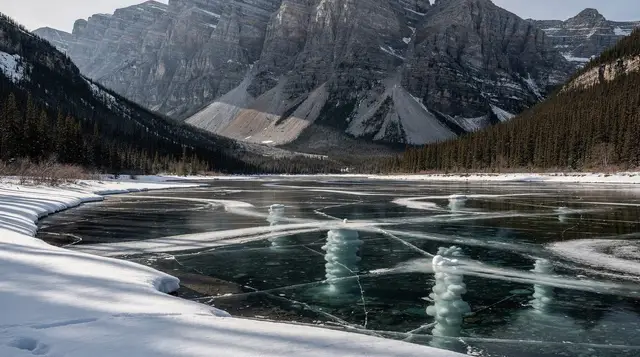
January is also typically when the Abraham Lake ice bubbles start to appear, usually from around mid-month. Abraham Lake sits outside the national parks, roughly 3 hours from Banff on the David Thompson Highway, and the bubble window depends on how the ice froze that particular year — some winters produce dense, photogenic clusters; others are patchier. It’s a day-trip commitment, not a side stop, so check recent conditions reports before setting out.
Full ski operations across Banff Sunshine, Lake Louise, and Mt Norquay are typically running by January, and this is peak season for that side of a Banff trip — see how the three compare in the SkiBig3 resorts guide if you’re deciding between them.
February: peak cold, peak ice bubbles, family day crowds
February runs similarly cold to January — daytime highs typically -15 to -25°C — but this is usually the month the Abraham Lake ice bubbles are at their most developed, roughly through mid-February before spring warming starts to soften the ice.
Crowds pick up around Family Day long weekend (a mid-February Alberta holiday) and stay moderate-to-high through the rest of the month as ski season enthusiasm peaks. Book accommodation and any canyon ice walk near Canmore further ahead than you would for a quiet December weekday.
Ski conditions are typically at their most consistent in February — snowpack has built up through December and January, and resorts are usually running full terrain. If skiing is the priority rather than ice walks or lake photography, February is generally the safer bet over the shoulder months on either side.
For visitors mixing skiing with sightseeing, a shuttle-based ski day avoids the need for winter-rated tires and chains, which matters if you’re not used to driving on packed snow — see the winter driving guide if you are renting a vehicle regardless.
March: longer days, softer snow, spring break crowds
March brings a real shift. Daytime highs typically climb to -8 to -15°C, daylight extends noticeably, and snow on lower trails starts to soften, especially by late in the month. The resorts are typically still fully open, and spring skiing conditions — softer snow, brighter light, longer days on the hill — appeal to a different crowd than the cold-and-crisp January visitor.
That appeal shows up in the numbers: March, particularly the back half tied to spring break periods, sees crowds rise noticeably from the February baseline, both at the resorts and in town. Ice walk season is typically winding down or already closed by mid-to-late March, as canyon ice becomes less stable with warming daytime temperatures — check with operators directly rather than assuming an ice walk booked for late March will run as scheduled.
March is a reasonable window if you want meaningfully longer days and a bit less bite in the cold than January or February without waiting for the full transitional feel of April.
April: the transition month, and why it’s tricky to plan around
April is where winter Banff genuinely starts breaking down into something else. Daytime highs typically run from -2 to -10°C, meaningfully warmer than the deep-winter months, but overnight freezes are still routine and fresh snow at higher elevations is entirely possible any day of the month.
Mt Norquay and Lake Louise Ski Resort typically close in April, while Banff Sunshine, thanks to its higher elevation, usually keeps running into May — sometimes to the end of the month. That gap is worth checking closely if skiing is the main reason for an April trip, since two of the three SkiBig3 resorts may already be closed for the season.
April is also the messiest month for planning around specific activities. Ice walks are generally finished. The lakes are still frozen — Lake Louise typically doesn’t thaw until mid-June — but the surrounding trails can be a mix of packed snow, ice, and mud depending on elevation and sun exposure. It’s a legitimate month to visit for lower crowds and milder cold, but pack for both winter and slush, and don’t expect the crisp postcard conditions of January or February.
Planning around the calendar, not a single date
A few practical points apply across the whole season regardless of which month you pick:
- Book weather-dependent experiences with a flexible mindset. Ice walks, ice bubbles, and skiing all depend on conditions that shift year to year — a specific date that worked perfectly for someone else’s trip report last winter is not a guarantee for yours.
- SnowDays is the one fixed point. Unlike ice conditions, the January festival runs on a published schedule, which makes it easier to build a trip around if a specific date matters to you.
- Check resort and ice-walk status close to your trip, not months in advance. Opening, closing, and ice-safety dates are set by conditions, and official operator pages update faster than any guide can.
- Winter driving rules differ by province. Winter tires are legally required from October 1 to April 30 on mountain highways in British Columbia (including routes toward Yoho and Kootenay), but not in Alberta, where they remain strongly advised for the Calgary-to-Banff drive and around town.
- Pack for the coldest scenario, not the average one. A chinook can turn a -25°C forecast into a comparatively mild day within hours, but the reverse happens too — see the packing guide for layering that covers both.
If you’d rather have someone else handle the driving and logistics on a cold-weather day, options like a guided winter hike and gondola day around Banff or an evening ice walk through Johnston Canyon bundle transport, equipment, and local knowledge of current conditions into one booking, which matters more in winter than in any other season here.
Choosing your month: quick comparison
| If you want… | Best months |
|---|---|
| The quietest crowds | Early December, or November |
| Coldest, crispest conditions | January, February |
| Abraham Lake ice bubbles | Mid-January to mid-February |
| Full ski terrain across all three resorts | January, February |
| Longer daylight with skiing still running | March |
| Mildest temperatures, lowest ski reliability | April |
| SnowDays festival | January (fixed dates each year) |
None of this replaces checking real-time conditions before you go. Trail and road closures, resort status, and ice safety reports all update through the season on official channels — this page tells you what to generally expect, not what will happen on any single day you pick.
FAQ: visiting Banff across the winter months
Is Banff too cold to visit in winter?
Daytime highs typically run from -15 to -25 degrees Celsius, with occasional dips below -30 during a cold snap. Chinook winds can push temperatures up by 15 to 20 degrees within a day, so conditions swing more than a single forecast suggests. Dress in layers and check the forecast the day before, not the week before.
When do the ski resorts open and close in Banff?
The three SkiBig3 resorts run roughly November to May, but not on the same calendar. Banff Sunshine usually has the longest season, often into late May, thanks to its high elevation. Lake Louise and Mt Norquay typically wrap up in April. Opening dates depend on early snowfall and vary by a few weeks each year.
When are the Abraham Lake ice bubbles visible?
The methane ice bubbles at Abraham Lake are usually visible from around mid-January to mid-February, though the window shifts with ice thickness and snow cover each winter. Abraham Lake sits outside the national parks on the David Thompson Highway, about 3 hours from Banff.
What is SnowDays in Banff?
SnowDays is Banff’s annual winter festival held in January, built around a snow sculpture competition along with other cold-weather events in town. It runs on a set schedule each year, unlike weather-dependent activities such as ice walks or the Abraham Lake bubbles.
Can I count on snow for photos on a specific date?
No. Snowfall, ice thickness, and lake freeze timing vary from year to year, and a date that produced perfect conditions last winter can be bare or slushy the next. Build flexibility into a winter itinerary rather than planning around one specific day.
Is December or February better for a quieter visit?
Early December, before the winter holidays, is typically the quietest stretch of the season in Banff. Late December through early January gets busy with holiday travellers, and February picks up again around family day long weekends and the run-up to spring break.
Do I need winter tires to drive to Banff in winter?
Winter tires aren’t legally required on Alberta highways, including the drive from Calgary, but they’re strongly recommended given ice and sudden snowfall. They are legally required from October 1 to April 30 on mountain highways in British Columbia, including routes toward Yoho and Kootenay.
Snowshoeing, ice walks & winter tours on GetYourGuide
Verified deep-linked GetYourGuide tours. Book through these links and we earn a small commission at no cost to you.
GetYourGuide does not provide a product photo for this activity — the image shows the meeting point, photographed by us.