Lake Louise Ski Resort: size, views, and what it isn't
How big is Lake Louise Ski Resort, and is it the same place as the lake?
Lake Louise Ski Resort is one of the largest ski areas in Canada by skiable acreage, spread across four mountain faces on Whitehorn Mountain. It sits on the opposite side of the valley from Lake Louise itself and the Chateau, reached by its own access road off the Trans-Canada Highway — not the road to the lakeshore.
Two Lake Louises: the ski area and the frozen lake are not the same trip
If you’re planning a winter visit and typing “Lake Louise” into a map, it’s worth stopping to check which Lake Louise you mean. Lake Louise — the lake, the Fairmont Chateau, and the small village strung along the highway — sits at the end of Lake Louise Drive, a short spur off the Trans-Canada Highway. Lake Louise Ski Resort, also known locally as Whitehorn, sits on the opposite side of the Bow Valley, up its own access road (Whitehorn Road) roughly 4 kilometres further along the Trans-Canada. They share a name, a general postal code, and a train of tour buses, but they are two separate destinations with two separate roads in.
This isn’t a pedantic distinction. In winter, the lake itself is frozen solid — it stays under ice from roughly November through mid-June — so nothing about it is a summer-style lake visit. What draws people to the lakeshore in winter is a maintained skating rink and a short walk to a view of the frozen basin and Victoria Glacier; see when the lakes thaw and the separate page on skating at Lake Louise for what’s actually there in that season.
The ski resort, meanwhile, is an entirely different kind of day: lift lines, groomed and ungroomed alpine terrain, and a mountain lodge, all on Whitehorn Mountain, with no lakeshore in sight from the base. If your plan for the day is “ski in the morning, walk around the frozen lake in the afternoon,” that’s entirely doable, but budget driving time between two distinct parking lots, not a five-minute stroll from one to the other.
How big Lake Louise Ski Resort actually is
Size is the resort’s real headline, and the numbers back it up. Lake Louise Ski Resort spreads across roughly 4,200 acres (about 1,700 hectares) of skiable terrain on four connected mountain faces, which puts it consistently among the largest ski areas in Canada by acreage — not the single largest (that title usually goes to Whistler Blackcomb, in a different province entirely), but solidly in the next tier, and the largest of the three SkiBig3 resorts around Banff.
This guide sticks to Lake Louise on its own; for a run-through of how it actually compares to Banff Sunshine and Mt Norquay on terrain, price, and crowds, see the SkiBig3 resorts compared page rather than treating this one as the comparison.
| Stat | Lake Louise Ski Resort |
|---|---|
| Base elevation | ~1,646 m |
| Summit elevation (Whitehorn Mountain) | ~2,637 m |
| Vertical drop | ~991 m |
| Skiable terrain | ~4,200 acres (1,700 ha) |
| Named runs | 145+ |
| Mountain faces | 4 (Front Side, Ptarmigan Bowl, Larch, Back Bowls) |
| Lifts | 8, including the summit gondola/chair |
Those four faces are genuinely different mountains in feel. The Front Side, facing the highway and the day lodge, is where almost everyone starts and where the groomed cruisers live. Ptarmigan Bowl and the Larch area, reached by traversing further across the ridge, open up longer intermediate and advanced terrain with more of a backcountry feel despite being fully lift-served. The Back Bowls, on the far side of the mountain, are where the resort’s size really shows: wide-open alpine bowls with minimal grooming, best suited to confident intermediates and above, and often the last section to fill in with enough snow early in the season.
The view from the top: Rockies, not water
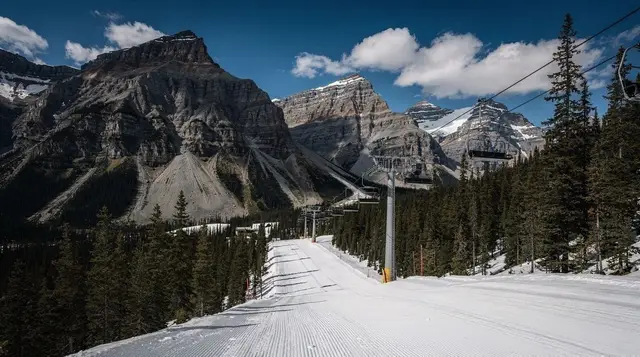
Riding the upper lifts on a clear day is arguably as much a reason to come as the skiing. From points near the top of Whitehorn Mountain you look out across the Bow Valley to the Waputik Range, back toward the Lake Louise area and Victoria Glacier in the distance, and along the Continental Divide that separates Alberta from British Columbia. It’s one of the more scenic lift rides in the Rockies precisely because the terrain below is glaciated peaks and valley forest rather than another ski hill.
Don’t expect a postcard close-up of the lake itself, though — you’re seeing its valley from a distance and an angle, not the turquoise shoreline you’d get standing at the Chateau in July (and in winter the water isn’t turquoise at all; it’s under a metre or more of ice and snow). The view is genuinely worth stopping for on a calm run or a coffee break at the mid-mountain lodge, but it’s a mountain-and-glacier panorama, not a lake photo.
Terrain by ability level
Lake Louise’s size means there’s real terrain at every level, but the mountain doesn’t distribute it evenly across the four faces:
- Beginner and novice: concentrated on the Front Side, close to the day lodge, with wide, consistently graded runs and the gentlest gradients on the mountain.
- Intermediate: the largest single category, spread across the Front Side, Ptarmigan Bowl, and Larch, with long cruising runs that make up the bulk of the resort’s mileage.
- Advanced and expert: concentrated in the Back Bowls and the steeper pitches off Ptarmigan Bowl and Larch, including ungroomed bowl skiing that can be genuinely demanding by mid-winter, and glades and chutes that require confident off-piste skiing.
As with most large mountains, conditions matter as much as the map. Early in the season, before the Back Bowls have enough base, a good chunk of the advanced terrain simply isn’t open yet, and the mountain can ski smaller than its acreage suggests. Check current terrain openings before building a day plan entirely around expert-only zones.
Because the four faces spread out so widely, getting from one side of the mountain to the other takes real time — a first-time visitor can easily spend the morning entirely on the Front Side without realizing how much terrain sits beyond it. If you only have one day, it’s worth deciding in advance whether you want to sample all four faces or spend the day lapping the runs that suit your ability best, rather than losing an hour of ski time to traverses partway through the afternoon.
Season, snow, and lift tickets
Lake Louise typically runs from early November to early May, snow and conditions permitting, which puts it among the longer seasons in the region — though Banff Sunshine usually edges it out at the tail end of spring. Because the resort sits high and largely north- or shaded-facing on several faces, it tends to hold snow quality reasonably well through a Rockies winter, though a chinook warm spell can still soften things for a day or two anywhere in the region.
Single-day adult lift tickets run roughly 130 to 180 CAD depending on the date and how far ahead you book, with online advance pricing consistently cheaper than walk-up window rates. Multi-day and season options are sold through SkiBig3, which bundles access across Lake Louise, Sunshine, and Norquay — useful if you’re planning more than one resort in a trip, less useful if Lake Louise is your only stop. On top of the lift ticket, remember that Lake Louise Ski Resort sits inside Banff National Park, so a Parks Canada day pass or annual Discovery Pass is a separate requirement, priced and sold independently of your lift ticket; see the Parks Canada pass explained for current rates.
For a first-time visit or a short trip where you’d rather not manage lift tickets and gear logistics yourself, a guided option covering multiple resorts in one outing is worth considering — a guided ski safari that samples Lake Louise, Sunshine Village, and Mt Norquay across a single trip is one way to see how the three actually differ without committing a full multi-day pass to any one of them.
Cross-country skiing: a different sport, a different location
Lake Louise Ski Resort is an alpine, lift-served mountain — there’s no cross-country trail network on Whitehorn Mountain itself. The Nordic skiing around Lake Louise happens down in the valley: groomed trails near the village and around parts of the lakeshore, and, notably, the winter-closed section of Moraine Lake Road, which becomes a groomed cross-country route once it’s off-limits to vehicles for the season. These trails are flat to gently rolling, aimed at classic and skate techniques rather than the descents that define the ski resort up the road.
If cross-country is what you’re actually after, a beginner-friendly cross-country skiing lesson on the valley’s groomed trails is a better fit than a day at the ski resort, and it’s worth booking separately rather than assuming your lift ticket covers both — they’re genuinely different trail systems with different gear.
Non-skiers and the shoulder-season gondola
Outside the ski season, the same lift infrastructure on Whitehorn Mountain runs as a sightseeing gondola, carrying visitors up for the mountain views without any skiing involved — a different product from the winter lift tickets described above, and one that overlaps with visits to the surrounding lakes rather than the snow season. A gondola ride paired with stops at three of the area’s lakes is a reasonable way to combine the mountain views with a broader look at the region if your visit falls in warmer months, though it isn’t a ski-season option.
Getting there and parking
This page focuses on the resort itself, not the logistics of reaching it — those are covered in more depth elsewhere. In short: the resort has its own paid parking lots at the base, reached via Whitehorn Road off the Trans-Canada Highway, separate from any parking near the lake or village. If you’re staying in Banff or Canmore without a car, Roam Transit and dedicated ski shuttles cover the route, and most hotels run their own service in season.
For the full rundown of shuttle schedules, routes, and which hotels include service, see the Banff ski shuttle guide; for parking specifics at both Lake Louise Ski Resort and the lake itself, see parking at Banff and Lake Louise.
If you need rental gear or lessons and haven’t sorted them in Banff or Canmore, the resort has its own rental and lesson operation at the base, covered alongside the other SkiBig3 options in the ski rental and lessons guide. And if you’re weighing whether skiing or a non-ski winter activity makes more sense for your trip, the winter month-by-month guide and the what minus 25 actually means page are useful reality checks before you commit to a lift ticket over a quieter day elsewhere in the valley.
For travellers building winter skiing into a broader trip, the winter in Banff: skiing itinerary lays out how a Lake Louise day fits alongside Sunshine and Norquay, and how much driving and shuttle time to budget between them.
Lake Louise Ski Resort FAQ
Is Lake Louise Ski Resort the same as Lake Louise the lake?
No. Lake Louise Ski Resort is a separate destination on Whitehorn Mountain, about 4 kilometres from the lake and the village by road, on the opposite side of the Bow Valley. The lake, the Chateau, and the ski area share a name and a general area but sit at the end of two different access roads off the Trans-Canada Highway.
Can you see Lake Louise from the ski runs?
From several points on the upper mountain, yes — you get distant views toward the lake’s valley, Victoria Glacier, and the Continental Divide, along with the Bow Valley below. It’s a scenic backdrop, not a close-up view of the lakeshore itself, and it depends on which run and lift you’re on.
How big is Lake Louise Ski Resort compared to other Canadian ski areas?
It’s consistently ranked among the largest ski areas in Canada by skiable acreage, with roughly 4,200 acres (about 1,700 hectares) spread across four mountain faces. For a side-by-side look at how it stacks up against Banff Sunshine and Mt Norquay specifically, see the SkiBig3 resorts compared.
Is the lake frozen when the ski resort is open?
Yes, for essentially the entire ski season. Lake Louise stays frozen from roughly November through mid-June, so there’s no boating, canoeing, or open water anywhere near the ski resort while lifts are running. The lake’s winter draw is the maintained skating rink on its surface, not water activities.
Do I need a Parks Canada pass to ski at Lake Louise?
Yes. Lake Louise Ski Resort sits inside Banff National Park, so a Parks Canada day pass or annual Discovery Pass is required in addition to your lift ticket, even though you’re parking at a ski area rather than a lakeshore or trailhead.
Is cross-country skiing available at the ski resort?
Not really — Lake Louise Ski Resort is an alpine (downhill) area with lift-served terrain. Groomed cross-country trails exist nearby around the Lake Louise village and lakeshore, and along the closed winter section of Moraine Lake Road, but they’re a separate trail network from the downhill mountain.
What’s the ski season at Lake Louise?
Typically early November to early May, snow and conditions permitting. It’s one of the longer seasons among the Banff-area resorts, though Banff Sunshine’s season usually stretches a little further into late May.
Do I need a car to reach Lake Louise Ski Resort?
No — Roam Transit and dedicated ski shuttles run from Banff and Lake Louise village in winter, and most hotels offer their own shuttle. If you’re driving, there’s paid parking at the base; see the separate guide on getting to the slopes without a car for the full rundown.
Ski and snowboard days on GetYourGuide
Verified deep-linked GetYourGuide tours. Book through these links and we earn a small commission at no cost to you.
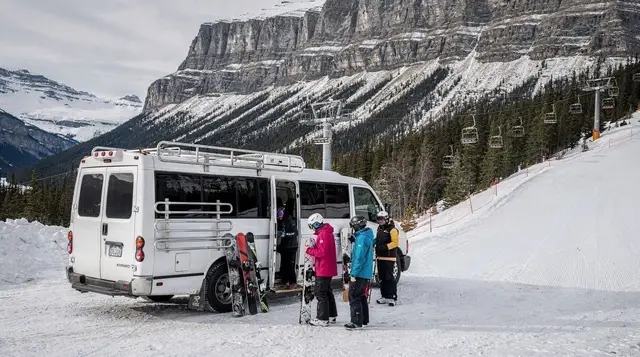
GetYourGuide does not provide a product photo for this activity — the image shows the meeting point, photographed by us.