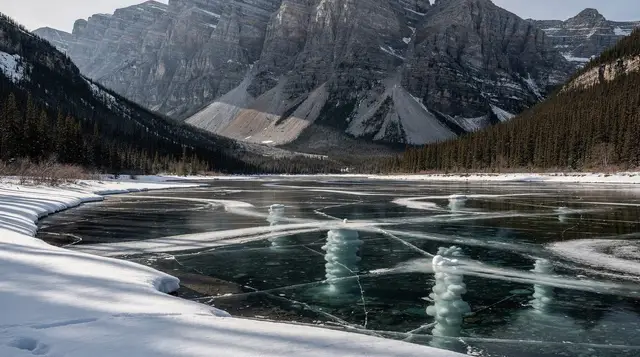
Ice skating on Lake Louise: a rink in front of the château
Can you really skate on Lake Louise, and when?
Yes, on a patch of the lake's surface that's cleared and maintained in front of the Fairmont Chateau Lake Louise once the ice is officially confirmed thick enough, usually from around late December into February or March. The lake doesn't freeze solid overnight and it doesn't thaw until roughly mid-June, so skating is a deep-winter activity only, never a shoulder-season one.
A rink on a national historic lake
Every winter, once the ice on Lake Louise has built up enough to be checked and confirmed solid, a patch of it in front of the Fairmont Chateau Lake Louise is cleared, groomed, and sometimes strung with lights for skating. It’s one of the more photographed winter scenes in the Canadian Rockies: the château’s stone façade behind you, the frozen lake underfoot, and the same glacier-carved peaks that draw summer paddlers standing over a sheet of ice thick enough to hold skaters instead of canoes.
This is a genuinely different experience from a municipal rink. There’s no boards, no Zamboni line, and the ice surface can be uneven where wind has rippled the snow before it was groomed flat. What makes it work at all is that someone has actually checked the ice thickness before opening the area — this isn’t a case of visitors deciding for themselves that the lake “looks frozen enough.”
When the ice is actually skateable
Lake Louise sits at 1,750 metres, and its winters are long enough that the lake does freeze solid — but not immediately, and not for the whole cold season. Ice needs weeks of sustained sub-zero temperatures to reach a safe thickness, and the maintained skating patch typically doesn’t open until sometime in late December, once that threshold has been checked and cleared.
The window that follows runs through a good stretch of the coldest months, commonly into February and, in a cold year, into March. After that, days lengthen and temperatures start climbing enough that ice quality becomes unreliable again well before the lake’s actual thaw.
| Period | Ice status | Skating |
|---|---|---|
| November – mid/late December | Freezing in progress, thickness unconfirmed | Not open |
| Late December – February | Solid, checked, maintained | Typically open |
| March (cold years) | Still solid in places, checked | Sometimes still open |
| April – early June | Thinning, breaking up | Not safe, not open |
| Mid-June onward | Lake ice-free, water visible | N/A — this is the summer lake |
That last row matters more than it looks. Lake Louise doesn’t fully lose its ice until around the middle of June, later in a heavy-snow year, which is a big part of why the turquoise, glacier-fed lake in every summer postcard and the grey-white frozen surface you’d skate on look like two completely different places. A photo of open turquoise water at Lake Louise taken in April or May doesn’t exist — the lake is still locked up at that point, just past its best skating and not yet at its summer colour.
Why you never just walk out and check the ice yourself
This is the one rule on this page that matters more than any tip about rentals or timing. The reason skating happens at all on Lake Louise is that the ice on the maintained patch has been measured and confirmed by the people responsible for the area before it’s opened to the public — not because the lake looked solid from the shore.
Ice thickness on a mountain lake is not uniform. Wind, snow cover acting as insulation, inflows from meltwater, and depth variation across the lake bed can all leave one stretch of ice well over 30 centimetres thick while another patch metres away is dangerously thin, with nothing visible from above to tell the two apart.
This is exactly why the safe area is a small, defined, maintained rink rather than “the lake” in general — walking beyond that boundary, or onto any unchecked stretch of ice anywhere in the Rockies, including other frozen lakes around the park, is not something a guide, an outfitter, or common sense should ever wave you toward. If the maintained area is closed on the day you visit, that’s the answer — not an invitation to find your own patch.
Getting your skates
Skate rental is usually available close to the ice itself, near the Fairmont Chateau Lake Louise, so a fair number of visitors show up without their own pair and rent on the spot. If you’d rather have skates sorted before you make the drive up from Banff or Canmore, both towns carry rental gear at outdoor shops, though neither has a rental fleet built specifically around lake skating — call ahead on a busy holiday weekend rather than assuming a pair in your size will be waiting.
Bring or rent skates that actually fit; an ill-fitting rental pair on uneven natural ice is a much less forgiving combination than the same pair on a smooth arena floor. A guard or blade cover for the walk from the parking area to the ice is worth having too, since the approach is usually packed snow rather than a cleared path.
What it costs, roughly
Pricing on the cleared ice itself has typically run as a no-charge amenity tied to the Fairmont property, though that’s the hotel’s call and can shift from one season to the next — treat any specific number as something to confirm close to your dates rather than a fixed rule. Skate rental is the cost that’s actually consistent, and it’s a modest add-on rather than a major line item in a Banff-area winter budget.
| Item | Typical cost (CAD) | Notes |
|---|---|---|
| Access to the maintained skating ice | Often no charge | Set by the hotel property, confirm seasonally |
| Skate rental (adult) | Modest hourly or session rate | Available near the rink, and in Banff/Canmore |
| Skate rental (child) | Usually cheaper than adult | Availability tighter on weekends |
| Parking near Lake Louise | Separate cost, and can be limited | See our parking guide |
| Parks Canada day pass | About 11 CAD per adult per day | Required to enter the park at all |
Don’t forget the Parks Canada pass — it’s a separate requirement from anything to do with the rink, and it’s needed simply to be inside Banff National Park for the day, skating or not.
Getting there and parking
Lake Louise sits about 58 kilometres from Banff, roughly a 45-minute drive on a clear winter road, longer if snow is falling or the highway has slowed for conditions. Winter driving in the Rockies deserves its own preparation — see our winter driving guide before you go, especially if you’re not used to snow-covered mountain highways.
Parking at Lake Louise in winter is less chaotic than the packed summer lots, but it’s not unlimited, and on a clear weekend with good ice it can still fill through the middle of the day. If you’d rather not drive at all, a private transfer or minivan charter run by a local operator takes the parking and winter-driving questions off the table entirely, and can be paired with other stops along the way.
a private minivan transfer between Calgary and Lake Louise is one way to skip both the drive and the parking search on a cold winter day.
Making a day of it
Skating itself is a short, self-paced activity — an hour or two on the ice covers most visitors, longer if you’re taking a lot of photos or warming up in the château lobby between sessions. Because of that, it pairs naturally with other winter activities rather than filling a whole day on its own.
A guided outing that bundles skating with other stops removes some of the logistics, particularly the question of what else to do with the rest of the day once you’ve had your fill of the ice.
a guided Lake Louise ice skating outing that builds the rink time into a wider day trip is one straightforward way to handle it without arranging transport, timing, and rentals separately.
For a longer combined day, some tours pair the skating and gondola side of Lake Louise with the hot springs back in Banff, which works well if you want a soak to finish off a cold afternoon on the ice.
a winter day combining Lake Louise’s gondola with the Banff hot springs covers that pairing in one booking.
If you’d rather see Lake Louise from above before or after skating, the enclosed winter gondola is a separate activity worth knowing about — it runs independently of both the skating rink and the neighbouring ski resort, and includes viewpoints over the valley that you don’t get from ice level, with an optional meal add-on if you’d rather eat up top than head back to the château.
How this differs from the ski resort next door
It’s an easy mix-up for first-time visitors: the Lake Louise Ski Resort is a separate mountain operation up on its own slopes, with lift tickets, terrain, and a season that runs on its own calendar, largely independent of when the lake’s ice is skateable. Skating happens down on the valley floor, right at the shoreline in front of the château; skiing happens up the mountain across the highway.
One pass or one shuttle stop doesn’t cover both, and a day built around one doesn’t automatically include the other. If you’re weighing which to prioritize, our Lake Louise ski resort guide covers that side in full rather than repeating it here, and puts the resort in context with Banff’s other two SkiBig3 hills.
Other cold-weather ice to know about nearby
Lake Louise’s rink isn’t the only winter ice worth seeing in the area, though the others are walking routes rather than skating surfaces. Johnston Canyon turns into a guided ice walk in winter, with crampons provided and frozen waterfalls as the destination rather than open ice to skate on — see our Johnston Canyon and Maligne Canyon ice walk guide for how that differs from what’s on this page. Further out, Abraham Lake is known for its methane ice bubbles rather than for skating, and sits outside the national parks on the David Thompson Highway, roughly three hours from Banff.
If you want ice underfoot in a different setting altogether, a guided walk through a canyon rather than across a lake is worth considering as a contrast to the rink experience.
a guided ice walk through Grotto Canyon near Lake Louise swaps the open lake for a narrower, sheltered canyon route.
Other winter things to pair with a skating trip
Beyond the rink itself, the Lake Louise area and the wider Banff region carry a full winter calendar worth building a trip around. A horse-drawn sleigh ride is a low-effort complement to a skating afternoon if you want a second slow, scenic activity without more physical exertion. Dog sledding is a higher-energy alternative for the same general window of the season. And our month-by-month winter guide lays out how conditions, crowds, and daylight shift from November through into spring, which is useful for deciding exactly when in that window to plan a skating trip.
For general trip planning around the season, our winter itinerary covers how a skating day on Lake Louise fits into a broader Rockies winter trip, whether you’re basing yourself in Banff, Canmore, or Lake Louise itself for a few nights.
Frequently asked questions about ice skating on Lake Louise
Is it actually safe to skate on a frozen lake instead of a rink?
The maintained patch in front of the Fairmont Chateau Lake Louise is only opened once ice thickness has been checked and confirmed by the people responsible for the property, and it’s groomed like a rink rather than left as raw lake ice. That’s different from walking out onto an unchecked stretch of the lake yourself, which is never something to do based on how solid the surface looks from shore.
When during the winter can you actually skate on Lake Louise?
Roughly from late December through February, sliding into March in a cold year, once the ice has built up enough depth and been checked. Early winter (November, early December) and late winter into spring are unreliable, since the lake needs sustained hard freezing before anyone will vouch for the ice, and it starts breaking up again well before its mid-June thaw.
Do I need my own skates, or can I rent them there?
Skate rental is usually available right at Lake Louise near the rink, and also in Banff and Canmore if you’d rather sort it out before you drive up. Neither town has a huge rental fleet dedicated to lake skating, so on a busy holiday weekend it’s worth asking your hotel concierge in advance rather than assuming skates will be waiting.
Is the skating rink free, or is there a fee?
The cleared ice itself has typically been free to use, though that’s set by the Fairmont Chateau Lake Louise property and can change season to season, so treat it as a detail to confirm rather than a fixed rule. Skate rental, if you need it, is a separate paid cost on top.
Can I skate on Lake Louise at night, or is it a daytime-only thing?
The rink area is typically lit and decorated for the evening, and skating after dark in front of the illuminated château is one of the more atmospheric versions of this. Cold deepens fast after sunset at this elevation, though, so evening sessions call for warmer layers than a bright midday one.
How does this compare to skiing at the Lake Louise Ski Resort next door?
They’re unrelated activities on unrelated ground: the ski resort is a separate mountain operation with its own lift tickets and season, covered in its own guide, while lake skating happens down on the valley floor in front of the château. Don’t expect one pass or one shuttle stop to cover both.
What should I wear or bring for skating on the lake?
Warm insulated layers, a hat and gloves that still let you lace skates, and waterproof or water-resistant boots for getting to and from the ice, since the approach is often packed snow rather than a cleared path. A thermos of something hot and a change of dry socks make the walk back to the car noticeably more pleasant.
Is there anywhere to warm up nearby if I get cold?
The Fairmont Chateau Lake Louise lobby and its cafes are right there, and most visitors treat a hot drink inside as the natural break between skating sessions. Public washrooms and warming space directly at the rink itself tend to be limited, so budget time to walk into the hotel rather than counting on trailside facilities.
Lake Louise & Moraine Lake tours on GetYourGuide
Verified deep-linked GetYourGuide tours. Book through these links and we earn a small commission at no cost to you.
GetYourGuide does not provide a product photo for this activity — the image shows the meeting point, photographed by us.