Mount Norquay: Banff's closest ski hill
What makes Mount Norquay different from Banff's other two ski resorts?
Mount Norquay sits a few minutes' drive from downtown Banff, making it the closest of the three SkiBig3 resorts to town. Its terrain is smaller and more compact than Lake Louise or Sunshine Village, with a reputation for steeper, more technical runs, and it's the only one of the three that runs lit night skiing sessions.
Why skiers choose Mount Norquay over the other two resorts
Banff has three ski resorts, and they get lumped together often enough under the SkiBig3 pass that it’s easy to assume they’re interchangeable. They aren’t. Lake Louise Ski Resort is the biggest, Banff Sunshine has the longest season and the highest, snowiest terrain, and Mount Norquay is the one that sits closest to where you’re actually staying. If your hotel is on or near Banff Avenue, Norquay is the resort you can reach in the time it takes to finish a coffee.
That proximity shapes everything else about the place. Because it’s so close to town, Norquay draws a heavier local crowd than the other two — Banff and Canmore residents who ski a few runs after work, on a weeknight, rather than committing a full day to a resort further up the valley. It also means Norquay is the only one of the three that bothers with lit night sessions, since it’s the only one close enough to town for an evening ski to make practical sense. Neither Lake Louise nor Sunshine Village offers anything comparable.
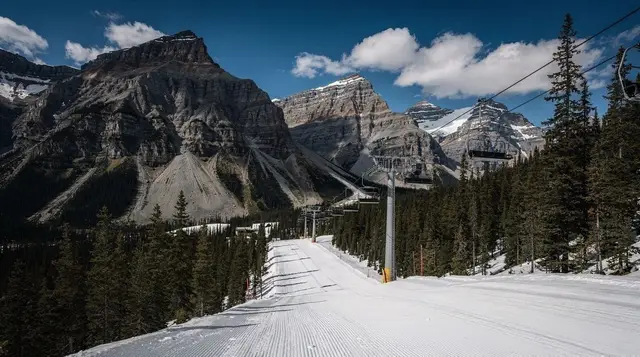
The terrain itself has a reputation that follows it around: more compact and more technical than what you’ll find at the other two. Norquay isn’t trying to be the biggest ski area in the valley. It’s smaller, steeper in places, and the kind of hill locals return to for a handful of specific, challenging runs rather than a full day of exploring. If you want the numbers — skiable area, vertical, lift counts, season length, and how the three resorts actually compare on price — that comparison lives on our SkiBig3 resorts compared page, not here. This page is about what Norquay is like to ski, not how it stacks up on a spreadsheet.
One thing worth saying plainly, because it trips people up: Norquay does not have the longest season of the three. That record belongs to Sunshine Village, which routinely stays open into May thanks to its higher, more sheltered terrain. Norquay’s season is shorter and sits more squarely in the middle of winter — plan around that if you’re arriving in early season or late spring.
Getting to Mount Norquay from Banff
Mount Norquay sits on the mountain of the same name, on the edge of the Banff National Park townsite, a short drive up Mount Norquay Road from the highway junction near downtown. In practical terms, that’s a few minutes from most hotels on or near Banff Avenue — closer than Lake Louise (58 kilometres, roughly 45 minutes) or Sunshine Village (a shuttle-and-gondola combination from a parking lot outside town). You won’t find that kind of convenience at either of the other two resorts, and it’s the single biggest reason people choose Norquay for a half-day or an evening rather than a full day trip.
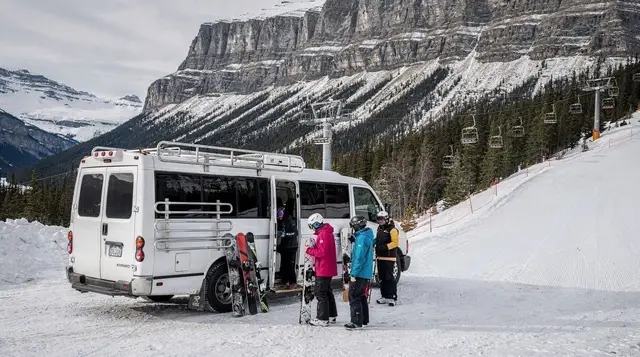
SkiBig3 runs shuttle service connecting Banff and Canmore hotels to all three resorts, Norquay included, and for Lake Louise and Sunshine that shuttle is genuinely useful — it saves you the drive and the parking. For Norquay, plenty of visitors skip the shuttle altogether and just drive themselves, since the trip up Mount Norquay Road takes only a few minutes from most parts of town. If you’d rather not deal with a rental car for the whole trip, our Banff ski shuttle guide covers how the shuttle network works across all three hills, including pickup points and timing.
Whichever way you get there, remember your Parks Canada pass — Mount Norquay sits inside Banff National Park boundaries, so the same pass requirement that applies everywhere else in the park applies here too, even if you’re only driving up for a few hours of skiing. Winter driving in the Rockies has its own learning curve if you’re not used to it, so give yourself extra time before you head up if you’re unfamiliar with mountain roads in snow.
What the terrain is actually like
Where Lake Louise sprawls across several bowls and Sunshine spreads over a ridge straddling the Continental Divide, Norquay is compact by comparison — you can get a genuine sense of the whole hill in a way that isn’t really possible at the other two. That compactness is part of what gives it its reputation for steeper, more technical skiing. Norquay isn’t the place to bring a nervous beginner looking for wide, gentle groomers to build confidence on; that’s a better fit for Lake Louise’s broader lower-mountain terrain.
What Norquay does well is deliver a concentrated dose of steeper pitches and more demanding lines without requiring you to hike or traverse far to find them. Locals who ski here regularly tend to talk about it in terms of a handful of specific runs rather than the resort as a whole — the kind of hill where you learn the terrain and come back for particular lines rather than exploring something new every visit. If that’s the kind of skiing you’re after, and you don’t have the time or inclination to drive out to Lake Louise or shuttle out to Sunshine, Norquay delivers it close to home.
None of this means Norquay lacks easier terrain entirely — it doesn’t — but its overall character skews more technical than the other two resorts, and that’s worth knowing before you commit a half-day to it with a mixed-ability group. If your group spans a wide range of comfort levels, from complete beginners to confident skiers, you may find it easier to split time between resorts, or to lean on Lake Louise for the easier members of the group while more confident skiers head to Norquay separately.
Night skiing: the feature the other two don’t have
This is Norquay’s real point of difference, and it’s not close. Neither Lake Louise nor Banff Sunshine runs lit evening skiing — both close at the end of the regular day and that’s it. Mount Norquay lights part of its terrain for night sessions, and because it’s a few minutes from downtown Banff rather than a 45-minute drive or a shuttle-and-gondola combination away, it’s the only one of the three where an evening ski actually fits into a normal day.
That makes Norquay the obvious choice if you’ve already spent the day doing something else — a morning at Lake Louise, a walk through Johnston Canyon, or simply arriving in Banff mid-afternoon — and want to get a couple of hours on snow before dinner rather than write off the whole day. It’s also the choice locals make on an ordinary weeknight, which gives the hill a different feel after dark than the daytime crowd: fewer tourists, more people who ski here regularly, and a shorter, more focused session rather than a full day’s outing.
Night skiing sessions run on a portion of the mountain, not the whole thing, and conditions and hours shift through the season, so check current schedules before you plan an evening around it. If you’re coming to Banff specifically for the skiing and want to fit in more than one resort, an evening at Norquay after a full day at Sunshine or Lake Louise is a realistic way to add a second resort to the same day without a second full outing.
Lessons, rentals, and lift tickets
This page isn’t the place for the details on ski school or equipment rental — that’s covered properly in our ski rental and lessons guide, which walks through what’s available at each of the three SkiBig3 resorts, including Norquay. If you need to rent gear or book a lesson before you show up, start there rather than here.
Pricing is the same story. Lift ticket costs, multi-day pass options, and how the three resorts compare on value all live on our SkiBig3 resorts compared page. What’s worth knowing here is simply that SkiBig3 passes are generally valid across all three resorts, so a multi-day pass lets you split your time between Norquay’s steeper, closer terrain and the bigger, more varied terrain at Lake Louise or Sunshine without buying separate tickets for each. Single-day tickets tend to be resort-specific, so check the current terms if you’re only planning one day and want to keep options open.
If you’d rather have someone else handle logistics — lift access, terrain knowledge, and moving between resorts — a few guided options cover exactly that combination. One tour groups Lake Louise, Sunshine Village, and Mount Norquay into a single multi-resort experience:
a guided day that moves between Lake Louise, Sunshine Village, and Mount Norquay, which is a reasonable way to sample Norquay’s terrain alongside the other two resorts without arranging transport yourself.
A similar option runs as a dedicated ski safari across the same three hills: a ski safari touring all three SkiBig3 resorts in one trip, useful if you’re short on time and want a taste of each resort’s terrain rather than committing a full trip to just one.
When to plan around
Because Norquay’s season runs shorter than Sunshine’s and doesn’t stretch into late spring the way Sunshine’s does, timing matters more here than it does for the other two resorts. Early and late season are the periods most likely to catch Norquay closed or running on limited terrain while Sunshine is still open. If you’re travelling in November or in April and later, check current operating dates for Norquay specifically rather than assuming all three resorts share the same calendar — they don’t. Our month-by-month winter guide breaks down what’s typically open when across the whole season, and it’s worth a look if your trip falls near either edge of winter.
Cold is also worth factoring in, particularly for an evening session. Banff’s winter temperatures commonly sit between -15°C and -25°C, with occasional dips below -30°C, and standing on a chairlift after dark is colder than moving around during the day. If you haven’t skied in genuine mountain cold before, our guide to what -25°C actually feels like covers what to expect and how to dress for it, which matters more for a night session at Norquay than for a midday run at Sunshine or Lake Louise.
Beyond skiing: Mount Norquay in summer
Outside ski season, the same slopes that host Norquay’s technical runs become the setting for guided via ferrata climbing — assisted rock climbing routes using fixed cables and rungs, run as guided outings rather than something you’d do independently. It’s a genuinely different use of the mountain, and one of the more distinctive summer activities based right at the edge of Banff rather than out along the Icefields Parkway or deeper into the backcountry.
a guided via ferrata climb on Mount Norquay, run in either a shorter or longer format gives you a way to see the mountain from a completely different angle than skiing does — worth knowing about if you’re visiting in summer and wondering whether Norquay has anything to offer outside winter. For more on how that activity works and what to expect, see our dedicated via ferrata guide.
If you’re building a broader winter itinerary around Banff and want Norquay to fit into a bigger picture — other gondolas, other winter activities, other resorts — our winter skiing itinerary lays out how to combine a few days across Sunshine, Lake Louise, and Norquay’s evening sessions without wasting time backtracking across the valley. And for a broader look at what else there is to do on and around this specific mountain beyond the pistes, our Mount Norquay activities page rounds up the rest.
Mount Norquay questions, answered
How far is Mount Norquay from downtown Banff?
A few minutes by car from Banff Avenue, up Mount Norquay Road. It’s the closest of the three SkiBig3 resorts to town, and the only one you can reasonably reach for an evening session after work or dinner.
Does Mount Norquay have the longest ski season in Banff?
No. That distinction belongs to Banff Sunshine, which typically stays open into May. Norquay’s season is shorter and more concentrated around midwinter. See our SkiBig3 comparison for season dates before you book.
Is Mount Norquay good for beginners?
It has beginner terrain, but its overall reputation is for being more compact and more technical than Lake Louise or Sunshine Village. Families and first-timers often find Lake Louise’s broader beginner zones more forgiving.
What is night skiing at Mount Norquay?
Mount Norquay runs lit evening sessions on part of its terrain, something neither Lake Louise nor Banff Sunshine offers. It’s popular with locals and with visitors who’ve spent the day elsewhere and want an hour or two on snow after dark.
Is there a shuttle to Mount Norquay?
SkiBig3 runs shuttles from Banff and Canmore hotels to all three resorts, Norquay included, though its short distance from town means plenty of visitors just drive themselves.
Can I use one lift ticket at all three SkiBig3 resorts?
SkiBig3 sells multi-day passes valid across Lake Louise, Sunshine Village, and Mount Norquay, so you can split a trip across resorts without buying separate tickets. Single-day tickets are usually resort-specific; check current terms before you buy.
What else is there to do at Mount Norquay besides skiing?
Outside winter, the same slopes host guided via ferrata climbing routes. In winter, beyond the pistes, it’s mainly the night skiing and a smaller, quieter base area that set it apart from the other two resorts.
Ski and snowboard days on GetYourGuide
Verified deep-linked GetYourGuide tours. Book through these links and we earn a small commission at no cost to you.
GetYourGuide does not provide a product photo for this activity — the image shows the meeting point, photographed by us.