What minus 20 actually feels like, and whether Banff winter is worth it if you don't ski
The first ten minutes outside are the ones that decide everything
I remember stepping out of the hotel on Banff Avenue on a January morning, mount Cascade sitting sharp and white at the end of the street, and thinking the air didn’t feel that bad. That lasted about four minutes. By the time I’d walked two blocks toward the river, my face had gone from cold to genuinely painful, and I understood something about winter here that no forecast number had prepared me for: -20°C in Banff isn’t an abstraction you adjust to once and then ignore. It’s a condition that reasserts itself every time you step outside, and it structures the whole day around how long you’re willing to be in it.
That’s really what this post is about. Not gear, not layering systems — there’s a separate practical page for that — but what the cold itself actually does to a day of sightseeing when you’re not there to ski.
What the cold takes away
The plain fact is that daytime temperatures in Banff National Park commonly run -15 to -25°C through December, January, and February, with clear nights dropping further and the occasional stretch sliding past -30°C. A chinook can blow through and shove the number up sharply for a few days, sometimes dramatically, but I’ve learned not to bank on one showing up during any particular week I happen to be there. Treat it as something that occasionally happens, not a redemption arc built into every trip.
What that cold actually removes from a day is not “the outdoors” in general — it’s endurance. My own tolerance tops out around 30 to 40 minutes of real outdoor activity before my hands go numb inside supposedly warm gloves and my feet start to feel like blocks rather than feet. Past that point, nothing about the view improves the experience; I’m just cold and distracted. A slow wander down Banff Avenue toward Bow Falls, something I’d stretch to two unhurried hours in July, becomes three or four short outings broken up by ducking into a cafe to thaw out.
Waiting is worse than walking. Standing at a Roam Transit stop for fifteen or twenty minutes with no shelter, watching your breath freeze on your scarf, is a completely different experience from checking a bus app on a warm sidewalk. I underestimated this the first time I came in January, and it’s the single thing I’d flag hardest to anyone planning a non-ski winter trip: build in buffer time and expect that waiting outside, more than walking outside, is where the cold actually gets to you.
Anything that depends on standing still is affected the same way. A slow look at Vermilion Lakes at sunset, or a wait for a photo at Two Jack Lake, gets shorter and more purposeful in winter, because you can’t just linger the way you would in warmer months.
What the cold gives you instead
Here’s the part that actually convinced me to keep coming back in winter. The park empties out. I can’t hand you a visitor count that proves it — nobody publishes a clean month-by-month figure I trust enough to quote — but the difference in how the streets and viewpoints feel is not subtle. Parking that’s a fight in July is trivial in January. The boardwalk in front of the Château Lake Louise stands empty enough that you can actually stop and look rather than shuffle past.
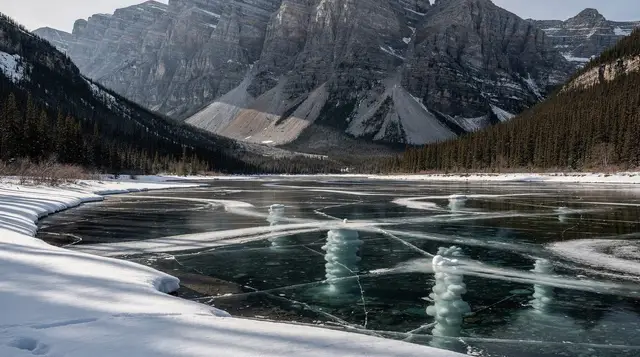
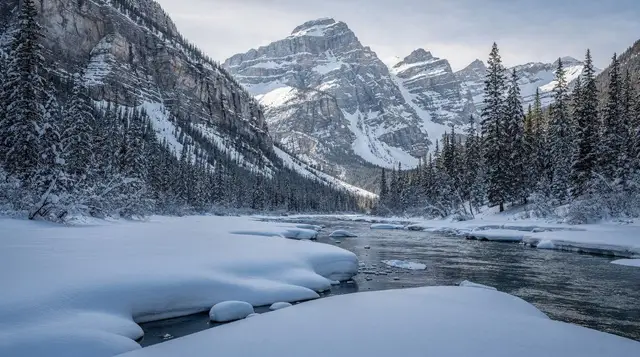
The light does something summer never manages. Low winter sun raking across a snow-covered Mount Rundle or lighting up the frozen edge of Lake Minnewanka has a quality that no July afternoon replicates, precisely because the sun sits low in the sky for most of the day rather than climbing overhead and flattening everything.
Ice itself becomes the attraction rather than an obstacle: a guided walk into Johnston Canyon in winter, crampons on, ice climbers frozen mid-pitch on the canyon walls around you, is a completely different experience from the same trail in August, and one I’d argue is better. A trip like a day combining Lake Louise with the Johnston Canyon ice walk covers exactly that pairing without you having to work out logistics in the cold yourself.
January adds one more reason to time things deliberately: SnowDays, Banff’s winter festival built around a snow-sculpture competition and a run of other cold-weather events around town. It’s worth checking the festival calendar before you book, because a trip that lines up with it has something to do in the evenings beyond just retreating from the cold.
Where I’d actually spend the short outdoor windows
Given that outdoor time is the scarce resource, I’ve stopped trying to cram in long, ambitious days and instead built winter trips around two or three deliberately chosen outdoor blocks per day. A gondola ride up Mount Norquay or Sulphur Mountain gives you the view without the endurance test, since most of the cold exposure is limited to walking between the car or bus and the lift. A day like this gondola-and-short-hikes day trip is built the same way, in bursts, rather than assuming you’ll want to be outside continuously for six hours.
For a longer outing, I’d rather do it as a guided day than a self-drive one in deep winter, since a driver who knows the conditions on the Icefields Parkway removes one whole category of stress. A trip like a full-day private winter tour up the Icefields Parkway lets you see the frozen waterfalls and the Columbia Icefield without doing the driving yourself on a road that gets far less forgiving once ice sets in.
Closer to town, a half-day covering the canyons and lower lakes, similar to this Banff winter canyons and lakes tour, is a reasonable way to see several of the cold-weather highlights without overcommitting to a single long day outdoors.
Ice skating on Lake Louise’s maintained rink, a short dog-sledding outing, or a horse-drawn sleigh ride are all built for exactly this problem: real winter atmosphere delivered in a window short enough that the cold doesn’t get the upper hand. None of them ask you to be outside for hours at a stretch, and all of them work whether or not you have any interest in skiing at Banff Sunshine or Lake Louise Ski Resort.
My honest verdict
I’ll say it plainly: winter is worth it for a non-skier, but only if you go in with the right expectations. It is not a colder version of a summer trip where you swap a jacket for a warmer one and carry on as before. It’s a trip built around short, deliberate outdoor sessions — twenty minutes here, forty there — separated by warm breaks, with waiting for transit treated as seriously as the outdoor activity itself.
In exchange you get a park with almost none of the crowd pressure of summer, light that photographs better than anything July offers, and a set of experiences — the ice walks, the frozen lake, the empty boardwalks — that simply don’t exist the rest of the year. If you can’t accept standing outside in real cold at all, even briefly, this isn’t your season; go in summer or aim for the shoulder months instead. If you can tolerate it in short doses, I think winter is the version of Banff I’d send a first-time visitor to see, not the fallback.
Snowshoeing, ice walks & winter tours on GetYourGuide
Verified deep-linked GetYourGuide tours. Book through these links and we earn a small commission at no cost to you.
GetYourGuide does not provide a product photo for this activity — the image shows the meeting point, photographed by us.