First time in the Canadian Rockies: a 5-day orientation from Banff
Why Banff needs an explanation before Jasper does
If this is your first trip to the Canadian Rockies, the first thing worth understanding is that Banff is not simply a mountain town near a national park — it’s a town located inside one. Banff National Park was established as a hot springs reserve in 1885 and became Canada’s first national park in 1887, and it was named for Banffshire in Scotland, not for any local feature.
In 1984, UNESCO listed it together with Jasper, Yoho and Kootenay as the Canadian Rocky Mountain Parks. That history matters practically: because the townsite sits inside park boundaries, commercial development is capped and residents need to demonstrate a reason to live there, which is part of why Banff feels compact and lodging books up fast.
This land is also the traditional territory of the Stoney Nakoda (Îyârhe Nakoda), the Blackfoot Confederacy (Siksika, Kainai and Piikani), and the Tsuut’ina, within Treaty 7 — worth knowing as context before you arrive, rather than something you’ll be told on site. If you want more depth than a paragraph can give, see Indigenous history and experiences in Banff.
Because you’re entering a national park, you need a Parks Canada pass for every day you’re inside the boundary — roughly 11 CAD per adult per day or about 22 CAD per vehicle, with a Discovery Pass around 75 CAD per adult (150 CAD per vehicle) covering a full year across Banff, Jasper, Yoho and Kootenay if that’s cheaper for your trip. This applies even if you’re just driving the Trans-Canada Highway through the park without stopping. Full details, current pricing and where to buy one are in the Parks Canada pass explained.
The trap that catches almost every first-timer is Kananaskis. It sounds like part of the same system, and it isn’t: Kananaskis is Alberta provincial land, not a national park, and it runs its own Kananaskis Conservation Pass, roughly 15 CAD per day or 90 CAD per year per vehicle. Your Parks Canada pass does nothing there, and a Kananaskis pass does nothing in Banff. This itinerary doesn’t include Kananaskis at all — five days is better spent going deeper on fewer places — but it’s worth knowing the two systems exist before you see a Kananaskis sign and assume you’re already covered. See Kananaskis pass versus Parks Canada if you’re tempted to add it on a later trip.
How this five-day pace differs from a shorter trip
This is deliberately paced slower than a typical three-day Banff classic loop. Instead of stacking two or three sights into every day, each day here has one clear anchor, with the extra time going toward orientation — reading trailhead signage, figuring out the shuttle system, understanding what you’re looking at — rather than checking off a longer list. If you finish this trip wanting more, the natural next additions are Jasper and the Icefields Parkway, or a proper Kananaskis day, both better handled as separate trips or extensions once you already know how the region works.
| Day | Focus | Where you’ll be |
|---|---|---|
| 1 | Arrival and orientation | Banff townsite |
| 2 | Elevation and views | The Banff Gondola, Sulphur Mountain |
| 3 | The famous lakes | Lake Louise, Moraine Lake |
| 4 | A different pace | Canmore |
| 5 | One more walk, then departure | Johnston Canyon |
You’ll want a car for this itinerary, mainly for Canmore and Johnston Canyon on your own schedule; Roam Transit covers Banff, Lake Louise and Canmore reasonably well if you’d rather go without one, and Moraine Lake requires its shuttle system regardless. Base yourself in Banff for simplicity, though Canmore works too and tends to run cheaper — see where to stay across Banff, Canmore and Lake Louise if you’re still deciding. Expect a mid-range budget overall: how much a day in Banff actually costs breaks down realistic numbers rather than best-case ones.
Day 1: Banff townsite and getting your bearings
Spend your first day almost entirely on foot in Banff, resisting the urge to drive anywhere yet. Start on Banff Avenue, where Cascade Mountain fills the view straight up the street — a useful first lesson in how close the peaks actually are to daily life here. Walk down to Bow Falls, a short, easy stretch of river rapids rather than a dramatic waterfall, then continue to the Surprise Corner viewpoint for a view of the Fairmont Banff Springs, the 1888 hotel nicknamed “the castle in the Rockies,” across the valley.
In the afternoon, visit Cave and Basin National Historic Site, the actual birthplace of Canada’s national park system — the hot springs discovered here in 1883 by Canadian Pacific Railway workers led directly to the park’s creation two years later. It’s also home to an endemic snail found nowhere else, a small detail that says something about how specific and fragile this ecosystem is. If you’d rather sit in hot water than read about it, the Banff Upper Hot Springs is the more typical choice; either way, Cave and Basin: birthplace of national parks covers both properly.
Round out the day at the Whyte Museum of the Canadian Rockies or the Banff Park Museum if you want more regional context, then a low-key dinner on Banff Avenue. If you arrived by flying into Calgary, remember the airport is 128 kilometres away, about 1.5 hours via the Trans-Canada Highway — there’s no regular passenger train, no metro and no tram serving Banff, and the Rocky Mountaineer is a scenic luxury product, not a practical transfer option. See Calgary airport to Banff for transfer options if you haven’t sorted that out yet.
Day 2: The Banff Gondola and a slower afternoon
Book the Banff Gondola for a morning slot if you can — lines build through the day, especially in July and August. The gondola climbs Sulphur Mountain to 2,281 metres, and a boardwalk at the top leads to Sanson’s Peak for a wider view over the Bow Valley. If you’d rather walk up under your own power, the Sulphur Mountain trail is 5.5 kilometres one way with about 655 metres of elevation gain, and you can still ride the gondola back down — see Sulphur Mountain on foot guide for that option.
In the afternoon, drive or take Roam Transit route 6 out to Lake Minnewanka, the largest lake in the park at 21 kilometres long, with a seasonal boat cruise running from May through October if you want to get out on the water rather than just look at it from shore. If you’re driving out this way and it happens to be outside March 1 to June 25, the Bow Valley Parkway’s eastern section reopens to vehicles and makes for a good, slower wildlife-watching alternative back into town instead of the highway — worth checking before you go, since the closure is strictly seasonal for wildlife protection.
Keep the evening unstructured. This is the day in the itinerary built with the most slack, partly because gondola queues and weather can eat into your morning, and partly because a five-day trip should have at least one day that isn’t fully scheduled.
Day 3: Lake Louise and Moraine Lake, on someone else’s schedule
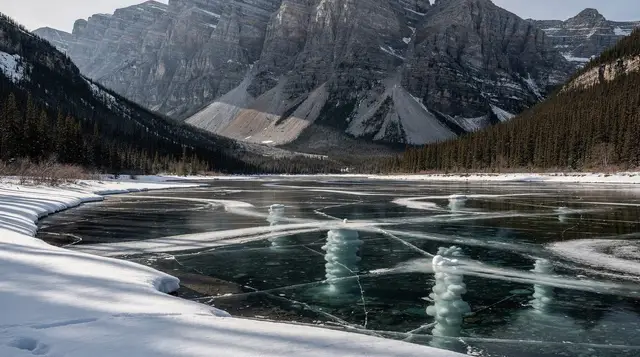
This is the day everything else has been building toward, and it’s also the day where advance planning matters most. Both Lake Louise, at 1,750 metres with the Victoria Glacier at its far end, and Moraine Lake, at 1,884 metres in the Valley of the Ten Peaks, owe their colour to glacial flour — fine rock particles ground up by moving ice that stay suspended in the water and scatter light into that turquoise you’ve likely seen in photos. Those photos are never taken in May: both lakes stay frozen well into the year, with Lake Louise typically thawing around mid-June and Moraine Lake a little later still.
The road to Moraine Lake has been closed to personal vehicles year-round since 2023, full stop — there is no parking lot to aim for regardless of how early you arrive. Access is by the Parks Canada shuttle, Roam Transit, a booked tour, or bicycle. Shuttle seats go on sale in blocks in spring, then shift to a rolling 48-hour booking window for the rest of the season, so book the moment a window opens rather than waiting until the week of your trip — see the Moraine Lake shuttle guide for the current process. Parking at Lake Louise itself is paid, limited and best reserved ahead too, with an overflow lot at the Lake Louise Ski Resort if the lakeshore lot is full.
Given how much coordination this day involves on your first visit, a guided option removes most of the uncertainty: a Moraine Lake sunrise tour handles transport and timing for you, or a Lake Louise, Emerald Lake and Peyto Lake day tour pairs Lake Louise with stops further afield if you’d rather cover more ground in one booked day. If you’d rather add a short walk once you’re at Lake Louise, the Lake Agnes Tea House hike is 3.4 kilometres with about 400 metres of elevation gain, though the tea house itself is seasonal and doesn’t always take cards.
Day 4: Canmore, and a different kind of mountain town
Drive 26 kilometres (about 20 minutes) to Canmore for a change of pace. Canmore sits just outside Banff National Park’s boundary, which means no Parks Canada pass is needed here specifically — a useful, concrete illustration of the park boundary you’ve been navigating around all week. It’s also generally cheaper than Banff for comparable lodging and food, which is worth knowing if you’re still deciding where to base a future trip.
Spend the morning on an easy trail — Grassi Lakes is the gentler option, a well-marked path to two small turquoise pools with modest elevation gain, while Ha Ling Peak is a genuinely demanding half-day hike with around 700 metres of gain over loose scree near the top, better suited to a fit, prepared hiker than a first-timer short on time. A guided Canmore and Banff National Park scenic lakes tour is a reasonable option if you’d rather have the day’s logistics handled after yesterday’s shuttle planning. Grotto Canyon is a quieter third option if both of the others sound too busy.
Spend the afternoon in downtown Canmore itself — smaller and less overtly touristic than Banff Avenue, with a handful of breweries and distilleries if that’s of interest. Drive back to Banff (or stay in Canmore if that’s your base) in the evening.
Day 5: Johnston Canyon, then decide what comes next
Save Johnston Canyon for your last full day — it’s a manageable morning activity that still leaves you time to pack and travel afterward. The walk to the Lower Falls is 1.1 kilometres each way and easy; continuing to the Upper Falls extends it to 2.7 kilometres with more elevation gain but nothing technical.
If you’re not in a rush, the Ink Pots — a set of cold mineral springs in a meadow beyond the falls — extend the walk to 5.8 kilometres round trip and thin out the crowds considerably compared with the falls themselves. A guided Johnston Canyon hike to the Ink Pots takes the routefinding and pacing decisions off your hands if you’d rather not manage them on a departure day.
Johnston Canyon sits along the Bow Valley Parkway, and arriving early is worth it for parking as much as for crowds — this is one of the most visited short walks in the park. By early afternoon, head back toward Banff to pack, or continue straight on to Calgary for a flight home, keeping the 128-kilometre, roughly 1.5-hour drive in mind if you have a specific departure time to hit.
Where this trip leaves you
By the end of five days you’ll have covered the core of what makes Banff National Park distinct — a townsite inside a park boundary, two of the most photographed lakes in Canada, an easy canyon walk and a mountain gondola — along with the practical systems (park passes, lake shuttles, the Kananaskis distinction) that trip up visitors who arrive without any of this context. If you found the pace comfortable and want to go further next time, the natural additions are the Icefields Parkway toward Jasper, a genuine Kananaskis day under its own pass, or Yoho and Kootenay across the Continental Divide — see how many days in Banff for how those pieces fit together if you’re already planning a return trip.
tours.5 days
Verified deep-linked GetYourGuide tours. Book through these links and we earn a small commission at no cost to you.
GetYourGuide does not provide a product photo for this activity — the image shows the meeting point, photographed by us.