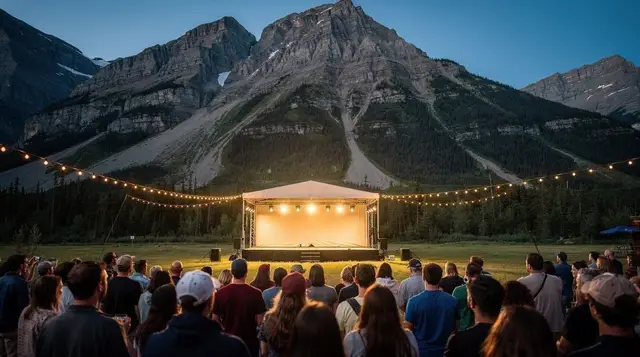
Cave and Basin: the birthplace of Canada's national parks
Can you swim at the Cave and Basin in Banff?
No. Swimming has been closed for decades to protect the endangered Banff Springs snail, found nowhere else on Earth. For a bathable hot spring, go to Banff Upper Hot Springs instead.
Where the whole idea of a national park started
Every national park in Canada, and the whole system that manages Banff National Park today, traces back to one hole in a rock on the side of Sulphur Mountain. In 1883, a small crew of Canadian Pacific Railway workers were exploring above the Bow Falls when they found a cave with warm, mineral-laden water bubbling up through a natural opening. What they’d stumbled onto was a hot spring that had been forming that cave for thousands of years.
Word travelled fast, and so did competing claims. Within two years the federal government stepped in, setting aside a small reserve around the springs in 1885 to keep them out of private hands. That reserve grew into the Rocky Mountains Park Act of 1887, which created Canada’s first national park. The park has been renamed and its boundaries redrawn more than once since, but the Cave and Basin is where the paperwork, and the whole concept, began. It’s a National Historic Site today, run by Parks Canada, and it sits a short walk from downtown Banff, tucked below the Fairmont Banff Springs on the lower slope of Sulphur Mountain.
If you’re building out a first visit to town, this is one of the few Banff attractions that’s genuinely about history rather than scenery, which makes it a useful counterweight to a trip otherwise built around lakes and mountains. It pairs naturally with an afternoon that also takes in the Whyte Museum or a walk along the Bow Valley Parkway.
The cave itself
The cave is the reason the site exists, and it’s smaller than most people expect. A short tunnel, cut into the rock in the early 20th century to replace the original ladder-and-hole entrance, leads down into a low limestone chamber with a pool of warm, faintly sulphurous water at the bottom. The air inside is humid and mineral-scented, and an opening in the cave’s roof lets in a shaft of daylight that lands on the water below, which is the same effect that likely caught the original discoverers’ attention.
You cannot touch or enter the water in the cave. A viewing platform and railing keep visitors a few steps back, partly for safety on the wet rock and partly, as with the rest of the site, to protect the spring itself. The water temperature runs warm rather than hot, generally in the low-to-mid 30s Celsius, noticeably cooler than the bathing pool at Banff Upper Hot Springs across town.
The cave is compact enough that you won’t spend more than 10 to 15 minutes inside, but it’s the one experience here that has no equivalent anywhere else in Banff. Nowhere else in the park can you walk into the actual spring that led to its founding.
The outdoor basin
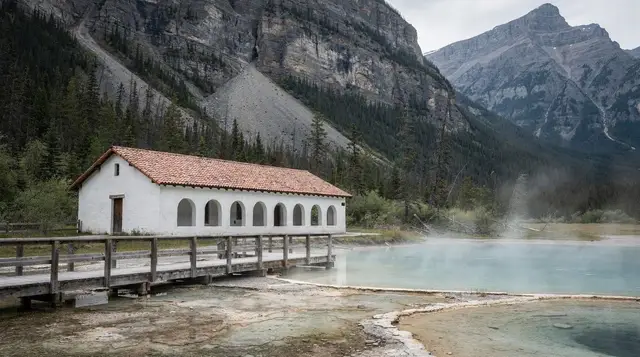
Outside the cave, a paved path leads to the basin: a round, artificial pool built around a second outflow of the same spring system, open to the sky. Historically this was a bathing pool, the original commercial hot spring facility in what would become Banff, complete with a bathhouse and, for a stretch of the early 20th century, some fairly elaborate architecture. None of that survives as a place to swim.
Today the basin is fenced and viewed from a boardwalk. The water sits at a similar mild warmth to the cave pool, tinted slightly by mineral deposits, and often has a faint sulphur smell that carries a short distance on the breeze. It photographs well, particularly with the stone retaining walls and mountain backdrop, but it functions purely as a heritage and conservation feature now, not a facility.
Around the basin, interpretive panels lay out the site’s architectural history alongside its natural one, showing how the same pool went from Victorian-era bathhouse to protected habitat over roughly a century.
Why nobody swims here anymore
This is the detail that trips people up, so it’s worth being direct about it: the Cave and Basin is closed to bathing, full stop. If a swim in a warm spring is what you’re after, that’s the Banff Upper Hot Springs, a separate site up the mountain road, with a heated, chlorinated, genuinely bathable pool. The Cave and Basin looks similar at a glance, warm water, stone pool, mountain setting, but it serves the opposite purpose now: conservation rather than recreation.
The reason is a snail. The Banff Springs snail, Physella johnsoni, is a small freshwater species found only in a cluster of thermal spring pools in this immediate area and nowhere else on the planet. It’s listed as endangered under Canadian species-at-risk legislation, and its entire known range sits within a few hundred metres of where you’re standing. Swimming, chemical contamination from sunscreen and skin oils, and general disturbance of the shallow spring pools all threaten a population that has no other home to retreat to. Parks Canada closed bathing here in stages through the 20th century, with full closure and active habitat protection now standard practice.
It’s a small, easily overlooked animal to have shaped so much policy, but the logic holds: this is one of the rare places on Earth where an entire species’ survival depends on keeping people out of the water. A short marsh boardwalk near the site sometimes offers a glimpse of the spring outflow habitat where the snails actually live, with interpretive signage explaining what makes the ecosystem unique. Don’t expect to spot individual snails without knowing exactly what to look for; they’re a few millimetres long.
The exhibition
Inside the visitor centre, the exhibition covers three overlapping stories: the discovery of the springs, the creation of the national park system that followed, and the natural history of the thermal spring ecosystem, snail included. Displays are a mix of historical photographs, artifacts from the early bathhouse era, and interactive panels aimed at a general audience rather than specialists.
It’s a manageable exhibition, not a sprawling museum. Most visitors move through it in 20 to 30 minutes, longer if travelling with kids who stop to interact with the touch-screen and hands-on elements. It gives useful context before or after the cave and basin themselves, explaining why a site this modest in scale ended up as the origin point for a park system that now spans the country.
If museums and historical context are your thing on a Banff trip, this pairs naturally with the Whyte Museum of the Canadian Rockies downtown, which covers the broader human history of the valley, or with the Banff Park Museum, a preserved early 20th-century natural history collection housed in the same guide.
Sundance Canyon and the Marsh Loop
The Cave and Basin sits at the trailhead for two easy walks that extend a visit without much extra effort. The Marsh Loop is a short, flat boardwalk trail circling a warm-water marsh fed by spring outflow, generally well under an hour round trip, and a decent option even with a stroller. It’s also where you’re most likely to see the marsh habitat that supports the endangered snail and other spring-dependent species, explained through signage along the route.
Sundance Canyon is a longer proposition: a paved multi-use path runs along the Bow River for a few kilometres before climbing into a short canyon loop with small waterfalls. Many people walk it, some cycle the flat river section and walk the canyon loop on foot. Either trail is a reasonable way to fill an afternoon that started at the Cave and Basin, especially on a day when the bigger destinations like Lake Louise or Moraine Lake feel like too much driving.
Practical details
The site sits a short drive or a longer walk from downtown Banff, along the road that also leads up to the Banff Gondola base station. Roam Transit’s town routes serve the general area, though check the current route map, since transit routings around Banff shift between seasons.
Hours run seasonally: expect daily opening through the summer months, with reduced days and hours in the shoulder and winter seasons. The Cave and Basin charges its own modest admission separate from the Parks Canada park day pass that gets you into Banff National Park in the first place; the Discovery Pass covers national historic sites like this one, but confirm current pricing on the official Parks Canada site before your visit, since historic site fees are set independently of the park entry fee described elsewhere on this site.
| What | Covers | Needed for the Cave and Basin? |
|---|---|---|
| Parks Canada park day pass | Entry to Banff National Park itself | Yes, to be in the park at all |
| Cave and Basin site admission | This specific historic site | Yes, a separate ticket or included with a Discovery Pass |
| Discovery Pass (annual) | All Parks Canada sites, parks and historic sites, for a year | Optional, worthwhile if visiting several sites |
Photography is allowed throughout, including inside the cave, though low light in the tunnel and cave chamber means a phone camera will struggle without bracing against a rail. Washrooms and a small gift shop are on site. There is no food service at the Cave and Basin itself; plan to eat downtown before or after.
How it fits into a Banff itinerary
For a first-time visitor building a one-day Banff itinerary, the Cave and Basin works best as a half-day slot, paired with the Banff Gondola or a downtown walk, rather than as a full day on its own. It’s also a solid option on a rainy day, since the exhibition and the cave are both indoors or covered, and the outdoor basin and boardwalks are manageable in light rain.
Travelling with kids tends to work well here: the format is short, the cave has some genuine wow factor for the size of the site, and the interactive displays hold attention longer than a standard museum case does. If you’re weighing things to do with kids in Banff, this belongs on the list alongside the more obvious outdoor picks.
Several guided day tours from Banff or Calgary route through the Cave and Basin as one stop among several, which suits travellers without a rental car or those who’d rather not manage the driving and parking themselves. One option worth knowing about is a full day combining Lake Louise, the Banff Gondola, Lake Minnewanka, and the Cave and Basin, which stitches this site into a broader introduction to the area for anyone short on time.
For a tour weighted more toward wildlife and heritage rather than the big lakes, there’s also a wildlife-focused outing that includes a stop at the Cave and Basin.
Travellers arriving straight from Calgary sometimes prefer to fold this into their transfer day rather than add it later, and a Calgary-to-Banff day tour covering Bow Falls and the Cave and Basin handles that route directly. If you’d rather combine the history stop with a broader mix of short walks and canyon scenery, a tour pairing lesser-known lakes and canyon trails with the historic cave site covers more varied ground in a single outing.
What to skip if you’re short on time
If you only have an hour and have to choose, prioritize the cave itself over the exhibition. The cave is the one experience unique to this location; the exhibition, while informative, covers ground you can also pick up from interpretive panels at other Banff National Park visitor centres or from the Whyte Museum. Skip the Marsh Loop and Sundance Canyon extensions entirely if you’re tight on time; they’re pleasant but not essential to understanding the site’s history.
Don’t come here expecting a soak, and don’t plan a swimsuit into the day around this stop. That’s the single most common source of disappointment for visitors who mix this site up with the Upper Hot Springs before arriving. The Cave and Basin’s value is historical and ecological, not recreational, and treating it that way sets the right expectations before you go.
Cave and Basin questions answered
Can you swim at the Cave and Basin?
No. The outdoor basin and the cave pool are both closed to bathing. The site exists to protect the thermal spring ecosystem, including the endangered Banff Springs snail, not to provide a soak. Banff Upper Hot Springs, a separate site across town, is the bathable option.
Why is the Cave and Basin considered the birthplace of Canada’s national parks?
Railway workers found the warm mineral spring here in 1883. The federal government protected a small reserve around it in 1885, then expanded that protection into the Rocky Mountains Park Act of 1887, Canada’s first national park and the basis of today’s Banff National Park.
What is the Banff Springs snail?
It is a tiny freshwater snail, Physella johnsoni, that lives only in a handful of warm mineral springs around the Cave and Basin. It is federally listed as endangered, and protecting its habitat is the main reason swimming ended here.
How long does a visit to the Cave and Basin take?
Most visitors spend 45 minutes to 1.5 hours, enough time for the exhibition, the cave, the outdoor basin, and a short walk on the marsh boardwalk. Add another 30 to 60 minutes if you continue onto the Sundance Canyon or Marsh Loop trails.
Is the Cave and Basin included in the Parks Canada Discovery Pass?
The Discovery Pass covers admission to national historic sites including the Cave and Basin, but it is a separate product from the park day pass required to enter Banff National Park itself. Check current rates on the Parks Canada website before you go.
Is the Cave and Basin worth visiting if I’ve already done the Banff Upper Hot Springs?
Yes, because they cover different ground. Upper Hot Springs is a bathing experience with a view. The Cave and Basin is a history and conservation site: the actual spring where the discovery happened, an exhibition on the park system, and the cave itself, which you cannot enter anywhere else.
Can kids visit the Cave and Basin?
Yes. The boardwalks are stroller-friendly, the cave is a short, level walk-through, and the interactive exhibits on wildlife and the park system tend to hold children’s attention better than a plaque-heavy museum.
Museums, history & Indigenous experiences on GetYourGuide
Verified deep-linked GetYourGuide tours. Book through these links and we earn a small commission at no cost to you.
GetYourGuide does not provide a product photo for this activity — the image shows the meeting point, photographed by us.