Banff Upper Hot Springs vs. Radium: which one is worth your time
What's the real difference between Banff Upper Hot Springs and Radium Hot Springs?
Banff Upper Hot Springs is a single heated outdoor pool a few minutes from downtown Banff, with a view of Sulphur Mountain. Radium Hot Springs is a separate facility about 135 km away in Kootenay National Park, British Columbia, with a larger hot pool and a cooler swimming pool. Both are developed, chlorinated pools fed by natural hot springs, not wild soaking spots, and both run on seasonal hours and pricing that should be checked before you go.
Two pools get lumped together constantly in trip-planning threads, and they shouldn’t be. Banff Upper Hot Springs sits a few minutes from downtown Banff. Radium Hot Springs sits in a different national park, in a different province, 135 km away. Confusing the two means either wasting a day driving to the wrong one, or skipping a genuinely different experience because you assumed it was a duplicate of what’s already in town.
Neither is a wild spring you hike to and slip into unnoticed. Both are developed, managed pools: concrete basins, filtration systems, lifeguards, and a gate you pay to get through. That’s not a knock — it’s the honest starting point for deciding whether either one is worth your time, and which one fits the day you actually have.
What Banff Upper Hot Springs actually is
Banff Upper Hot Springs is a single outdoor pool built into the hillside below Sulphur Mountain, a short drive or a Roam Transit ride from Banff Avenue. The water is naturally hot, drawn from mineral springs on the mountain, then filtered and temperature-regulated to a controlled range — figure roughly 37 to 40°C depending on season and how recently the pool’s been topped up. It is not a soak-at-your-own-risk spring; it operates like any supervised public pool, with lifeguards, change rooms, and a rental counter for suits and towels if you didn’t pack your own.
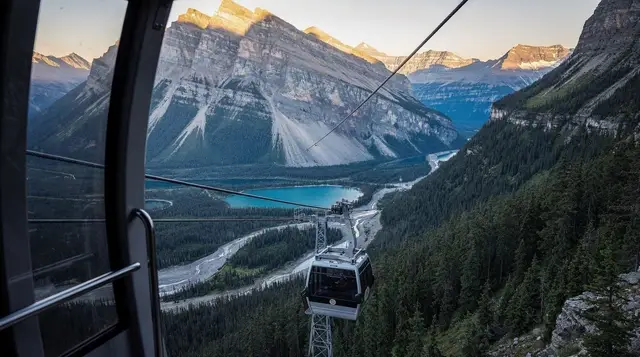
The setting is the reason people bother. The pool faces the slope of Sulphur Mountain, and the Banff Gondola base sits close enough that pairing the two into one outing is the default move for a lot of visitors — ride up for the view, soak afterward, or the other way around depending on the queue at either end. In winter, steam rising off the water against a snow-covered mountain is the postcard shot, and it’s one of the few outdoor things in Banff that stays genuinely pleasant when it’s -15°C outside, since you’re mostly submerged.
What it is not: a large facility. It’s one pool, and on a peak summer afternoon or a busy winter weekend it gets crowded enough that you’re soaking shoulder to shoulder rather than floating in space. It’s also not open every hour of every day — hours shift by season, with shorter windows in shoulder months, so checking the current schedule before you walk down is worth the two minutes it takes.
The building itself dates to a 1930s rebuild of an earlier, more modest bathhouse, and it still has the feel of a heritage structure rather than a modern wellness spa — tiled changing rooms, a snack counter, and a viewing deck rather than saunas, treatment rooms, or the multi-pool circuits you’d find at a purpose-built spa resort. That’s part of the appeal for some visitors and a letdown for others expecting something closer to a European thermal bath. Go in knowing it’s a single well-situated pool, not a spa complex, and it won’t disappoint.
What Radium Hot Springs actually is
Radium Hot Springs is a different facility entirely, located in Kootenay National Park in British Columbia, near the community of Radium Hot Springs — itself a real town, not a neighbourhood inside Banff National Park, which is the mix-up that trips people up most often. This is not a satellite pool of the Banff operation; it’s run for a different valley, fed by different springs, and reached by a different highway entirely.
The facility is larger than its Banff counterpart, with two pools rather than one: a hot pool that runs comparably warm to Banff’s, and a separate, cooler pool meant for actual swimming laps rather than just soaking. That second pool is the practical difference for families — kids who find one 38°C pool boring for more than twenty minutes get an easier place to burn energy at Radium than they do at the single tank in Banff.
Getting there from Banff means about 135 km of driving, close to an hour and forty-five minutes, west along the Trans-Canada and then south through Kootenay National Park on Highway 93. That drive itself passes Marble Canyon and the Paint Pots, both worth a stop, which is exactly why Radium works best as one leg of a bigger Kootenay day rather than a single-purpose round trip for a soak.
The pools sit at the mouth of Sinclair Canyon, where the highway squeezes through a narrow, red-rock gap before opening onto the townsite of Radium Hot Springs. That canyon setting is arguably more dramatic than the Banff facility’s mountainside view — steep rock walls rise close on both sides of the pool deck — though it comes at the cost of the effortless access Banff offers. There’s no gondola next door, no downtown a five-minute walk away; Radium is a destination you plan a day around, not a stop you make on the way to somewhere else in town.
Side by side
| Banff Upper Hot Springs | Radium Hot Springs | |
|---|---|---|
| Location | Banff National Park, minutes from downtown Banff | Kootenay National Park, British Columbia |
| Distance from Banff | A few minutes’ drive or a Roam Transit ride | About 135 km, roughly 1 h 45 by road |
| Pools | One heated outdoor pool | Two pools: a hot pool and a cooler swimming pool |
| View | Sulphur Mountain slope | Sinclair Canyon walls |
| Paired well with | Banff Gondola, downtown Banff | Marble Canyon, Paint Pots, Golden |
| Best as | A same-day, low-commitment add-on | One stop in a longer Kootenay day trip |
| Park pass required | Yes, Parks Canada, Banff National Park | Yes, Parks Canada, Kootenay National Park |
Prices and hours for both are seasonal and change year to year — treat any specific number you read anywhere, including here, as a starting estimate to confirm on the current schedule before you drive out or plan your day around it.
The one everyone confuses these two with
If what you actually want is Cave and Basin, stop here: it is neither of these. Cave and Basin is the site where the discovery of hot springs by railway workers in the 1880s led to Canada’s first national park — it’s a heritage building and interpretive centre, preserved for that history, and it is not open for bathing. People occasionally show up expecting a third soaking option and leave disappointed; the Cave and Basin guide covers what it actually offers, which is history, not a pool.
Deciding which one fits your trip
If you’re spending one or two nights in Banff and want a low-commitment way to end a day of sightseeing, Banff Upper Hot Springs is the obvious choice — it costs you an hour, not a day, and it’s close enough to fold in after dinner or before checkout. Pairing it with the gondola next door is common enough that a combined ticket exists for exactly that reason.
a combined Banff Gondola and hot springs outing that bundles both into one morningIf you have a full day free and you’re the kind of traveller who’d rather see more of the region than repeat a soak you can get in town, Radium earns the drive — especially if you route it through Kootenay National Park rather than treating the highway as dead time. Marble Canyon alone justifies a stop, and Golden is close enough to extend the day further if you’re not driving back to Banff the same night.
a guided day that combines the soak at Radium with stops through Kootenay National ParkFor travellers based in Calgary rather than Banff, the calculus shifts again — Radium becomes a full-day excursion in its own right rather than an add-on to a Banff stay.
a day trip from Calgary built specifically around Kootenay National Park and the Radium poolsAnd if hot springs are just one piece of a bigger winter day that also includes skiing or a sleigh ride, the Banff option folds naturally into that kind of itinerary in a way Radium’s distance doesn’t allow.
a winter day that pairs skiing at Sunshine Village with a soak and a sleigh rideWhy these are heated pools, not wild springs
Neither Banff Upper Hot Springs nor Radium Hot Springs is a source you could stumble on unmarked in the backcountry and climb into. Both draw from real geothermal sources — mineral-rich groundwater heated at depth and forced up through faults in the Rockies’ limestone — but by the time that water reaches the pool you’re standing in, it has been piped, filtered, chemically balanced, and metered into a fixed temperature range, exactly the way any public swimming facility operates. That’s a deliberate trade-off: an unmanaged hot spring would be unsafe to bathe in at any scale, prone to algae, bacteria, and fluctuating temperatures that a supervised facility exists specifically to control.
If the idea of a genuinely wild soak is what drew you to this comparison in the first place, neither of these two delivers it, and no such site exists officially within Banff or Kootenay national parks — off-trail hot springs elsewhere in British Columbia exist, but they’re a different kind of trip entirely, with no lifeguard, no changing room, and no guarantee the water’s safe that day. For the purposes of a Banff-based trip, Banff Upper Hot Springs and Radium Hot Springs are the two legitimate, developed options, and the comparison above is between them, not against some undeveloped alternative.
Practical notes for either pool
Bring your own towel and swimsuit if you can — rentals exist at both facilities but cost extra and the lineup for them is its own small delay. Lockers are typically coin- or card-operated; check which before you arrive so you’re not stuck at the door without the right payment method. Neither pool is heated to spa-like intensity in the way some travellers expect from photos — both sit in a supervised, moderate range, not the near-boiling temperatures of some geothermal spas elsewhere in the world.
Both facilities are inside national parks, which means a Parks Canada park pass is required to be in the park at all, on top of whatever admission the hot springs charge at the door — those are two separate costs, not one bundled fee. The pass itself, what it covers, and current pricing are explained in the Parks Canada pass guide rather than repeated here.
If you’re driving to Radium in winter, treat it as a mountain highway drive, not a quick errand: conditions through Kootenay National Park can turn quickly, and the route crosses into British Columbia, where winter tire requirements differ from Alberta’s. Our winter driving guide covers what that means in practice before you commit to the trip on a rough-weather day.
Crowding at Banff Upper Hot Springs peaks midday in summer and on winter weekends; early morning or late evening (when hours allow) is quieter. Radium sees fewer casual walk-ins simply because of the drive, so its crowding pattern tracks more with the flow of Kootenay day-trippers and Golden-bound travellers than with Banff’s own tourist rhythm.
Building either one into a bigger day
A soak alone rarely fills a full day, and neither pool is designed to. In Banff, the natural pairing is the Banff Gondola, which climbs the same Sulphur Mountain slope the hot springs sit against, plus a wander through downtown before or after — the three sit close enough together that combining them costs little extra time or driving. Some travellers stack a hot springs stop onto a Sunshine Village or Mount Norquay ski day too, since both resorts run shuttles that pass close to downtown Banff on the way back, and arriving back cold and wet from a ski day is exactly the situation a hot pool is built for.
For Radium, the day writes itself along the highway: Marble Canyon for a short canyon walk, the Paint Pots a few minutes further, then the pools themselves, with Golden as an optional extension if you want to keep going rather than turn back toward Banff. Our Kootenay day trip guide lays out that route stop by stop, and the five-day Banff, Yoho and Kootenay itinerary works Radium in as part of a longer loop rather than a single out-and-back.
If you’re weighing whether a hot springs day even belongs in your schedule at all versus other things to do around the region, our broader day trips hub and the things to do at Radium Hot Springs page both help you compare it against the alternatives before committing a day to either pool.
The bottom line
Banff Upper Hot Springs and Radium Hot Springs solve two different problems. One is a convenient, low-stakes soak you can fit into an evening without rearranging your itinerary. The other is a genuinely separate destination in a different park and a different province, worth the drive only if you build a real day around it rather than treating the highway as a tax on getting wet. Pick based on how much day you have to spend, not on the assumption that “hot springs near Banff” only ever means one thing.
Hot springs & wellness experiences on GetYourGuide
Verified deep-linked GetYourGuide tours. Book through these links and we earn a small commission at no cost to you.
GetYourGuide does not provide a product photo for this activity — the image shows the meeting point, photographed by us.