Three days: the Banff classic
What this three-day loop covers, and what it skips
This itinerary is built around a simple decision: cover the Banff essentials properly rather than stretch to Jasper or Kananaskis and rush everything. Three days is enough for the Banff townsite and its gondola, a full day at Lake Louise and Moraine Lake, and a mixed final day pairing Johnston Canyon with Canmore and a Lake Minnewanka boat cruise. It is not enough to also reach Jasper, 288 kilometres and 3.5 hours up the Icefields Parkway, or to add Kananaskis, which sits under a separate provincial pass system anyway. Both make better subjects for their own trip.
You’ll need a car for getting between bases, though not for reaching Moraine Lake itself — more on that below. Base yourself in Banff or Canmore for all three nights; both work, and Canmore is 26 kilometres (20 minutes) from Banff and generally cheaper.
A Parks Canada pass is required for every day you’re inside Banff National Park, roughly 11 CAD per adult per day or about 22 CAD per vehicle, with a Discovery Pass around 75 CAD per adult covering a full year if that works out cheaper for your group. Canmore itself doesn’t require it, but you’ll need the pass again the moment you drive back into the park for Lake Minnewanka.
On budget, expect this loop to run mid-range rather than cheap: peak-season lodging in Banff or Lake Louise, a couple of paid activities each day (gondola, boat cruise, guided tours), and restaurant meals in a town that knows it has a captive audience. Canmore lodging tends to run somewhat cheaper than Banff for a comparable room, which is one reason it’s worth considering as a base even with the extra 20-minute drive each way. All prices here are in Canadian dollars and shown before tax — Alberta charges 5 percent GST with no provincial sales tax, plus a municipal destination fee on accommodation, so build a little room into whatever a listed rate shows.
The order below assumes you’re driving yourself and have a rental car or your own vehicle for the full three days — Roam Transit covers Banff, Canmore and Lake Louise well enough that a car isn’t strictly mandatory, but it does add transfer time between the pieces of this loop, so budget accordingly if you’re going carless. See getting around without a car if that’s the plan.
Day 1: Banff townsite and the gondola
Start in town. Banff Avenue runs straight at Cascade Mountain and is worth walking end to end before the day gets busy — it’s also the easiest place to sort out bear spray, park passes and any last-minute gear, since a canister can’t travel in checked or carry-on luggage and has to be bought or rented locally.
Mid-morning, take the Banff Gondola up Sulphur Mountain — an eight-minute ride to 2,281 metres — then walk the boardwalk to Sanson’s Peak for the wraparound view over the Bow Valley. Expect lineups by midday in July and August; an early or late-afternoon ride avoids most of it. Budget two to three hours round trip including the boardwalk.
Back down, spend the afternoon on the classic short walks: Bow Falls, the Surprise Corner viewpoint above it, and the Fairmont Banff Springs, the 1888 “castle in the Rockies” that’s worth a look even if you’re not staying there. If you have energy left, Tunnel Mountain is a 4.3-kilometre round trip with about 300 metres of climbing — the shortest genuine hike in town and a reasonable way to close out day one.
If the gondola line looks daunting or you’d rather have someone else handle logistics, plenty of first-day visitors instead spend the afternoon settling in and save the mountain for a quieter early-morning slot on day two or three — the gondola runs year-round and doesn’t need to happen on day one specifically, so don’t feel locked into the order here if jet lag or a late flight into Calgary throws the morning off.
For dinner, look at where to eat in Banff on a budget — the townsite skews expensive, and a little research saves real money over three nights. If you’re travelling with kids, it’s also worth a look at Banff with kids before locking in day two’s early start, since a sunrise tour to Moraine Lake is a harder sell with young children than it is for a couple.
Day 2: Lake Louise and Moraine Lake
This is the day to get right, and the one piece of advance planning that actually matters: the Moraine Lake road has been closed to personal vehicles year-round since 2023. There is no parking lot to aim for and no way to drive yourself there. Access is by the Parks Canada shuttle, by Roam Transit, by a booked tour, or by bicycle. Parks Canada releases shuttle bookings in blocks starting in spring, then shifts to a rolling 48-hour booking window for the rest of the season — reserve the moment a window opens, not the week of your trip, or plan on a guided option instead.
a guided sunrise trip to Moraine Lake solves the access problem and gets you there before the tour-bus crowds, which is worth the early alarm — Moraine Lake at 1,884 metres, with the Valley of the Ten Peaks behind it, is at its stillest in the first hour of light.
From there, move to Lake Louise itself, 58 kilometres (45 minutes) from Banff. Parking at the lake is limited, paid, and increasingly reservation-based in peak months; the overflow lot at the Lake Louise Ski Resort with a shuttle connection is the reliable fallback. Walk the lakeshore, then if you want more, the Lake Agnes Tea House hike is 3.4 kilometres and 400 metres of climbing to a seasonal teahouse that doesn’t always take cards — bring cash. a guided Lake Louise and Emerald Lake day tour is a solid alternative if you’d rather not navigate parking and shuttles on your own.
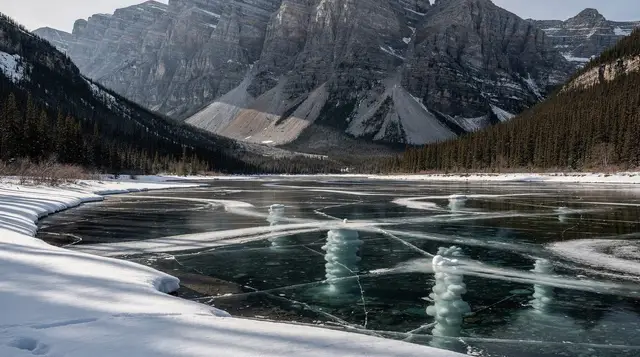
Both lakes stay frozen well into spring — Lake Louise thaws around mid-June, Moraine Lake a little later — so if you’re travelling in May, expect ice, not turquoise water. The colour itself comes from glacial flour suspended in the meltwater, covered in more detail in why the lakes are turquoise.
Day 3: Johnston Canyon, Canmore, and Lake Minnewanka
Start early at Johnston Canyon, reached along the Bow Valley Parkway — note that the parkway’s eastern section is closed to vehicles from March 1 to June 25 for wildlife, so check the current routing before you go. The catwalk trail to the lower falls is 1.1 kilometres each way and suits any fitness level; continuing to the upper falls adds up to 2.7 kilometres total, and the full push to the Ink Pots is 5.8 kilometres round trip through quieter forest once the crowds thin out past the falls. a guided Johnston Canyon hike to the Ink Pots is a good option if you’d rather have a naturalist along for the walk.
By early afternoon, head to Canmore, 26 kilometres from Banff and outside the national park boundary. Here the plan splits on fitness: Grassi Lakes is a short, well-marked trail to two turquoise pools with modest elevation gain, suitable for most visitors with a couple of hours to spare. Ha Ling Peak, by contrast, is not a casual add-on — it’s a genuinely demanding hike with roughly 700 metres of gain, much of it over loose scree near the summit, and realistically needs three to four hours round trip for a fit, prepared hiker. Choose it only if you have the legs and the daylight for it; choose Grassi Lakes if you don’t.
Close the day back inside the park at Lake Minnewanka, the largest lake in Banff National Park at 21 kilometres long. A scenic boat cruise runs from May to October and is the easiest way to see the lake properly without a full day of paddling. a combined Canmore and Banff National Park scenic lakes tour is worth considering if you’d rather have Canmore and Minnewanka bundled into one guided afternoon instead of self-driving between them.
Stay alert for wildlife on this stretch: elk and the occasional bear are regularly seen along the Minnewanka loop road, and if you’re travelling in September or October, the elk rut makes bull elk genuinely dangerous even close to parking lots — give them the standard 30-metre berth and don’t linger for photos.
Where this itinerary leaves room to extend
If you have a fourth or fifth day, the natural additions are Yoho National Park and Emerald Lake, about 85 kilometres (an hour) from Banff, or Kootenay National Park and Radium Hot Springs. Both require their own half-day at minimum and aren’t worth squeezing into this three-day frame. Jasper and the Icefields Parkway need a multi-day extension of their own — see the four-day Banff, Jasper and Icefields itinerary if that’s the direction you want to go instead. For a shorter version of exactly this loop, the two-day Banff and Lake Louise itinerary drops Canmore and Minnewanka and keeps only the core.
Three-day Banff classic FAQ
Do I need to book the Moraine Lake shuttle in advance?
Yes, and earlier than most visitors expect. Parks Canada opens shuttle booking blocks in spring, then switches to a rolling 48-hour booking window for the rest of the season. Either way, book the moment a window opens rather than waiting until the week of your trip.
Can I just drive to Moraine Lake myself?
No. The Moraine Lake road has been closed to personal vehicles year-round since 2023. Your only options are the Parks Canada shuttle, Roam Transit, a booked tour, or arriving by bicycle.
Is Ha Ling Peak an easy hike?
No. It’s a demanding half-day to full-day hike with roughly 700 metres of elevation gain over loose scree near the top, not a casual stroll. Fit, prepared hikers should budget three to four hours round trip; anyone less sure of their fitness should choose Grassi Lakes instead.
Should I do Grassi Lakes or Ha Ling Peak in Canmore?
Grassi Lakes is the easier, shorter option, a well-marked trail to two turquoise pools with modest elevation gain. Ha Ling Peak is the harder, longer alternative with a genuine summit view. Pick based on your fitness and the time you have left in the afternoon, not on which one sounds more impressive.
Does this itinerary include Jasper or Kananaskis?
No, deliberately. Three days is too short to add either without cutting into Banff, Lake Louise or Moraine Lake, so both are left for separate trips — Jasper needs its own multi-day plan and Kananaskis its own provincial park pass.
What time of year does this itinerary work best?
Roughly June through September, once Lake Louise and Moraine Lake have thawed to their turquoise colour, usually by mid-to-late June. The Lake Minnewanka cruise and the Canmore hikes are also seasonal, running from spring through fall.
Do I need a Parks Canada pass for all three days?
Yes, for any day spent inside Banff National Park, including Canmore day trips back into the park for Lake Minnewanka. Canmore itself sits outside the park boundary, so no pass is needed there specifically, but you’ll need one again as soon as you cross back in.
tours.3 days
Verified deep-linked GetYourGuide tours. Book through these links and we earn a small commission at no cost to you.
GetYourGuide does not provide a product photo for this activity — the image shows the meeting point, photographed by us.