A river that turns a corner and drops
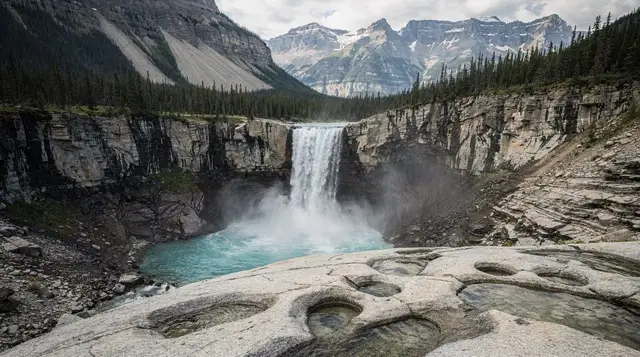
Most waterfalls on the Icefields Parkway fall the way you’d expect: over a lip, straight down. Sunwapta Falls does something odd first. The Sunwapta River, which has been running in a fairly wide, braided channel across the valley floor, hits a band of resistant bedrock and is forced into an almost perfect right-angle turn before it drops. That bend is the whole reason to stop here — it squeezes a respectably wide river into a narrow slot canyon in the space of a few metres, and the water folds over on itself in a way that’s more interesting to watch than a simple vertical drop would be.
The falls themselves aren’t tall. They’re not going to compete with the Columbia Icefield or the Glacier Skywalk for a highlight-reel photo. What they’re good for is a five-minute leg-stretch that actually shows you something, on a drive where a lot of the “stops” are just a pull-off with a view across the valley. A short, paved-to-gravel path leads from a dedicated parking lot to a bridge over the canyon, and from the bridge you can look straight down into the turn and the drop below it.
Getting there and parking
Sunwapta Falls sits on the Icefields Parkway (Highway 93 North), on the Jasper side of the Columbia Icefield and south of Athabasca Falls and Jasper townsite. From Banff it’s roughly 235 km, about 3 hours of driving if you don’t stop, though almost nobody does this stretch without stopping — see the stop-by-stop guide to the parkway for what else lines up along the way. From Jasper townsite the falls are much closer, under an hour south.
There’s a marked turnoff and a paved parking lot right at the falls, with washrooms and, in season, a lodge with a small restaurant and gas — one of the few fuel stops on this whole road, worth knowing about given how thin services are along the Icefields Parkway. The lot fills up in July and August, particularly midday when tour buses from Jasper and coach tours running the full parkway both stop here, but turnover is fast because most people are only here for 20 minutes. Cell coverage is unreliable this far from town, so don’t count on looking up hours or a map once you’ve pulled in.
A Parks Canada pass is required to stop here, the same as anywhere else in Jasper National Park — see the parks pass guide if you haven’t sorted one out yet. There’s no separate fee for the falls themselves.
The main viewpoint: two minutes from the car
The signature view is almost absurdly accessible. From the parking lot, a short paved path leads a couple of hundred metres to a bridge that crosses the canyon directly above the main drop. This is the view most photos of Sunwapta Falls show: the river funnelling through the right-angle bend, dropping in a broken curtain of white water, and disappearing into the shaded, narrow canyon below. Guardrails line the bridge and the short viewing area beside it, which matters here more than at some other stops — the rock is wet, often slick with spray, and the drop into the canyon is a real one.
Budget 20 to 30 minutes for this part: walk out, look at the falls from a couple of angles, walk back. It’s an easy stop to build into a longer day that also takes in Athabasca Falls, Peyto Lake, or the Columbia Icefield — see the full rundown of what to do with one day versus two on the parkway.
The lower falls: a longer, quieter option
Almost everyone who stops here sees only the upper viewpoint from the bridge. Fewer people know there’s a second stage to the falls further downstream, reached by a trail that continues past the bridge into the forest along the canyon rim. It’s an out-and-back walk of roughly 2.5 kilometres return, with some elevation change and tree roots underfoot rather than pavement, and it takes most people 45 minutes to just over an hour round trip depending on how long they linger.
The reward is a second, lower cascade where the Sunwapta continues its drop through the canyon, seen from a viewpoint with a fraction of the people at the main bridge. It’s not a dramatically different waterfall — same river, same general character — but it’s a genuinely quiet spot in July when the parking lot above is full of idling cars, and it’s one of the better ways to get five minutes of forest and moving water to yourself on a parkway day that’s otherwise mostly done through a windshield. Wear real footwear; the path isn’t technical, but it isn’t a boardwalk either, and it can be muddy after rain or early in the season when snowmelt is still draining off the slopes above.
Don’t mix this up with Athabasca Falls
This is the trap worth naming directly: Sunwapta Falls and Athabasca Falls are two different stops on the same road, roughly 25 minutes apart, and travellers mix them up constantly when planning from an itinerary or a map at a glance. Athabasca Falls is further north, closer to Jasper townsite, considerably busier, and generally the more dramatic of the two — it’s the one most “top parkway stops” lists lead with, and it gets covered on its own page rather than here. Sunwapta Falls is the quieter, smaller, right-angle-bend stop to its south, closer to the Columbia Icefield.
If your plan says “see the falls on the Icefields Parkway” without specifying which one, check twice before you decide you can skip a stop because you’ve “already done the falls.” Many people do both in the same day without realizing they’re separate attractions until they’re standing at the second one.
| Sunwapta Falls | Athabasca Falls | |
|---|---|---|
| Position on the parkway | South, closer to the Columbia Icefield | North, closer to Jasper townsite |
| Character | Right-angle bend, narrower canyon | Wider, more powerful straight drop |
| Crowds | Moderate | Heavier, especially midday |
| Extra option | Longer forest trail to lower falls | Short paved loop only |
Flow changes a lot with the season
The Sunwapta River is fed mostly by snowmelt and glacial melt higher in the valley, and its volume swings hard across the year. Flow builds through late spring as snow melts off the surrounding slopes, typically peaks in July and into August when both snowmelt and glacial melt are running at their strongest, and then tapers through September as temperatures drop and the melt season winds down. A photo taken at the falls in early June can look like a noticeably different, thinner river than one taken in late July — this isn’t a case of a photo being staged or misleading, it’s just a genuinely different amount of water coming down the canyon.
Winter is a different situation again. The Icefields Parkway itself stays open year-round, but the falls area sees far fewer services, the trail to the lower falls is typically snow-covered and unmaintained, and the falls partially ice over rather than running as open water. If you’re driving the parkway outside of June to September, treat this as an optional, cold-weather stop rather than a guaranteed highlight, and check the guide to winter driving on Rockies mountain roads before you commit to the drive at all.
| Month | What to expect at the falls |
|---|---|
| May-early June | River rising, but often still icy at the edges; trail to lower falls can be muddy or snow-patched |
| Late June-August | Fullest flow, busiest parking lot, best chance of a dramatic photo |
| September | Flow noticeably reduced, quieter parking lot, cooler forest walk |
| October-April | Falls partially frozen, services at the lodge limited or closed, lower-falls trail generally not maintained |
Light, timing, and getting a decent photo
The canyon at Sunwapta Falls sits below tree level and in a fairly tight gap, so direct midday sun tends to blow out the white water while leaving the surrounding rock in deep shadow — not a flattering combination. An overcast sky, or a visit earlier or later in the day when the sun is lower and the light is more even, generally produces a better result than a clear blue-sky afternoon at noon, which is exactly when most tour buses pass through anyway.
A slower shutter speed smooths the water into the classic silky-blur look, but the bridge does shift slightly underfoot when other visitors walk across it, so a monopod or a braced elbow works better than a full tripod if you’re shooting handheld in a crowd. None of this requires special gear or a dawn start the way a lake sunrise does — it’s a five-minute adjustment to when you happen to pull into the parking lot, not a reason to build your whole day around this one stop.
Where it fits on a parkway day
Sunwapta Falls works best as one stop among several rather than a reason to drive the Icefields Parkway on its own. A typical day running Lake Louise or Banff to Jasper might take in Bow Lake and Peyto Lake near Bow Summit, the Columbia Icefield for the ice explorer or the Glacier Skywalk, then Sunwapta Falls and Athabasca Falls back to back before rolling into Jasper townsite.
If you’re building this into a longer Rockies trip rather than a single long day, the four-day Banff, Jasper and Icefields itinerary spreads these same stops across two directions of travel instead of one exhausting round trip, and the honest take on why Jasper deserves more than a single day is worth reading before you try to cram the whole parkway plus Jasper townsite into 24 hours.
Practical details
There’s no separate admission fee for Sunwapta Falls; your Parks Canada pass, required anywhere you stop in Jasper National Park, covers it. Washrooms are available at the parking lot, and the seasonal lodge nearby sells basic food and fuel — useful given how few services exist along this stretch. There’s no cell signal to rely on, so download any maps or bookings before you leave Jasper or Lake Louise. The main viewpoint is fully accessible by an able-bodied visitor of any fitness level; the lower falls trail is not paved and involves uneven ground, so it’s a harder call for strollers or limited mobility.
Because this is a short stop rather than a destination, most travellers see it as part of a guided day rather than planning a dedicated trip around it. A guided tour also takes the parking and timing pressure off a busy summer day, since drivers know exactly when the lot tends to clear out.
a full day from Jasper that pairs the falls with the town and a glacier stop covers Sunwapta Falls alongside the bigger-name attractions nearby, which suits travellers based in Jasper rather than Banff. For those coming from further south, a tour such as a combined Athabasca and Sunwapta Falls day with Peyto Lake worked in strings several of the parkway’s short stops together in one outing, which spares you the job of timing your own drive between them.
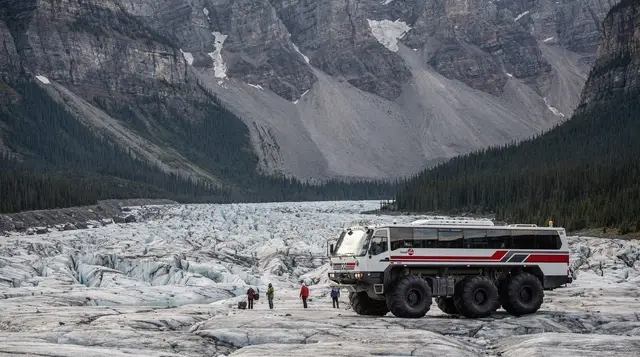
And since most people who stop at Sunwapta Falls are already headed to or from the icefield itself, it’s worth comparing rates for a discounted Columbia Icefield outing that includes the Ice Explorer and the Skywalk before booking that leg separately.
Questions about visiting Sunwapta Falls
Is Sunwapta Falls the same as Athabasca Falls?
No. They’re two separate waterfalls on the Icefields Parkway, roughly 25 minutes apart by car. Athabasca Falls is further north, closer to Jasper townsite, and is generally busier and more powerful. Sunwapta Falls sits further south, closer to the Columbia Icefield, and is smaller and quieter, distinguished mainly by the river’s sharp right-angle turn before it drops.
How long does it take to see Sunwapta Falls?
The main viewpoint, reached by a short paved path from the parking lot, takes most visitors 20 to 30 minutes round trip. Adding the longer forest trail to the quieter lower falls brings the total closer to 1 to 1.5 hours.
Is there a fee to visit Sunwapta Falls?
There’s no separate admission charge. A valid Parks Canada pass, required to stop anywhere in Jasper National Park, covers the visit.
What’s the best time of year to see the falls at their fullest?
Late June through August, when snowmelt and glacial melt from higher in the valley keep the Sunwapta River running at its highest volume. By September, flow noticeably drops off, and in winter the falls partially freeze.
Is the trail to the lower falls hard?
It’s not technical, but it’s unpaved, has some elevation change, and can be muddy, especially early in the season. Real footwear is worth having; it’s not a walk to do in sandals.
Can I combine Sunwapta Falls with a Columbia Icefield visit in the same day?
Yes, and most travellers do exactly that, since the icefield sits just south along the same road. Many guided day tours from Jasper pair the two stops along with Athabasca Falls or the Glacier Skywalk in a single outing.
Is there gas or food near Sunwapta Falls?
There’s a seasonal lodge at the falls turnoff with basic food service and fuel, one of the few such stops on this section of the parkway. Don’t rely on cell service to find it on a map; the location is well signed from the road itself.
Do I need a car to visit Sunwapta Falls, or can I do it on a tour?
Both work. Drivers can pull off directly at the marked lot. Travellers without a rental car, or who’d rather not manage the parkway’s long, service-thin stretches themselves, can see the falls as part of a guided day tour running between Jasper and the Columbia Icefield.