Bow Lake and Crowfoot Glacier: the easy stop on the Icefields Parkway
Do you need a shuttle or reservation to visit Bow Lake?
No. Bow Lake has a public parking area right on the Icefields Parkway (Highway 93 North), about 36 kilometres north of Lake Louise. You park, walk to the shore in a few minutes, and drive on — unlike Moraine Lake, which has been closed to personal vehicles since 2023.
Most people driving the Icefields Parkway for the first time are aiming for Peyto Lake and its overlook, or racing north toward the Columbia Icefield. Bow Lake gets driven past. That’s a mistake, and also exactly why it’s worth the five-minute detour: no shuttle, no timed reservation, no crowd control — just a parking lot off the highway, a lake the colour of a glacier, and a historic lodge that’s been sitting on its shore since the 1920s.
A roadside lake that doesn’t need a reservation
Bow Lake sits on Highway 93 North, roughly 90 kilometres from the town of Banff (about 1 hour 15 minutes) and about 36 kilometres north of Lake Louise village (25 to 30 minutes). It comes after the Crowfoot Glacier viewpoint and before the climb to Bow Summit and Peyto Lake, so on a drive north it’s the second scheduled stop after Herbert Lake.
The entire appeal of Bow Lake is how little it asks of you. There’s a paved parking area right beside the highway, and the shoreline is a two- or three-minute walk from your car. Compare that to Moraine Lake, which has been closed to personal vehicles year-round since 2023 — access there now runs exclusively through Parks Canada’s shuttle system, Roam Transit, or a commercial tour.
Bow Lake has none of that friction. You pull in, you look at the water, you get back on the road. If your Icefields Parkway day already has enough scheduling (glacier tour departure times, Skywalk timed entry, dinner reservations in Jasper), Bow Lake is the stop that costs you nothing but a few minutes.
That said, don’t mistake “easy” for “empty” — the parking area is modest, and in July and August it fills during the midday hours between roughly 11 a.m. and 3 p.m., when tour buses and self-drive traffic overlap. Early morning or early evening light is also simply better here, since the lake faces west toward the glacier and Num-Ti-Jah Lodge.
Don’t confuse Bow Lake with the Bow River
This trips up a fair number of visitors, so it’s worth saying plainly: Bow Lake is not the Bow River. The Bow River is the long river that flows down through Banff — past the Bow Falls viewpoint — and continues on to Calgary. Bow Lake is a small alpine lake roughly 90 kilometres away on the Icefields Parkway.
The two names aren’t a coincidence. The Bow River’s most significant headwater is meltwater from the Bow Glacier, which drains into Bow Lake and then flows out as the beginning of the Bow River itself. So Bow Lake really is the river’s origin point, geographically — but as a visitor, they are two completely separate stops with nothing in common except the name and the water that eventually connects them. If you’re trying to see “the Bow River” as a sight in its own right, that’s a Banff-townsite outing, not an Icefields Parkway one.
What you’re actually looking at
Bow Lake’s far shore is dominated by two features stacked on top of each other. Lower down and closer, Crowfoot Glacier clings to a ridge of Crowfoot Mountain — it has its own dedicated highway pullout a few kilometres south of Bow Lake, worth a separate short stop if you haven’t already made it. Bow Lake itself is fed by meltwater coming down from the larger Bow Glacier, tucked further back and higher, mostly out of sight unless you’re standing near the west end of the lake or hiking toward Bow Glacier Falls.
The lake’s colour follows the same rule as every other glacially-fed lake on this stretch of the Rockies: the fine rock flour ground out by moving glacier ice stays suspended in the meltwater and scatters light, producing that particular blue-green. Like Lake Louise and Peyto Lake, Bow Lake is frozen well into spring, and it doesn’t reach its full colour until meltwater season is properly underway — usually by mid to late June. A photo of a turquoise Bow Lake taken in May doesn’t exist; expect ice, snow patches, and dull grey-green water instead.
Num-Ti-Jah Lodge: the one building on the lake
The lodge on Bow Lake’s east shore, Num-Ti-Jah Lodge, is one of the older backcountry-style lodges left on the Icefields Parkway. It started as a trading post and outfitting base in the 1920s under guide Jimmy Simpson, and the current log-and-stone main building dates to the 1940s, distinctive for its octagonal shape. It’s a working lodge today — rooms, a dining room, and a small general store — and it operates seasonally, so hours and availability shrink or close outright outside the summer and early autumn window. If you’re planning to eat here rather than just photograph it, check current hours before you commit a meal stop to the itinerary; there’s no other food service at Bow Lake.
The lodge is also the trailhead for the walk up to Bow Glacier Falls, and its parking area doubles as informal overflow parking for the lake viewpoint when the main highway pullout is full.
Walking the shore and the trail to Bow Glacier Falls
Two options, depending on how much time you have.
The shoreline walk takes five to ten minutes from the main parking pullout and gets you to the water’s edge with a clean view across to Crowfoot Glacier. This is the stop most people make, and it’s enough if you’re managing a full Icefields Parkway day with several other stops ahead.
The hike to Bow Glacier Falls is a longer commitment: about 9 kilometres return, starting from the Num-Ti-Jah Lodge parking area rather than the main highway pullout. The trail runs along the lakeshore, crosses a gravel outwash flat below the old moraine, then climbs a short, rougher section to the base of the falls, where meltwater drops off the lip of the valley that holds the Bow Glacier itself. Total elevation gain is modest, and most hikers take 2.5 to 3.5 hours round trip. It’s a reasonable half-day add-on if Bow Lake is your main stop for the day rather than a five-minute pause on the way to somewhere else.
Getting there and what to bring
| From | Distance | Drive time |
|---|---|---|
| Banff | ~90 km | ~1 h 15 min |
| Lake Louise village | ~36 km | 25–30 min |
| Jasper | ~195 km | ~2 h 30 min |
A few practical notes specific to this stretch of road:
- Parks Canada pass required. Bow Lake is inside Banff National Park, so a valid park pass covers even a short roadside stop — see the Parks Canada pass explained guide for current rates.
- No fuel or reliable cell service. There’s no gas station at Bow Lake, and mobile coverage on this section of the parkway is patchy at best. Fill up in Lake Louise or Banff before heading out — see gas and cell coverage on the Icefields Parkway.
- Washrooms are seasonal pit toilets at the main pullout; Num-Ti-Jah Lodge has indoor facilities for guests and diners when the lodge is open.
- Wind and weather change fast. Bow Lake sits higher and more exposed than Banff townsite; bring a layer even on a warm summer day.
Best light and best season
Bow Lake faces roughly west across the water toward Crowfoot Glacier and Num-Ti-Jah Lodge, which means late afternoon and early evening light tends to work better here than a midday stop, when the sun sits high and flattens the glacier’s texture. Morning works too, especially before the parking area fills, but the lodge and shoreline photograph with more contrast once the sun has moved lower in the sky.
Summer (July through early September) is when the lake shows its full colour and the Bow Glacier Falls trail is clear of snow. Shoulder season — June and late September into October — brings smaller crowds and a decent chance of larch colour on the drive north toward Bow Summit, but expect the lake to still be partly frozen in early June and the falls trail to be patchy with snow at either end of the season. Winter closes the Num-Ti-Jah Lodge dining room in some years and reduces it to limited hours in others, and the lake itself freezes solid; the highway stays open and plowed, so a winter roadside stop is still possible, but there’s little reason to detour for it beyond the glacier view itself.
The road is part of the Icefields Parkway in winter, which covers what actually stays open and what doesn’t between November and April.
Tours that include Bow Lake
If you don’t want to self-drive the parkway, or you’d rather have a guide handling the driving and timing while you look at scenery, most full-day Icefields Parkway tours from Banff, Lake Louise, or Calgary build in a stop at Bow Lake alongside Peyto Lake and the Columbia Icefield. The Columbia Icefield tour that stops at Bow, Peyto, and Crowfoot Glacier is built around exactly this stretch of road, pairing the lake stops with the Icefield itself.
If you’d rather combine the glacier walk with the Skywalk experience, the Columbia Icefield Skywalk tour that also covers Peyto and Bow Lakes handles both in one day departing from Calgary. For a version with more time built in at each stop and an adventure-tour pacing, the Columbia Icefield adventure tour covering Bow Lake and Peyto Lake is worth comparing on itinerary length before booking.
And if Bow Lake is one stop among several lake visits on your list rather than the main event, the day tour linking Lake Louise, Moraine, Emerald, Peyto, and Bow Lakes packages five lakes into a single guided day, which solves the Moraine Lake shuttle problem for you at the same time.
Where Bow Lake fits in an Icefields Parkway day
Bow Lake works best as a five- to fifteen-minute stop inside a longer drive, not a destination on its own. A typical order for a one-day Icefields Parkway run north from Lake Louise looks like: Herbert Lake, the Crowfoot Glacier viewpoint, Bow Lake, Bow Summit and the Peyto Lake overlook, Mistaya Canyon, Saskatchewan River Crossing, then on toward the Columbia Icefield.
See the Icefields Parkway stops in order guide for the full sequence, or a one-day-versus-two-days comparison if you’re deciding how much of this to attempt without an overnight in between. For a structured version of the whole drive, the Icefields Parkway road trip itinerary lays out timing for each stop including Bow Lake.
If you’re building this into a broader Banff visit, Bow Lake pairs naturally with a four-day Banff and Jasper Icefields itinerary, where it becomes one stop on the transit day rather than something you drive out for on its own.
Bow Lake, Crowfoot Glacier, and the Bow River: frequently confused, not the same thing
Is Bow Lake the same as the Bow River in Banff?
No. Bow Lake is a small glacial lake on the Icefields Parkway, about 90 kilometres from the town of Banff. The Bow River is the much longer river that flows through Banff and Calgary. The Bow River actually originates from Bow Lake and the Bow Glacier above it, which is why the names overlap, but they are two different things to visit.
Do I need a shuttle to reach Bow Lake?
No. Bow Lake has its own parking area directly off Highway 93 North, with no shuttle, quota, or reservation. This is different from Moraine Lake, where the access road has been closed to personal vehicles year-round since 2023.
How far is Bow Lake from Banff and Lake Louise?
Bow Lake is roughly 90 kilometres from Banff (about 1 hour 15 minutes) and about 36 kilometres from Lake Louise village (25 to 30 minutes), driving north on the Icefields Parkway.
What glacier can you see from Bow Lake?
Crowfoot Glacier hangs on the ridge across the lake, and the Bow Glacier is visible further back, feeding meltwater into Bow Lake. Crowfoot Glacier has its own dedicated roadside viewpoint a few minutes’ drive south of Bow Lake.
Can you eat or stay at Bow Lake?
Yes. Num-Ti-Jah Lodge sits on the lake’s east shore and has a dining room and rooms for overnight stays, both operating seasonally. It is the only building at Bow Lake, so check current hours before planning a meal stop.
Is the walk to Bow Glacier Falls difficult?
The trail from the Num-Ti-Jah Lodge parking area to Bow Glacier Falls is about 9 kilometres return with modest elevation gain, mostly flat along the lakeshore and moraine before a short climb near the falls. It takes most hikers 2.5 to 3.5 hours.
When does Bow Lake lose its ice and turn turquoise?
Like the other glacial lakes on this stretch of the Rockies, Bow Lake is frozen well into spring and does not show its full turquoise colour until the glacial meltwater season is underway, typically by mid to late June.
Is there a Parks Canada pass needed to stop at Bow Lake?
Yes. Bow Lake is inside Banff National Park, so a valid Parks Canada pass is required even for a short roadside stop, the same as anywhere else on the Icefields Parkway.
Columbia Icefield & glacier tours on GetYourGuide
Verified deep-linked GetYourGuide tours. Book through these links and we earn a small commission at no cost to you.
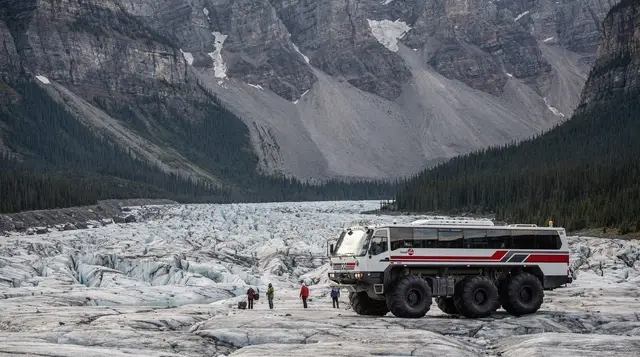
GetYourGuide does not provide a product photo for this activity — the image shows the meeting point, photographed by us.