Northern lights in the Rockies: the real odds, explained
Can you see the northern lights from Banff or Jasper?
Sometimes, but never on a schedule. It takes elevated geomagnetic activity, a clear sky, and a dark, moonless night away from town lighting, and none of those line up on demand. Jasper's Dark Sky Preserve status gives it the edge over Banff, but a real-time aurora forecast matters far more than the destination alone.
No calendar can promise you the aurora here
Every fall, searches for the northern lights in Jasper and Banff climb, and every fall a share of visitors leave disappointed because they treated it as a seasonal attraction rather than a weather-dependent, solar-dependent event. It is not the same thing as a dark sky.
A dark sky preserve, which Jasper is and Banff is not, only guarantees that light pollution will not be the thing standing between you and a view of the stars. Whether there is an aurora to see at all is decided by something entirely separate: how active the sun is that particular night, whether the resulting geomagnetic disturbance reaches this far south, and whether the sky over the Rockies happens to be clear when it does.
This page covers what actually has to align for a sighting at this latitude, how to check real conditions rather than guess from a season, where to stand once the conditions look promising, and what a realistic display looks like compared with the photos that circulate online. For the broader dark-sky experience in Jasper, unrelated to the aurora, our Jasper Dark Sky Preserve guide covers the October festival and general stargazing; this page is specifically about the northern lights.
What actually has to happen
Three things need to line up, and missing any one of them means no display, regardless of the other two:
- Elevated geomagnetic activity. The aurora is driven by charged particles ejected from the sun reaching Earth’s atmosphere. At the Rockies’ latitude, roughly 51 degrees north for Banff and just over 52 for Jasper, that requires a noticeably stronger disturbance than would be needed to see the same lights from Yellowknife or Whitehorse. A quiet solar night here means nothing overhead at all, no matter how dark or clear the sky is.
- A clear sky. Mountain weather changes quickly, and cloud cover blocks an aurora as completely as it blocks any other view of the stars. A clear forecast at dinner is not a guarantee of a clear sky three hours later, particularly along the Icefields Parkway corridor where systems can build against the peaks.
- A dark night. Moonlight and artificial light both wash out all but the strongest displays. A new moon or a thin crescent helps considerably, and getting away from townsite lighting matters more than most visitors expect; even a lit parking lot behind you can be enough to dull a faint band low on the horizon.
None of these can be scheduled, and no combination of them can be promised weeks in advance. That is the honest starting point for planning around this.
Why the window runs roughly September to April
Nights need to actually get dark for any of this to be visible, and at this latitude, summer nights barely do. Around the solstice, twilight lingers past 11 p.m. and returns before 4 a.m., leaving too short and too pale a window for anything but the strongest possible storm to register. From roughly September through April, nights are long enough and dark enough that a display, if the sun cooperates, has a real chance of being seen.
That is the full extent of what the season buys you: darkness, not likelihood. Within that seven-month window, most nights still produce nothing, and a handful of nights, unpredictable in advance, produce a clear and memorable one. Treating “aurora season” as a booking window the way you might treat ski season or larch season sets up a visit for disappointment; treating it as the period during which checking is worthwhile is the more honest framing.
Check activity in real time, not a seasonal calendar
The single most useful habit is checking a real-time aurora or geomagnetic activity forecast the same evening you plan to look, not relying on a general seasonal expectation. Several free aurora forecast apps and websites report the current Kp index, a 0-to-9 scale for geomagnetic disturbance, updated through the evening.
| Kp index | Typical southern reach | What it means at Rockies latitude |
|---|---|---|
| 0–2 | Arctic and far northern Canada only | Nothing visible here |
| 3–4 | Yukon, Northwest Territories, northern provinces | Still unlikely from Banff or Jasper |
| 5 (minor storm) | Northern Alberta and BC | A realistic chance on a clear, dark night, low on the northern horizon |
| 6–7 (moderate to strong storm) | Well into Alberta and BC | Good chance from Jasper or Banff if skies stay clear |
| 8–9 (severe to extreme storm) | Much further south, rare | Strong, sometimes overhead display; genuinely uncommon |
These numbers describe general geomagnetic behaviour, not a forecast for any specific night or year, and a strong solar cycle can push activity higher than usual for a stretch without changing what any single night will bring. Pair the Kp reading with a local cloud-cover forecast and moon phase before deciding whether it is worth heading out, and check again closer to the time you’d actually go; conditions along the Icefields Parkway and around Jasper can shift within a few hours.
Why Jasper gives you the better shot
Jasper National Park is one of the largest Dark Sky Preserves in the world, a designation tied to its size, its distance from major cities, and shielded lighting standards inside the townsite itself. None of that creates an aurora, but it removes the light pollution that would otherwise drown out a faint or moderate one, which matters because most Rockies displays are moderate rather than dramatic. Banff sits closer to Calgary’s light dome and runs a brighter, busier townsite, so a borderline display that would register clearly from a dark pull-off near Jasper may simply not show from central Banff.
That advantage narrows for a strong storm. A Kp 7 or 8 disturbance can light up the sky over both towns, town lighting and all, and in that case the difference between Jasper and Banff matters far less than simply being outside and looking north. The Dark Sky Preserve designation earns its keep on the more common, more marginal nights, not the rare spectacular ones.
a guided evening in Jasper built around dark-sky viewing, with aurora photography tips folded in when conditions allow combines the location advantage with a guide checking real-time conditions on your behalf, useful for visitors who would rather not track Kp forecasts themselves.
Where to actually stand
Away from artificial light and with an open view toward the north is the short version. In practice:
- Around Jasper: Pyramid Lake and Old Fort Point sit a short drive or walk from town with minimal light spill and an open sky. Maligne Lake, further out along a road that closes seasonally, offers a genuinely dark setting for anyone already staying that direction, though it is a longer, wildlife-heavy drive to make after dark.
- Around Banff: Vermilion Lakes and Two Jack Lake both give a clear northward view away from the brightest part of town, and both sit close enough to reach quickly if a real-time forecast turns promising on short notice. Lake Minnewanka works for the same reason, with a longer shoreline to spread out along.
- Outside the parks: Abraham Lake, roughly three hours from Banff along the David Thompson Highway and better known for its winter methane bubbles, sits well outside Parks Canada jurisdiction and away from any townsite lighting at all, making it a genuinely dark option for a strong-storm night, though the distance only makes sense as a dedicated trip rather than a same-evening decision.
Wherever you go, the same road hazards apply after dark as during the day: wildlife on unlit highways, patchy or absent cell coverage on stretches like the Icefields Parkway, and, outside Alberta on routes such as those through Yoho and Kootenay, winter tire requirements from October through April. None of that changes because you’re chasing a specific sky event; if anything, night driving on mountain roads deserves more caution, not less.
What you’ll actually see
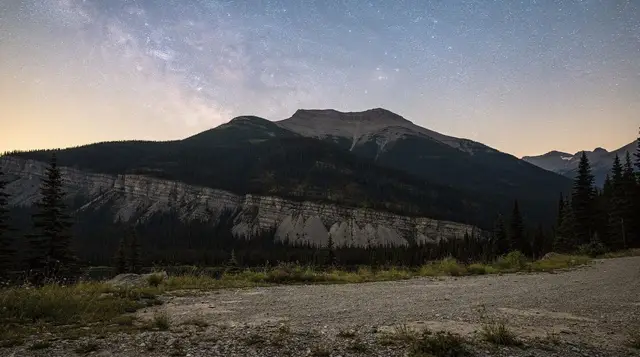
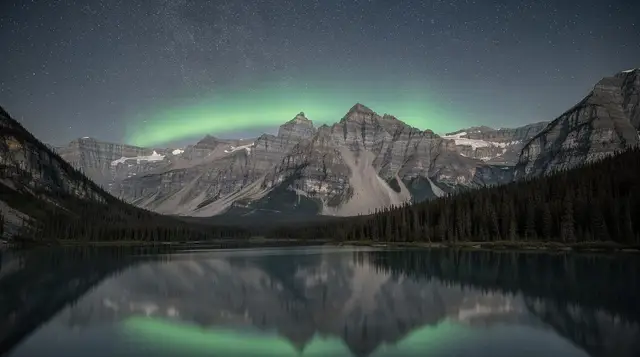
Photographs are the main source of disappointment, not because they are fake, but because a camera on a long exposure collects far more light than the human eye does in the moment. A moderate display that photographs as a vivid green band across half the sky often looks, to the naked eye standing there, like a pale, sometimes greyish glow low on the horizon, occasionally with a visible shimmer or slow movement. Colour becomes more obvious as the storm strengthens; a strong Kp 7 or higher event can genuinely look close to what shows up in photos, with clear green and sometimes pink or red visible without a camera at all.
Bringing a camera capable of a manual, several-second exposure at a high ISO setting substantially improves what you capture even on a modest night, and a basic tripod matters more than an expensive lens. Visitors planning a trip partly around night photography, aurora or otherwise, may find our photography-focused itinerary useful for pacing a trip around both daytime shooting and evening waiting.
Guided tours versus watching the forecast yourself
a small-group evening tour out of Banff that watches conditions and picks a viewing spot on the night takes the guesswork of where to park and how long to wait off your hands, with a guide who has already checked the forecast and knows the current best pull-offs. That convenience, plus warm shelter in a vehicle between checks and someone else doing the driving on a dark road, is the actual value on offer. No tour, however well run, can promise the aurora will appear; the honest ones say so upfront.
an evening stargazing outing from Banff that covers the night sky generally, with the aurora as a possible bonus rather than the guarantee suits visitors who want a solid night under the stars regardless of whether a geomagnetic storm cooperates, treating the aurora as a possibility layered on top rather than the reason for going.
Going independently costs nothing beyond fuel and works just as well, provided you already know a dark, safe pull-off and are willing to check a forecast yourself rather than relying on a fixed date picked weeks in advance. The main things a tour buys are not standing alone on an unlit roadside at 11 p.m. and not having to drive yourself home if the wait runs late.
Planning around the uncertainty rather than against it
Because no single night can be guaranteed, the trips with the best outcomes build in more than one chance rather than pinning everything on one evening. A stay of three or four nights in the September-through-April window gives several evenings to check the forecast, rather than one fixed date that might land on a quiet solar night with mixed cloud cover. Our guide to how many days to budget for a Rockies trip covers this kind of buffer planning more generally, and it applies just as directly here.
Cold is the other planning factor worth taking seriously; waiting outdoors for an hour or more in a Rockies winter night is a different proposition from a quick walk to a viewpoint. Our guide to what minus 25 degrees actually feels like and our broader winter driving guide both cover the practical side of being out after dark in the colder months, and checking cell coverage along the Icefields Parkway before a night drive is worth the five minutes it takes.
For visitors timing a trip around the aurora specifically rather than treating it as a possible bonus, keeping expectations tied to real-time forecasts rather than a booked date is the difference between a trip that delivers what it promised and one that didn’t. The mountains and the dark skies are the reliable part; the lights above them are not, and no page, tour, or app changes that.
Northern lights in the Rockies: common questions
What causes the northern lights in the Canadian Rockies?
The aurora appears when charged particles from the sun collide with gases in Earth’s upper atmosphere, a process driven by solar activity rather than anything specific to the Rockies. The mountains contribute only two things: dark skies away from cities, and, in Jasper’s case, official protection of that darkness. Everything else depends on what the sun is doing that night.
When is the best time of year to see the northern lights near Banff and Jasper?
Roughly September through April, simply because nights are long and dark enough to see a display if one occurs. That is not the same as a season when the aurora is guaranteed or even likely; summer nights at this latitude barely get dark before dawn, which rules them out regardless of solar activity, but every night from fall through spring is only a possibility, never a booking.
Is Jasper really better than Banff for seeing the aurora?
Jasper has the advantage on darkness: it is a designated Dark Sky Preserve with shielded townsite lighting and far less regional light pollution than Banff, which sits closer to Calgary’s glow and has a busier, brighter townsite of its own. That said, a strong enough geomagnetic storm can put the aurora over both, and a weak one may show over neither. Location improves your odds; it does not create the display.
Do I need to travel further north, like Yellowknife, for a real chance?
For a reliable, near-nightly chance, yes, that is what Yellowknife and other far-northern destinations are built around. The Rockies sit much further south, so a display here requires a stronger geomagnetic storm than one visible from the Northwest Territories. It happens, but it is the exception rather than the expectation, and no operator in Banff or Jasper can honestly promise otherwise.
What’s the best way to check if the aurora might be visible tonight?
A real-time aurora or Kp-index forecast app, checked the same evening, tells you far more than any seasonal guide. Look for a Kp index of around 5 or higher for a realistic shot at this latitude, paired with a clear sky forecast and a low or absent moon. Checking once at dinner and again before heading out catches the changes that mountain weather causes within a few hours.
Do the northern lights look the way they do in photos?
Often more subdued to the naked eye. A camera on a long exposure gathers light the eye cannot, which is why photos show vivid green, pink, or purple bands that in person often read as a paler, sometimes greyish glow, occasionally with a visible shimmer or movement. A strong storm can genuinely look close to photos; a moderate one usually does not, and that gap catches first-time viewers off guard.
Is a guided tour worth it, or can I just drive out and look?
A guided tour adds warm shelter, a driver who is not also trying to watch the sky, and often camera guidance, but no operator can guarantee a sighting since nobody controls solar activity. Driving out on your own works just as well if you already know a dark, safe pull-off and are checking the forecast yourself; the value of a tour is convenience and safety after dark, not better odds.
Does a Parks Canada pass affect where I can go at night?
Yes. Anywhere inside Banff or Jasper National Park, including after dark, requires the same Parks Canada day pass or Discovery Pass checked during daytime visits. Areas just outside the park boundary, such as Abraham Lake along the David Thompson Highway, fall outside Parks Canada jurisdiction and do not require it, though other rules and hazards still apply after dark.
Stargazing & dark-sky tours on GetYourGuide
Verified deep-linked GetYourGuide tours. Book through these links and we earn a small commission at no cost to you.
GetYourGuide does not provide a product photo for this activity — the image shows the meeting point, photographed by us.