Jasper Dark Sky Preserve: when and where to actually see the stars
Where's the best place to see stars in Jasper?
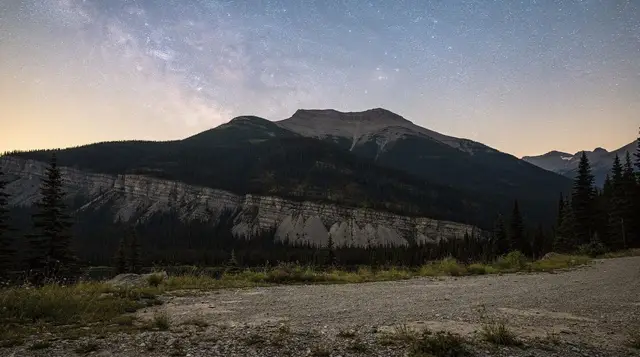
Pyramid Lake and Old Fort Point are the two most reliable viewpoints close to town, both a short drive or walk from the townsite with minimal light interference. The real variable isn't location so much as timing: a moonless, cloud-free night gives a dramatically better view than location alone, and mountain weather can shift within a few hours even in summer.
A dark sky is a fact about lighting, not a promise about weather
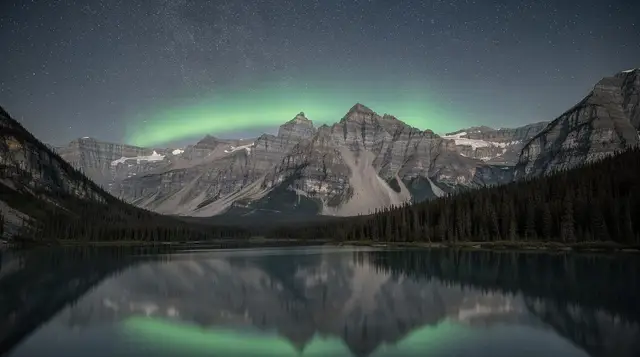
Jasper is one of the largest Dark Sky Preserves in the world, a designation that has nothing to do with the northern lights and everything to do with how little artificial light reaches the sky here. That distinction matters because visitors regularly conflate the two: a dark sky preserve means the Milky Way is visible on a clear night, not that you’ll see the aurora, and it certainly doesn’t mean every night delivers a clear sky at all. This guide covers what the designation actually means, when the dedicated festival runs, where to stand to get the most out of it, and the two things that genuinely limit the experience: weather that turns on short notice, and cold that shows up even in July.
For the aurora specifically, a different and much less predictable phenomenon, see our guide to the odds of seeing the northern lights in the Rockies. For the Jasper SkyTram as a daytime attraction, that’s covered elsewhere too; this page is about what happens after the tram stops running for the day.
None of this requires specialist equipment or a background in astronomy. What it requires is timing a visit around the moon, choosing a spot that’s actually dark rather than assuming the whole park qualifies, and accepting that a clear forecast at dinnertime is not a guarantee of a clear sky three hours later.
Why Jasper qualifies as a Dark Sky Preserve
Jasper National Park covers close to 11,000 square kilometres, making it the largest of the Canadian Rockies parks and one of the largest Dark Sky Preserves anywhere. The designation, awarded through the Royal Astronomical Society of Canada, recognizes both the absence of nearby large cities and the park’s own lighting policy: streetlights and building exteriors in Jasper townsite use shielded fixtures that direct light downward instead of scattering it upward into the sky. Combined with the park’s remoteness from Edmonton and Calgary’s light domes, the net effect is a sky darker than almost anywhere else accessible by paved road in Canada.
That doesn’t mean every corner of the park is equally dark. Jasper townsite itself still has streetlights, hotel signage, and parking lot lighting, enough to wash out the fainter stars directly overhead even if the horizon looks impressively dark by comparison. Getting the full effect means moving a few minutes outside town to one of the viewpoints below, where the ambient glow drops off sharply.
For comparison, Banff National Park sits inside the same UNESCO World Heritage designation as Jasper, but it doesn’t carry a Dark Sky Preserve label of its own, largely because Banff townsite and the Trans-Canada Highway corridor put more light into the night sky than Jasper’s smaller, more contained townsite does. Visitors splitting a trip between the two shouldn’t expect the same stargazing experience in both places; Jasper is the destination built around it.
Getting there, and why it’s worth an overnight rather than a drive-through
Jasper sits about 288 kilometres from Banff along the Icefields Parkway, close to three and a half hours of driving each way without stops, and the road itself has no fuel between Saskatchewan River Crossing and Jasper outside of the warmer months. That distance rules out a same-day round trip built around an evening stargazing session; by the time a clear night sets in, a same-day driver would already be looking at a very late return through a stretch of highway with minimal lighting, poor cell coverage, and a meaningfully higher chance of wildlife on the road after dark.
Staying overnight in Jasper townsite solves that, and it also solves the weather problem: a second night gives a real second chance if the first one clouds over. Visitors combining the drive with the rest of the Icefields Parkway’s stops, the Columbia Icefield chief among them, generally find one night in Jasper too short for both a full day of parkway stops and unhurried evening stargazing; two nights removes the rush from both.
The Jasper Dark Sky Festival, in October
The festival runs across two or three weekends in October, timed for longer nights, cooler air with less atmospheric haze, and a gap before winter road conditions complicate travel. The program mixes ticketed indoor talks, often featuring astronauts, physicists, or Indigenous knowledge keepers speaking on sky traditions, with free outdoor sessions and telescope viewing nights open to anyone in town.
Exact dates and the lineup change year to year, so check the current schedule before locking in travel. What doesn’t change is that accommodation in Jasper townsite sells out for festival weekends well in advance, more so since the 2024 wildfire reduced the town’s total room count. Booking three to six months ahead for a festival weekend isn’t excessive.
| Aspect | Detail |
|---|---|
| Timing | October, two to three weekends |
| Format | Ticketed talks plus free outdoor telescope sessions |
| Booking window | 3 to 6 months ahead for festival-weekend rooms |
| Cost | Free public events; ticketed talks priced separately |
| Weather risk | Cloud cover can cancel outdoor sessions with little notice |
You don’t need to visit during the festival to see a dark sky. Any clear, moonless night through the shoulder seasons and summer works; the festival simply adds programming, guest speakers, and organized telescope access on top of a sky that’s dark most nights of the year regardless.
Where to actually stand: Pyramid Lake and Old Fort Point
Two viewpoints handle most of the demand, both close enough to Jasper townsite to reach without a long drive, and both dark enough that the difference from standing in town is immediate.
Pyramid Lake sits a short drive north of downtown Jasper on Pyramid Lake Road, with a few pull-offs along the shoreline before reaching the lake itself. The open water gives a wide, unobstructed sky view and the option of a reflection shot on a still night, though wind off the lake can cut visibility of the surface and adds to the chill. Parking is limited at the best pull-offs, so arriving before full dark, while there’s still enough light to find a spot safely, is worth doing.
Old Fort Point sits across the Athabasca River from town, reached by a footbridge and a short trail. The lower slopes, well before the summit lookout, already clear enough of the townsite’s light glow to give a solid view, and they don’t require navigating the full uphill trail in the dark. Attempting the actual summit at night adds real risk for a view that isn’t meaningfully better than the lower ground.
Both spots require no vehicle beyond getting there and back, and both sit inside Jasper National Park, so the standard Parks Canada day pass or Discovery Pass applies, the same one covering the Icefields Parkway drive-through further south.
A few other options exist for anyone staying longer or driving in from the Icefields Parkway direction: pull-offs along the highway well south of town, away from any lighting, can work in a pinch, though they lack the marked parking and easy footing of the two spots above. None of them beat Pyramid Lake or Old Fort Point enough to justify the extra driving on a first visit.
What actually makes a night good: no moon, no cloud
Location matters less than most visitors expect. The two variables that decide whether a night delivers are lunar phase and cloud cover, and both need to line up.
A bright moon washes out the fainter stars and the Milky Way’s band in the same way city light pollution does, just from a different direction. The days around new moon, roughly a week-long window each month, give the darkest possible sky; a full moon essentially cancels the effect the preserve exists for, even from a perfect viewpoint. Checking the lunar calendar before picking a date matters more than checking which viewpoint to use.
Cloud cover is the harder variable, because mountain weather changes fast and doesn’t always show up in a same-day forecast. A clear evening can cloud over within two or three hours as air moves over the Continental Divide, and a forecast showing “clear” at 6 p.m. is not a guarantee for what the sky looks like at 11 p.m. Nobody, including festival organizers running ticketed telescope sessions, can promise a clear sky on any given night. The only real hedge is building slack into a trip: staying two or three nights rather than one gives a second or third chance if the first night clouds over, and checking a same-day mountain forecast rather than the week-old one from when you booked flights.
Dress for the cold, every season
The temperature drop after dark surprises visitors more consistently than the weather does, because it happens even when the day was warm. Jasper sits at elevation in a mountain valley, and nights lose heat fast once the sun is down, regardless of season.
| Season | Typical daytime high | Typical night temperature outdoors |
|---|---|---|
| Summer (Jun-Aug) | 20-25°C | 5-10°C, colder at open viewpoints |
| Shoulder (May, Sep-Oct) | 10-18°C | At or near 0°C, sometimes below |
| Winter (Nov-Apr) | -5 to 5°C | -15 to -25°C, colder with wind |
Standing still for an hour or more at a viewpoint, rather than walking or hiking, removes the body heat that a moving hike generates, which is why a summer night that feels mild for a short walk back to the car can still leave someone cold and uncomfortable after 45 minutes of standing to look up. A warm layer, a hat, and something to sit or stand on to insulate from cold ground make more difference than most people plan for on a summer trip. In winter, the same cold that defines the season elsewhere in the Rockies applies here too, and a short stargazing stop needs the same layering as any other outdoor winter activity.
Wildlife is also active after dark, including near Pyramid Lake Road and the approach to Old Fort Point. The same 100-metre distance from bears and wolves, 30 metres from other wildlife applies at night as during the day, and carrying bear spray remains sensible even on a short evening walk to a viewpoint. Our guide to wildlife viewing times and locations covers the broader pattern of dusk and dawn activity that overlaps with the best stargazing hours.
Making a night of it without overplanning the day
Stargazing doesn’t need a dedicated trip by itself; it slots naturally onto the end of a day already built around Jasper. A guided evening activity that runs into dusk, followed by finding a clear patch of sky once full dark sets in, uses the same evening without adding a separate outing.
an evening wildlife-spotting drive that runs from late afternoon into dusk pairs naturally with a stargazing stop right after, since both take advantage of the same low-light hours and both already have you out past the townsite. For a festival weekend or any night with a public telescope session,a guided dark sky package with telescope access and interpretation removes the guesswork of finding a spot and reading a star chart alone.
For the day itself, a guided outing that also touches on how the park is recovering gives useful context before an evening under the same sky the 2024 fire burned beneath: a guided hike through the burn area with lunch included covers regrowth and recovery in a way a self-guided walk through town doesn’t. Our full account of Jasper after the fire has more on what’s changed and what visitors should expect walking through town before dark.
Anyone driving up from Banff or Lake Louise specifically for a stargazing night should plan for more than a single day. A same-day round trip from the Icefields Parkway direction is workable but tight, and it leaves no slack if the first night clouds over. An overnight in Jasper, built into a longer Banff-to-Jasper itinerary, gives the buffer night that a clear-sky guarantee can never provide.
Dinner is worth planning around too, since most people aren’t heading straight to a viewpoint from an empty stomach in near-freezing air. a downtown Jasper food tour that runs in the early evening fits neatly before a night that’s going to end standing around outside, and it keeps the last part of the evening free for checking the sky rather than hunting for a restaurant with a table open.
If the drive back to Banff or Lake Louise happens after a stargazing night, remember that cell coverage along the Icefields Parkway is minimal to nonexistent for most of the 232 kilometres, and wildlife on the road is more likely, not less, once it’s fully dark. Fuelling up in Jasper before setting out, and allowing extra time rather than driving tired after a late night, matters more on this stretch than on most Rockies drives.
Jasper’s dark sky, in context
Jasper’s designation doesn’t stand alone; it’s one part of what things to do in Jasper covers, alongside daytime attractions like the Icefields Parkway and the SkyTram. For visitors specifically planning around the sky, our stargazing category rounds up the other angles: aurora odds, seasonal timing, and how dark sky viewing compares across the park.
Stargazing & dark-sky tours on GetYourGuide
Verified deep-linked GetYourGuide tours. Book through these links and we earn a small commission at no cost to you.
GetYourGuide does not provide a product photo for this activity — the image shows the meeting point, photographed by us.