Watching a glacier disappear, one metre at a time
Two ways to meet the same piece of ice
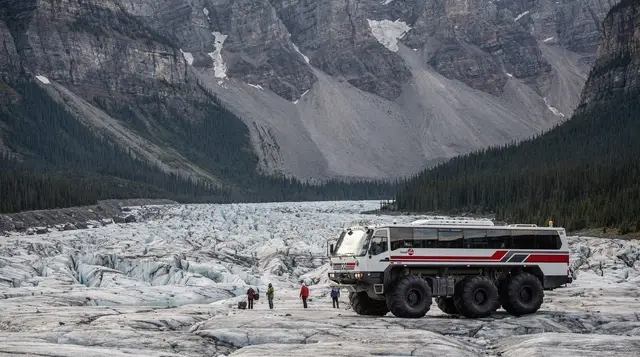
The bus door hisses open and everyone stands up at once, phones already out, before the driver has finished saying we can disembark. This is the Columbia Icefield, and the vehicle we’ve just ridden onto the glacier in is an Ice Explorer — a bus built on tires taller than I am, designed for exactly one job, driving people onto the compacted ice of the Athabasca Glacier and back.
Outside, the surface is grey-white and gritty with rock dust, streaked here and there with meltwater running in thin channels, and colder underfoot than the mild parking lot air had suggested. Someone near me is filming a slow pan of the icefield behind us. Someone else is already back on the bus, having decided ten minutes was enough.
I’d done the other half of the combined ticket the day before: the Glacier Skywalk, a curved glass-floored platform jutting out 280 metres above the Sunwapta Valley a short drive from the icefield itself. No ice underfoot there, just air, and a floor you can see straight through to the valley floor if you’re willing to look down.
The two attractions get sold together and get talked about together, but they’re not really the same thing at all — one puts you standing on a moving mass of ice, the other suspends you over a canyon with a view of glaciers in the distance. Both are thoroughly organized. Timed tickets, a fleet of buses running on a schedule, an interpretive centre with a gift shop and a cafeteria, guides working from a script they’ve clearly given hundreds of times. None of it feels like an accident, and none of it feels like it’s trying to hide the organization behind some illusion of untouched wilderness.
What the guide said when I asked the wrong question
I asked our guide, at some point during the standard patter about crevasses and safe walking zones, whether the glacier looked different from when she’d started the job. She paused in a way that told me it wasn’t the first time she’d been asked, and also wasn’t a question she brushed off. She’d been guiding on the ice for six seasons, she said, and yes — she pointed toward a spot further down the valley, roughly where the toe of the glacier had reached when she started, now a stretch of bare rock and rubble with nothing icy about it. From where we stood, that gap read as ordinary terrain, grey stone that could have been there forever. To her it was a specific, remembered distance.
That’s the strange thing about a glacier’s retreat: it isn’t visible in the way a single afternoon can show you. I stood on the ice and saw ice — solid, present, cold enough to make my hands ache after a few minutes without gloves. Nothing about the view told me it was smaller than it used to be. The evidence isn’t in what you see once; it’s in the gap between what someone saw a decade ago and what’s in front of them now, and that’s a comparison only repeat visitors and the people who work there get to make firsthand.
The marker posts, walked past by everyone
On the walk from the main parking lot toward the toe of the glacier — a separate, unguided trail that doesn’t require any ticket — there’s a line of small signs planted in the ground, each one dated, marking how far the ice had retreated by that year. I’d read about these before arriving, and I still wasn’t prepared for how far apart some of them are.
Walking from one sign to the next takes a few unhurried minutes on foot, land that used to be glacier and is now just a rocky slope with alpine plants starting to take hold in it. Athabasca Glacier has been retreating for more than a hundred years, and current estimates put the pace at somewhere around five metres a year, though I’d treat any single figure as an average rather than something you could clock on a stopwatch during one trip.
Most people on that trail walk past the markers at a brisk pace, checking a box on the way to the Ice Explorer boarding area, and I don’t think that’s a failure of attention so much as a natural response to a fact that doesn’t announce itself. A dated sign in a rocky field looks unremarkable unless you already know what it’s counting. I stopped at three or four of them longer than felt necessary, doing the mental math on how much distance a hundred-plus years of five-metres-a-year adds up to, and coming away less with a number and more with a sense of how patient this kind of change is. Nothing about it looks urgent standing there. It only looks that way once someone tells you what year you’re standing in.
The organized part and the unorganized part
What’s stayed with me isn’t a single dramatic moment but the contrast between the two halves of the visit. One half is entirely managed — the buses, the timed entry, the safety briefing, the gift shop selling icefield-branded toques. The other half is something none of that infrastructure controls at all: a line of ice that keeps ending a little further back than it did the year before, tracked by people who happen to work there long enough to notice, and by a handful of signs that most visitors walk past without a second look. I don’t think the organized tourism cheapens the other part. If anything, it’s the only reason someone like me gets close enough to see it at all, guide included.
If you’re weighing which version to do, a Columbia Icefield tour with the 4x4 glacier ride is the one that puts you on the ice itself, and a combined tour pairing the icefield with the Glacier Skywalk adds the platform over the Sunwapta Valley on the same day. Both run as day trips from Banff, and for anyone based further out, a Columbia Icefield day tour departing from Calgary or Canmore covers the same ground without an overnight stop in between.
This stretch of the Icefields Parkway only runs seasonally — the icefield facilities and both experiences are open roughly from April or May through October, and the road itself changes character completely once winter sets in, something covered in more detail in the guide to driving the parkway in winter.
If you’re planning the drive itself, the full guide to the Icefields Parkway and the list of stops in driving order are more useful than anything I’d try to recreate here, and the practical notes on fuel and cell coverage along the route are worth reading before you leave Lake Louise, not after.
For the logistics of tickets and timing at the icefield specifically, the dedicated Columbia Icefield guide and the page on the Ice Explorer experience cover what I’ve deliberately left out of this one. Anyone who wants to get onto the ice on foot rather than by bus should look at what a guided glacier walk adds before booking either.
The drive continues on toward Jasper from here, a town that’s spent the past couple of years rebuilding after the 2024 wildfire — a different kind of change, and one I’d rather not fold into a glacier story except to say that what returning to Jasper is actually like right now is worth reading on its own terms.
If you’re mapping the whole drive out in advance, a full Icefields Parkway road trip itinerary is a better planning tool than trying to piece one together from a handful of blog posts. And if you’d rather have someone else handle the driving on the day you see the ice yourself, a Jasper-based tour covering Athabasca Falls, Sunwapta Falls, and Peyto Lake strings several of these stops together without putting you behind the wheel for the whole day.
Columbia Icefield and glacier retreat: what readers ask
How fast is the Athabasca Glacier retreating?
Roughly five metres a year on average, though the rate varies year to year and isn’t something a single visitor can measure by eye. The dated marker posts along the walk from the parking lot to the toe of the glacier are the clearest way to see the cumulative distance.
What’s the difference between the Ice Explorer and the Glacier Skywalk?
The Ice Explorer is a specialized bus with oversized tires that drives visitors onto the surface of the Athabasca Glacier itself. The Glacier Skywalk is a separate, unrelated structure a short drive away: a glass-floored platform cantilevered 280 metres above the Sunwapta Valley, with no ice underfoot at all. They’re often sold as a combined ticket but are two different experiences in two different locations.
When is the Columbia Icefield open to visit?
The Ice Explorer and Glacier Skywalk both run seasonally, roughly from April or May through October, weather and ice conditions permitting. Outside that window the access road and facilities are closed.
Can you just walk up to the glacier without a tour?
There’s a public trail from the parking area toward the toe of the glacier that doesn’t require a booking, though it stops well short of the ice itself for safety reasons. Getting onto the glacier’s surface means going with the Ice Explorer or a guided glacier walk, not on your own.
Is the Columbia Icefield worth the stop on the Icefields Parkway?
For most people, yes, if you have the extra hour or two it adds to the drive. It’s one of the few points on the parkway where you can get close to a named glacier rather than just seeing one from a viewpoint, and the visitor centre gives it a natural rest stop for a long drive.
Will the Athabasca Glacier disappear?
I’m not going to guess at a timeline. What’s documented is a retreat that’s been underway for over a century and continues today; what happens over the longer term isn’t something I can responsibly predict from a couple of visits, and I’d rather leave that question to people who study the ice for a living.
Columbia Icefield & glacier tours on GetYourGuide
Verified deep-linked GetYourGuide tours. Book through these links and we earn a small commission at no cost to you.
GetYourGuide does not provide a product photo for this activity — the image shows the meeting point, photographed by us.