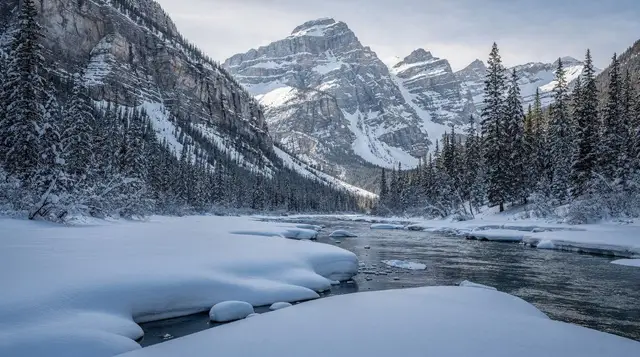
Jasper, two summers after the fire
What I expected versus what I found
I put off writing about Jasper for almost two years, unsure what tone the piece should take. Every version I drafted leaned one of two ways: a grim inventory of loss, or a relentlessly upbeat “Jasper is back, come on down” piece that would have read as false to anyone who’d seen the town in July 2024. Neither felt honest, so I kept not writing it. What finally got me to sit down was the drive itself, in the summer of 2026, down the Icefields Parkway from the Columbia Icefield toward town, where the actual, mixed picture presented itself well before I’d parked the car.
The wildfire that reached Jasper in July 2024 destroyed roughly a third of the town’s buildings. That’s the number I keep coming back to: specific enough to be useful, vague enough not to pretend I know which streets, exactly. A third is a lot and it isn’t everything, and driving in, both of those facts turn out to be true at once.
The approach, where the fire actually shows
The clearest evidence of the fire isn’t in town, it’s on the hills around it. Coming down from Athabasca Falls and the stretch past the Columbia Icefield, there are slopes where the standing timber is blackened and bare, right up against sections that look completely untouched a few hundred metres later.
It isn’t a uniform scorched landscape, which is somehow more unsettling than if it were: a burned ridge, then a green one, then another burned one, with no obvious logic from the road about why one drainage went up and its neighbour didn’t. Fire doesn’t move in straight lines, and from a car window that unevenness is the most honest visual record of what actually happened here.
The townsite, block by block
Inside Jasper itself, the pattern repeats at a smaller scale. Some blocks are entirely rebuilt, with new siding and rooflines that read as obviously recent next to a hundred-year-old façade two doors down that never burned at all. Other lots still sit cleared and empty, waiting on a build that hasn’t started, framed by orange construction fencing that’s clearly been there a while. I walked past one stretch where a functioning café sat directly beside an empty gravel pad, and there was nothing about the street that explained the gap except the fire itself, and whatever combination of insurance and contractor availability determines which property gets rebuilt first.
None of this stopped the town from working, in the sense that matters to a visitor. Restaurants had tables, the grocery store had groceries, and the information centre had staff who’d clearly answered the same “is it okay to be here” question from enough people to have worked out a calm, unbothered answer. I didn’t get the sense anyone wanted the fire minimized, but I also didn’t get the sense anyone wanted it to be the only thing a visitor noticed.
Talking to people who live off this
The two conversations that stuck with me were with people whose income depends directly on visitors showing up. One ran a small outfitting shop and said the slow months after the fire had been harder on the business than the fire itself, not from physical damage, which the shop hadn’t taken, but because bookings dried up on the assumption Jasper wasn’t a place you could visit anymore. The other, a server at a rebuilt restaurant, said something similar: the fire was one event, contained in time, but the perception that Jasper was closed lasted much longer than the fire did, and that lag was the part actually threatening jobs.
Neither of them wanted me to pretend the town looked the way it did before 2024. They wanted people to know it was open, which is a narrower and more useful thing to say than either “Jasper has fully recovered” or “Jasper is still recovering,” both of which flatten a situation that’s genuinely uneven from block to block.
What survived without needing to recover
The thing I kept returning to, driving back out of town after dark, was the sky. Jasper’s status as one of the world’s largest dark sky preserves has nothing to do with buildings, and the fire didn’t touch it: the park’s darkness is a function of the sheer size of protected land around a small townsite, and that geography didn’t burn.
Standing outside town with no streetlight within a couple of kilometres, looking at a sky that owed nothing to anything I’d just seen rebuilt or not rebuilt, was the closest I got to a clean, uncomplicated feeling about the whole trip. The landscape that actually makes this park worth the drive, the scale of Maligne Lake, the walls of Maligne Canyon, the sightlines behind the dark sky designation itself, carried on being itself the whole time the town figured out its rebuild.
That’s not a tidy conclusion, and it shouldn’t be one. Jasper isn’t finished rebuilding, and I’d rather say that plainly than round it up to a comeback story for a better ending. What I can say, having gone, is that the town works, the people running it want visitors there, and the parts of the park that drew me here in the first place, the icefield, the canyons, the sky, were never the parts that needed fixing.
Planning around it, briefly
If you’re weighing whether this is the year to include Jasper, the practical question of which trails and sections have longer-term closures belongs on a different page, and I’d point you to a dedicated look at how much time Jasper actually needs rather than answering it here. What I can tell you is that the town supported a normal visit without any sense of intruding on something still raw.
Most people driving the Icefields Parkway from Lake Louise treat Jasper as the payoff at the end of a long day, whether as part of a four-day Banff-to-Jasper loop or the fuller six-day version.
For two summers I told myself I was waiting for the town to “be ready.” Having gone, that was never really the question. Jasper was ready well before I showed up; I was the one who needed time to stop picturing it as a headline instead of a place. Comparing it honestly against what each town actually offers beats waiting for a recovery to look finished, because by most measures that matter to a visitor, it already does.
If you’d rather see the drive than plan it solo, a guided run up the parkway — like a day trip covering Athabasca and Sunwapta Falls, Abraham Lake, and Peyto Lake or a Columbia Icefield tour that continues through to Jasper — puts a local narrator between you and the burn scars, which some travellers find easier than reading them alone through a windshield. Either way, the town is there, working, and glad to have you.
Jasper after the fire, answered directly
Is Jasper open to visitors after the 2024 wildfire?
Yes. Jasper has been open since the immediate aftermath ended, and by the summer of 2026 hotels, restaurants, and the townsite’s main services were running close to normal. Some individual sites and trails have had longer, case-by-case closures unrelated to whether the town itself is open.
How much of Jasper burned in the 2024 fire?
About a third of the town’s buildings were destroyed in the July 2024 wildfire. That’s a townsite figure, not a park-wide one — the vast majority of Jasper National Park’s 11,000 square kilometres was never touched.
Can you still see fire damage driving into Jasper?
Yes, in places. Hillsides along the approach show standing burnt timber and blackened slopes, and a few in-town lots still sit as cleared ground awaiting new construction. It’s patchy rather than continuous — a scarred ridge next to an unaffected one, a rebuilt block next to a vacant lot.
Is it in poor taste to visit Jasper as a tourist right now?
I don’t think so, and most people I spoke with who work in Jasper’s tourism economy were direct about wanting visitors back. The rebuilding is tied to the same visitor spending that supports the town any other year, so staying away doesn’t read as respect so much as one fewer booking.
Are Jasper’s main attractions like Maligne Lake and the Columbia Icefield still open?
The park’s headline sites, including Maligne Lake, Maligne Canyon, and the Columbia Icefield, have been operating through the 2025 and 2026 seasons. Specific trail and access closures change year to year and are worth checking against a current trip-planning page.
Is Jasper’s dark sky preserve status affected by the fire?
No. Jasper’s designation as one of the world’s largest dark sky preserves is about the absence of light pollution across the night sky, and the fire didn’t change that. If anything, it’s the clearest sign the landscape beyond the townsite carried on largely unbothered by what happened to the buildings.
Best day trips from Banff on GetYourGuide
Verified deep-linked GetYourGuide tours. Book through these links and we earn a small commission at no cost to you.
GetYourGuide does not provide a product photo for this activity — the image shows the meeting point, photographed by us.