Why I keep telling people to skip July and August in Banff
The parking lot that talked me into this
The moment that converted me was not scenic. It was a 7:40 a.m. arrival at the Moraine Lake shuttle stand in late July, watching a queue that was already forty minutes long before I’d had coffee, next to a reader board warning that same-day tickets were essentially gone.
I’d booked the shuttle in advance, so I got through, but the sheer machinery of it — timed lots, sold-out blocks, a line for the line — was the opposite of what I’d pictured when I planned a trip to the Canadian Rockies. Two years later I came back in the last week of September and rode a half-empty shuttle to a nearly empty viewpoint. That contrast is the entire argument of this post, and I want to make it honestly, without pretending the quieter months are free of downsides.
What actually gets better
Start with the number that made me a convert in the first place: Banff National Park takes in more than four million visitors a year, and the overwhelming share of them land in July and August. Outside that window, the difference isn’t subtle. Parking lots that fill by 8 a.m. in summer still have spaces at 10 a.m. in late September. The boardwalk at Lake Louise is walkable rather than a shuffling queue for a photo spot. Roam Transit buses that run standing-room-only in August have seats.
Hotel pricing follows the same curve, and it’s the part that changes a budget the most concretely. A room in Banff or Canmore that runs top rate in late July routinely drops well below that in the last two weeks of May or through most of October — I’ve tracked the same properties both ways and seen discounts in the 30 to 50 percent range, though it varies by hotel and how far ahead you book. If you’re pricing out a trip with our Banff budget tool, shoulder season is the single biggest lever available before you even touch flights or car rental.
There’s a quieter benefit too: restaurant tables without a wait, easier same-week bookings on things like Columbia Icefield tours, and a version of Banff Avenue where you can actually window-shop instead of getting swept along by foot traffic. None of that shows up in a brochure, but it’s the difference between a relaxed week and a managed one.
What actually gets worse, and I won’t pretend otherwise
Here’s where a lot of shoulder-season pitches go soft, and I don’t want to do that. The biggest issue is the lakes themselves, which are the reason most people come. Lake Louise typically doesn’t fully thaw until around mid-June, and Moraine Lake, sitting higher in its valley, tends to clear a bit later.
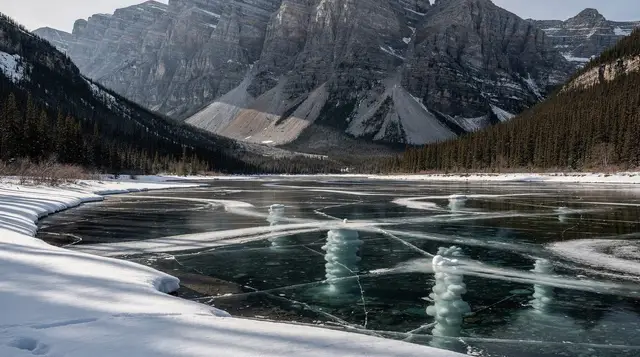
Show up in the first half of May or even early June and you may find a lake that’s still substantially frozen, or a surface of grey meltwater rather than the turquoise most photos show. I’m not going to promise you a colour that depends on suspended glacial flour reaching a certain concentration on a certain week — nobody can promise that, and any page that does is guessing.
Snow is the second honest downside. It can fall at elevation in Banff in any month of the year, and September and October see it more than people expect, especially up around Bow Summit or in Sunshine Meadows. A trip built entirely around hiking can get rerouted by a morning of fresh snow on a trail you’d planned to do that day. It usually clears within a day or two at lower elevations, but if your whole itinerary hinges on one specific hike on one specific day, shoulder season adds a real variable.
Services thin out too. The Lake Agnes Tea House and the teahouse on the Plain of Six Glaciers route are seasonal, generally open only through the warmer months, and they don’t always take cards — bring cash if you’re counting on either stop. Some shuttle schedules and boat cruises also scale back outside the main season, so check specific operators rather than assuming everything from July stays available.
How I’d actually plan around it
If the ice is the main worry, push a lake-focused trip to the second half of June onward, once Lake Louise has reliably cleared and Moraine Lake is close behind. May and early June are better suited to a trip built around lower-elevation walks — Johnston Canyon, the Bow Falls viewpoint, a slow lap of Banff townsite — where you’re not gambling on a specific lake’s thaw date. A guided day like our tour that covers Lake Louise, Emerald Lake, and Peyto Lake in one day is a reasonable way to hedge that bet, since you’ll see all three and at least one is likely to be at its best regardless of exact melt timing that year.
For late September and October, I’d lean into the parts of the park that don’t depend on lake colour at all. A trip up the Icefields Parkway to the Columbia Icefield, for instance through a full-day Columbia Icefield tour with the Ice Explorer and Skywalk, works just as well in cool, quiet October as it does in the peak crush of August, arguably better since the highway itself is calmer.
Pack for genuine cold-weather variability either way: layers, a real waterproof shell, and gloves, since a 20°C afternoon can be followed by a morning near freezing at higher stops along that drive.
A mixed day covering Mount Norquay and a short hike, similar to this gondola-and-hikes day trip out of Banff, gives you a full day that doesn’t hinge on lake colour at all. And if you’re staying in Canmore to stretch the savings further, this Canmore-to-Moraine-Lake day tour handles the shuttle-access headache on a day the lake is more likely to be reasonably clear.
The honest bottom line
I’m not telling you shoulder season is secretly better in every way, because it isn’t. If a specific saturated-turquoise photo of Moraine Lake is the entire point of your trip, come in July or accept a real chance of disappointment in May. What I am telling you is that the trade-off is more favourable than most people assume: you give up some certainty about lake colour and a bit of weather predictability, and in return you get a park that’s actually pleasant to move through, at meaningfully lower cost. For my own trips now, that trade is one I’ll keep making, and I plan around the parts I know will still work — the parkway, the canyons, the gondolas — rather than pretending I can guarantee the parts I can’t.
Shoulder season in Banff: common questions
When exactly is shoulder season in Banff?
I use it loosely for May through mid-June and mid-September through October, the weeks bracketing the July-August peak. Neither block is a fixed date range Parks Canada publishes; it’s really just whatever falls outside the two months when every campground, tour, and restaurant in town is at capacity.
Are the lakes still frozen in shoulder season?
Often, yes, especially early on. Lake Louise typically doesn’t fully thaw until around mid-June, and Moraine Lake, sitting higher, usually clears a bit later than that. A trip in May or the first half of June can mean partial ice, grey meltwater, or a lake that’s simply still frozen over.
How much cheaper are hotels in shoulder season?
I’ve seen the same room in Banff or Canmore run 30 to 50 percent less in late May or October than in late July, though the exact spread depends on the property and how close you book to summer weekends. It’s not a fixed discount, but it’s consistently the biggest single lever on a Banff trip’s cost.
Can it snow in Banff in September or May?
Yes, in any month, at any elevation, though it’s more common and heavier the later into October or earlier into May you go. A dusting on the valley floor and real accumulation up around Bow Summit or Sunshine Meadows on the same September day is normal, not a freak event.
Are hiking trails and tea houses open in shoulder season?
Most low-elevation trails are open, but higher routes can hold snow and ice into June, and the Lake Agnes and Plain of Six Glaciers tea houses are seasonal operations that may not be running on the exact dates you show up, particularly in May or late October. Call ahead rather than assume.
Is shoulder season worth it if I can only see the lakes in full colour?
Then it isn’t the trip for you. There’s no date I can hand you that guarantees turquoise water, and shoulder season stacks the odds against it further in May and early June specifically. If a saturated-blue lake photo is the whole point of the trip, come in July or August and accept the crowds that go with it.
Seasonal experiences on GetYourGuide
Verified deep-linked GetYourGuide tours. Book through these links and we earn a small commission at no cost to you.
GetYourGuide does not provide a product photo for this activity — the image shows the meeting point, photographed by us.