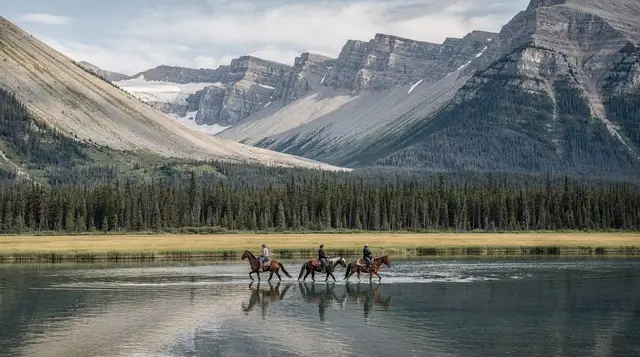
Horseback riding in the Bow Valley near Banff
Where can you go horseback riding near Banff, and how long do rides last?
Local ranches run guided rides from stables at the edge of town into the Bow Valley, toward Sulphur Mountain, the Spray River, and Johnson Lake, ranging from one-hour outings to half-day trips with a cookout lunch. They're beginner-friendly trail rides on a lead line or in a small group, not a way to reach areas closed to vehicles.
Saddle up: what a guided ride in the Bow Valley actually involves
Banff sits inside a national park where the wildlife, the topography, and the working-ranch history all point toward one obvious way to see part of the valley: from the back of a horse. Guided horseback riding here isn’t a re-enactment or a photo prop. It’s a genuine, long-running local trade, run out of stables at the edge of town, using trails that have carried horses for well over a century, since long before Banff Avenue had cars on it.
What you’re booking is a trail ride, not a lesson and not an expedition. A wrangler leads a small group along fixed routes into the Bow Valley, at a walking pace, on horses chosen and matched to the group’s experience. Trips run from one hour to a half day, and every version covered on this page is designed for people who have never sat on a horse before. This guide sticks to that: guided, valley-floor riding toward Sulphur Mountain, the Spray River, and Johnson Lake. It doesn’t cover rafting, canoeing, biking, or motorized tours, all of which have their own dedicated pages.
One thing worth saying plainly before anything else: horseback riding here is a recreational activity, not a transport option. It will not get you to Moraine Lake, which has been closed to private vehicles year-round since 2023, or to any other area where the road is restricted. If getting to Moraine Lake without a car is the actual goal, our Moraine Lake shuttle guide is the page that answers it. Riding stays inside the Bow Valley near Banff and doesn’t function as a workaround for park access rules.
The three routes: Sulphur Mountain, Spray River, and Johnson Lake
Most Bow Valley operators run their rides out of stables near the Fairmont Banff Springs, the hotel long associated with the valley’s guided-riding tradition, and the routes fan out from there. The exact trail mix depends on the outfitter and the season, but three destinations come up repeatedly:
Toward Sulphur Mountain. Rides in this direction climb gently along the lower slopes on the south side of the valley, with views back across the Bow River toward Banff townsite and Mount Rundle. It’s the same general massif that the Banff Gondola climbs, though the ride stays on the lower forested trails and doesn’t approach the summit boardwalk that hikers or gondola riders reach. It’s a scenic-valley ride, not an ascent.
Along the Spray River. The Spray River trail follows the river south from behind the Fairmont Banff Springs, through open forest with the water in view for long stretches. It’s a flatter, easier route than the Sulphur Mountain side, which is part of why it turns up on the shorter one-hour rides aimed at complete beginners.
Out to Johnson Lake. The longer rides, including the half-day cookout trip, extend farther into the valley toward Johnson Lake, a small, quiet lake east of town that gets a fraction of the foot traffic of Lake Minnewanka nearby. Reaching it on horseback rather than on foot changes the pace of the day considerably: what would be a modest hike becomes a slower, longer ride with more time to actually look around.
None of these routes cross into areas with road closures or shuttle-only access. They’re all inside the everyday, drivable, walkable part of the Banff National Park front country, which is exactly why they work for a half-day activity rather than a full expedition.
Rides compared: duration, distance, and who they suit
| Ride | Typical duration | Rough distance | Best for |
|---|---|---|---|
| Bow River loop | 1 hour | Short valley loop | First-timers, families with older kids, tight schedules |
| Spray River ride | 1 hour | Short, mostly flat | Nervous first-timers, easier terrain |
| Sundance loop | 2 hours | Moderate valley loop | Riders who want more time in the saddle without a half day |
| Bow Valley loop | 3 hours | Longer valley circuit | Confident beginners wanting a fuller outing |
| Cowboy cookout ride | Half day | Longest, includes Johnson Lake area | Groups wanting a full-morning or full-afternoon experience with a meal included |
Prices scale with duration and what’s included. As a rough order of magnitude at the time of writing, the one-hour rides run in the neighbourhood of CAD 75 to 100 per person, the two-hour and three-hour rides climb into the CAD 120 to 180 range, and the half-day cookout ride, which bundles a wrangler-cooked lunch into the price, lands closer to CAD 200 to 250. Always check the current listing before booking; ranch pricing moves from one season to the next.
For a straightforward first outing, the one-hour Bow River horseback ride covers the basics without asking for a big block of your day. If flatter terrain matters more to you than distance covered, the one-hour Spray River ride is the gentler of the two short options.
Riders who want more saddle time without committing to a half day tend to land on the three-hour Bow Valley loop, and groups celebrating something, or just wanting the day built around it, book the horseback ride with a cowboy cookout lunch.
Who this suits, and who it doesn’t
These rides are aimed squarely at beginners and casual riders. Kids old enough to sit securely and follow simple instructions are usually welcome on the shorter routes, though minimum age and weight limits vary by outfitter and are worth confirming before booking, especially for the family-friendly Banff itinerary. Older riders in reasonable general health also do fine on the one-hour and two-hour options, since the pace is a walk and dismounting partway through isn’t part of the plan but also isn’t a serious problem if genuinely needed.
Where it suits people less well: anyone hoping for a fast-paced or advanced ride will find these routes slow by design, since the group moves at the pace of its least experienced rider. It’s also not the activity for someone who wants a serious wilderness experience away from other visitors; trails see regular use through the summer, and you’ll likely pass other groups. And it’s simply not a substitute for a hiking trip if your goal is reaching a specific viewpoint on foot, such as Sulphur Mountain on foot or a canyon walk; the horse follows its own route, not a hiker’s.
Mobility is worth thinking through honestly. Mounting and dismounting takes reasonable hip and leg mobility, and a saddle for an hour or more is genuinely tiring on unfamiliar muscles. If you’re unsure whether it’s a good fit, calling the ranch directly and describing your situation gets a clearer answer than guessing.
What to wear and what to bring
Long pants are close to mandatory, since bare skin against a saddle and stirrup leather for an hour or more is uncomfortable fast; jeans or similar work clothing are standard. Footwear matters more than people expect: closed-toe shoes with at least a small heel are strongly preferred, since a heel keeps your foot from sliding through the stirrup. Runners without much of a heel are usually tolerated but not ideal; sandals and flip-flops generally aren’t allowed.
Layers matter even in July. The valley floor near the Bow River sits in shade for parts of the morning and can be noticeably cooler and breezier than Banff Avenue a few blocks away, so a light jacket that packs down small is worth carrying even on a warm forecast. Sun protection, a hat that won’t blow off easily, and water for anything beyond the one-hour rides round out what to bring. Cameras and phones are fine to carry, but leave both hands free while the horse is moving; most riders stop briefly to take photos rather than shooting one-handed at a walk.
Helmets are typically available and, on many rides, either provided as standard or offered on request; ask when booking if a helmet matters to you, since policies vary by outfitter and by rider age.
Booking and season
Riding season in the Bow Valley runs roughly from May through September, sometimes stretching into early October in a mild year, which lines up with when trails are clear of the deep snow that makes them impractical for horses. There’s no winter riding option here; unlike a gondola ride or a groomed ski trail, the stables close for the season and don’t reopen until the ground firms up in spring.
Within the season, mornings tend to be cooler and calmer, both for temperature and for the wildlife encounters covered below, while afternoons in July and August draw the largest crowds to the stables and can mean a wait even with a booking. The half-day cookout rides, which combine a longer trail with a meal, are the option most likely to sell out on summer weekends, so booking a few days to a week ahead is a reasonable habit rather than an overreaction. For a shorter, one-hour ride outside peak season, booking a day or two in advance is usually enough.
Bring your park pass information along, or at minimum know that a valid Parks Canada day pass or Discovery Pass is required to be inside Banff National Park at all, riding included, the same requirement that applies to a simple drive-through.
Safety, horses, and wildlife on the trail
Every guided ride starts with a short orientation: how to mount, how to hold the reins, how to signal the horse to stop, and what to do if your horse gets close to another. Wranglers ride with the group, not ahead of it, and set the pace to match the least experienced rider present, which is part of why these trips move slowly and don’t cover the ground a hiker might in the same time.
Wildlife is a real consideration in the Bow Valley, not a marketing detail. Elk, deer, and occasionally bears use the same valley floor these trails cross, and wranglers carry bear spray and adjust routes based on recent sightings reported through the park. During the elk rut in September and October, bull elk can become aggressive even close to town, and outfitters factor that into which trails they run and how closely groups are kept together.
Riders are asked to stay with the group and follow the wrangler’s instructions immediately if an animal is spotted, rather than stopping to take a closer photo. The general safe-distance guidance that applies to hikers, roughly 100 metres from bears and wolves and 30 metres from other large animals, is the same instinct wranglers are applying on your behalf, even from horseback.
Horses themselves are working animals selected for temperament, and a well-run outfitter matches nervous or inexperienced riders to its calmest, most seasoned horses. That said, a horse is not a machine; sudden movements, loud noises, or ignoring a wrangler’s instruction can spook even a well-trained animal. Listening to the safety briefing at the start, rather than treating it as a formality, is the single biggest factor in a ride going smoothly.
Where this fits with the rest of a Banff trip
A one-hour or three-hour ride slots comfortably into a single morning or afternoon alongside other things to do in Banff on foot, such as a stroll along Bow Falls or a walk through Banff itself. The half-day cookout ride is more of an anchor activity, worth building a day around rather than squeezing between other plans, and pairs naturally with a slower evening in town rather than another big outing on the same day.
If cost is a factor in deciding how many paid activities to fit into your trip, our Banff daily budget guide and how many days in Banff breakdown both help place a horseback ride against the Banff Gondola, the hot springs, and other ticketed activities competing for the same afternoon. For canoeing or paddling as an alternative way to spend time on the water rather than the trail, that’s covered separately; this page is about riding, not paddling.
Anyone weighing a longer valley outing might also consider the two-hour Sundance loop ride, which sits between the short introductory rides and the full three-hour loop in both time commitment and price.
Horseback riding in the Bow Valley: your questions answered
Do you need riding experience to book a horseback ride near Banff?
No. The one-hour and three-hour rides in the Bow Valley are built for first-timers, with a wrangler leading the group at a walking pace and matching each rider to a horse suited to their experience. You’ll get a short briefing on mounting, steering, and stopping before setting out; nobody is expected to already know how to ride.
How much does horseback riding near Banff typically cost?
As a rough order of magnitude, a one-hour ride runs in the neighbourhood of CAD 75 to 100 per person, the three-hour Bow Valley loop climbs toward CAD 150 to 180, and a half-day ride with a cowboy cookout lunch is priced closer to CAD 200 to 250. Check current listings before booking, since ranch pricing changes season to season.
Can horseback riding take you to Moraine Lake or Lake Louise?
No. The Bow Valley rides covered here start and finish near Banff townsite and stay within that valley; they don’t reach Moraine Lake, Lake Louise, or any other area where private vehicles are restricted. If you’re trying to get to Moraine Lake without a car, that’s a shuttle-and-bus question, not a horseback one.
What should you wear for a horseback ride in the Bow Valley?
Long pants are essentially required to avoid chafing against the saddle, and closed-toe shoes with at least a small heel are strongly preferred over runners or sandals. Bring a layer for wind even on a warm day, since the valley floor near the Bow River can be several degrees cooler than downtown Banff, and sun protection for exposed, open sections of trail.
Is horseback riding in the Bow Valley safe around bears and other wildlife?
Rides operate on established, regularly used trails with an experienced wrangler present, which is a different risk profile than hiking alone. Wranglers carry bear spray and know current wildlife activity on their routes, and will adjust or reroute a ride if bears or other animals have been reported nearby. Riders still need to stay quiet, stay with the group, and follow the wrangler’s directions if wildlife appears.
What’s the season for horseback riding near Banff?
Rides typically run from May through September or early October, weather and trail conditions allowing, then pause for winter. Unlike hiking or skiing, there’s no cold-weather version of this activity in the Bow Valley; the stables close once the ground freezes and snow makes the trails impractical for horses.
How far in advance should you book a horseback ride near Banff?
A few days ahead is usually enough outside peak summer weekends, but July and August afternoons, especially the cowboy cookout rides, can sell out a week or more in advance. If a specific date and time matter to your itinerary, book as soon as your dates are fixed.
Horseback rides & sleigh tours on GetYourGuide
Verified deep-linked GetYourGuide tours. Book through these links and we earn a small commission at no cost to you.
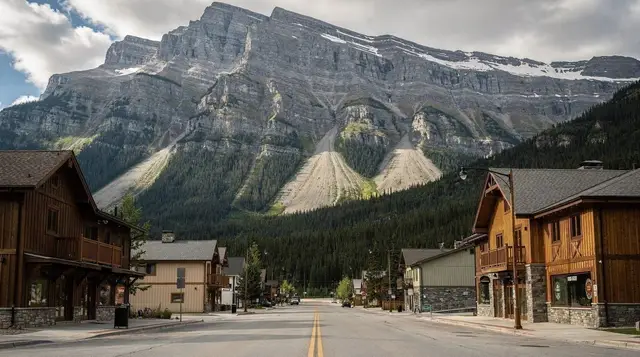
GetYourGuide does not provide a product photo for this activity — the image shows the meeting point, photographed by us.