Three summits, one skyline over Canmore
Drive 26 kilometres east from Banff along the Trans-Canada Highway, about 20 minutes, and Canmore appears below a jagged wall of rock that most visitors photograph within their first hour in town. That wall is the Three Sisters: three summits in a row, traditionally named Faith, Charity and Hope and known locally as the Big Sister, Middle Sister and Little Sister. They sit in the Goat Range on the edge of Kananaskis Country, and unlike almost everything else on this site, they aren’t a destination you hike to. They’re a destination you look at.
That distinction matters because the name invites confusion. Banff’s Rockies are full of peaks with maintained trails to a summit or a shoulder below one — Tunnel Mountain and Sulphur Mountain among them — and it’s easy to assume the Three Sisters work the same way. They don’t. The rock is steep, loose in sections, and exposed enough that route-finding mistakes have consequences. This page covers where to see the trio well, not how to climb it; if scrambling and alpine routes are what brought you here, that’s a conversation with a mountain guide and a topo map, not a travel guide.
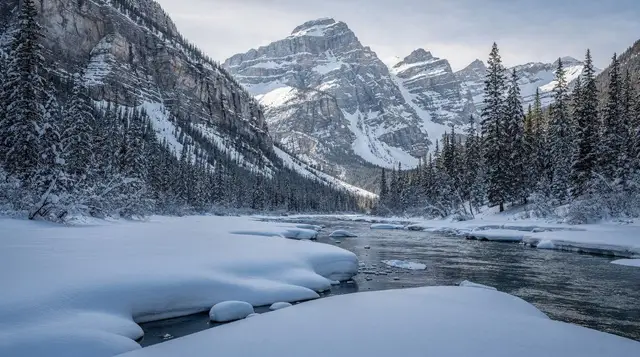
The trio’s appeal is partly that it changes constantly without anyone doing anything to it. Morning light picks out the rock in warm tones before the sun swings around and puts the faces in shadow by mid-afternoon; a fresh dusting of snow in September or a clear January cold snap can make the same three summits look like an entirely different mountain range from one visit to the next. That’s part of why locals treat the Three Sisters less as a single photo opportunity and more as a backdrop that’s worth checking on repeatedly during a stay in Canmore, rather than ticking off once and moving on.
Where the name comes from, and what’s actually there
Local tradition holds that the three peaks were named for their resemblance to three robed, kneeling figures when viewed from the valley — hence Faith, Charity and Hope, rather than anything more literal. Whatever the exact origin, the names have stuck for well over a century and appear on every regional map. Geologically, the Three Sisters belong to the same folded sedimentary rock — mostly limestone and shale laid down as ancient seabed, then thrust upward — that forms most of the front ranges along this stretch of the Rockies.
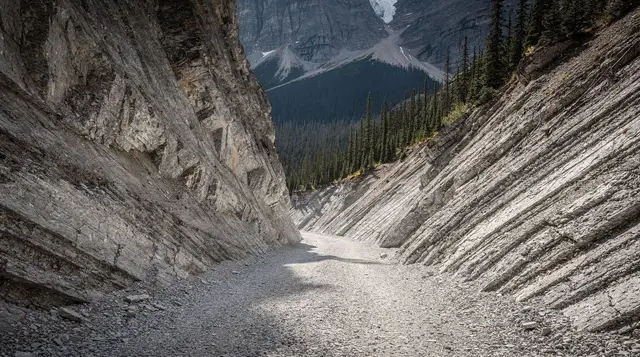
That layered structure is part of why the rock breaks apart the way it does: the same bedding planes that make for dramatic, angular ridgelines from a distance also make for loose, fractured rock underfoot, which is a large part of why the summits stay in scrambling-and-climbing territory rather than hiking territory.
Where to see them without leaving Canmore
You don’t need to plan around the Three Sisters — they’re visible from most of downtown Canmore on a clear day. A few spots stand out. Policeman’s Creek, a boardwalk loop a few minutes on foot from Main Street, frames the trio over a calm marsh channel and is the easiest option for anyone without a car. The pathway along the Bow River gives a similar angle with the water in the foreground. Quarry Lake, a short drive or bike from downtown, adds a reflection shot on still mornings.
For a wider view with less foreground clutter, Spray Lakes Road climbs south out of Canmore toward Kananaskis and offers several pullouts that look back at the peaks from a slightly elevated angle. That’s also the route toward Spray Lakes itself, if you want to combine the two. None of this requires a park pass — Canmore sits outside Banff National Park, so there’s no Parks Canada fee here. Continue further down Spray Lakes Road into Kananaskis Country proper, though, and the separate Kananaskis Conservation Pass applies; see Kananaskis pass vs. Parks Canada if you’re unsure which one you need.
The view from Ha Ling Peak
The single best elevated view of the Three Sisters comes from Ha Ling Peak, a separate mountain directly across the valley from the trio. Its trail climbs to a summit that looks straight across at all three peaks at close to eye level, close enough to pick out individual gullies and rock bands that are invisible from the valley floor. That’s the extent of what belongs on this page — the hike itself, its distance, elevation gain and difficulty, is covered on its own in the Ha Ling Peak hike guide, since it’s a demanding but non-technical trail in its own right and deserves the full detail there rather than a summary here.
It’s worth repeating the distinction because it trips people up: standing on Ha Ling Peak is not the same as standing on any of the Three Sisters. They’re different mountains on opposite sides of the same valley, and Ha Ling’s trail, however strenuous, doesn’t cross onto the Sisters’ terrain at any point.
Why the summits aren’t a hiking objective
It’s worth being blunt about this, because guidebooks and trip-planning sites sometimes blur the line between a “scramble” and a “hike.” Reaching any of the three Three Sisters summits is scrambling terrain at minimum, with sections that call for route-finding judgment, comfort with exposure, and a helmet for rockfall. There’s no maintained trail, no signage, and no easy bail-out partway up. This is the kind of objective experienced alpine climbers plan for with a guidebook, a partner, and appropriate gear — not something to attempt on the strength of a good pair of boots and a sunny forecast.
Part of the confusion comes from the word “scramble” itself, which covers a wide range of terrain across the Rockies — some scrambles really are closer to a steep, unmarked hike, while others shade into low-grade rock climbing with real fall consequences. Routes on the Three Sisters sit at the harder end of that spectrum, which is why local guiding companies list them under mountaineering rather than hiking, and why search-and-rescue callouts on this trio tend to involve parties who assumed the easier end of “scramble” applied here.
Loose rock also means conditions change with the seasons: freeze-thaw cycles through spring loosen material that has sat in place all winter, so even climbers experienced elsewhere in the Rockies treat early-season attempts here with extra caution and often wait for rock to settle later in summer.
None of that takes away from what the Three Sisters offer everyone else. They’re one of the more photogenic mountain backdrops in the Bow Valley precisely because they’re seen rather than climbed, and Canmore has built a good amount of its identity around that skyline.
If the appeal is the terrain itself, not just the view of it, a guided approach is the honest way in: a scenic flight gets you close to the ridgelines and glaciated ground beyond them without the technical risk, and a route with a certified guide is the responsible way to actually set foot on the peaks. For the first option, a short helicopter flight out of Canmore that passes near this stretch of the Rockies and its glaciers gives a sense of the scale that no roadside photo captures.
Comparing the viewpoints
| Viewpoint | Distance from downtown Canmore | Effort | Best for |
|---|---|---|---|
| Policeman’s Creek | Walking distance | Flat boardwalk loop | No car, quick photo |
| Bow River pathway | Walking distance | Flat pathway | Water in foreground |
| Quarry Lake | 5-10 minutes by car or bike | Flat, short walk | Still-water reflections |
| Spray Lakes Road pullouts | 10-20 minutes by car | None, roadside | Elevated, wider angle |
| Ha Ling Peak summit | 15 minutes by car to trailhead | 5-6 hour round-trip hike | Closest, highest view |
Getting there and getting around
Canmore is reached from Banff the same way as everywhere else in this corridor: 26 kilometres on the Trans-Canada Highway, about 20 minutes without stops, or on Roam Transit’s route 3 if you’re travelling without a car. Cyclists can also cover the distance on the Legacy Trail, a paved path that runs alongside the highway. Once in Canmore, the viewpoints listed above are close enough together to cover on foot or by a short drive in under an hour, which is why the Three Sisters work well as a stop rather than a planned outing on their own.
Drivers continuing past Canmore toward Kananaskis on Spray Lakes Road should budget extra time — it’s a gravel and paved mountain road with no services for a stretch, and it’s where the Kananaskis Conservation Pass requirement starts. If Kananaskis itself is on the itinerary, the Kananaskis destination guide covers what else is worth the detour.
Weather in this stretch of the valley can shift quickly regardless of the season. The Bow Valley funnels wind between the Three Sisters and the ranges opposite, so a calm, clear morning at a Canmore viewpoint can turn gusty within an hour, and cloud can settle over the upper summits even when the town itself stays sunny. None of that affects the roadside and townsite viewpoints much, but it’s worth checking before committing to the longer drive along Spray Lakes Road or the hike up Ha Ling Peak, since the view from either is far less rewarding under low cloud.
Pairing the Three Sisters with the rest of Canmore
Because the Three Sisters are a view rather than an activity, most visitors fold them into a broader stop in Canmore rather than visiting them alone. The town itself rewards a few hours: Canmore in one day lays out a workable order for first-time visitors, and where to stay, Banff or Canmore is worth reading before booking if the Three Sisters’ visibility from your hotel matters to you — rooms on the south side of Canmore generally face the trio directly.
Nearby, Grassi Lakes and Grotto Canyon are both short, non-technical trails that pair naturally with a Three Sisters viewpoint stop, and both keep well clear of the alpine terrain described above; see the Grassi Lakes trail guide and the Grotto Canyon hike guide for details. Mountain bikers have their own set of options on the valley’s lower slopes, covered in mountain biking near Canmore.
For a guided day that ties Canmore’s scenery to Banff’s better-known lakes without arranging your own route, a scenic tour that links Canmore and Banff National Park’s lakes in one outing covers ground that’s awkward to piece together on a single tank of gas and a tight schedule. Travellers who’d rather stay closer to Canmore and let a guide handle the driving and wildlife-spotting can look at a private guided drive from Canmore into Banff National Park with a stop for a nature walk, which works well for anyone short on time or without their own vehicle.
Photographers planning a longer stop should also check the Banff photography itinerary for light timing across the wider region, and anyone drawn to climbing terrain in general, rather than the Three Sisters specifically, will find via ferrata and guided scrambling options in Banff covered elsewhere on this site.
The Three Sisters at a glance
| Location | Goat Range, on the edge of Kananaskis Country, southeast of Canmore |
| Traditional names | Faith (Big Sister), Charity (Middle Sister), Hope (Little Sister) |
| Access | View only, from Canmore or Ha Ling Peak; summits are technical alpine terrain |
| Pass required | None to view from Canmore; Kananaskis Conservation Pass beyond that point |
| Best viewing season | June to September, clear winter days also work |
| Closest maintained trail | Ha Ling Peak, on the opposite side of the valley |
The Three Sisters, Canmore’s landmark peaks
Can visitors climb any of the Three Sisters?
Not casually. All three summits are scrambling and technical alpine routes with loose rock and steep exposure. They’re climbing objectives for experienced mountaineers with the right gear and route knowledge, not a hiking trail, and shouldn’t be attempted by anyone without scrambling experience.
What are the names of the Three Sisters?
The three peaks are traditionally named Faith, Charity and Hope, commonly called the Big Sister, Middle Sister and Little Sister. All three sit in the Goat Range on the edge of Kananaskis Country, southeast of Canmore.
Where is the best place to photograph the Three Sisters from Canmore?
Policeman’s Creek and the pathway along the Bow River in downtown Canmore give an unobstructed view of the trio, as do the pullouts along Spray Lakes Road heading toward Kananaskis. For a higher, wider angle, the trail up Ha Ling Peak looks straight across at all three summits.
Is hiking Ha Ling Peak the same as climbing the Three Sisters?
No. Ha Ling Peak is a separate mountain on the opposite side of the valley. Its trail is a demanding but non-technical hike, and reaching its summit gives a clear view of the Three Sisters rather than a route up any of them.
Do you need a park pass to view the Three Sisters?
No pass is needed to view them from Canmore, which sits outside Banff National Park. Driving further along Spray Lakes Road into Kananaskis Country requires the separate Kananaskis Conservation Pass, unrelated to the Parks Canada pass used in Banff.
When is the best time of year to see the Three Sisters clearly?
June through September gives the most reliably snow-free, clear views of the rock faces. On a clear winter day the snow-covered summits are just as visible, though early morning light is often better before afternoon cloud builds over the peaks.
How far is Canmore from Banff?
Canmore is about 26 kilometres from Banff, roughly a 20-minute drive along the Trans-Canada Highway, and is also reachable on Roam Transit’s route 3.
Can you see the Three Sisters from the Banff townsite?
Not really. Banff’s townsite views are blocked by Mount Rundle and Tunnel Mountain. The Three Sisters come into view once you’re in or near Canmore.