Canmore in one day: a realistic itinerary 26 km from Banff
Can you visit Canmore as a day trip from Banff, and what should you do there?
Yes. Canmore is 26 km and about 20 minutes from Banff by road, with no park pass required since it sits outside Banff National Park. A realistic day covers the Grassi Lakes trail, the Canmore Nordic Centre, and a wander through Main Street, with Ha Ling Peak added only if you're fit and have the full day free.
Why give Canmore a full day instead of a quick drive-through
Most people staying in Banff treat Canmore as something they pass on the way to Calgary — a gas stop, maybe a coffee. That undersells it. Canmore is 26 kilometres and about 20 minutes from Banff on the Trans-Canada Highway, close enough to fold into a Banff-based trip without changing hotels, but far enough outside Banff National Park that the whole visit runs by different rules. There’s no Parks Canada pass to buy, no townsite development cap pushing up prices, and noticeably fewer tour buses.
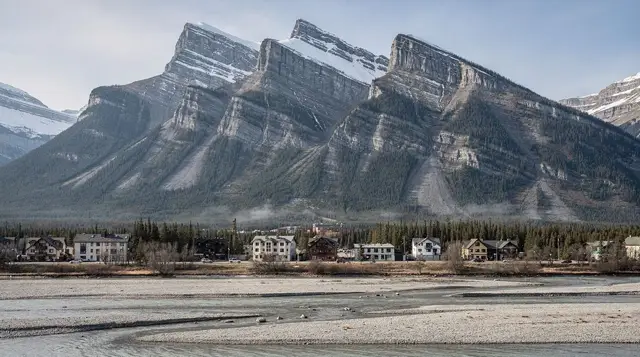
The trade-off is that Canmore isn’t trying to be a postcard. It’s a working mountain town of about 15,000 people that grew out of a coal-mining settlement, picked up new life as the venue for the 1988 Winter Olympics’ Nordic events, and has since become the more affordable, more residential half of the Banff-Canmore pair. The Three Sisters peaks anchor the skyline from nearly everywhere in town, but you won’t find a Banff Avenue-style strip of matching gift shops. What you get instead is a legitimate trailhead town: two of the best short hikes in the region start a few minutes from downtown, and the trail network from the old Olympic venue is still there to walk, run, or ride.
This itinerary treats Canmore as a full day trip from Banff, built around one hike, one town wander, and one honest call about whether to add a second, harder hike. It skips Grotto Canyon and doesn’t get into the mechanics of the Kananaskis Conservation Pass — Kananaskis is close by and worth knowing about, but it’s a separate destination with its own provincial pass, and it deserves its own planning rather than a rushed afternoon add-on.
Getting from Banff to Canmore
Driving is the simplest option. It’s a straight 26 km run on the Trans-Canada Highway (Highway 1), took most of it at highway speed, and the drive itself takes about 20 minutes outside of long-weekend traffic. There’s no toll and no park gate to pass through in either direction, since you’re leaving Banff National Park as soon as you cross the boundary near the Bow Valley Parkway junction.
If you’d rather not drive, Roam Transit runs Route 3 between Banff and Canmore multiple times a day, with stops near the Banff townsite and through central Canmore. It’s a reasonable option if you’re not renting a car for your whole trip, though it adds time compared with driving yourself and ties you to a schedule for the return leg — see our notes on getting around without a car for how this fits a wider Banff-based trip. A private transfer or shared shuttle is another option if you’d rather not deal with either.
However you get there, budget the return trip into your day. Leaving Canmore by late afternoon avoids the worst of the commuter traffic heading back toward Banff and Calgary.
The pass question, settled up front
This trips people up more than almost anything else in the area, so it’s worth stating plainly: Canmore is not inside Banff National Park. The Parks Canada day pass that’s mandatory in Banff, Lake Louise, along the Icefields Parkway, and in Yoho and Kootenay does not apply here. You can drive into Canmore, park at a trailhead, and walk around downtown without buying a single pass.
Where this gets confused is with Kananaskis, the Alberta provincial recreation area that sits just southeast of Canmore and shares some of the same mountain scenery. Kananaskis requires its own Kananaskis Conservation Pass, a completely separate provincial system with its own fee, unrelated to Parks Canada. If your Canmore day trip drifts into Kananaskis territory — say, for a hike further down Highway 40 — you’ll need that pass for your vehicle.
For a day that stays within Canmore proper, covered below, you don’t need to think about either pass at all. If a Kananaskis add-on is on your mind, our guide to the Kananaskis pass versus the Parks Canada pass is worth reading before you go, and a full Kananaskis day trip is better planned on its own rather than squeezed into a Canmore day.
A realistic one-day plan
| Time | Stop | What you’re doing |
|---|---|---|
| Morning (arrive 8:30–9:00 am) | Grassi Lakes trailhead | Hike to the two turquoise pools, 1.5–2 hours |
| Midday | Downtown Canmore | Lunch on or near Main Street |
| Early afternoon | Canmore Nordic Centre | Walk or bike the Olympic trail network, 1–2 hours |
| Late afternoon | Policeman’s Creek / riverside | Easy stroll, photos of the Three Sisters |
| Optional, full-day only | Ha Ling Peak | 3–4 hour round-trip hike, replaces the afternoon plan |
This isn’t the only order that works, but it groups the driving-adjacent stops (Grassi Lakes and the Nordic Centre both have their own parking lots outside downtown) so you’re not doubling back through town more than once.
Grassi Lakes: the hike to start with
Grassi Lakes is the trail most people mean when they say they hiked in Canmore, and it earns the reputation. Two small lakes, fed by snowmelt and turned a genuine turquoise by suspended glacial rock flour, sit in a short canyon a few minutes’ drive from downtown.
There are two ways up: an easier gravel trail that switchbacks gently over about 4 km return with roughly 150 m of elevation gain, taking most people 1.5 to 2 hours, and a steeper original trail past an old limestone quarry that’s closer to 3.5 km return but climbs more sharply over looser footing. Families and anyone short on time should take the gravel trail; hikers who want a bit more of a workout can take the steeper route up and the gravel trail back down, or the reverse.
Parking at the trailhead is free, which is one more small thing Canmore does differently from Banff. Full detail on both trail options, what to expect at the lakes themselves, and how the hike compares with Ha Ling Peak is in our Grassi Lakes trail guide.
If you’d rather have the geology and history explained as you walk, a guided version of this trail is one option worth considering: a two-hour private guided nature walk around Canmore covers similar ground with a local guide filling in the context a solo hike won’t.
Ha Ling Peak: only if you have the legs and the time
Ha Ling Peak shares a trailhead and parking lot with Grassi Lakes but is a different proposition entirely: an 8.5 km round trip climbing to a 2,675 m summit, with sustained, switchback-heavy elevation gain the whole way up. Fit hikers typically need 3 to 4 hours round trip; less experienced hikers should plan for longer. The reward is a genuinely wide-open summit view across the Bow Valley, the Spray Lakes reservoir, and the Goat Range, which is a step up from what you see at Grassi Lakes.
If you’re weighing this against other regional hikes, our roundup of Banff’s best day hikes by difficulty puts Ha Ling in context alongside trails closer to Banff itself. The honest trade-off: fitting Ha Ling into a one-day Canmore visit means giving up most of the rest of this itinerary.
If you start it, plan on it replacing the Nordic Centre and much of downtown, not sitting alongside them. It’s a fine choice if hiking is the point of your day and you’re comfortable with a steep, sustained climb; it’s the wrong choice if you also want unhurried time in town. Our Ha Ling Peak hike guide breaks down the full route, elevation profile, and what the summit actually looks like.
Downtown Canmore and lunch
Canmore’s Main Street runs a few blocks, lined with independent cafés, outdoor shops, and restaurants rather than chain stores. It’s smaller and quieter than Banff Avenue, without the same density of tour groups, which is a large part of why people who’ve done both describe Canmore as feeling more like an actual town. Prices for food and coffee tend to run somewhat lower than in Banff, though not dramatically so — this is still a mountain resort town, not a bargain.
If you’d rather see the town with some context than wander on your own, a guided walking tour through downtown that ends with a sweet treat and a drink covers the town’s mining and Olympic history in a couple of hours, which pairs naturally with an afternoon at the Nordic Centre.
For a different pace entirely, an electric scooter tour around Canmore’s pathway network covers more ground than walking without needing a car, useful if your legs are already tired from Grassi Lakes.
The Canmore Nordic Centre: 1988 Olympic history you can still walk or ride
The Canmore Nordic Centre was built for the cross-country skiing and biathlon events of the 1988 Calgary Winter Olympics, and unlike some Olympic venues, it never became a museum piece. It’s now a Provincial Park with a network of trails that switches purpose by season: cross-country skiing and biathlon training in winter, and hiking, trail running, and mountain biking in summer and shoulder season. The terrain is rolling rather than steep, cut through forest with occasional views out toward the Three Sisters, and it works well as a lower-intensity counterpart to a morning spent climbing at Grassi Lakes or Ha Ling.
There’s no requirement to ski or compete to visit — the trailhead, day lodge, and most of the trail network are open to anyone showing up for a walk or a ride. Rentals are available on-site if you didn’t bring your own bike. Budget an hour for a short loop, or two or more if you want to cover more of the network.
The Three Sisters: the backdrop, not a separate stop
The Three Sisters — three connected summits visible from nearly every part of Canmore — aren’t a destination you drive to on their own. They’re the reason so many photos taken in this town look the way they do: whether you’re at the Nordic Centre, walking along the Bow River, or standing on Main Street, the three peaks sit in the background more often than not. The best unobstructed view for most visitors is from the open ground near the Nordic Centre or from the riverside paths east of downtown, in the late afternoon when the light comes from the west.
Getting the light on the water: Policeman’s Creek and the Bow River
If there’s time left after the Nordic Centre, the pathway along Policeman’s Creek and the Bow River on Canmore’s east side is an easy, flat walk with some of the best late-afternoon photo opportunities in town — calm water, the Three Sisters reflected when conditions cooperate, and none of the crowds you’d find at a comparable spot in Banff.
For a different way to see the same river, a scenic float trip down the Bow River through Canmore is a low-effort way to close out the day, floating rather than paddling, with the mountain views from the water instead of the bank.
If you’re staying into the evening
Canmore’s clearer skies and lower light pollution than Banff make it a reasonable base for stargazing, and an evening stargazing and night adventure tour is worth considering if your day trip stretches past sunset rather than heading straight back to Banff. Wildlife activity also tends to pick up around dusk in the surrounding valley, so an early-evening option like a guided wildlife viewing tour is another way to use the last daylight hours before heading home.
What this itinerary skips, and why
This plan deliberately leaves out Grotto Canyon, a slot canyon hike with pictograph sites a short drive from town — it’s a legitimate half-day option, but it doesn’t fit alongside Grassi Lakes and the Nordic Centre without cutting one of them short, and it’s covered in more depth as part of the region’s canyon-focused hiking content rather than here.
It also doesn’t get into the details of the Kananaskis Conservation Pass beyond the basic distinction above. Kananaskis is close enough to Canmore that it’s tempting to fold in, but the pass system, the fee structure, and the trailheads it covers are different enough from anything in Canmore that they’re better handled as their own planning topic rather than squeezed into a day already built around Canmore itself.
How a Canmore day compares with staying in Banff
| Canmore | Banff | |
|---|---|---|
| Distance from Banff townsite | — | 26 km |
| Parks Canada pass required | No | Yes |
| Feel | Residential, working mountain town | Resort town inside a national park |
| Signature short hike | Grassi Lakes | Tunnel Mountain |
| Crowd level in summer | Noticeably lighter | Heavy, especially midday |
| Price level | Somewhat lower | Higher |
For more on how to split time or choose a base between the two, see our comparison of Banff versus Canmore for where to stay.
Practical notes for the day
Parking is free at both the Grassi Lakes/Ha Ling trailhead and the Nordic Centre, which is a genuine break from paid, limited parking in Lake Louise. Downtown Canmore has metered and time-limited street parking along with a few pay lots, so don’t assume it’s free everywhere. Cell coverage is reliable throughout town and along the trails, unlike stretches of the Icefields Parkway further north. As anywhere in the Bow Valley, bear activity is a real possibility on the Grassi Lakes and Ha Ling trails — carry bear spray, make noise on blind corners, and give any wildlife you encounter plenty of room. Our bear safety guide covers what to carry and how to fly with (or without) bear spray.
Canmore day trip questions
How far is Canmore from Banff and how do you get there?
Canmore is 26 km from Banff, about a 20-minute drive on the Trans-Canada Highway. Roam Transit’s Route 3 runs between the two townsites throughout the day, so a car isn’t required, though it does add travel time compared with driving yourself.
Do you need a Parks Canada pass to visit Canmore?
No. Canmore sits outside Banff National Park, so none of the Parks Canada day pass rules that apply in Banff, Lake Louise, or along the Icefields Parkway apply here. You can drive in, park, and walk around town without buying anything. Nearby Kananaskis is a separate matter: it requires its own provincial Kananaskis Conservation Pass, unrelated to the Parks Canada system.
Is Canmore worth visiting if you’re already staying in Banff?
Yes, mainly for the contrast. Canmore has the same Rocky Mountain backdrop without Banff’s commercial core or its summer crowds, plus trailheads like Grassi Lakes and Ha Ling Peak that see noticeably fewer people than comparable hikes closer to Banff.
Can you hike Ha Ling Peak and still see the rest of Canmore in one day?
It’s tight but doable if you start early. Ha Ling Peak alone typically takes 3 to 4 hours round trip for a fit hiker, which leaves a shortened afternoon for the Nordic Centre and Main Street. Most people who want an unhurried day pick Grassi Lakes instead and treat Ha Ling as a separate, hiking-focused trip.
What is the Canmore Nordic Centre and can you visit it without skiing?
It’s the cross-country ski and biathlon venue built for the 1988 Calgary Winter Olympics, now a year-round Provincial Park with trails open to hikers, trail runners, and mountain bikers in summer. You don’t need to ski or compete to visit; the trail network and day lodge are open to anyone.
Are the Three Sisters mountains in Canmore or somewhere else?
The Three Sisters are the three connected peaks that form Canmore’s most photographed skyline, visible from town, from the Nordic Centre, and from several trailheads on the valley’s south side. They’re not a separate destination to drive to; you see them as a backdrop throughout the day.
Is Grassi Lakes hike suitable for families?
The easier of the two Grassi Lakes trails is suitable for most families, at roughly 4 km return with about 150 m of elevation gain on a maintained gravel path. The alternative, steeper route past the old quarry is better suited to older kids and adults comfortable with uneven footing.
Do you need a car to do a one-day Canmore itinerary?
A car makes the day easier since Grassi Lakes and the Nordic Centre both have their own parking areas outside downtown, but Roam Transit’s Route 3 connects Banff and Canmore, and the town centre itself is entirely walkable once you arrive.
Banff sightseeing on GetYourGuide
Verified deep-linked GetYourGuide tours. Book through these links and we earn a small commission at no cost to you.
GetYourGuide does not provide a product photo for this activity — the image shows the meeting point, photographed by us.