Radium Hot Springs is the hot pool and cooling pool that Parks Canada operates at the southern entrance to Kootenay National Park, reached by driving through the narrow rock walls of Sinclair Canyon just before the site. It sits about 135 km from Banff, roughly 1 hour 45 minutes by car on Highway 93 South, and it’s a common stop on a loop that also takes in the village of Radium Hot Springs, Golden and the Columbia Valley.
The name causes real confusion, and it’s worth clearing up before anything else. The pools described here are inside the national park, run by Parks Canada, and are a public bathing facility with admission fees, lockers and limited rentals. This page is specifically about that Parks Canada pool complex at Kootenay’s south gate, not about any hotel or resort in the village nearby.
Two places share one name
The village of Radium Hot Springs, British Columbia, sits a short distance outside the national park boundary, past the Parks Canada gate. It has its own hotels, restaurants, golf courses and, separately, a privately owned resort-style pool complex that also uses the “hot springs” name and draws on nearby mineral water sources. It is not the same operation as the pools inside the park, does not share admission, hours or booking systems with it, and is not covered by this guide.
If you’re reading a listing, a hotel package or a tour description and it isn’t specific about which “Radium Hot Springs” it means, treat that as a reason to check before paying for anything. Confusing the two has led travellers to book a hotel package expecting park access, or to show up at the park gate expecting a private resort’s amenities. The two are geographically close, a few kilometres apart along the same highway corridor, but administratively unrelated.
The drive in through Sinclair Canyon
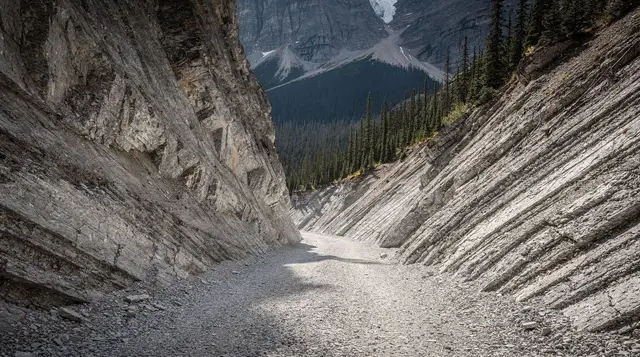
The approach to the Parks Canada pools is part of the experience, not just a way of getting there. Coming from Banff, Highway 93 South narrows dramatically as it enters Sinclair Canyon: the rock walls close in tight on both sides, high enough to block direct sun for stretches of the road, with the highway squeezed to essentially one lane’s worth of usable width at its narrowest point. The canyon opens out again almost exactly where the hot springs parking area begins, so the pools appear right as the walls fall back and the valley widens.
Coming from the opposite direction, from deeper inside the park past Marble Canyon and the Paint Pots, the drive runs most of the length of the park before reaching the same stretch, arriving at Sinclair Canyon from its upper end rather than its lower one.
There’s no meaningful walk from a distant lot to the pools; parking sits directly next to the entrance, with a modest fee area in peak season. As with every other stop inside Kootenay, Yoho or Banff, a Parks Canada day pass or annual Discovery Pass is required for the vehicle and everyone in it, checked periodically at points along the highway rather than only at a single gate, and it applies even to travellers who are only passing through Highway 93 South without stopping.
Inside the pools: hot pool and cooling pool
The facility itself is straightforward and purpose-built rather than rustic. A large hot pool holds the mineral water at a soaking temperature, comparable to a heated outdoor pool anywhere else, and an adjacent cooling pool is kept several degrees lower for anyone who wants a break from the heat without getting out of the water entirely. Both are outdoor, chlorinated and monitored to public-pool standards, which is a meaningful difference from how some visitors picture an untouched natural hot spring bubbling up from the ground. Change rooms, lockers and showers are on-site, and a small snack or concession counter typically operates through the busier months.
Bring your own swimsuit if at all possible. Towel and suit rental sometimes exists at the counter, but the stock is limited and not guaranteed, particularly on a busy July or August afternoon when the pool itself is near capacity. Travellers who assume they can simply rent whatever they need on arrival occasionally find nothing left by mid-morning; packing a suit and a towel from wherever you’re staying removes the risk entirely.
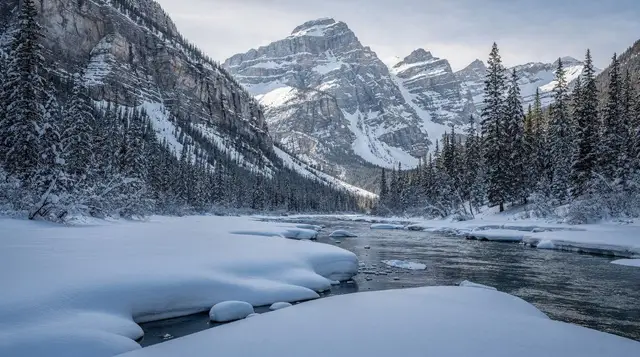
Midday in peak summer is the pool at its most crowded, with a mix of road-trippers stopping between Banff and Golden, day visitors from the village, and travellers finishing a hike elsewhere in Kootenay. Early morning and evening sessions are noticeably calmer. Winter carries its own appeal: soaking in heated water with snow piled on the canyon walls and steam rising off the surface is close to the same draw that brings people to Banff Upper Hot Springs on the other side of the Continental Divide, just with fewer crowds given how much further Radium sits from the main Banff hotel strip.
Water, warmth and where the name comes from
The mineral water that feeds both pools emerges naturally warm from the ground nearby, the same underlying geology that produces hot springs at several points along the Rocky Mountain Trench. The “Radium” in the name reflects trace natural radioactivity once measured in the water when the springs were first being assessed for public use in the early twentieth century, not any additive or treatment applied since.
It’s a naming quirk shared with a handful of other historic mineral springs across North America from the same era, when trace radioactivity was marketed as a health benefit rather than something to be cautious about; today the pools are run and tested as a standard public facility, with the name simply carried forward from that history.
Parks Canada took over management of the site as part of its broader stewardship of Kootenay National Park, which itself was established in 1920 largely because the province ceded a strip of land along the new automobile road through the Kootenay and Sinclair valleys in exchange for the federal government building it. The hot springs, already known locally and to Indigenous peoples of the region long before the road existed, became one of the park’s signature visitor facilities once that road, the ancestor of today’s Highway 93 South, opened the valley to cars.
How it compares with Banff’s other hot-spring sites
Travellers doing a longer Rockies loop often ask whether it’s worth visiting more than one hot-spring stop. Banff National Park has two: Cave and Basin, the site where hot springs were discovered by Canadian Pacific Railway workers in the 1880s and which led directly to Canada’s national park system, now preserved as a heritage building with an endangered snail in its waters and closed to bathing; and Banff Upper Hot Springs below Sulphur Mountain, reachable on foot or by the Banff Gondola base area, which is an active soaking pool much like Radium’s.
Radium’s pools sit in a different park entirely, at Kootenay’s south gate past Sinclair Canyon, roughly two hours further from Banff by road than either Banff site. If your route already passes through Kootenay on the way to Golden or the Columbia Valley, Radium is a natural stop rather than a detour. If you’re staying close to Banff and Canmore for the whole trip, Banff Upper Hot Springs covers a very similar experience without the extra driving. None of the three should be confused with one another: Cave and Basin for the history, Banff Upper Hot Springs for a soak near town, Radium for a soak at the Kootenay gate.
| Site | Location | Can you swim? |
|---|---|---|
| Cave and Basin | Banff townsite | No — heritage site, bathing closed |
| Banff Upper Hot Springs | Below Sulphur Mountain, Banff | Yes — active soaking pool |
| Radium Hot Springs (Parks Canada) | Kootenay National Park, south gate | Yes — hot pool and cooling pool |
| Radium village resort pool | Village of Radium Hot Springs, BC | Yes — separate, privately run |
Seasonal hours, admission and what to check first
Radium Hot Springs runs on seasonal hours rather than one fixed year-round schedule. Summer hours generally extend later into the evening, while shoulder-season and winter hours are shorter, and the facility does occasionally close for maintenance in the off-season, sometimes for several days at a stretch. Check the currently posted hours before a winter or early-spring visit specifically, since arriving to a locked gate after a 1 hour 45 minute drive is a genuinely disappointing way to end a Kootenay day.
Admission is charged per adult, with reduced rates for youth and seniors and family pricing typically available. That fee is separate from, and in addition to, the Parks Canada park pass required simply to be inside Kootenay National Park at all. It’s easy to budget for one and forget the other; both apply on the same visit.
Pairing the pools with the rest of the Kootenay Parkway
Most visitors don’t drive to Radium Hot Springs on its own; it’s usually one stop on a longer day along the Kootenay Parkway. Coming from Banff, the order typically runs Marble Canyon and the Paint Pots first, deeper inside the park, followed by the drive through Sinclair Canyon and the hot springs near the south exit.
From there, it’s a short continuation to the village of Radium Hot Springs itself, and on to Golden if the Kicking Horse River rafting or the Golden Skybridge are also on the day’s plan. A five-day loop through Banff, Yoho and Kootenay is a common way to fit all of it in without rushing any single stop.
| Stop | Distance from Banff | Notes |
|---|---|---|
| Radium Hot Springs pools | 135 km, ~1 h 45 | Parks Canada pool, inside Kootenay National Park |
| Village of Radium Hot Springs, BC | ~137 km, ~1 h 50 | Just outside the park boundary; separate resort pool here |
| Marble Canyon (Kootenay) | ~100 km, ~1 h 20 | Same highway, further north inside the park |
| Golden, BC | 135 km, ~1 h 30 by direct route | Skybridge, Kicking Horse River rafting |
A day that starts in Banff, runs the length of the Kootenay Parkway, stops at the hot springs, and continues to Golden or the village of Radium for the night is a workable way to see this corner of the Rockies without doubling back the same day. Doing the pools as a stand-alone round trip from Banff also works, though it’s a long day once the driving both ways is added to the soak itself; budget most of a full day if that’s the plan.
For a fuller written walkthrough of combining the hot springs with the rest of the drive, a dedicated day-trip guide breaks down timing options in more detail than fits here.
Booking a guided day instead of self-driving
For travellers who’d rather not manage the Kootenay Parkway themselves, a day trip covering Radium Hot Springs and Marble Canyon from Calgary bundles the drive, the canyon stop and the pools into one outing with a guide handling the route.
Travellers continuing further west sometimes pair the same general corridor with a guided day trip to Golden and Takakkaw Falls, or add a half-day of whitewater rafting on the Kicking Horse River near Golden as a more active counterpoint to an afternoon soak. For a shorter add-on closer to Golden itself, admission to the Golden Skybridge suspension bridges fits naturally into the same loop without much extra driving.
What a stop actually costs
| Item | Approximate cost (CAD) |
|---|---|
| Parks Canada day pass, per adult | ~11 |
| Parks Canada day pass, per vehicle | ~22 |
| Pool admission, per adult | Varies by season; budget 15-20 |
| Towel or swimsuit rental, if available | Extra, and not guaranteed in stock |
| Snack or light meal on-site | 10-20 |
None of these figures are large individually, but travellers budgeting a Kootenay day should count the park pass, the pool admission and any food together rather than treating the pools as a free add-on to a scenic drive that’s already priced into the trip.
Winter visits and driving conditions
Winter is a genuinely good time to visit, with the contrast of hot water and snow-covered canyon walls being part of the appeal, but it comes with real driving considerations. The Kootenay Parkway is kept open year-round, but it does carry snow and ice through the colder months, and British Columbia requires winter tires on this and other mountain highways in the province, including routes 93 and 95, between October 1 and April 30. A winter driving guide for the Rockies is worth a read before a cold-season trip through Sinclair Canyon specifically, since the narrow canyon walls mean less room to manoeuvre if conditions turn icy.
What to bring and what to expect
Bring a swimsuit rather than counting on rental, and pack a change of clothes for afterward since change rooms can get busy during peak hours. Sandals help on the pool deck and on parking-lot pavement, which gets genuinely hot in midsummer sun. A reusable water bottle is worth carrying, since soaking in warm mineral water for an hour or two dehydrates faster than most visitors expect. If you’re travelling with young children, note that both pools are shared public facilities without dedicated shallow areas beyond the cooling pool’s slightly lower temperature, so supervise closely rather than assuming a wading-pool depth throughout.
Radium Hot Springs questions before you go
Is Radium Hot Springs the same place as the village of Radium Hot Springs, BC?
They share a name but aren’t the same thing. The pools sit inside Kootenay National Park, run by Parks Canada, right at the park’s south entrance. The village of Radium Hot Springs is a small community just outside the park boundary, a couple of kilometres further along, with its own hotels, restaurants and a separate resort-style pool complex that is privately run and unrelated to the Parks Canada facility.
Do I need a Parks Canada park pass just to go to the hot springs?
Yes. The pools are inside Kootenay National Park, so a valid Parks Canada day pass or annual Discovery Pass is required in addition to the pool’s own admission fee. Driving Highway 93 South through the park, even without stopping, technically requires the same pass.
What’s the difference between the hot pool and the cooling pool?
The hot pool holds the mineral water at a higher temperature, similar to a heated soaking pool, while the adjacent cooling pool is kept several degrees lower for people who want a break from the heat without leaving the water entirely. Both are outdoor, chlorinated, and monitored by Parks Canada rather than left as a natural, untreated spring.
Do I need to bring my own swimsuit and towel?
Bring your own swimsuit if you can. Towel and swimsuit rental is sometimes available on-site, but supply is limited and not guaranteed, especially in peak summer weeks, so travellers who show up assuming they can rent one occasionally get turned away or have to wait.
How do you get to the pools from the highway?
From the south, Highway 93 (the Kootenay Parkway) passes through Sinclair Canyon, a narrow cut in the rock with steep walls close on both sides, just before reaching the pools. The parking area and pool entrance sit right at the canyon’s north end, so the drive itself is part of the approach rather than a separate detour.
Is Radium Hot Springs open year-round?
It operates on seasonal hours rather than a single fixed schedule, generally open longer hours in summer and shorter hours in the shoulder seasons and winter. Check Parks Canada’s current posted hours before a winter or off-season visit, since the pools do close for maintenance periods in some years.
Is it worth stopping here if I’m just driving through to Golden or Radium village?
For most drivers doing the Banff-Kootenay-Golden loop, yes, since Sinclair Canyon is on the direct route anyway and the stop adds an hour or two rather than a full detour. It’s a lower priority if you’re short on time and have already budgeted a soak at Banff Upper Hot Springs, since the two pools offer a broadly similar experience.
Can I combine Radium Hot Springs with Marble Canyon or the Paint Pots in one day?
Yes, and many visitors driving the Kootenay Parkway do exactly that, since both sit along the same highway further north toward Kootenay’s other entrance. This page focuses on the hot springs facility itself; plan the canyon and paint pot stops as separate legs of the same drive.