Local beer and distilleries around Banff
Are there real breweries and distilleries in Banff, or is it all in Canmore?
Both towns have working breweries and distilleries, but strict commercial limits inside Banff National Park mean Canmore, just outside the park boundary, has the bigger production sites and taprooms. Banff itself has smaller taprooms and bars pouring local beer rather than large brewhouses.
After a day on the lifts at Mt Norquay or a long climb up Tunnel Mountain, a lot of visitors want exactly one thing: a seat, something local in a glass, and no more walking. Banff and Canmore both have a working beer and spirits scene built around that moment, but it’s smaller and more scattered than the craft-beer strips you might know from bigger Canadian cities, and what’s pouring on tap changes often enough that naming a specific beer or bottle here would be out of date within a season.
This page is a map of where that scene actually sits, what a visit costs, and how to fit it around driving on mountain roads without pretending the two mix. It doesn’t cover Banff’s wider restaurant scene, which has its own guide, and it leaves the Fairmont Banff Springs out entirely — that’s a hotel and heritage landmark, not part of the independent brewery and distillery circuit this page is about.
Why Canmore has more breweries than Banff
The split between the two towns isn’t random, and it isn’t really about which one has more thirsty visitors. Banff sits inside Banff National Park, where Parks Canada caps commercial development and requires businesses to show a park-related need to operate within town limits at all. That constraint applies to everything from housing to retail, and brewing is no exception: a real production brewhouse needs space for tanks, cold storage, and a loading dock, which is a hard ask inside a townsite where square footage is both limited and expensive.
Canmore, 26 kilometres down the Trans-Canada Highway and entirely outside the park boundary, doesn’t carry that restriction. That’s a large part of why the region’s bigger production breweries, with barrel-lined taprooms and room for a proper brewhouse behind the bar, have clustered in Canmore’s light-industrial parks rather than in Banff itself. It’s a similar pattern to why Canmore, not Banff, tends to be the cheaper base for a longer stay — the same park development cap shapes both.
None of this makes Banff dry. The townsite has its own smaller taprooms and bars pouring locally brewed beer, usually built into a bar or pub rather than standing alone as a dedicated brewhouse, and they’re a perfectly good stop if Canmore isn’t on your route that day. But if the goal is specifically to see where the beer is actually made, tour a working brewhouse, or try a flight in a taproom built for exactly that, Canmore is where most of that infrastructure lives.
Distilleries: a smaller, newer scene
Spirits production is even more concentrated than beer, and for the same underlying reason — a still, aging barrels, and a bottling line take up more space and carry different licensing requirements than a bar pouring cans. The distilleries in this region tend to lean on the same marketing angle: mountain water, and small-batch runs of gin, vodka, or whisky rather than mass-market volume. Most run a retail counter selling bottles on site, and some pair that with a short tasting flight, generally poured in smaller measures than a beer flight given the higher alcohol content, and priced accordingly.
Because the whole distillery scene here is newer and smaller than the brewery side, hours are often tighter and more seasonal, with some producers cutting weekday hours back outside peak summer and winter windows. Calling ahead or checking a producer’s own posted hours before making a special trip out to a light-industrial unit is worth the two minutes it takes, especially in shoulder season when a listed address can turn out to be open by chance rather than by schedule.
Après-ski taproom culture
Après-ski in this region isn’t the loud, DJ-driven scene some European resorts are known for — it’s closer to a tired, satisfied crowd filtering into whatever taproom or bar is closest to the base area or the shuttle stop, still half in ski gear, ordering a pint and something to eat before heading back to town. Banff Sunshine, Lake Louise Ski Resort, and Mt Norquay are all covered by shuttle service back into Banff and, on some routes, Canmore, which matters here specifically: the shuttle is what lets the après crowd actually drink without anyone needing to drive back down the mountain.
The ski season here runs roughly November through May, and taproom hours in both towns tend to track that rhythm — busier and often with extended evening hours through the January–March peak, quieter in the shoulder weeks at either end of the season. Expect a wait for a table on a bluebird powder day in a small taproom near the base of any of the three SkiBig3 resorts — a lot of people have exactly the same plan you do.
Après-hike patios in summer
The same pattern flips to patios once the snow clears. After a hike up Johnston Canyon, a climb to Ha Ling Peak, or a long day on Sulphur Mountain, the draw is an outdoor table, mountain views, and something cold rather than a dark taproom. Canmore’s brewery patios, in particular, tend to face the Three Sisters or Ha Ling directly, and they fill up fast on a warm summer evening between roughly June and September, when Banff sees its busiest crowds of the year.
Hydration matters more here than it sounds like it should. Mountain air is dry, elevation adds up faster than it feels on a trail, and a beer or two after a hard hike hits differently at altitude than it does at sea level — pace accordingly, and treat water as the actual recovery drink, with the beer as the reward rather than the rehydration.
Tastings, flights, and guided routes
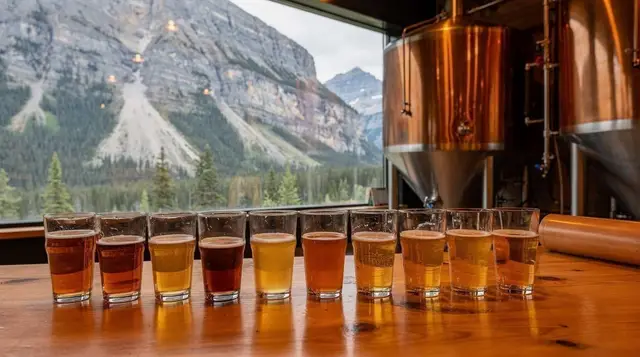
Trying more than one style without committing to a full pint at each stop is the point of a tasting flight — usually four to six small pours arranged on a paddle or board, letting you compare a light lager against a hoppier pale ale or a darker stout in one sitting. Flights are the standard way to sample a brewery’s range, and most taprooms in both towns offer one even if it isn’t always listed on a printed menu; asking at the bar usually works.
For visitors who’d rather not manage their own multi-stop route by taxi, a small-group tour built around a brewery stop takes the logistics off the table entirely, since the transport is arranged and nobody in the group needs to volunteer as the driver. A day tour from Calgary that builds a Banff-area brewery stop and lunch into the itinerary is one option if you’re routing in from the airport rather than starting from a Banff hotel. From Banff itself, a premium small-group tour pairing food tasting with sightseeing around the park covers similar ground without the Calgary drive.
Neither of these is a dedicated brewery crawl — the region doesn’t really run one as a standalone product — so treat them as sightseeing days that happen to fold in a tasting stop, not as the main event for a serious beer trip. A tour that mixes national park canyons and lakes with stops at local favourites works the same way: the scenery is the headline, the tasting is the bonus. If winter is your window instead, a winter day trip combining hikes and gondola rides around Banff is a reasonable way to end a snowy day at a taproom without having driven yourself there.
What it costs
| Item | Typical range (CAD, before tax) |
|---|---|
| Single pint at a taproom | 8–11 |
| Tasting flight (4–6 pours) | 12–20 |
| Distillery tasting flight | 15–25 |
| Bottle to take home, brewery | 8–14 |
| Bottle to take home, distillery | 45–75 |
| Food truck plate at a taproom | 12–18 |
These are planning ranges, not a menu, and every one of them shifts by producer, by season, and by year. Alberta’s 5% GST applies on top, and there’s no additional provincial sales tax on drinks purchased in Alberta the way there would be across the border in British Columbia. A hospitality gratuity of 15–20% on food and drink service is the local norm, same as anywhere else in this region — see our daily budget guide for how a beer stop fits into a wider day’s spending.
Driving, drinking, and the roads in between
This is the part worth being blunt about. The roads connecting Banff, Canmore, and the wider park — the Trans-Canada Highway, the Bow Valley Parkway, the Icefields Parkway — are mountain roads: narrow shoulders in places, wildlife crossing without warning, sudden weather changes, and in winter, ice and snowpack that punish any lapse in attention. None of that pairs well with alcohol, and a tasting flight or two is enough to affect judgment on a road like that even well under whatever number is on a legal limit.
Canada’s Criminal Code sets a nationwide impaired driving threshold, and Alberta adds its own provincial licence sanctions on top of that at a lower reading than the criminal limit, with roadside checks not unusual near ski hill exits and townsite approaches on busy weekends. The specific numbers matter less for trip planning than the practical takeaway: treat a brewery or distillery stop as something you do on foot, by shuttle, by taxi, or as a passenger, and treat the driving leg of the day as a separate, alcohol-free block.
Roam Transit’s Banff–Canmore route 3 exists precisely so this isn’t a hard trade-off, and it’s the easiest way to reach Canmore’s brewery cluster and get back to a Banff hotel without anyone in the car needing to stay sober by default.
Fitting a beer stop around the rest of a Banff trip
A brewery or distillery stop rarely deserves to be the anchor of a whole day here — it’s a good way to close one out. Pair it with an afternoon in Canmore after a morning hike, or with a rainy day when outdoor plans fall through and an indoor taproom becomes the fallback rather than the plan. If your visit lines up with one of the town’s festivals, expect extended hours and bigger crowds at whichever taproom is closest to the action, and book a table ahead if you can rather than counting on a walk-in seat.
For anyone building a longer stay around food and drink specifically, the budget dining guide is the better starting point for meals, with this page as the add-on for the drink itself. Between the two, a realistic day might run: a morning hike, a mid-afternoon taproom stop by shuttle or on foot, and dinner back in town — no driving anywhere in between the second and third parts of that sequence.
Local beer and distilleries in Banff and Canmore: frequently asked questions
Is it easy to get from a Banff hotel to a Canmore brewery without a car?
Roam Transit’s route 3 connects Banff and Canmore on a scheduled bus timetable, and it’s the practical way to reach Canmore’s brewery cluster without driving. Taxis and rideshare-style services also cover the 26-kilometre stretch, which matters more once tasting flights are involved.
Do Banff and Canmore breweries serve food, or just beer?
Most taprooms serve some kind of food, from a rotating food truck parked outside to a short kitchen menu of pub-style plates, but very few run a full restaurant service. If a proper sit-down dinner matters more than the beer, our budget dining guide covers Banff’s wider restaurant scene separately.
Can I buy beer or spirits to take home from these places?
Most breweries sell cans or bottles to go, and distilleries typically sell bottles from an on-site retail counter, though hours and what’s in stock both vary by season and by producer. Cross-border rules on bringing alcohol back apply on top of whatever a shop allows you to buy, so check your own destination’s limits before stocking up.
Is there a legal blood alcohol limit I should know about before driving in Alberta?
Canada’s Criminal Code sets a nationwide impaired driving threshold, and Alberta layers its own provincial licence sanctions on top of that at a lower reading, with roadside checks common on routes near ski hills and townsites. The safe planning assumption on any mountain drive is zero: treat a tasting stop and a driving leg as two separate parts of the day, never the same one.
Are Banff’s own breweries smaller than Canmore’s because of the national park rules?
Largely, yes. Banff sits inside Banff National Park, where commercial development is capped and businesses must justify a park-related need to operate at all, which limits the scale of any brewhouse built within town limits. Canmore sits outside the park boundary entirely, with no such cap, which is why the bigger production breweries and their barrel-lined taprooms cluster there instead.
What does a typical tasting flight cost?
A flight of four to six small pours generally runs in the CAD 12 to 20 range at most breweries, before the 5% GST and any hospitality gratuity, with distillery tasting flights usually priced a little higher given the cost of spirits versus beer. Exact pricing and pour sizes vary by producer and by season, so treat these as planning ranges rather than a fixed menu.
Is there a guided way to see a few breweries in one outing without driving myself?
Yes — small-group tours built around a Banff or Canmore brewery stop exist precisely so nobody in the group has to be the designated driver, and they typically bundle transport with a lunch or food-tasting component. That’s a more relaxed option than trying to string together your own multi-stop route by taxi.
Banff & Canmore food and brewery tours on GetYourGuide
Verified deep-linked GetYourGuide tours. Book through these links and we earn a small commission at no cost to you.
GetYourGuide does not provide a product photo for this activity — the image shows the meeting point, photographed by us.